
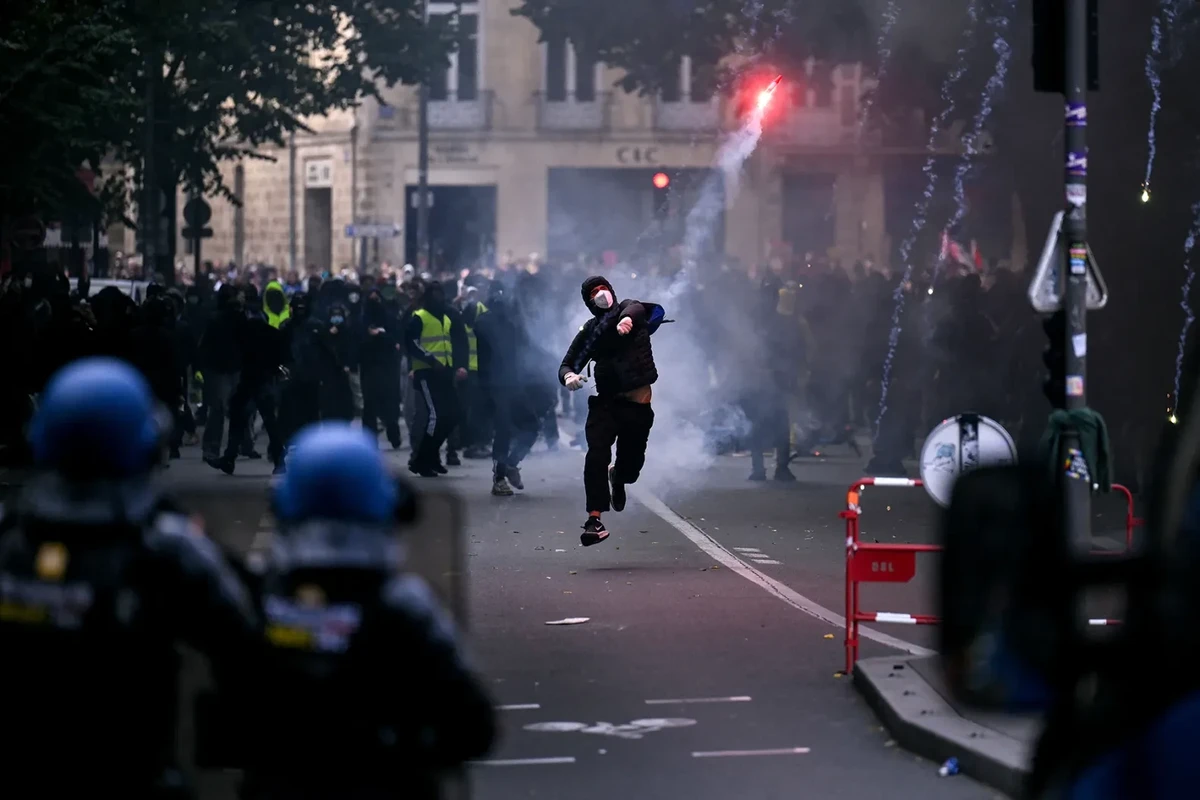
BORDEAUX, FRANCE — France’s student-led protest movement, which generated shocking scenes of violence and destruction and at least partially inspired a wave of similar civil unrest in other parts of Europe, shows few signs of abating.
Hundreds of thousands of demonstrators turned out in cities across France for the third straight weekend, despite a massive mobilization of police and security services aimed at quashing riots and looting that broke out after previous protests. At its peak last weekend, organizers said a million people had taken to the streets.
The movement has drawn in a broad coalition of student groups, trade unions, and political activists. While the students who began the demonstrations have specific grievances about the French education system, the protests are becoming a generational cri de coeur about fading economic prospects and quality of life across Europe.
“Whether we’re from the suburbs, the countryside or the big city, we don’t know what future to imagine for ourselves,” says Mathys Le Coz Ndzié, a 17-year-old Parisian. “The current government hasn’t managed to give us a clear picture of the future, or the world we’re heading into. So we feel completely lost.”
“Will our degrees still be worth anything when we’re 30, long after we’ve finished our studies?” the student asks. “We haven’t been prepared for the world that’s coming. The one they’ve prepared us for no longer exists.”
Le Coz Ndzié is among the tens of thousands of high-schoolers who joined the protests in recent weeks, demanding more funding, more teachers and better educational facilities.
“We’ve all seen the images shared by our fellow students in the banlieues, showing dilapidated buildings, crumbling classrooms. The conditions in which we’re studying are just shameful,” Le Coz Ndzié says. His own school in Paris has few major problems, he says. But he joined the protests in solidarity with students elsewhere.
While anger over France’s chronically underfunded education system may have been the catalyst for the protests, they have spiraled into a much broader economic movement.
“We have a supposedly rich country, yet wealth is concentrated in the hands of a few. What we’re seeing is deteriorating living and working conditions, and deteriorating public services,” Diane Derrien, a 31-year-old labor attorney, tells Rolling Stone. “For me, it’s like May ‘68. Students started the movement, but ultimately it revealed very deep failings in society, affecting both students and the rest of the population.”
 Sign at a protest in Paris on Saturday, Oct. 24: “Expensive life and suffering schools. Same government, same misery.”
Guillaume Ptak
Regardless of the motivations and demands of protesters, it is the rioting and looting accompanying them which have caught the attention of politicians in France.
“The demands and complaints of the demonstrators could not be heard over the sound of destroyed storefronts, looted shelves, and burnt down infrastructure,” Thomas Cazenave, the mayor of Bordeaux, says.
The intensity and scale of the unrest caught the government of President Emmanuel Macron off-guard.
Sophie Brocas is prefect of Gironde, a department in a region of southwestern France known for its beaches and its wine, and is no stranger to emergencies. She spent the summer overseeing the evacuation of residents and tourists in the face of the region’s worst wildfires in decades.
Last week, the 65-year-old political appointee — a prefect is a kind of unelected governor — oversaw the evacuation of her own official residence in Bordeaux when rioting protesters stormed the building, looting it.
The protesters were only dissipated when RAID — an elite French counterterror force —was dispatched to liberate the residence.
“We were overwhelmed for several hours,” Brocas says. Describing the rioters, she says: “I believe their profile is quite varied. Forty percent are minors, and there are plenty of people with no criminal record, who are not habitual offenders but are what we call ‘opportunistic offenders.’”
“It’s looting for personal gain — either for personal profit, to resell, or because some of them simply get swept up in the action,” she says.
Bordeaux is just one of the many cities across France where protests devolved into mayhem and chaos, prompting Macron to respond with a draconian crackdown. More than 70,000 police, gendarmes, and soldiers have now been deployed in an effort to rein in violence.
“Nothing justifies it, nothing explains it, nothing excuses it,” Macron said in a televised address on Oct. 18, after large riots first broke out in Paris and Marseilles. “Tonight, we all feel anger and shame.”
Thousands of protesters and rioters have now been arrested, with several deaths. Macron, an increasingly unpopular leader in the final year of his presidency, has resisted declaring a state of emergency — as demanded by politicians on the far-right.
“The state has lost control of everything,” declared Marine Le Pen, the leader of the far-right National Rally party. Le Pen is widely considered a top contender for the presidential election set for May. She vowed that if elected to power, her party “would restore order.”
But the election is still seven months away. For now, Macron’s government is seeking to neutralize the protests much the same way as it did the Gilet Jaunes, or “Yellow Vests,” protests that began in the first year of his presidency: with a combination of concessions, dialogue, and a no-nonsense police response.
Prime Minister Sébastien Lecornu, in a meeting with student leaders on Monday, promised an end to a controversial university admissions system, increased funding, more teachers, and more investment in schools. But the students say it is not enough, and have vowed to continue nationwide protests. Critics of the government note that although France’s senate quickly passed a bill aimed at increasing punishment for rioters in the immediate wake of the violence, they have not acted with equal urgency on education reforms.
The violence in France has also attracted the attention of American politicians.
“You’re destroying your country,” President Donald Trump said, in a broadside aimed at Macron.
Trump has sought to connect the protests to the upcoming U.S. midterm elections, telling a rally in Kansas that they would see similar unrest if Republicans did not win.
“We’re not going to let that happen to this country,” he said, continuing with a portmanteau he uses for Democrats. “When you see burning steeples and raging fires in France, just remember that is what the radical Dumocrats want to do to America.”
Trump was referencing a video that became a viral sensation online, of the burning spire of the Limoges town hall clock tower. While the truth was dramatic enough — rioters used a battering ram to break down the town hall’s doors before setting the building alight — numerous right-wing commentators portrayed the spire as a “steeple,” implying that rioters were burning down churches across France.
Far-right activists like Elon Musk, who habitually trade in “great replacement” and other white supremacist ideologies, routinely portray Europe as being overrun by Muslim immigrants. As rioting peaked, they sought to portray the unrest as a budding sectarian race war, in which a horde of Muslim immigrants was violently sweeping aside the increasingly outnumbered vestiges of European Christian civilization.
Such blatantly racist fear-mongering about barbarian hordes knocking at the gates of Europe have a long history, and meshes well with nativist anti-immigrant populism in the U.S. But aside from the presence of keffiyeh and Palestinian flags — which in many quarters have become an almost generic symbol of leftist resistance detached from their original context, like portraits of Che Guevara — there is little evidence to support the idea that the riots in France are motivated by a unified ideology, Islamist or otherwise.
There are, however, signs that the protests and their attendant unrest are manifestations of a broader anti-establishment sentiment, which became apparent as similar civil unrest spread across a range of European cities over the past two weeks.
In Italy, thousands marched in Milan and Rome against increased military spending and the war in Gaza. In Belgium, people rallied in Brussels against rising education costs. In Spain, citizens took to the streets of Madrid and Barcelona, protesting rising housing prices and rent. In Albania, a cycle of protests and crackdowns took on new life, as students gathered in Tirana against government corruption. In Serbia, a nearly two-year long student-led anti-corruption protest movement culminated in a victory party on Oct. 25th, with the ouster of Prime Minister Aleksandar Vučić in an election.
Across 14 European nations, protests began or took on new life in October. While it may be too soon to say whether the movement in France is the harbinger of a spreading spirit of revolution across the continent, the fact is that almost all of the protests had something in common: they were largely initiated by Gen-Z students, and they all spread into wider complaints about cost-of-living.
The war in Ukraine has forced governments across Europe to boost defense spending, embarking on a major rearmament as they contemplate a direct confrontation with Russia. The war in Iran, meanwhile, has added to global instability and jacked up fuel prices around the world, affecting nearly every corner of economic activity.
Aurélien Boudon, a 36-year-old vocational high-school teacher in the Parisian suburb Saint-Denis, is national secretary of Solidaires, a French federation of trade unions. He says that students he talks to aren’t just complaining about the education system, “they were also talking about their parents, who can no longer afford to fill the gas tank or stock the fridge.”
The economic pressure is only adding to a general anxiety about the future not felt in decades now permeates across most European societies, as does a feeling of helplessness.
“What people are asking is: What do we have to do to be heard?” asks Boudon. “They feel as though they’ve tried everything: petitions, demonstrations. Even when huge numbers turn out, even when everything happens peacefully — perhaps especially when everything happens peacefully — they aren’t heard.”
With few solutions offered by the mainstream political establishment, people instead look elsewhere for answers. Civil discourse gives way to extremist politics in a kind of ideological parallel to the protests themselves: the often idealistic and well-meaning student demonstrators of the day give way to the anarchists, thieves, and casseurs — the “wreckers” or hooligans — of the night.
What the culture wars and engineered social media outrages obscure is that in France or America, reactionary and revolutionary politics tend to generate heat through the same economic friction.
In many of the world’s wealthiest nations, life for most people — especially the young — is getting worse. And no one at the top seems able or willing to do anything about it.




 Courtesy of Sam Reich

Supporters of James Talarico cheer as they watch midterm election returns during a watch party at the Long Center for the Performing Arts Nov. 3, 2026 in Austin, Texas.
America Slammed the Door on Trump. Now the Hard Work Begins
The American people have spoken, and to paraphrase Dean Wormer of Animal House fame: Lazy, stupid, and corrupt is no way to go through life, let alone run a country. The repudiation of Donald Trump and his MAGA movement was seismic and inevitable.
The gravitational laws of politics held true, and Trump’s star crashed and burned. The thrill for MAGA is gone, at least for the moment. You simply can’t keep telling people that they are winning all the time when they feel like they are losing. Counting on the American people to once again believe you over their own lying eyes is a trick play you can only run so much. Just ask Joe Biden.
The poisonous combination of an unpopular and unnecessary war, horrible candidates, rising costs, a lousy job market, soaring gasoline prices, masked police hunting immigrants, sweeping and naked corruption, and a president more focused on ballrooms and algae blooms than on the American people all spelled electoral doom. The election results were a clear and thoroughly well-deserved ass-kicking.
Historic GOP losses in Kansas, South Carolina, Iowa, and Texas mean the Trump lame-duck era has begun. How soon will the GOP start the painful process of moving on from his stranglehold? His complete capture of the party will make the breakup difficult. And he’s not going to let them go easy. The infighting and battles for leadership will likely be vicious, but hopefully they will be about ideas. In a two-party system, having one party this radical and beholden to one person’s cult of personality has been toxic for our politics.
A perfect example of the sort of poisonous viper from the era, MAGA diehard and presidential confidante Laura Loomer took to X last night to say, “America is over. The communist and jihadists are going to open our borders and replace our votes with votes from illegal aliens. We now have reps who openly speak about their hatred of America…” It was just this sort of culture war BS from Loomer or Secretary of Defense Pete Hegseth (“no weirdos, beardos,” etc.) that voters grew tired of — when gas is over $4 a gallon these weak attempts at insults cease to distract. Owning the libs feels hollow when you are weighing whether to fill up the tank or buy eggs.The donor class might as well have lit a dump truck filled with cash on fire. How will Elon Musk, who spent over a whopping $450 million on the election, swallow this most bitter pill? Will he blame the president for his failures as a leader and withdraw support? Where do you even go once you have gone full MAGA?
On the other side, the Democrats set some historic and impressive firsts: first Black Speaker of the House, first openly gay man to be senator, first Black woman governor, first Native-American woman governor, first Muslim senator. These victories are truly inspiring, with more potentially on the way as votes continue to be counted (the first Black senator from Mississippi since Reconstruction seems a real possibility). The Dems have to keep growing the tent; it’s their greatest strength.
That said, now comes the hard part. The Democrats’ principal work must be to restore the country to a state of normalcy. Show voters you are fighting for them every day — stop trying to get on cable TV to grandstand about Trump and protecting democracy. The Democrats need to focus on voters’ real needs, reject the endless culture wars, and remind people that the Democrats were the party of working people for decades. Right now, folks desperately need jobs, lower prices on food and shelter, and healthcare.
Throughout his career, Sherrod Brown, returning to the Senate in Ohio after two years away, has been a messenger for working America in Washington. He represents a Rust Belt state that felt the full brunt of job losses from NAFTA and endured the opioid crisis. Dems should follow his lead to find their footing. Hold Trump accountable but don’t forget the voters back home who need help, and need it fast.
This is a huge reason for last night’s historic rebuke of Trump: He abandoned everyday Americans to focus on triumphal arches designed to honor himself. Democrats need to remember the lesson the American people just sent — being a people’s representative is not about party, it’s about service.
As Trump likes to say: Thank you for your attention to this matter.