
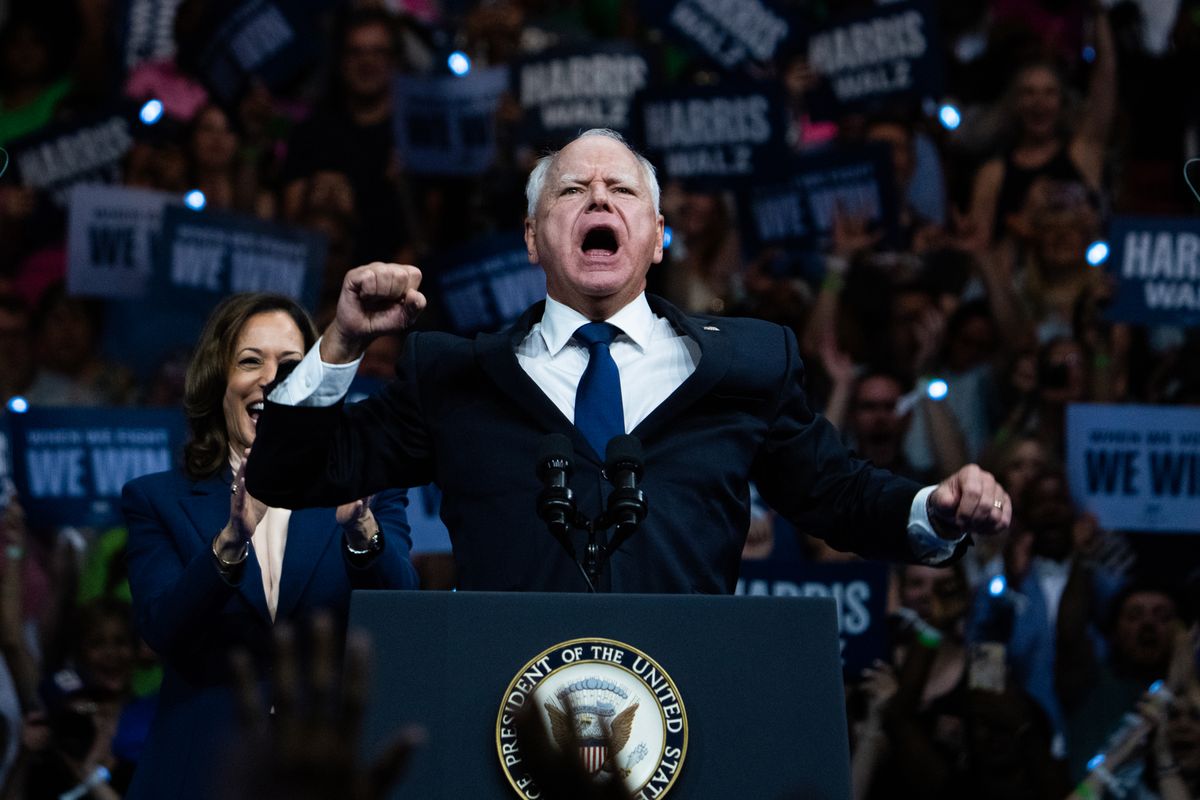
It’s been less than a day since Vice President Kamala Harris officially rolled out progressive darling Tim Walz as her 2024 running mate, and he already has a specific mandate from his boss: drive Donald Trump, J.D. Vance, and the right as crazy as he possibly can.
According to multiple Democratic sources on and close to the Harris 2024 campaign, the vice president and her allies are planning to deploy Walz over the next three months in the media and on the campaign trail as an omnipresent, MAGA-trashing attack dog. Walz is set to be, in the phrasing of one Harris 2024 source, the campaign’s go-to “sledgehammer against Vance and Trump” from now until Election Day.
That role was on full display at the first Harris-Walz rally in Philadelphia Tuesday. “These guys are creepy and, yes, just weird as hell,” Walz said of Trump and his VP nominee, Vance. He called them out for wanting to “invade your doctor’s office.” Walz even referenced the unfounded, viral claim that J.D. Vance had sex with a couch. “I can’t wait to debate the guy,” he said, waiting until the audience quieted down to drop the hammer. “That is, if he’s willing to get off the couch and show up.”
Harris and her senior staff, sources say, were impressed by Walz’s style of unapologetically progressive and anti-Trump messaging, as well as his ability to tilt entire news cycles at this relatively late stage in the president election. It was Walz who helped drive the message that Trump and Vance are “weird” — an attack that quickly became a large-scale Democratic Party talking point against Team Trump and the GOP.
The “weird” message, Rolling Stone recently reported, has gotten under Trump’s skin. “Nobody’s ever called me weird,” the former president protested last week. Speaking with aides and other advisers privately, Trump has gotten particularly incensed about how those attacks have been directed at Vance.
“We are running against a weird dangerous agenda of taking away people’s rights, monitoring women’s pregnancies, and other insane hurtful bullshit like making Trump a dictator,” says a source familiar with Harrisworld’s thinking on Walz. “The antidote to that is a regular guy in Tim Walz — a veteran, football coach, friendly neighbor who helps fix your car, and a really successful governor. It’s why his attacks have been so potent the last month and why he won in a swing district for years against GOP attacks. His shit isn’t poll-tested, it’s gut-checked.”
After Walz’s announcement as the Democratic VP nominee on Monday, Trump and his allies spent the day testing out several messages. They tried depicting Walz as a dangerous, San Francisco-loving, radical liberal with no charisma, despite his rather obvious gift of gab and extremely Midwestern vibe. Conservative media outlets launched several attacks on Walz’s military record, faulting him for retiring from the Minnesota National Guard after two decades of service to run for Congress. Walz, meanwhile, said Tuesday that Trump “doesn’t know the first thing about service — because he’s too busy serving himself.”
Walz has been a progressive governor, particularly in his second term. After the Minnesota Democratic-Farmer-Labor Party secured a governing trifecta, capturing both legislative chambers for the first time in years, he and lawmakers rammed through universal free school meals, child tax credits, strong protections for abortion access and LGBTQ+ rights, paid leave, infrastructure investments, and universal gun background checks.
He’s not running away from his record on social issues. “In Minnesota, we respect our neighbors and their personal choices that they make — even if we wouldn’t make the same choice for ourselves,” Walz said Tuesday. “There’s a golden rule: mind your own damn business.”
And Walz is proud of the way he and his party enacted their agenda. Last summer, he posted that “Minnesota is showing the country you don’t win elections to bank political capital — you win elections to burn political capital and improve lives.”
Since Harris replaced President Joe Biden as the Democratic nominee, there has been a remarkable sea change in strategy, as the party has shown a new willingness to play rougher and get down in the mud with Trump. While Harris was reportedly enthused about Walz’s record of accomplishments as governor, his selection is a sign that Democrats intend to keep up the attacks on the GOP.
Democrats have seized on Walz’s “weird” attack line against Republicans since the moment he trotted it out. “These are weird people on the other side,” he said on MSNBC on July 24. “They want to take books away. They want to be in your exam room. That’s what it comes down to. And don’t, you know, get sugarcoating this. These are weird ideas.”
Walz’s message has pleased liberal TV viewers, frustrated Trump, and made an impression with Americans more broadly, according to a new poll from University of Massachusetts Amherst. Respondents were to give one-word descriptions of Vance — without any priming — and the UMass Poll created a word cloud with the results. The two largest words: “unknown” and “weird.
Harris’ selection of Walz earned plaudits from certain Democrats and centrists who have often been highly critical of the party’s more progressive flank and cultural liberalism. Even Joe Manchin — Joe Manchin! — is on board with the Walz pick. He wrote Tuesday that Walz will “bring normalcy back to Washington.”
James Carville, a veteran Democratic strategist who was a central figure in engineering Bill Clinton’s presidential victory, offered praise for Harris’ VP selection, too.
“I have been saying the Democrats have their scariest problems with male voters,” Carville tells Rolling Stone. “But this guy is a veteran, he’s a hunter, a football coach, a fisherman — he is definitely a male. Everything about [Tim Walz] screams male.”
Carville had been harshly critical of Democrats for not pushing Biden to drop his reelection bid sooner, and had recently warned liberals to temper their “triumphalism” over Harris’ rise.
“The NPR crowd, they’ll never get it. But 48 percent of the people who come out and vote are male, and that’s not an insignificant percentage of voters,” Carville adds. “Now, it remains to be seen if it was the right selection, but the early signs are encouraging.”







War Is Peace: Trump’s Regime-Change Reversal
As American and Israeli rockets fly into Tehran, with the stated goal of regime change, anyone who bought into the self-evidently absurd idea of “Donald the Dove” ending America’s forever wars ought to be suffering from a bloody form of buyer’s remorse.
It was always bullshit. But that’s what the Trump team was selling hard. Take human ghoul Stephen Miller’s tweet days before the election: “Kamala = WWIII. Trump = Peace.”
The Trump team reads George Orwell’s 1984 like an owner’s manual and so of course “war is peace.” Their undermining of NATO and the dismantling of American alliances in favor of a “might makes right” foreign policy executed by a sycophantic kakistocracy is a guarantee of more war amid autocratic power grabs worldwide, with a side order of corrupt crony capitalism to profit from the chaos.
If you voted for Trump and believed him, this is on you. And that includes self-styled Palestinian peace activists who thought that Biden and Harris were the worst of all possible worlds and stayed home. We will no doubt see protests for the innocent lives lost in these strikes — but I’d have a lot more time for those folks if they were also seen protesting the estimated 20,000 to 30,000 Iranian lives snuffed out by murderous mullahs in the last few months alone.
The Islamic Republic of Iran has been despotic and dangerous from its inception. The Iranian people have been oppressed and denied basic freedoms for decades. But this is an extreme example of a war of choice. The American military strikes against Iran’s nuclear weapons facility last year were justified because Iran cannot be trusted with a nuclear weapon. That is true. But the much trumpeted total obliteration of those facilities is apparently not true — or so goes the justification for this war. And don’t forget that it was Trump who pulled the U.S. out of an Obama-era deal to stop Iran from developing weapons — arguing absurdly that the imperfect anti-nuke deal needed to be blown up to stop Iran from developing a bomb. Iran’s subsequent progress toward a bomb then created the rationale toward these strikes. This is a self-inflicted state of emergency. Peace is war and war is peace.
Pity the willful dupes in Congress who deluded themselves into thinking that Trump deserved the Nobel Peace Prize. They’ll probably rationalize that he would’ve been peaceful if he got the honor. Now it will be read as a cautionary tale for not sucking up. The chairman of the Board of Peace is now bored of peace. While Rand Paul remains admirably consistent, it’s Lindsey Graham who is pirouetting around the Senate floor while the Gimp Speaker Mike Johnson is unable to speak for the basic constitutional principles of separation of powers let alone authorization to go to war.
If you’re feeling shell-shocked trying to keep up with Operation Epstein Distraction, get ready for the inevitable next crisis — regime change without a plan for replacement. This is what the Trump administration did in Venezuela — kidnapping the socialist dictator Maduro but keeping his regime in place in exchange for crude oil access. The opposition is still in exile and its leader María Corina Machado gave her Nobel Peace Prize to Trump in exchange for exactly nothing.
One of the clear lessons of history is that if you don’t win the peace, you don’t win the war. The Saudis and their Sunni allies will back the U.S. and Iran because they hate the Shia Iranians (who, incidentally, are not Arabs), but beyond removing the Iranian regime, the plans for replacement and stabilization seem TBD — and with Trump’s inability to stay focused on anything beyond his immediate self-interest, solid plans are unlikely to emerge. Maybe a leader will come from the underground opposition; maybe it will be the Shah’s son, who has been living in the U.S. waiting for a restoration like many members of the diaspora. The upside is that Iran has a distinguished history and an accomplished Persian culture: The Islamists don’t represent the entirety of the people of Iran and never have.
But the path ahead will be messy at best. It will require concerted effort and civil commitment, not just an open call for private investment from Mar-a-Lago members. If the United States is now kidnapping and killing dictators without direct provocation, it establishes a dangerous precedent which will come back to bite us after demolishing our moral authority in the world.
It is the unexpected effects, the cascades of consequence where we cannot always plan ahead, that cause most responsible statesmen to try to keep the peace. But Trump has the carelessness of a rich-boy bully who can always buy or bluster his way out of trouble. He’s a con man who has found his ultimate mark in his followers, who fool themselves into thinking that a reflexive liar is the one man with the courage to tell the truth.
Perhaps the most prominent example is the vice president himself — a bright guy who not that long ago compared Trump to Hitler and a deadly narcotic but then convinced himself that careerism demanded an abrupt conversion. After all, he endorsed Trump less than two years ago with this very serious column headlined “Trump’s Best Foreign Policy? Not Starting Any Wars,” explaining, “He has my support in 2024 because I know he won’t recklessly send Americans to fight overseas.”