


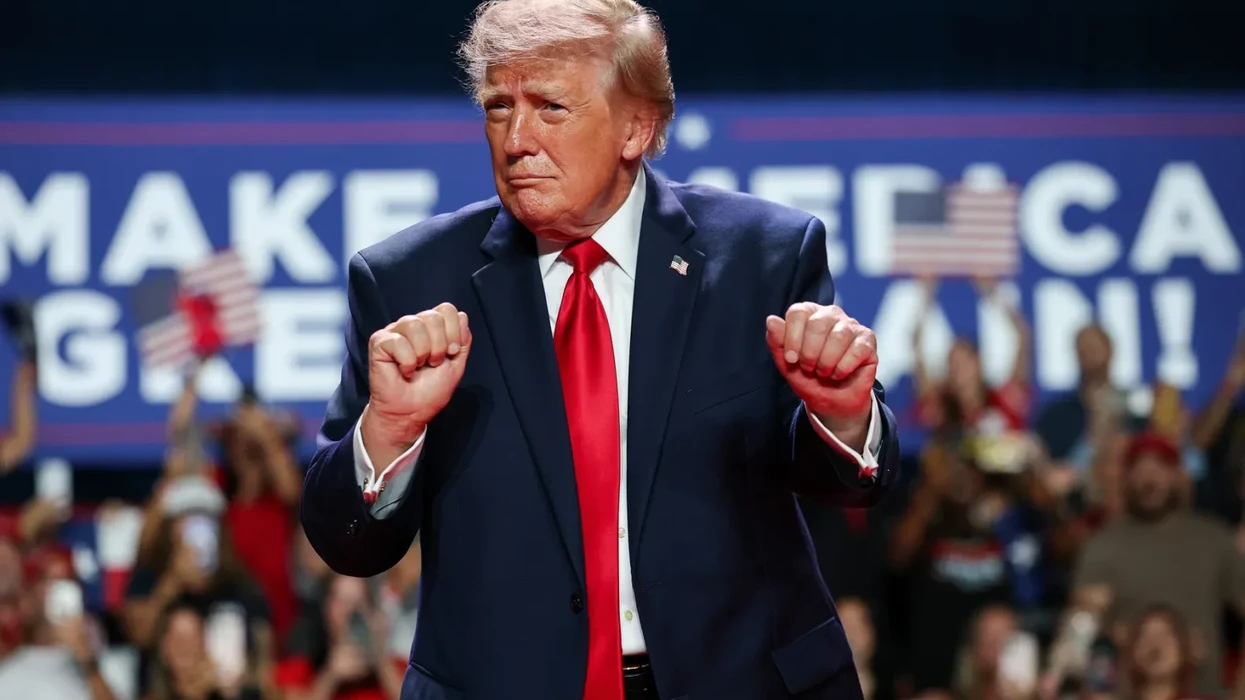
It’s Day 20 of the Kamala Era, but Trump World remains in the Before Times. Sure, the Let’s Go Brandon merch is being sold at a discount, but otherwise the mood in the non-swing state of Montana is very July 2024. Or July 2016. The ex-president is on his way for a rally tonight, and the sound system in the parking lot of Bozeman’s Brick Breeden Fieldhouse bleats out the same seven songs, including “Memory” from Cats. The roughly 8,000 supporters who began queuing at dawn will hear the song approximately 30 times before they enter the temple of Trump this evening.
There are plenty of other Trump comfort-food visuals; a Red Bull-slamming dude wears an electoral college T-shirt with Trump states in red and blue states labeled Dumb Fuckistan. The guy in the block suit is here and tells an admirer that it is his greatest wish to sub in for Fox’s Greg Gutfeld one day. (His dream comes a bit closer later today when Fox News misidentifies him as a Montana voter.) Huckleberry smoothies are being hawked for $14 next to a pickup truck emblazoned with the image of Donald Trump shooting a Tommy gun while saying “Merry MAGA you filthy animal.” A teen waits in line for a portable toilet and sings along with the Natasha Owens classic, “Trump Won”:
“We got dead people votin’ Dropboxes and Dominion
And facts are facts, it’s not just my opinion
The Democrats know how to steal
Come on man, here’s the deal
Trump won and you know it
Trump won and you know it.”
What we are all doing here is not exactly clear. The Kamala Harris-Tim Walz ticket is barnstorming swing states on a sugar high that may or may not last until November, but this is Trump’s only rally of the week. It is being held in Montana, a state he still owes money from previous rallies and a state he will win by at least 15 points. My theory is that Trump booked the Bozeman trip before President Joe Biden’s departure from the race. That’s when he thought he could cruise the country once a week grandstanding for Senate candidates that could get him a Republican majority.
I’m also guessing the fundraisers had already been locked in. Trump is heading to Big Sky’s posh Yellowstone Club this afternoon, the kind of event that would cause the fictional John Dutton to spit on the ground and then deliver a deranged monologue about all the rich fuckers ruining his beloved Montana.
One of those late-arriving arrivistes is Tim Sheehy, the Montana Republican Senate candidate running against three-term incumbent Jon Tester, a seven-fingered dirt farmer from Big Sandy. Sheehy is generically handsome with gelled, dark-blond hair. He glad-hands this morning in a Sheehy for Senate fleece, proclaiming, “We’re going to save America, and these people are going to help us do it.”
Tester was not available for comment because, according to a source, he was busy pulling 16-hour days on his tractor harvesting peas back on his farm in Big Sandy. Sheehy once called Tester’s farmer credentials fake and described the farm where Tester grew up as just a “weed patch.” I don’t think they are friends.
Sheehy’s background is different. He was raised in a posh Minnesota lake house and only moved to Montana in 2014. Sheehy has never spent a day involved in Montana politics, continuing a storied tradition of Republican rich dudes moving to Montana, buying a ranch, throwing on some work jeans, and trying to convince the locals he is a man of the people.
Sheehy has a lush bio, a Navy SEAL who served with distinction in Afghanistan before moving to Montana and founding Bridger Aerospace, an aerial firefighting company. Many of Sheehy’s photos feature him looking rugged in a flight suit with one of Bridger’s planes in the background. Tonight, he will talk about water-bombing forest fires for a living.
Alas, the thing about too-good-to-be-true candidates is they often turn out to be not actually true. Bridger Aerospace reported losses of $77 million in 2023 with its stock down 54 percent for the year. An auditor recently reported: “The company has suffered recurring losses from operations, operating cash flow deficits, debt covenant violations, and insufficient liquidity to fund its operations that raise substantial doubt about its ability to continue as a going concern.”
Well, he still has a stellar military record. Sort of, maybe? Sheehy has a bullet lodged in his arm that, depending on his various accounts, either happened in Afghanistan during an attack, or from friendly fire, or, uh, in Glacier National Park in 2015 when he dropped his Colt .45. Sheehy has shared a Rashomon number of accounts of his bullet, and I assumed this would cause him to low-key his military record tonight.
I should have known better. I also should have known that Donald Trump’s presence here has little to do with getting him to 270 electoral votes and a helluva lot to do with a political vendetta straight out of a not-picked-up Showtime pilot on corruption.
Stories emerged in the days after Trump was shot about how his brush with death had changed him into a softer version of himself. Politico posited, “A changed Trump? Some allies detect an ‘existential’ shift after shooting.”
Nope. In a few hours, Trump will take the stage and call a reporter a “maggot,” mock Tester’s weight, promise mass deportations, and question the origin of Kamala Harris’ last name.
Nothing has changed and that’s a problem.
I CAME ACROSS a half-dozen Trump supporters clasping hands and praying for his safety near their SUV as I walked toward the fieldhouse a few hours before the rally. It wasn’t residual words of thanks for Trump surviving last month’s assassination attempt, but news that Trump Force One had mechanical difficulties and had to land in Billings, a hundred miles away. Other supporters had more personal concerns.
“He better not fucking cancel; I’ve been out here for 12 hours,” mutters one guy.
Agreed.
Trump doesn’t cancel, but he has to hop a different plane from Billings to Bozeman and then his motorcade heads down to his Big Sky fundraiser. That meant he wouldn’t take the stage here until 9:30 p.m. local time, which seems to defeat any attempt to alter the political narrative as Harris and Walz held another rapturous rally in Arizona during primetime. This was my first Trump rally since his infamous one in Tulsa during the 2020 campaign that claimed Herman Cain’s life, but the presentation hit the same notes of malice and unintentional comedy.
The sound system pumps in Celine Dion singing the theme song from Titanic, and later there’s a video of Dennis Quaid as Jerry Lee Lewis singing “Great Balls of Fire” from the movie of the same name — the heartwarming tale of a 22-year-old man courting his 13-year-old cousin that surely would be anathema to the Pizzagate anti-pedo supporters in the crowd.
The gathered hear a series of opening acts who are obsessed with the issue of masculinity. Maybe this shouldn’t have surprised me in a fieldhouse with multiple national rodeo championship banners in a state governed by Greg Gianforte, a man once convicted of assaulting a reporter.
The Montana Republican Party chair derides Tester as a vodka cranberry drinker, which offends my personal vodka drinking preferences. The microphone finds Matt Whitaker, who has parlayed three months as Trump’s acting attorney general into a career often dropping the “acting” from his speech. He shouts for a while about a “world on fire” and a Justice Department targeting Catholics even though President Biden is a practicing Catholic.
Then we get Congressman Ryan Zinke, a man in a black cowboy hat going after Walz for purported stolen valor. Zinke, it should be pointed out, was a decorated Navy SEAL who never made captain because he was caught billing the Navy for personal expenses and was run out as Trump’s ride-a-pony-to-work interior secretary for using planes and helicopters for private travel. (He attempted to diffuse the controversy by making the distinction that he never took a jet for private travel; they were all prop planes.)
There’s still no sign of Trump, so Sheehy is brought out alone. He begins his speech with a joke.
“Well, you know my name,” says Sheehy. “Those are also my pronouns. ‘She-he.’ I can tell you going to middle school in the Nineties that wasn’t a fun thing to have.”
Oh boy.
Sheehy goes through his military record with no word about his own personal magic bullet. Then he makes a grievous mistake; he makes sense. He offers the usual Republican words about the border crisis and then makes an observation.
“If you wonder why we have a border crisis, it’s because everybody wants to come here and be Americans,” says Sheehy. “No one’s walking across deserts to move to China. No one’s climbing and going in the ocean to move to Russia. They are coming here to be Americans, and we should be proud of that.”
This is a good point! Alas, it runs counter to the Trumpian view that America has become a dystopian shithole. The crowd doesn’t know what to do and there’s an odd quiet. An uncertain Sheehy pivots back to familiar ground.
“Montanans want common-sense government. And what does common sense mean to Montanans? They want a secure border, safe streets, cheap gas.” The crowd stands and cheers. “Cops are good. Criminals are bad. Boys are boys and girls are girls.”
Sheehy exits to applause. The video screen cues up Freddie Mercury camping it up at Live Aid.
TRUMP FINALLY HITS the stage at 9:30 p.m., 90 minutes late. Maybe it’s all the rest he’s been getting, but he’s in a good mood. It’s moments like this that you get a real sense of the man, in all his dyspeptic glory. He talks of Biden and you get Trump unfiltered.
“You know, he wanted to debate. If we didn’t have a debate, he’d still be there. Can you imagine if we didn’t have a debate? Why the hell did I debate him?”
The crowd laughs, but you know from his face that Trump means it. He realizes debating Biden early is going to turn out to be the biggest fucking mistake of his life.
The idea that the shooting would transform Trump into a fully formed human was always ridiculous, but there still is the question of Donald’s own personal great reset: He is now trailing Harris nationally in some polls and performing poorly even in the swing states. The man is an amoral realist — could he pivot somewhat to the center in the search of the sliver of the electorate that could determine his fate?
The answer, my friends, is absolutely not.
Trump plays his hits in all their disgusting glory. He calls New York Times reporter Maggie Haberman “Maggot Haberman” because she wrote an article casting doubt on a story that the ex-president told about a treacherous helicopter ride. Speaking of Tester, Trump proclaims, “I don’t speak badly about somebody’s physical disability, but he’s got the biggest stomach I have ever seen.”
He offers insight into his verbal slam strategy. “I’ve done a lot of bad name-calling,” says Trump with a chuckle. “You know, when you call somebody that you know how to say the name perfectly, and you call it on purpose, they say, ‘Sir, you made a mistake.’ I say, ‘No, I didn’t.’”
His attacks on Harris are gross and predictable. “You know, it’s interesting. Nobody really knows her last name. If you ask people, ‘Do you know what her last name is?’ Nobody has any idea what it is. ‘Harris.’ How the hell did this happen?”
I did some reporting, and Harris turns out to be the last name of Vice President Harris’ father. Some further digging suggests taking your father’s last name is a common practice in Western cultures.
Trump hits an anti-media jag, and the crowd starts their usual finger-pointing and chanting at us reporters herded together in our veal fattening pen. I debate shouting back, “You want me on that wall, you need me on that wall!” but instead decide on a five-minute mental health break.
Trump has at least another 45 minutes in him despite the fact some fans are heading for the exits. So I go into a toilet stall and pull up a video I shot on my phone earlier in the day.
I’d heard that there was going to be a 20-foot inflatable IUD outside the Bozeman Public Library as part of a pro-choice, anti-Trump demonstration. Might be some good color. But I fucked up the time and instead stumble into Bubblepalooza. Twenty or so toddlers were blowing said bubbles, fitting themselves with crowns, and listening to the Treble-Makers harmonize through “Top of the World” and “Going to the Chapel.” Finally, I get a glimpse of some of that happiness and joy that Kamala has been talking about!
I leave the stall heartened and energized, only to see a four-year-old peeing on his shoes as he chants, “USA! USA!” Meanwhile, his dad and a friend are screaming, “Sword fight!”
I can do this.
The best thing about a Trump speech is that it is impossible to miss anything because the guy loops around a subject at least five times. Now he’s talking about brutal crimes committed by “illegal aliens,” and he makes a promise:
“Here’s all we’re going to do. It’s going to be called a Trump mass deportation, because we have no choice. We have no choice. We have no choice. If Harris wins, a never-ending stream of illegal alien rapists, MS-13 animals, and child predators will ravage your communities … We have a new form of crime. It’s called migrant crime, and it’s going to be as vicious as any crime ever seen in this country before.”
The remaining crowd stands and cheers. The thing you need to know about Trump rallygoers is they love Trump because he is the political equivalent of a Law & Order binge. He’s always going to hit the same bigoted points you’ve grown to love. You will go home confirmed in your entrenched ideology. Have some more Cheetos.
But tonight there’s a twist, a special guest star that might explain everything. Trump introduces his good friend and former White House doctor Ronny Jackson. Jackson is hyped up on something, maybe just revenge.
“I want to tell you a little bit about this man, Jon Tester. This man who says that he represents Montana in the Senate. This man who tells you that he’s up there trying to clean the place up and trying to fix what’s broken.” Jackson makes some odd motions inside his mouth. “This man is a sleazy, disgusting, swamp politician. He’s a fraud, and he’s a liar.”
Dejected reporter heads pop up from their Slack channels like dogs sensing a squirrel with a hobbled leg. Turns out Tester was the ranking member on the Senate Veterans Affair Committee when Trump nominated Jackson to be VA secretary in 2018. Tester helped torpedo Jackson’s nomination after discovering credible allegations of misconduct — drunkenness and the liberal distribution of prescription meds to his colleagues.
Jackson sees it differently.
“I had a spotless, spotless, flawless career in the Navy, I’ve never had a single complaint about anything,” says Jackson. “He came after me. He tried to destroy me. He tried to destroy my family.”
Jackson then turns back to his friend. “The end of Jon Tester starts tonight, and it starts by bringing this man back to the White House!”
Trump smiles at the doctor who proclaimed he was in better shape than Barack Obama. “You’re a great leader,” he says. “You’re a great admiral.”
This isn’t actually true and seems relevant in the time of Walz getting swift-boated over his use of the rank of sergeant major. Jackson is not actually a rear admiral anymore. The Navy demoted him in 2022 after the Navy Inspector General found the charges of unprofessional behavior brought to light by Tester were accurate. Point goes to the seven-fingered man with the big stomach.
And you may ask yourself, what the hell does any of this have to do with Trump turning his campaign around? Absolutely nothing. The fact that Trump trotted Jackson out to launch a personal vendetta is proof the man is never, ever, ever going to change. There are some benefits: This may result in the man not being able to replace Clarence Thomas when the judge finally discovers shame.
The arena is now a quarter empty. Trump wraps up with his own vulgar mantra.
“We will make America wealthy again. We will make America strong again. We will make America proud again. We will make America safe again. We will make America free again. We will make America great again.”
This is not a recording.
I stumble into the Montana night full of Trump bros high-fiving and cracking open cold ones.
I miss those happy babies blowing bubbles.








Vladimir Putin addressing the audience during the Valdai Discussion Club meeting on Oct. 1
As Trump Dithers, Ukraine War Is Approaching a ‘Fatal Point of No Return’
The war in Ukraine is becoming increasingly dangerous, with the risk of escalation spilling further into Europe. As Russia and European governments trade explicit warnings that the conflict is spreading, the United States is pursuing diplomacy aimed less at stopping the carnage than restoring ties with Moscow.
With the Russian military making little progress on the ground in eastern Ukraine despite nearly five years of war and more than a million casualties, the Kremlin is intensifying aerial attacks. Ukraine, which has been the target of Russian missiles and drones since the war began in February 2022, is now experiencing a sharp uptick in attacks on infrastructure and populated areas that threaten to plunge parts of the country into cold and darkness over the winter.
The aerial blitzkrieg is intended to destroy Ukraine’s morale, infrastructure, and economy, President Volodymyr Zelenskyy recently told the Financial Times, citing intelligence intercepted by his country’s security services.
Zelenskyy told the paper that Russian President Vladimir Putin, in discussions with top Kremlin officials, had removed constraints on the bombardment campaign: “He said there are no rules now.”
U.S. disengagement from the conflict during Trump’s second term, coupled with the American president’s animosity toward Zelenskyy and Ukraine more generally, has only emboldened Putin. After promising he would stop the war “within 24 hours” after reelection, Trump’s tepid support for Ukraine and its European allies has increasingly convinced the Kremlin it has a chance to permanently rupture the NATO alliance.
At the Valdai Discussion Club on Thursday — an annual high-profile international summit in St. Petersburg — Putin said that continued European support for Ukraine was pushing the conflict toward a “fatal point of no return.”
The Kremlin has long described the war as an extension of a confrontation with the collective West. With more than 1.5 million active service members in the Russian military, about 44 percent of Moscow’s budget for 2027 is dedicated to defense and security spending. Around 700,000 Russian soldiers are serving on the front lines in Ukraine, where casualties remain staggeringly high.
Editor’s picks
The 250 Greatest Albums of the 21st Century So Far
The 100 Best TV Episodes of All Time
The 500 Greatest Albums of All Time
100 Best Movies of the 21st Century
Meanwhile, Moscow is conducting a campaign of so-called “hybrid warfare” — with officials in multiple countries alleging that a series of drone attacks, arsons, and sabotage originated with Russian intelligence services. The Kremlin also continues to carry out targeted killings on European soil — and has even attempted to assassinate political dissidents in the United States, according to the FBI.
Russia’s belligerent activity has set alarm bells ringing across Europe.
Speaking at a NATO event on Thursday, German Chancellor Friedrich Merz said that the continent must brace for “severe hybrid attacks,” as Russia targets production facilities and logistics hubs by which Ukraine’s allies supply the beleaguered country with arms. Europe must be prepared to “respond quickly and very clearly” to Russian provocations, Merz said.
For its part, Moscow asserts that NATO is provoking conflict, citing recent unannounced military exercises near Kaliningrad — a Russian exclave on the Baltic coast. In a communiqué to NATO this week, Russian officials warned that action against Kaliningrad would initiate a serious response, “including nuclear weapons” in order to defend its territory, and “Russian strikes against decision-making centers in the alliance’s member states.”
“This is a war that Europe is waging against us,” Russian Foreign Minister Sergey Lavrov told reporters at the Valdai forum. When asked about hybrid attacks outside Ukraine that European leaders have attributed to Russia, he said his country was only targeting support for what it dubs the “Nazi regime” in Kyiv.
Related Content
California Leaders Erupt After Trump Suggests Letting Iran ‘Take Out’ Cities
Jon Stewart Breaks Down the Threat of AI: ‘Why Can’t We Just Slow This Down?’
Dolly Parton Estate Claims Nephew Used Caution Tape and Barbed Wire to Dodge Lawsuit Service
Hayley Williams Responds to DHS’ Suggestion to Thank Officers After ICE Comments: ‘Nazi Bitches’
As the sabers rattle louder, American engagement with Moscow and Kyiv comes in fits and starts, with no apparent overarching strategy.
Critics of the White House’s approach point to a recent trip by Trump’s friend and special envoy to the Middle East, real estate attorney Steve Witkoff, and son-in-law Jared Kushner, to Moscow and Kyiv. Their tour yielded headlines, but little progress toward negotiations between the warring parties — let alone toward ending the conflict.
“I hope they had a great discussion about opening a hotel or something,” one European official told Rolling Stone. “Because it was useless otherwise.”
Diplomacy via haphazard tête-à-têtes with the president’s personal envoys is almost certainly viewed as a sign of weakness by Putin, who is well aware that Trump hopes to claim normalized ties between the United States and Russia as a crowning foreign policy achievement.
The White House is considering a range of unprecedented diplomatic deals that would help keep Russia’s economy functioning while doing little to benefit Ukraine.
These proposals reportedly include an easing of economic sanctions if Putin agrees to release some political prisoners, and a potential multibillion-dollar oil deal ostensibly aimed at stabilizing energy markets and reducing gas prices.
With gas prices rising amid the U.S.-Israeli war on Iran and midterm elections around the corner, Trump has made energy central to his Russia policy. Washington has called for an “energy ceasefire” — while Trump has blamed Kyiv for rising diesel prices in the United States.
While high oil prices are the result of a concatenation of crises, Ukraine has been targeting Russian oil refineries, producing fuel shortages and long queues for gasoline — in one of the world’s largest oil producers — over the summer.
Ukraine is also developing its own domestically produced tactical ballistic missiles. Ukrainian officials said Friday that one type of missile, the FP-7, had been successfully used in combat for the first time. But whether Kyiv can produce enough of them to create a meaningful deterrent is unclear.
As winter nears, the outlook for Ukraine is bleak. A recent attack on Kyiv consisted of nearly a dozen ballistic missiles and hundreds of drones in a single night. That many munitions slip through highlights the dire situation faced by Ukrainian defenders, who are running out of advanced missile interceptors. They also struggle to shoot down drones that are becoming increasingly numerous, sophisticated, and effective as the war drags on.
In recent months, Russia has adopted widespread use of an advanced drone, the Geran-5 — a jet-powered drone that bears an uncanny resemblance to the V-1 “buzz bombs” used by the Nazis to bombard London toward the end of World War II.
As with the German V-1 campaign against London 80 years ago, the targets are often indiscriminate. Even before the ramping-up of attacks this fall, 2026 was on track to be the deadliest year for Ukrainian civilians since the early months of the full-scale war in 2022.
The proliferation of Russian attack drones and ballistic missiles means that cities like Kyiv now spend much of each day under air alert. Even aside from the human toll and physical damage that the weapons inflict, officials estimate that the disruptions to daily life are costing the country as much as $45 million per hour in lost economic activity.
Since Friday, a series of drone attacks has targeted two of Kyiv’s major bridges spanning the Dnieper River. The damage has disrupted traffic between the capital’s “Right Bank” — with its historic core and city center — and its “Left Bank,” with its sprawling Soviet-era industrial and residential developments.
Ukraine is already experiencing a severe financial squeeze. Prime Minister Sergii Koretskyi says the country is facing a $27 billion “funding gap” before the end of the year.
Ukrainian lawmakers warn the government could even run out of funds to pay soldiers. One serving member of the Ukrainian military, who spoke to Rolling Stone on background, said by the end of the summer, members of his unit had already begun experiencing “delays” in receiving their pay.
The Ministry of Defense disputes that soldier’s salaries could go unpaid, but acknowledges that “technical issues” had caused some delays.
Meanwhile, Zelenskyy is under pressure from corruption scandals and resignations involving members of his inner circle. Polls show him potentially losing hypothetical match-ups against rivals, including former Ukrainian Armed Forces commander Valerii Zaluzhny. The country’s “long-admired cohesion” has begun to crack — an outcome that aligns with Russia’s strategic objectives.
But after nearly five years of war, both combatants are showing signs of political and economic strain.
Russia’s regular military conscription process — 120,000 new recruits are expected over the next three months — barely offsets the grievous casualties its military is experiencing at the Ukrainian front, with high estimates exceeding 1,000 casualties per day.
Some analysts believe the Kremlin is considering a massive mobilization in the wake of parliamentary elections. But Putin so far has merely called for an increase in the total number of active-duty military members by a little more than 15,000. Russia’s president remains wary of generating a meaningful anti-war movement inside Russia, while also facing pressure from hard-line nationalists expecting him to deliver victory.
Across Europe, governments are no longer treating a direct confrontation with Russia as a remote possibility. They are preparing for worst-case scenarios, particularly in the Baltic states and other countries that experienced Russian rule under the Soviets. Meanwhile, NATO insists that all members — including the United States — have an “ironclad commitment” to collective defense.
In 1914, at the outset of the First World War, few leaders understood how faulty strategic assumptions, entangling alliances, and lethal technologies were pushing the continent toward cataclysm.
But some did. On the eve of war, U.K. Foreign Secretary Sir Edward Grey famously wrote that “The lamps are going out all over Europe.”
Trending Stories
Brian May Says Queen Won’t Tour Again: ‘50 Years Is Enough’
Dolly Parton Estate Claims Nephew Used Caution Tape and Barbed Wire to Dodge Lawsuit Service
See Jack Black’s Black Sabbath Cover Band Perform With Geezer Butler at Power to the People Festival
See Bruce Springsteen Cover Neil Young With Dave Grohl at Power to the People Fest
Across Ukraine, darkness will again become a feature of daily wartime life amid rolling blackouts as a hard winter looms. And the shadows are lengthening, far beyond its borders.
But in America, the White House dithers as the president has his attention elsewhere. Perhaps Trump’s new ballroom, at least, should be well lit.