
Donald Trump’s favorite thing about America is that he lives in it. It’s hard to point to a president that wasn’t self-absorbed, of course — Obama had an ego on him, as well — but “President DJT,” as he signs his tweets, takes personal pride to a new level.
Trump has put his personal stamp on every American institution within his reach, and the celebration of the country’s 250th anniversary, known confusingly as the semiquincentennial, is no exception. Instead of a celebration of the country, Trump’s “Freedom 250” celebrations honor a particular vision of America — one set by one man, organized largely to boost his ego and flex his power over our political system and way of life.
Trump’s co-option of the semiquincentennial has taken many forms — slow and gradual ones like the subtle rebranding of the event, and bizarre, brazen ones like placing his name and likeness on new U.S. passports, coins, and other items. It’s a fitting demonstration of the current state of America: at the end of its imperial rope, a society that has been degraded so far by its own excesses that the Founding Fathers would barely recognize it now.
Here are some of the ways Trump made our country’s 250th birthday all about himself.
Neutering the America 250 commission and replacing it with Freedom 250
You need time to plan a good party. In 2016, the last year of the Obama administration, the nation began looking ahead toward the 250th anniversary celebrations. Congress established a commission that would theoretically oversee planning of the festivities a decade in advance, to ensure that everything went well regardless of who was in power.
And then Trump happened. In 2025, upon his return to the White House, Trump effectively neutered America 250, and created his own party planning committee: Freedom 250. Where America 250 was supposed to be nonpartisan, Freedom 250 is Trumpian, stuffed with allies of the president and focused on projects that reflect the presidents’ personal style. To top it all off, the funds originally allocated to America 250 have largely been diverted to Trump’s commission, which is not subject to the same oversight and appropriations restrictions as the original group.
Starting the celebration on his birthday with UFC fights at the White House
Trump kicked off the American 250 celebrations not in the month of July, when the actual semiquincentennial falls, but in the middle of June. Specifically, he picked the weekend of June 14, his 80th birthday, to really go all out, hosting a unique Ultimate Fighting Championship event on the grounds of the White House. The event, according to the UFC, was a massive success — they certainly sold enough ads around it — but it was profound how little that had to do with the actual fights themselves. Sure, there was a shock upset when Justin Gaethje beat the Spanish phenom Ilia Topuria, but the real star on display was Donald Trump himself.
Putting his face on a new anniversary edition of the passport
Trump has spent much of his second term obsessing over branding, particularly putting his name and face on every piece of public property he could get his hands on. If seeing Trump’s name on the Kennedy Center or his face on the Department of Interior wasn’t enough, Trump wants to make sure you can’t escape him — even if you leave the country.
In order to commemorate the 250th, the president ordered the creation of 40,000 special edition passports featuring the image of a glaring Trump in front of the Declaration of Independence. An image which — according to Trump — conveys the message, ‘Welcome, but be good.”
Putting his face on “America 250” National Park passes
One of the nation’s greatest treasures are its beautiful landscapes and natural environmental diversity. Amber waves of grain, purple mountains’ majesty, you know the song. One of the ways Americans can enjoy the natural splendor of the country is through its national parks, and the National Parks Service offers a slate of passes for locals and travelers looking to enjoy public lands. The passes have historically featured photos of wildlife or famous American landmarks. But this is Trump’s America, and on the semiquincentennial he wants you to reflect not on the wild beauty that marked these lands centuries before the settlers, and will likely outlast the nation, but on himself.
To add insult to injury, Trump also has been raiding the coffers of the National Parks Service to fund a series of vanity projects for himself. A New York Times report found that nearly $60 million in Park pass revenue was going directly towards Trump’s repairs to Washington, D.C.’s ornamental fountains, and another $7 million is funding the disastrous Reflecting Pool renovation. The administration is being sued over it, but outdoorsmen across the country have already found themselves carrying Trump around in their wallets, all so he can freshen up the finishes on some of D.C.’s ceremonial hardware.
His administration trying to put his face on a $250 bill
If Trump’s favorite thing in the world is solid gold, his second favorite is cash money. Before becoming president and adopting “Y.M.C.A.” as his de-facto anthem, Trump’s theme song was quite literally “For the Love of Money” by The O’Jays.
These days, Trump has a lot more power than when he was on The Apprentice, and he wants to put his face on America’s currency. The Trump administration and the U.S. treasury proposed issuing a 250th anniversary $250 dollar bill featuring not a dead pv resident, but the very much still alive Donald Trump.
It’s actually against the law to put a living politician on currency. It would require an act of Congress to make an exception for Trump and, sure enough, Republicans have introduced legislation to get his face onto a $250 bill — even though it stands almost no chance of passing.
Putting his face on a commemorative gold coin
OK, so maybe a $250 bill isn’t in the cards, but you know what the mint is great at? Commemorative coins! The U.S. treasury did approve a design for a 24-karat gold coin bearing Trump’s presidential portrait on the front, and a bald eagle on the reverse. The size and worth of the coin have not yet been announced..
Replacing 250th anniversary musical performances with a rally speech
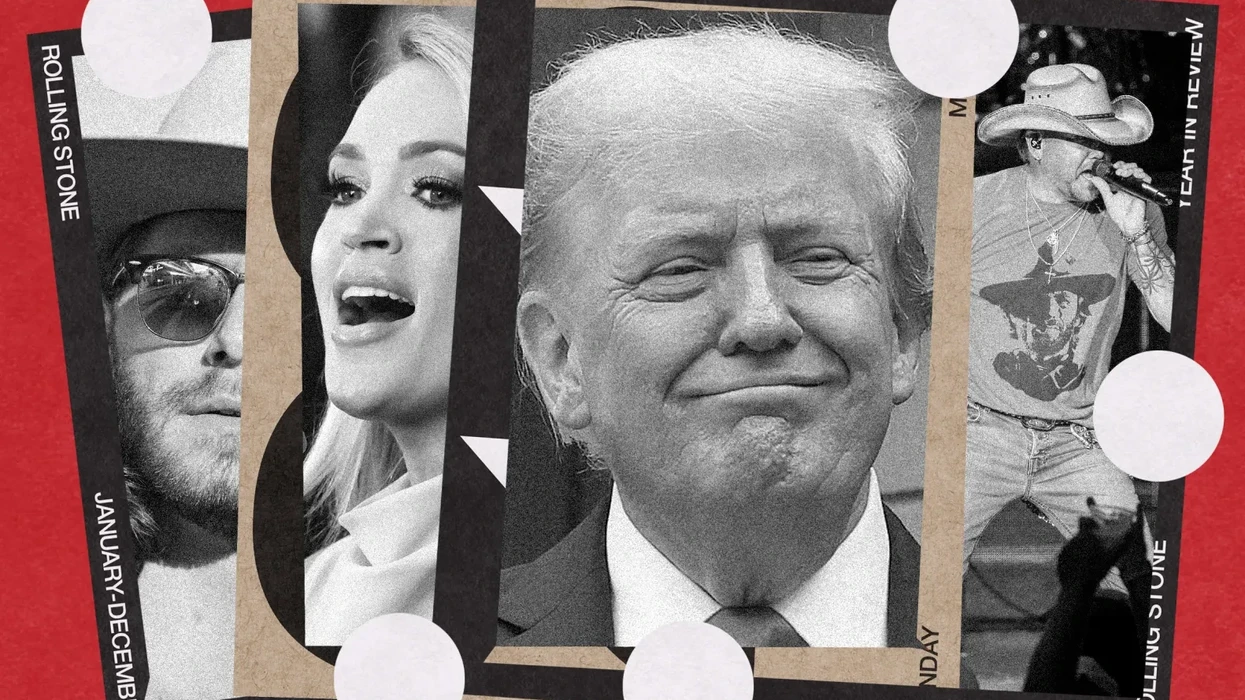
The regional musical headliner or aging country star is a vital part of most great fairs, and Trump certainly tried to make his national celebration the same. Unfortunately, he failed, as star after star pulled out when it became clear that Trump was relentlessly politicizing their performances. Instead, Trump did what he always does: took the spotlight himself. Instead of seeing, say, Martina McBride or … Vanilla Ice, for some reason, audiences instead were treated to, and you need to read this full quote by Trump himself, “the Number One Attraction anywhere in the World, the man who gets much larger audiences than Elvis in his prime, and he does so without a guitar, the man who loves our Country more than anyone else, and the man who some say is the Greatest President in History (THE GOAT!), DONALD J. TRUMP, to take the place of these highly paid, Third Rate ‘Artists,’ and give a major speech, rallying the Country forward like I have done ever since being President!”
Incredible stuff, Mr. President. Bars worthy of Vanilla Ice, indeed.
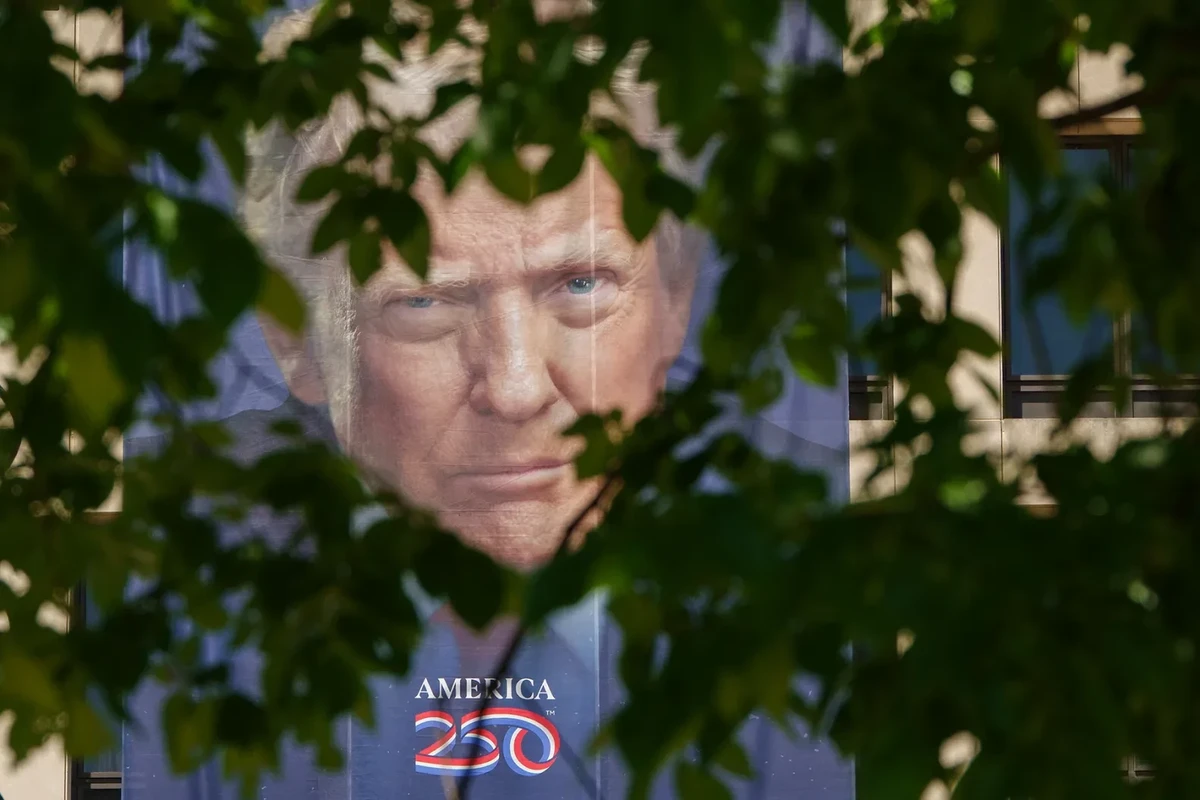
Putting his face on commemorative banners all over the capital
You may have noticed a pattern at this point: Trump likes seeing his own face. Perhaps he is psychologically trapped in the image like Narcissus, or pulling a reverse Dorian Grey in which the more portraits of himself he puts up looking 20 years younger, the older he looks in person. Trump has been hanging banners of himself on buildings across the capital, including on the Department of the Interior, the Department of Justice, and the Department of Labor. Many of the “America 250” banners are placed alongside images of other famed presidents like Abraham Lincoln and George Washington. It’s just another way Trump is trying to associate himself with the idea of American greatness. If the anemic crowds in Washington, D.C., this week are any indication, the effort is falling flat.




Volodymyr Zelensky and Donald Trump on the sidelines of the 81st United Nations General Assembly in New York, on Sept. 22, 2026.
Trump is Selling Out Ukraine to Putin
Most Americans continue to support Ukraine in its war against Russia. But under President Donald Trump, their government is now on Russia’s side.
The relationship between Washington and Kyiv has been in crisis since Trump returned to power last year. The White House increasingly blames Ukrainian President Volodymyr Zelensky, rather than Russian President Vladimir Putin, for the war’s continuation.
“Zelensky is not a good guy for us to deal with,” the president said in a TV interview on Friday. “I’m not a big fan of Zelensky. They’ve destroyed that country.”
Even as Trump blamed Zelensky, Russia was launching hundreds of missiles and drones targeting Kyiv.
The crisis has deepened over the past two weeks as Trump has taken a flurry of steps to undermine Ukraine and assist Moscow, beginning with a proposal to let Russia sell diesel fuel to the U.S. and culminating in Friday’s decision to effectively waive portions of the so-called “Graham Bill.”
The bill, named after recently deceased Russia hawk Sen. Lindsey Graham, is a recently enacted law that would have tightened economic pressure on Russia.
“The decision to undo all of this, to block all of it, seems wrong to me. And it definitely helps only the Russians,” Zelensky told reporters in Kyiv on Saturday. “It only fuels their satisfaction and their desire to keep killing people. This certainly does not stop the war.”
Ahead of the announcement, the administration worked throughout the week with tech billionaire Elon Musk to throttle access to the military version of Starlink. The space-based internet system has become a critical lifeline for Ukrainian defenders — although both the White House and Musk have denied responsibility for deciding to limit usage.
Multiple officials describe hours of heated phone calls between Americans and their Ukrainian counterparts, after the White House ordered its people to ramp up pressure on Kyiv and deliver an ultimatum that the U.S. would cut off intelligence unless Ukraine stopped attacking Russian oil refineries.
Trump has been courting Moscow with energy deals and eased sanctions to try to deliver lower fuel prices — which have spiked due to disruptions from the U.S.-Israeli war with Iran — ahead of midterm elections. He is trying to recast the fallout not only from the Iran quagmire, but also his failure to end Russia’s war in Ukraine, as someone else’s fault.
Once again, Trump has made Zelensky the scapegoat, blaming him for high diesel prices.
“Zelenskyy is using Diesel Refineries in Russia as a target, knowing that these attacks are seriously hurting the world diesel markets, including those in the United States,” Trump wrote on social media on Sunday, adding “he doesn’t want to end this war, and probably never did.
The world has gone through the looking glass since the first time I met Zelensky in Mariupol, less than two months after his election in 2019. The man once derided for his willingness to make peace is now condemned for refusing to surrender. In Washington, the victim has become the aggressor, the adversary has become the friend.
Zelensky was visiting the bustling industrial port to attend the Fifth Annual Liberation Day Parade, an event held by the Azov Regiment. The far-right volunteer unit had played a central role in retaking the city from pro-Russian separatists in 2014. Five years later, Azov had become a bugbear, a central pillar in the Kremlin’s propaganda about “neo-Nazi” Ukraine and a staple of Western media coverage — despite the combined far-right never pulling more than three percent of the vote in any Ukrainian election.
Zelensky campaigned on ending the simmering war in Donbas by speaking directly to Moscow — and that led many to fear he would give up land to secure peace. There was so much anger about it that there were already rumors of a coup plot by right-wing nationalists only 60 days into his term.
It seemed the “comedian-turned-politician” — as he was invariably dismissed in international media — was in over his head. But I had seen Servant of the People, the popular TV series in which he played a schoolteacher who becomes president due to a viral video rant about endemic corruption. This is no mere satire, I thought. It is a political manifesto packaged as mass entertainment.
And so it proved. Zelensky and his cohorts built a political base via sitcom. His party was named after the show, and the last episode aired three days before the start of the election that would bring him the presidency.
Zelensky was hardly the first to parlay a television personality into a political career. After all, back in the United States, Trump had built his candidacy largely on the popularity of his fictitious portrayal of a successful business tycoon in a reality TV show.
So on June 15, 2019, there was Zelensky in Mariupol, celebrating Azov’s triumph while keeping the regiment itself at arm’s length. Zelensky was trying to show he wasn’t afraid of the far-right — and he wouldn’t let it claim a monopoly on patriotism.
I watched Zelensky work the crowd at a concert. “Mariupol is a Ukrainian city forever,” he told the audience, to wild cheers. Few Americans at the time really cared about Ukraine’s new president. They weren’t watching what was happening between Moscow and Kyiv.
Within three summers Russia invaded, and that vibrant city by the sea was left in ruins, surrounded by mass graves.
Zelensky became the face of dogged resistance, rallying his nation in its desperate hour. He’s now in the seventh year of a five-year term, with elections prohibited while the country is under martial law.
The far-right threat proved stronger in America, where a cadre of reactionary extremists have taken power. They, too, want to oust Zelensky. The transgression they charge him with isn’t his willingness to sell out his country; it’s his unwillingness to give it up. It’s Putin who wants peace, Trump and his cohorts say. Zelensky is the war-mongering dictator.
Through the looking glass, indeed.
There was a time after that first disastrous Oval Office showdown, where Trump’s venal arrogance was on full display, when people thought the relationship between Washington and Kyiv could be salvaged. But Trump has yet to make any substantial moves to pressure Russia.
Trump’s overriding of the Graham bill shows exactly how unrestrained he feels in mollycoddling Putin — the bill passed with 86 votes in favor in the Senate, a display of bipartisan resolve that was for nought.
Republicans in Congress keep explaining away Trump’s words and actions. But the excuses never change the result. Trump’s actions might be defensible if they actually set the belligerents on a path to peace. But there’s no reason to think they will.
That’s because Trump and his MAGA mouthpieces are delusional. To anyone who knows Ukraine — to anyone who is honest about Russia — listening to the American president pontificate about the war is like attending the Mad Tea Party in Wonderland.
Trump, Hatter-in-Chief, presides over chaos with ever-changing rules, one minute spouting nonsense about the war having started because he lost a “rigged election,” and the next barking riddles about Crimea having “four sides of ocean.”
All the usual suspects echo the same ignorant talking points and hone in on the same culprit. Musk says “Zelensky has gone too far.” Former Trump adviser Michael Flynn, who nearly went to prison for lying about his meetings with Russians during Trump’s first campaign, says once Zelensky is gone, “this war will end and people of that region of the world can start rebuilding their lives.”
Trump and his allies behave as if this war is just a matter of personalities and deals. But the war in Ukraine is not a real-estate transaction. It’s not even about geopolitics — NATO expansion or spheres of influence — as so many seem to believe.
This war isn’t about empires, it’s about national identity.
That’s where Trump — and Putin — go wrong. Zelensky is a figurehead. Even if you get rid of him, Ukraine will keep fighting. Even if Kyiv were to fall, and Russia magically occupied the entire country, Ukrainians would resist.
Russian imperialists have been trying to destroy the idea of Ukraine for generations. Joseph Stalin, one of the bloodiest dictators in human history, starved millions of Ukrainians to death; he purged, executed, and deported tens of thousands in part to eradicate their national identity. He couldn’t do it. The tsars before him couldn’t do it, either.
This isn’t some mysterious, unique human experience. The English could never stamp out Irish nationhood in hundreds of years of occupation; Imperial Japan couldn’t stamp out the Koreans; neither the Israelis nor the Palestinians will eradicate the other nation, despite all their efforts.
Resistance to Russia is central to the very idea of Ukrainian statehood. So long as Russia is intent on destroying Ukraine as a nation, the war will go on. Peace doesn’t require Zelensky’s acceptance of Russia’s territorial demands. It requires Putin’s acceptance of Ukraine as a nation. Americans deserve a government that has figured this out and acts accordingly.
Alice found her way out of Wonderland by waking up. It’s high time America and its political leaders do the same.