

This article is being published in partnership with the watchdog group Documented.
Washington’s top pharmaceutical lobby oversaw the adoption of model legislation that would restrict voting access at the most recent meeting of the American Legislative Exchange Council (ALEC).
ALEC is an influential organization that brings together state legislators, private-sector corporations, and right-wing advocacy organizations to develop priorities and adopt model legislation for introduction in statehouses around the country. Its policy recommendations often become law in the states.
In this case, the model legislation capitalizes on MAGA-driven conspiracies around noncitizen voting and would make it easier for election officials to purge voters. The “Only Citizens Vote” model legislation directs state election officials to remove suspected noncitizens from voter rolls, offering vague direction that risks seriously restricting voting access for eligible voters.
The Election Integrity Network, led by Cleta Mitchell, helped draft and promote the model legislation. Mitchell — the former Donald Trump attorney who joined the infamous call in which the then-president demanded that Georgia’s top election official “find 11,780 votes” — also moderated a panel at the ALEC meeting.
A frequent critic of campus voting, Mitchell argued at the meeting that the manufactured threat of noncitizen voting justifies making it harder for college students to vote, too.
“You do not have to be a citizen of the United States to get a student ID, and you do not have to be a resident of the state to get a student ID,” Mitchell said to the room of state lawmakers. “I would urge you to introduce a bill to get rid of the student ID as one of the IDs that are accepted for voter registration [and] voting.”
The Election Integrity Network-backed “Only Citizens Vote” model policy was adopted unanimously by ALEC’s Federalism and International Relations task force. The task force is co-chaired by Douglas Petersen, a vice-president at Pharmaceutical Research and Manufacturers of America, or PhRMA — one of Washington’s most powerful lobbying groups, with $568 million in revenue in 2022.
ALEC task forces consist of state lawmakers and private sector members, who vote separately on whether to adopt model policy. On July 26, the task force’s public and private sector members unanimously voted to adopt the “Only Citizens Vote” model bill, including Cleta Mitchell herself, who is a new member of the task force as of December 2023.
The full list of members of ALEC’s Federalism and International Relations task force is not publicly available. An executive at the U.S. Chamber of Commerce, the nation’s top business lobby, previously served as the task force’s private chair — a position now held by Petersen.
Last month, the ALEC task force also voted unanimously to adopt a resolution supporting state constitutional amendments to ban local governments from allowing noncitizens to vote in school board or other municipal elections. The model bills will next go to ALEC’s board of directors for final adoption.
Notably, the pharmaceutical industry relies heavily on immigrant labor for its U.S. workforce.
Conspiracy theories about noncitizens casting ballots in U.S. elections have become a centerpiece of MAGA messaging in advance of the 2024 election. It is a manufactured threat: There is no evidence of noncitizens voting in significant numbers. House Speaker Mike Johnson (R-La.) has offered little more than “intuition” to support the claim that immigrants are casting ballots.
Still, noncitizen voting conspiracies have been mainstreamed by influential Republican politicians, amplified by billionaires like Elon Musk, and promoted by a network of election conspiracy theorists.
Those baseless conspiracy theories were on full display at the ALEC meeting. At the panel moderated by Mitchell, former Virginia Attorney General Ken Cucinnelli claimed without evidence that legal loopholes “are trying to be exploited on the left to move large numbers of noncitizens onto the voter rolls.”
Cuccinelli is now with the Election Transparency Initiative, a joint project of the anti-abortion group SBA Pro-Life America and American Principles Project. Both are funded by dark-money groups with ties to far-right billionaire Dick Uihlein and Leonard Leo, the highly influential architect of modern conservatism who helped orchestrate the overturning of Roe v. Wade. The Election Transparency Initiative is also a partner of the Honest Elections Project, a group helmed by Leo.
Another panelist, Chris Chmielenski of the Immigration Accountability Project, made the incredible assertion that “illegal aliens […] have already violated U.S. immigration law. So why not violate our voting laws as well?”
Chmielenski co-founded the Immigration Accountability Project last year after several years at Numbers USA, which the Southern Poverty Law Center has described as part of the “Nativist Lobby.”
The Immigration Accountability Project has been working closely with Mitchell, Cuccinelli, and other right-wing organizations as part of the “Only Citizens Vote Coalition,” which has been amplifying noncitizen voting conspiracy theories, organizing grassroots activists, and supporting federal and state legislation. The Only Citizens Vote Coalition sponsored the ALEC meeting at the “chairman” level, which cost at least $50,000.
Chmielenski also sought to use conspiracy theories about noncitizen voting to advance longstanding — and often cruel — policy goals. He argued that state lawmakers should prohibit young people who came to the U.S. as children from being eligible for in-state tuition, and tax remittances that immigrants send to family members in their home countries; additionally, Chmielenski also argued for barring undocumented immigrants from obtaining driver’s licenses.
“These are dealing with the magnets that would cause some of these illegal aliens to settle into your state,” he said.“If you can prevent illegal aliens from settling in your state, you’re going to drastically reduce the risk of these folks voting in your elections.”
Like Chmielenski, Cleta Mitchell sought to use noncitizen voting conspiracy theories to advance unrelated policy goals.
In addition to using the pretext of noncitizen voting to bar U.S. citizen students from using their college IDs to cast ballots, Mitchell argued that state legislators should make it harder for all citizens to register to vote. “I think same day registration is a huge problem for election integrity and particularly in this arena of protecting against noncitizen voting,” she told lawmakers at the ALEC meeting.
The ALEC “Only Citizens Vote” model policy also has repercussions for American citizens. The bill directs state election officials to cross-reference voter rolls against other state and federal data sources, and to remove voters who don’t respond to a demand that they provide proof of citizenship. Mitchell also asserted that the bill “establishes documentary proof of citizenship for new registrations,” although this is not reflected in the language on the ALEC website.
Documentary proof of citizenship is a key element of the SAVE Act, a federal bill introduced by Speaker Johnson that Mitchell, along with other members of the Only Citizens Vote Coalition, helped draft. The bill, which has been backed by Trump, is an ode to the racist Great Replacement Theory, or the idea that Democrats are encouraging immigrants to come to the U.S. to add new voters of color who will erode the influence of white Americans.
In a recent defense of the SAVE Act, Johnson claimed that Democrats’ opposition to the bill “exposes their intention to allow illegal aliens to vote,” demonstrating how this baseless conspiracy is used to pressure lawmakers and score shameless partisan points in an election year.
However, much like the SAVE Act, the Only Citizens Vote model policy presents several serious issues: Firstly, roughly 1 in 10 American citizens don’t have ready access to documents that can prove citizenship, like a birth certificate or passport, and would face substantial hurdles in gaining access to the ballot box under these proposals.
Another issue is that voters are busy. Even if a person has the necessary citizenship documents, making an additional trip to retrieve a passport from a bank deposit box, or asking for a family member to mail a birth certificate, creates unnecessary steps that will prevent some voters from registering to vote. Not to mention that voters could easily miss the mailed demand for their citizenship confirmation and show up on election day only to find that their registration has been removed from the voter rolls.
Ultimately, manufactured conspiracy theories about noncitizen voting are being used to justify restrictive voting laws and mass voter purges that will undermine the freedom to vote for American citizens.

 SACHA LECCA
 SACHA LECCA
 SACHA LECCA
 SACHA LECCA
 SACHA LECCA


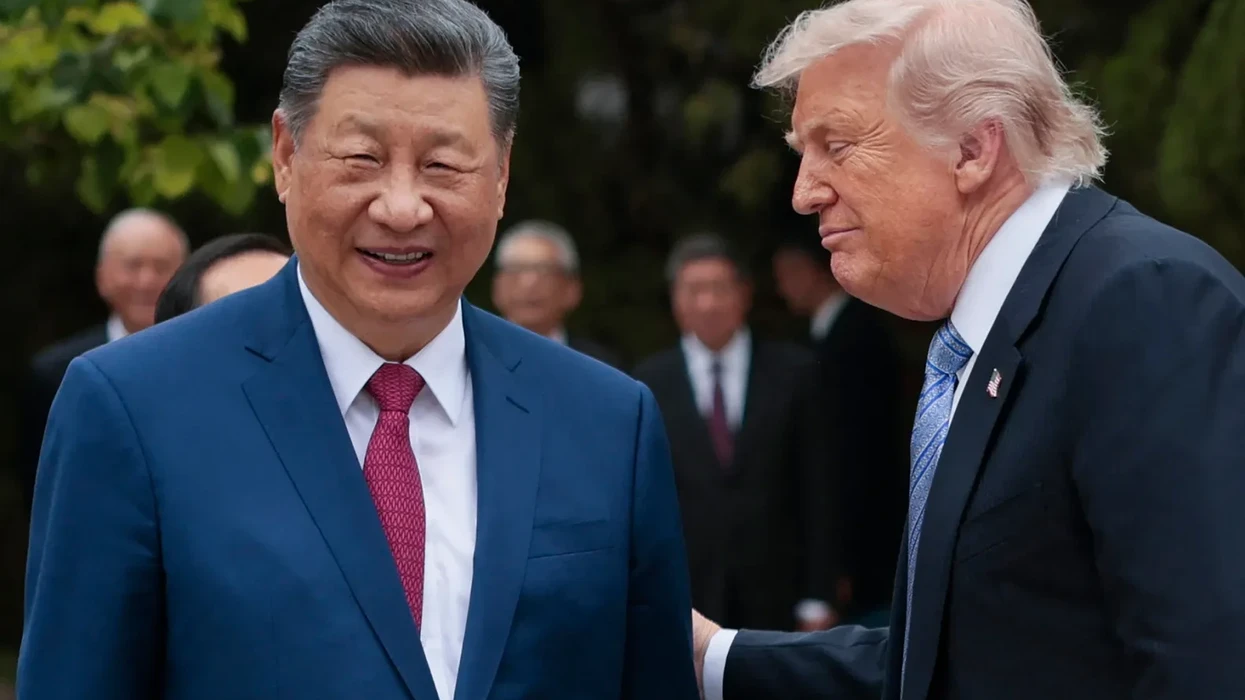

Donald Trump speaks in front of the American flag at the White House, on May 12, 2026.
It’s the Corruption, Stupid
Let’s say it plainly: There has never been a president as corrupt as Donald Trump. There is no close second in our history.
Take two days in May as Exhibit A. Americans just found out that in the first quarter of this year, Trump’s stock portfolio made 3,600 trades — an average of nearly 60 a day. This is a rapacious pace that would make a day trader on meth blush. Many of these appear suspiciously timed to benefit from actions approved by the president himself. For example, his Nvidia stock surged after Trump announced the company would be permitted to sell its cutting-edge AI chips to China. Similar suspiciously well-timed calls were made ahead of big government moves involving other companies, from Intel to Palantir to Boeing. The Trump Organization says all trades are made by a third-party investment advisor. If so, they appear to be psychic.
But the apparent insider trading scam being run from within the Oval Office is small change — merely millions of dollars — compared to the self-dealing plunder of $1.8 billion tax-payer dollars being pushed through the DOJ and IRS.
There’s never been a sitting president who sued his own government for $10 billion. That’s because it’s absurdly corrupt. But that’s what Donald Trump did, arguing he had suffered damages from prosecutions pursued before he was reelected. Trump, like many of his supporters, persistently confuses persecution with prosecution.
The judge who heard the case convened an independent panel to review the suit, suspecting it might be a scam. Before the case could be dismissed, Acting Attorney General Todd Blanche — who had previously served as Trump’s personal lawyer — declared that the bogus suit would be preemptively settled, not for $10 billion, but for the symbolic sum of $1.776 billion, which Trump said will be distributed to persecuted political allies.
This is a shakedown. The president is compelling a Justice Department he controls to redirect money from taxpayers — that’s you — to his most fervent supporters. This slush fund will set off a cash grab among MAGA lawyers and be used to reward partisan fanatics who attacked the U.S. Capitol — and police officers — on his behalf.
If that wasn’t enough of a blatantly illegal use of presidential power, it was revealed that the “settlement” deal included a pledge signed by the acting attorney general that would ensure — in the hysterical all caps of a Trump tweet — that the government would be “FOREVER BARRED and PRECLUDED from prosecuting or pursuing” any tax claims, audits or related prosecutions against Trump, his family or their businesses. This is an attempt to get a permanent get-out-of-jail-free card for the Trump family — a license to steal.
All of this is insane. All of it is unethical, and much of it is illegal and impeachable — but our system was not designed to deal with a shamelessly self-dealing president, a spineless Republican Congress, and a complaint conservative Supreme Court that has refused to enforce the emoluments clause of the Constitution and ruled that Trump has immunity for actions he takes as president. That ruling may prove to be the most consequential — and most corrosive — act of judicial abdication in American history. Against this partisan-group think, individual acts of courage matter. So kudos to the top lawyer at the Treasury Department, Brian Morrissey, who at least had the integrity to resign rather than oversee this tax-payer funded plunder.
Just to close out the corruption-palooza, Trump announced that he would endorse the Lone Star State poster-boy of corruption, Texas Attorney General Ken Paxton, in his primary against incumbent GOP Senator John Cornyn. Paxton’s scandals include a truly buffoonish array of fraud and bribery charges that resulted in him nearly being impeached by the state legislature. But corruption is a feature, not a bug, of Trumpland.All this smacks of late Rome and you’d be forgiven for half expecting Trump will next appoint a horse to an open Cabinet position, with Republicans rationalizing the need for more equine representation. It is no more absurd that the cavalcade of Trump appointees refusing to say that Biden won the 2020 election during their confirmation hearings in the Senate. The decision to parrot unreality for partisan gain defines deviancy down.
But in the search for something hopeful to hold onto in dark times, you can find some comfort in the fact that corruption is often the thing that turns the tide against authoritarian-adjacent administrations. And there is evidence this is happening.
Trump’s billions in self-enrichment, his reflexive twisting of U.S. policy to sell out long-term national interests and enduring values, comes at a moment when nearly half of Americans say they are feeling extremely anxious about their own financial situation.
That anxiety is driven by the widening gap between Main Street and Wall Street, a gap set on fire by a trade war and a real war Trump started, which has no end in sight but promises to further raise energy prices, fertilizer prices, and strangle the global economy. While CEOs embrace the transactional nature of this president, kissing his ring and offering vigs, the situation is grim if you’re not lining up at the Trump trough. At a time when the super-rich are getting richer, everyone else is told to go to hell by the man in the White House.
These are precisely the kinds of conditions that turn people against an aging, autocratic president who shows contempt for the very people who put him in office. It is not just that Trump’s approval numbers have plummeted to the point where two-thirds of Americans disapprove of the job he is doing. It is that Trump, for the first time, is opposed by a majority of non-college-educated white voters — a.k.a. his base — and they feel betrayed because Trump is raking in billions of dollars while they struggle to pay rent and buy groceries. Trump has dismissed and discounted their concerns, turning a blind eye to the anger about rising costs that carried him back into the presidency.
Trump’s aim is to make his thievery so blatant that we collectively become numb to it and disfigure our democracy in the process. Once upon a time conservatives warned about the dangers of “crony capitalism” and corruption. Now they are silent and complicit. It is the temporary triumph of partisanship over principle. Patriotism demands that we reassert the basic American idea that no man is above the law and that our presidents are not kings.