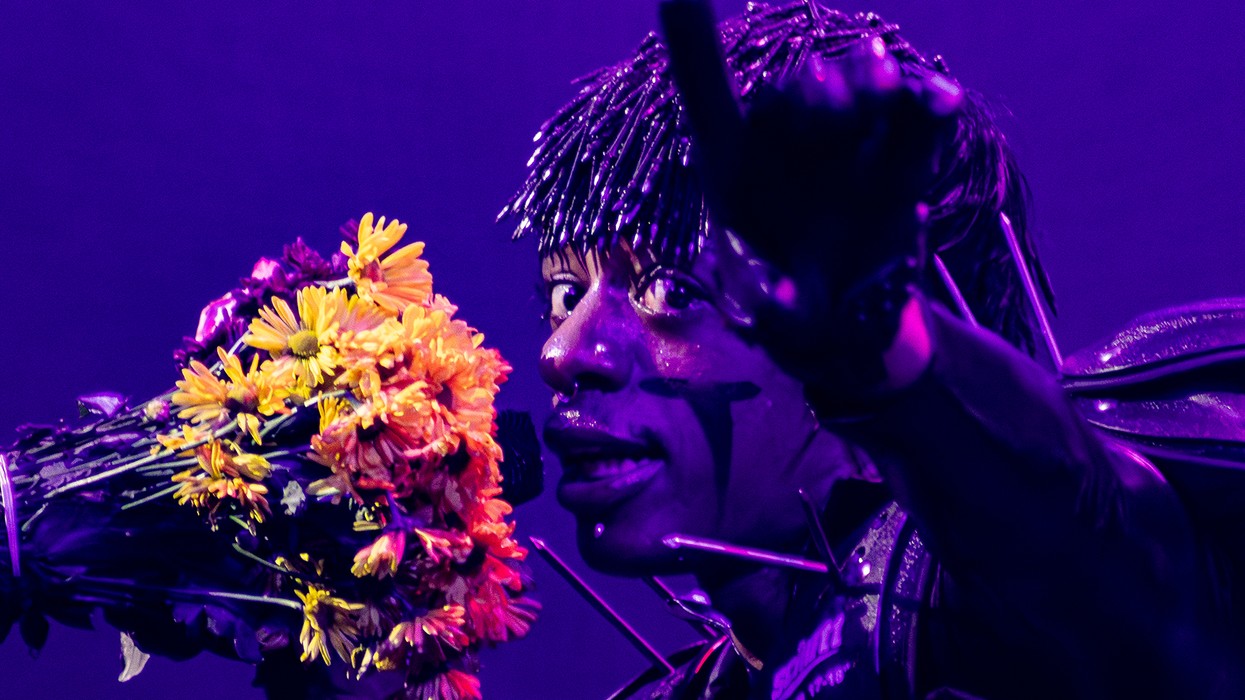

If it wasn’t already clear that North West, the scion of the West-Kardashian throne, had inherited serious star power, it only takes roughly 10 minutes for her to prove it on her debut EP. Over an efficient five tracks, West traverses the sonic styles of her generation — from nu-metal riffs to rage-rap 808s — with startling confidence. At just 12 years old, North’s debut is impressive regardless of her famous pedigree. Even for music royalty, talent still has to announce itself, and that’s what she’s done with N0rth4evr.
The EP opens with “H0w Sh0uld ! f33l,” spelled with the same chaotic eccentricity of the song titles on Playboi Carti’s Whole Lotta Red, and clocking in at just under two minutes. The song starts in emo territory, with a crooning vocal that could come from an Evanescence B-side, before launching into fast-paced drums that fit squarely in the Slayyyter universe of hyperactive pop influenced by the internet’s sprawling musical instincts. “They don’t see me, they just see the appeal,” she raps, somewhat devastatingly, as the song’s booming 808s, reminiscent of Ken Carson, glide into a Jersey Club-style rhythm.
On “#N0rth4evr,” the project’s emotional core is laid bare. It’d be easy to write North off as a novelty until you hear the angst oozing through the Slipknot-esque drums executed with startling conviction. Here is the daughter of one of the most scrutinized couples in pop-culture history, and she exhibits a self-awareness well beyond her years. North’s first single, “Piercing on My Hand,” channeled the public scrutiny over her style choices into a certifiable banger; similarly, the songs on her new EP navigate the realities of being born into fame with a sense of melodic urgency.
“How I’m younger than you, but I’m who you look up to,” she raps with a confident swagger that she’s frankly earned on “D!e.” In the spirit of both of her parents, North has already taken fame into her own hands, dictating on her own terms how she’ll engage with an increasingly adoring public. Her verse on FKA Twigs’ track “Childlike Things,” from last year’s Eusexua, exhibited West’s confidence in her creative vision; she even raps her lyrics there in Japanese, carrying a motif present throughout her work.
“Th!s t!m3” brings the EP’s emo sensibility into focus, fusing her varied sonic inspirations into something cohesive. As a producer and curator of sound, North seems less interested in recreating the past than in metabolizing the chaos of the present: ear-shattering guitars, post-punk beats colored with the gloss of hyperpop’s long tail, all with the diaristic melodrama of a generation raised online. Closing track “Aishite” feels like teen angst distilled into its most potent form. “Can’t be no one’s friend, I can’t let nobody in,” West raps, managing to tap into a universal adolescent experience while speaking to the contours of her extremely unique position.
That tension is what makes N0rth4evr so compelling. Rather than pretend to be anonymous or mysterious, she leans into the fact that her life has been public since before she had any say in the matter. But across these five songs, she begins to turn that impossible inheritance into material, shaping the noise around her into something undeniably her own. N0rth4evr is brief, but it leaves a surprisingly lasting impression: the sound of a young artist not merely entering the family business, but beginning to define the terms of her own mythology.






Albini and Whinna in an undated Polaroid snapshotCourtesy of Heather Whinna
2nd grade Courtesy of the Albini Family
7th grade Courtesy of the Albini Family
11th grade Courtesy of the Albini Family
Big Black in 1986Gail Butensky
Albini built Electrical Audio to embody his recording philosophy in a physical space.© Monfourny Renaud/DAPR/ZUMA
Albini got seriously into poker in his later years, as seen in this photo from the 2008 All Tomorrow’s Parties festival.Roger Kisby/Getty Images
Albini and Whinna founded the Letters to Santa charity in 1996.Courtesy of Heather Whinna
Whinna (center), Kim Deal (right), and Electrical Audio staff unveil the Steve Albini Way street sign in November 2024.Althea Legaspi
Althea Legaspi
Althea Legaspi


Elizabeth Weinberg
Elizabeth Weinberg
Elizabeth Weinberg
Pop Albums Are Getting More Ambitious. Can Audiences Keep Up?
This Music May Contain Hope, the second album from British songstress Raye, makes great demands of its audience. The record nearly runs the length of a feature film and most of the 17 songs sound like they could soundtrack one. When the credits roll at the end — she thanks each and every person who helped create the record for six and a half minutes on “Fin.,” — they conclude a gloriously disorienting listening experience. For most of the album, Raye is asking you to come along as she fights and prays through despair and self-criticism to keep hope alive.
Sometimes that battle is filtered through songs that sound like show tunes or gospel hymns. In the case of “Click Clack Symphony,” they crescendo into a dizzying Hans Zimmer composition. There’s a level of patience and reciprocity the album requires from its listeners: At once confrontational and confessional, This Music May Contain Hope is not designed for detached consumption — and it’s part of a surge of recent releases that find artists creating ambitious records that encourage intentional engagement.
Last year, Hayley Williams released Ego Death at a Bachelorette Party as 17 individual singles. Fans created their own sequencing and narratives guided solely by the themes and sounds they chose. A few months later, Rosalía released Lux, a captivating 18-track record performed in 13 languages. It shares a musical complexity with This Music May Contain Hope and an interrogative spirit with The Apple Tree Under the Sea, the debut album from Hemlocke Springs released earlier this year. Each record is as all-consuming as the ideas they’re engaging with — mental anguish, faith and religion, internal and interpersonal implosion.
Raye often describes music as medicinal. Backed by the London Symphony Orchestra and Flames Collective choir on “I Know You’re Hurting,” her melodies and harmonies are bandages and sutures. When she instructs the listener to “close your eyes and let this music get to working,” she exudes the wisdom of an elder passing home remedies through generations. At a time when easier access to music often means increasingly passive listening, these albums replace momentary distraction with connection and compassion. They give the audience something to return to.
Raye included the voices of her grandparents at the start of “Life Boat.” The portion her grandfather contributes, where he says, “I’m living, not giving up,” was recorded just days before his death. More voices flood in across the next four minutes. They all repeat some variation of “I’m not giving up, yet,” some with more desperation than others. “Say it,” Raye says, stern and direct. “Say, ‘I’m not giving up, yet.’” The mantra is set against the kind of thudding club beat that defined the earliest phases of her career. Drums and synthesizers are interspersed with delicately arranged strings, but there’s something transcendent about the contours and echoes of Raye’s voice.
That kind of vocal power is something Rosalía speaks about often: Duende. The flamenco term refers to a type of enchantment delivered through an especially evocative vocal performance. It’s not necessarily about technical prowess, or precision. “There’s something so ethereal and divine about el duende,” Rosalía told The New York Times last year. “El duende is something that visits you. It’s something that comes to you.” It makes the listening experience feel targeted and personal. This funneled into Rosalía on Lux. The record unravels in a way that transcends the barrier of language.
Rosalía begins “Mundo Nuevo” in Spanish. Its translation reveals she’s searching for a hint of truth. She finishes “De Madrugá” in Ukrainian with something searching for her this time. “I’m not looking for revenge,” she sings. “Revenge is looking for me.” The London Symphony Orchestra and the Escolania de Montserrat i Cor Cambra Palau de la Música Catalana choir bolster the album, their arrangements ranging from anxious and erratic to soothing and hypnotic.
Rosalía introduced Lux with the first single “Bergain,” which splinters across German, Spanish, and English. When Yves Tumor’s voice cuts through on the song’s outro, the persistent repetition of “I’ll fuck you till you love me” is harsh and abrasive against the preceding moments. Rosalía chases that friction across Lux. Like her mix of languages, she challenges the listener with existentialism and ruminations on the afterlife. It might turn some listeners away, but the ones who stay are rewarded.
Most of the record was inspired by saints, like Teresa of Ávila or Joan of Arc. Their history adds a third layer to the depth of Lux; Hemlocke Springs similarly fixates on religious motifs on The Apple Tree Under the Sea. She weaves in medieval tales and impulsive adventures made for a storybook. Positioning herself as a character in her fantastical stories gives her audience someone to root for while creating some distance between fiction and reality.
In that sense, The Apple Tree Under the Sea shares a theatrical ease of access with This Music May Contain Hope. Raye’s cautionary tales about traitorous South London men who should be banned from WhatsApp play into the same spectacle as Springs’ “Head, Shoulders, Knees and Ankles” and “Moses.” There’s a prelude towards the end of The Apple Tree Under the Sea that features the voice of a man who sounds far away as he preaches about sin and final judgements. It gets even harder to hear him when the sounds of running horses and marching feet cut through. The suspense builds into an orchestral outro that leads into “Sense (Is),” a booming, optimistic song about making the most of a clean slate and a glass half full.
Springs’ journey is the shortest within this set of albums. It spans 10 songs in just over half an hour, but retains its complexities with winding plot twists. Where she leans into communicating through stories and allegories, Raye through a version of theater, and Rosalía essentially through multinational cathedrals, Williams’ Ego Death at a Bachelorette Party brings listeners into an excruciatingly vivid reality. The achingly haunted “True Believer” walks the streets of Nashville. It moves down Broadway and past repurposed clubs. It attends the churches and questions the rhetoric presented in them. It runs parallel to the moments across the album that brings listeners into a home with fragile glass walls.
The album’s most shattering moment arrives towards the end: “Good ‘Ol Days.” It’s not as distressing as “Negative Self Talk,” or as sobering as “Whim.” It glides along a warm groove and drops burning one-liners with pointed specificity. What fortifies it the most is an appearance from Williams’ grandfather midway through the song. “You are so tacky/I think that’s why I love you so much,” he says in a voicemail message. “I just had to call you first on my new phone/I love you, y’all have a blast, bye.” The interlude emphasizes just how interior the content of the record is, made up of real moments, people, and feelings.
There’s a false perception in pop music that the best way to connect with the masses is to keep things broad — that vague generalizations are easier for people to latch onto. But the hyper-specificity and confrontation on these albums form real connection, creating the feeling that the listener is being trusted with someone else’s secrets and struggles — and safe to embrace their own, too.
There’s bravery in how these artists are driven by conviction. They understand the reach their platforms provide, but have little interest in idolatry. They each use different formats to craft a sense of togetherness even in their most intimate moments, like it means more to show someone they aren’t alone than to tell them. They ask for patience as they remind listeners it’s commendable to try. Some people don’t come to music looking for this; it can be challenging to have an artist in your ear telling you to bring your most shattering emotions and memories to the surface. But those are the kind of records that endure over time.