
Saturday was the last full day of music at SXSW 2024, and the exodus had begun by early afternoon, with many catching flights out of town just as large numbers of emerald-bedecked St. Patrick’s Day celebrants reclaimed the streets of Austin. But wait! Don’t go yet! There were still tons of brilliant, strange, surprising sounds coming from the venues that make Austin what it is. Here are the best things we saw on March 16.
Friko Get Emotional
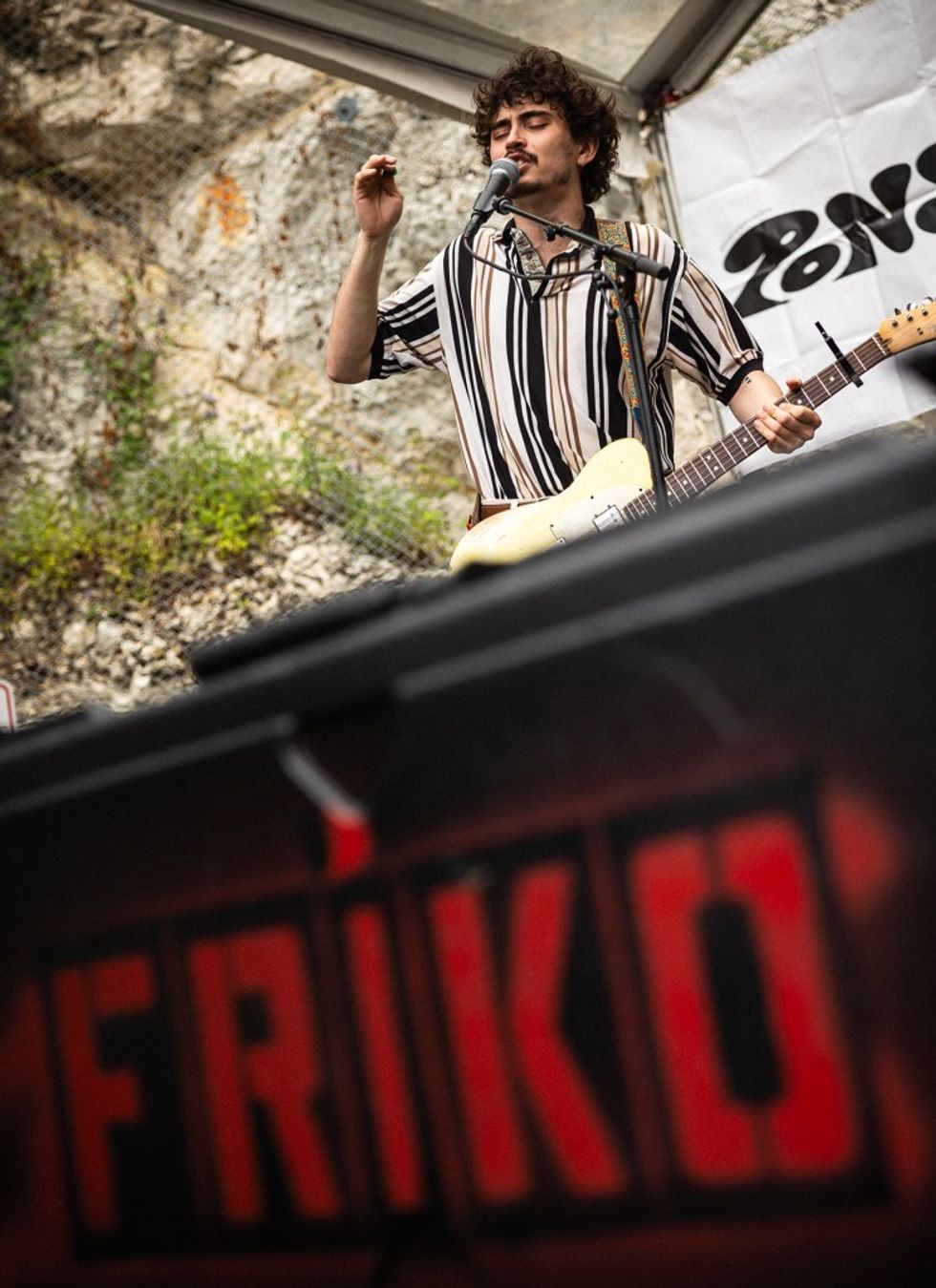
With rain threatening in the sky in the early afternoon, Friko summoned a storm at Cheer Up Charlie’s. The Chicago-based band is a duo on record, but they performed here in the classic power-trio lineup of guitar, bass, and drums, and they wrung the most they could out of that equation. Singer-guitarist Niko Kapetan spilled his tender, vulnerable vocals over squalling electric strums; when the band slowed down and joined their voices for some ragged harmonies, they sounded even better. This was their final show of the week, and it felt like they were putting it all on the line (which is also pretty much how this band always sounds). They closed with “Get Numb to It!,” one of the most joyful explosions from their recent ATO Records debut. If this set reminded you of the indie sincerity of the 2000s, it was just proof that everything old can be new again if you do it with enough raw emotion. —S.V.L.
Chanel Beads Bring on the Magic
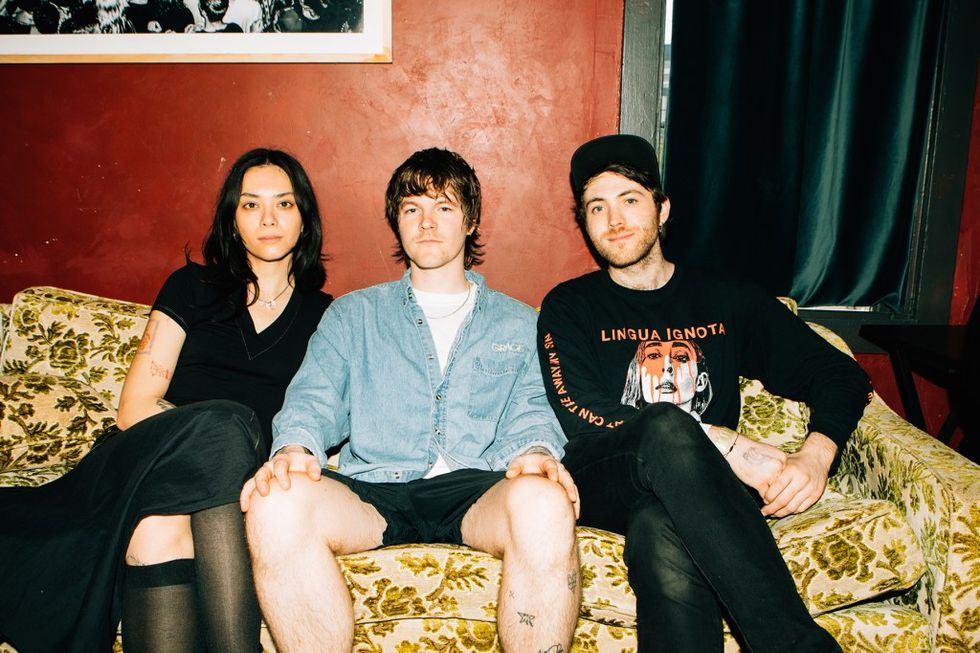
Chanel Beads is an experimental act with a growing reputation among in-the-know New Yorkers, which puts them right in line for a SXSW breakthrough. At Mohawk around 4 p.m., they showed why their shows have been getting enthusiastic word-of-mouth reviews all week. Shane Lavers sang melodic phrases over the thrum of his bandmates’ electric violin and guitar: “Will my instinct be good? Be good? Be good? Be good?” Noisy and serene at once, it was a fruitful contrast that yielded something oddly like pop. When Chanel Beads took the stage again hours later for a post-midnight set at the Creek and the Cave, they sounded looser, and the crowd responded in kind — dancing, waving hands in the air, and exchanging hugs like they were at a rave, which in a sense they were. —S.V.L.
Cinema Hearts Make a Good First Impression
Washington, D.C. act Cinema Hearts were facing a sparse audience at a bar on Austin’s west side early on Saturday evening, but no DIY band worth its salt would let that stop them, and Cinema Hearts didn’t. Singer-songwriter Caroline Weinroth was determined to be an engaging presence at her first SXSW, talking about her backstory — “I used to compete in Miss America. I wanted to be Miss Virginia so damn bad that I devoted years of my life and art to it” — in between songs that paired retro-styled prom-queen vocals with pointed lyrics and garage-punk music, as heard on her EPs I Want You and Your Ideal. On the new song “Kinda High School,” she sounded something like if Lesley Gore had lived in Olympia, Washington, in the Nineties. Before another song, she announced: “This one is about how I paid the rent of my ex-boyfriend. Don’t do that!” She closed with a spirited cover of the Stooges’ “I Wanna Be Your Dog.” “Now you get to go home and tell your friends, I went to SXSW and saw this girl, she used to be in Miss America, and she did ‘I Wanna Be Your Dog,'” Weinroth told the audience wryly. —S.V.L.
YHWH Nailgun’s Unsettling, Unmissable Spectacle
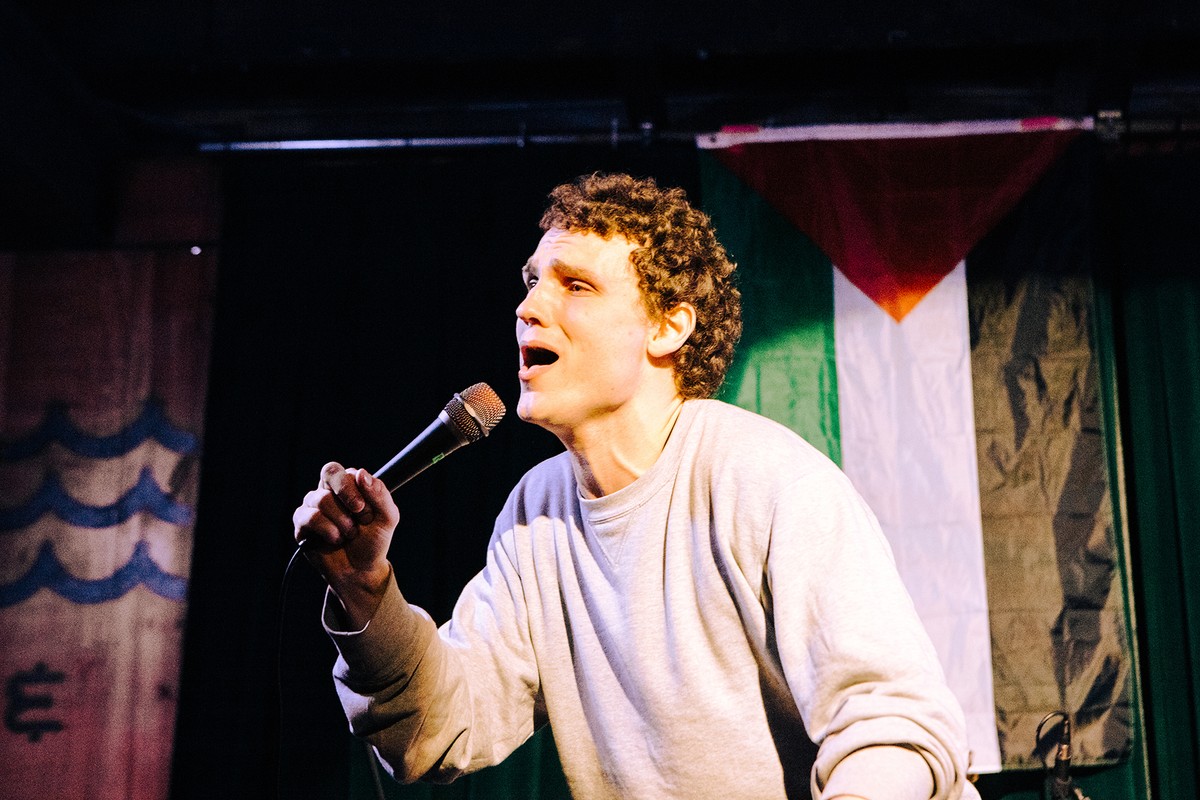
With a name like YHWH Nailgun, you know you’re not going to be getting gentle acoustic music. At the Creek and the Cave on Saturday night, frontman Zack Borzone delivered on those hints of violence and sacrilege immediately, growling and shouting, his face contorted as if in pain, as the performance began just after 8 p.m. Over unpredictable darts of guitar, loud synth bass hits, and nervously rattling drumming from his three bandmates, he stretched his arms wide, did double-dutch with an invisible rope, and whipped his sweater off like it was burning him. (Dramatic, unpredictable movement was a big theme among buzz bands at this year’s SXSW.) The New York group, which probably won’t be unsigned for much longer, made music you could dance to, even if you wouldn’t always describe what their vocalist was doing as dancing. Songs stopped abruptly, with Borzone teetering unsteadily at the end of the stage, then just as suddenly resumed. You only knew one of them was over when he said “Thank you,” in a surprisingly mild tone, and smiled. —S.V.L.
Greg Freeman’s Heart of Gold
Some musicians make you wonder if what they’re doing is some sort of ironic mischief. Not Greg Freeman. He really means every word, bashing away on his electric guitar as bandmates on bass, drums, saxophone, and pedal steel guitar add rich colors to his visions. Freeman, who’s from Vermont (“We’re gonna drive there tomorrow. It’s too hot here”), is another act who won a lot of new fans at SXSW this year. He performed at the Creek and the Cave wearing a gray blazer over a button-down shirt, and he carried a harmonica around his neck for occasional emphasis. Add to this a high vocal register that makes comparisons to Neil Young inescapable (or to Jason Molina, depending on your frame of reference), and what you’ve got is a new artist who is basically making classic rock in 2024. If you’re into that, Freeman hits the spot. —S.V.L.
Meet Birthday Girl
The small back room at Empire Garage and Control Room is a good place to find an under-the-radar pick that melts your circuits. On Saturday afternoon, that was Birthday Girl, an unsigned Brooklyn alt-rock band that has the elements of downtown cool nailed. Singer Eva Smittle stalked the stage in a distressed Death Row Records T-shirt, mini-skirt, and fishnets while her bandmates hammered out heavy riffs. “So sick, dude, must feel so good to be you right now,” she needled on a memorably catchy new one called “Rupert!” The performance gained steam and got noisier as they went along, and by the end the band was drawing impressed cheers. —S.V.L.
Illenium Drops the Big Beats
You couldn’t quite call Illenium’s set at Billboard’s the Stage at Moody Amphitheater the official closing party for SXSW, but in some respects, it felt like the conference’s last hurrah. The last of three evenings of entertainment at the Stage — the first featured R&B from PartyNextDoor, the second was headlined by Latin star Christian Nodal — this Saturday was dedicated to dance. Facing a busy but not dense crowd as an opener, DJ Sober served up oversized remixes of millennial favorites and prompted the audience to sing along to George W. Bush-era oldies — which they did, shouting out the chorus to Fall Out Boy’s “Sugar, We’re Goin Down” with gusto.
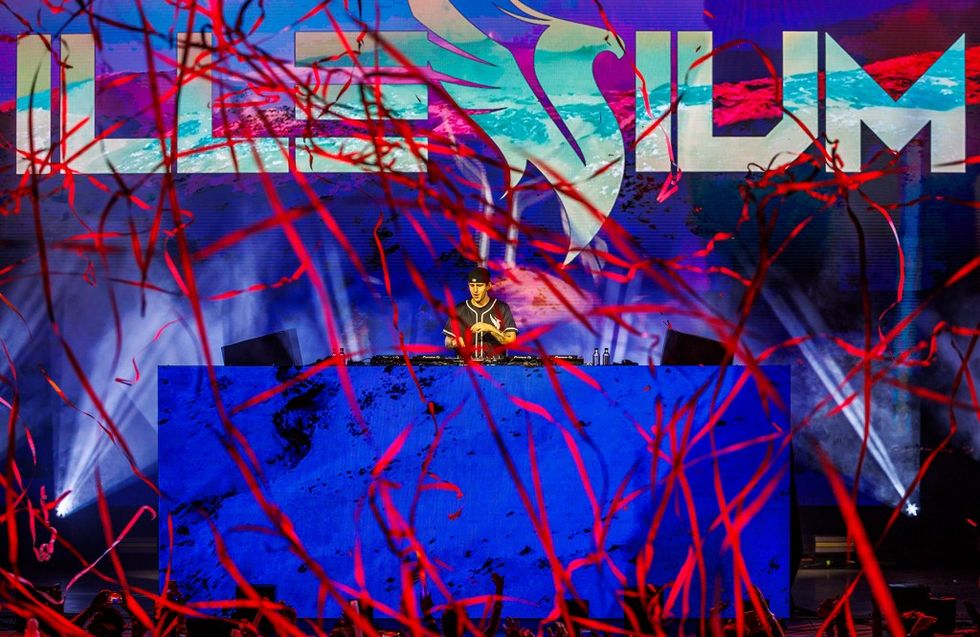
Illenium doesn’t indulge in such overt gestures to the masses, but he certainly isn’t above crowd-pleasing theatrics, triggering confetti cannons almost as often as lighting great big balls of fire. The pyrotechnics simultaneously serve as punctuation and motivation for his relentless set, and he generated a lot of the action himself. A vigorous presence onstage, Illenium is in constant movement, bopping and dancing behind his gear, twiddling buttons then grabbing a mic to shout at the audience. Bobbing heads, jumping and waving glow sticks, the crowd didn’t get hyped up, per se. They weren’t just there to dance, they were there to marvel at the spectacle, soaking in the cavalcade of sci-fi, fantasy, and video game imagery that adds context to the ominous bass rumble and skittering rhythms, and also meaning. —S.T.E.
Jon Langford Is Everywhere
Jon Langford may have been the hardest-working musician at SXSW, at least as far as the conference’s final day was concerned. The leader of the punk institutions the Mekons was here with the Waco Brothers, the group he formed in the early 1990s so he could explore his love of country music and Americana with ease. The Waco Brothers crammed three separate shows into a marathon Saturday, opening their day with a spot at Mojo’s Final Mayhem — a blowout celebration of the recently departed Mojo Nixon, the rock & roll wildman who was a mainstay of SXSW since its earliest days — then shut down the night with their own bash at the Carousel Lounge, a celebrated dive far off SX’s campus. In between these two extremes came the Waco Brothers’ official showcase at the Palm Door on Sixth, not to mention Langford’s solo showcase at the Seven Grand, arriving less than an hour after the Wacos departed the Palm Door.
Arriving between two raucous parties, the Palm Door set seemed casual in comparison. Initially intended to be part of a family-friendly showcase at Auditorium Shores but moved indoors due to the possibility of inclement weather, the gig retained a warm, intimate feel enhanced by the thinning crowd of a late Saturday afternoon. There was room to breathe and to relax with a crack rock & roll band. Even if there was a casual air to the proceedings, the group wasn’t blowing off the gig. They played with muscle and vigor, pounding out sharp and flinty country-rockers where Jean Cook’s fiddle was as likely to scrape as it was to sigh. That slight trace of poignancy didn’t overwhelm the set, not when it was balanced by covers of the Undertones’ punk classic “Teenage Kicks” and Johnny Cash’s “Big River.” It was the kind of effortlessly rousing, loose and soulful afternoon show that has defined SXSW since its inception and remains a rollicking good time. —S.T.E.
Diana DeMuth Sings Clear and True
Early evening on SXSW can be a tough time for an artist. It’s the moment when the festival is in flux, with the day parties still being ushered away as the evening lurches into gear. The Parish fits in that netherworld. Once located in the thick of things on Dirty Six, now tucked away on a side street just east of I-35, it’s not quite off the beaten path but if the moment hits just right, it can seem quiet and intimate, which meant that the timing and location happened to be just right for Diana DeMuth, a singer-songwriter anchored in Americana but distinguished by a powerful voice that soars over her strumming. The revelation that she competed on The X Factor doesn’t quite come as a surprise; her clear, commanding voice demands attention, relegating her gentle fingerpicking to an afterthought. Despite this bold natural instrument, the starkness of the Parish setting showed Demuth’s affinity for such modern troubadours as Zach Bryan; she doesn’t quite favor his diaristic emotional bloodletting, yet she’s within the same ballpark. DeMuth sings sweeter than Bryan, which helps emphasize her true forebear: With her clarion voice and crystalline melodies, DeMuth suggests Joan Baez. —S.T.E.
Victoria Canal Keeps It Real
A longtime SXSW institution, the British Music Embassy set up shop for eight straight days at SXSW 2024, making it one of the few events to run through almost the entirety of the festival. Victoria Canal commenced the BME’s final party on Saturday evening and, in some respects, she seemed like a curious choice for the event. Lacking any strong tie to the United Kingdom — the same could not be said of KiLLOWEN, a quintessentially British hip-hop act that followed her on an adjacent stage at the Embassy set up at the Sheraton — Canal was born In Germany to an American mother and Spanish father, being raised in cities across the world. She shared a fair amount of this biography onstage during her gregarious stage patter, chatter she dismissed with a quip of “This all the result of the PMS, I don’t normally talk this much.” Nevertheless, the lovely, lyrical songs she shared during her set also tend to be quite candid; she’ll introduce a tune saying it’s about feeling uncomfortable in her body due to a congenital disorder, then play a song that lays out her dysmorphia quite plainly itself. That forthright emotion is ingratiating, yet happily, these same skills also are evident in lighter material, such as a new song about her fervent desire that her ex be murdered by his new girlfriend. With its lithe, swinging melody providing a sugarpill for the tune’s dark humor, the number suggested Canal is starting to hit her stride as a songwriter. —S.T.E.
(Full disclosure: In 2021, Rolling Stone’s parent company, P-MRC, acquired a 50 percent stake in the SXSW festival.)
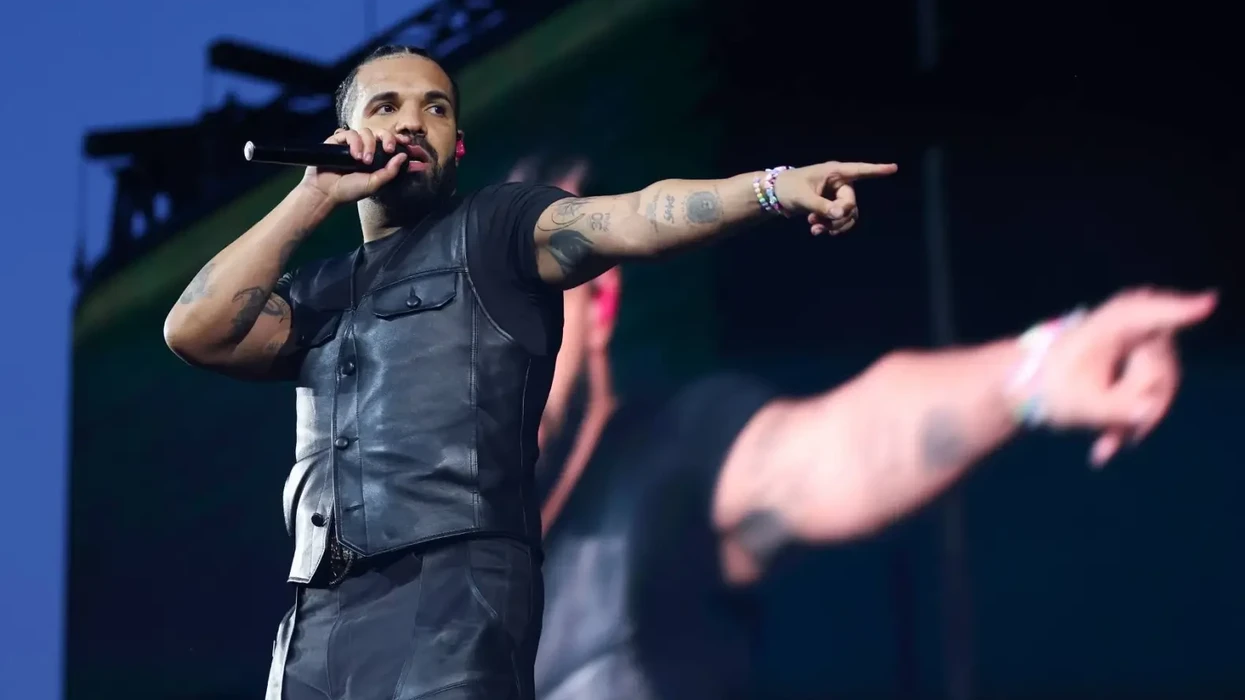
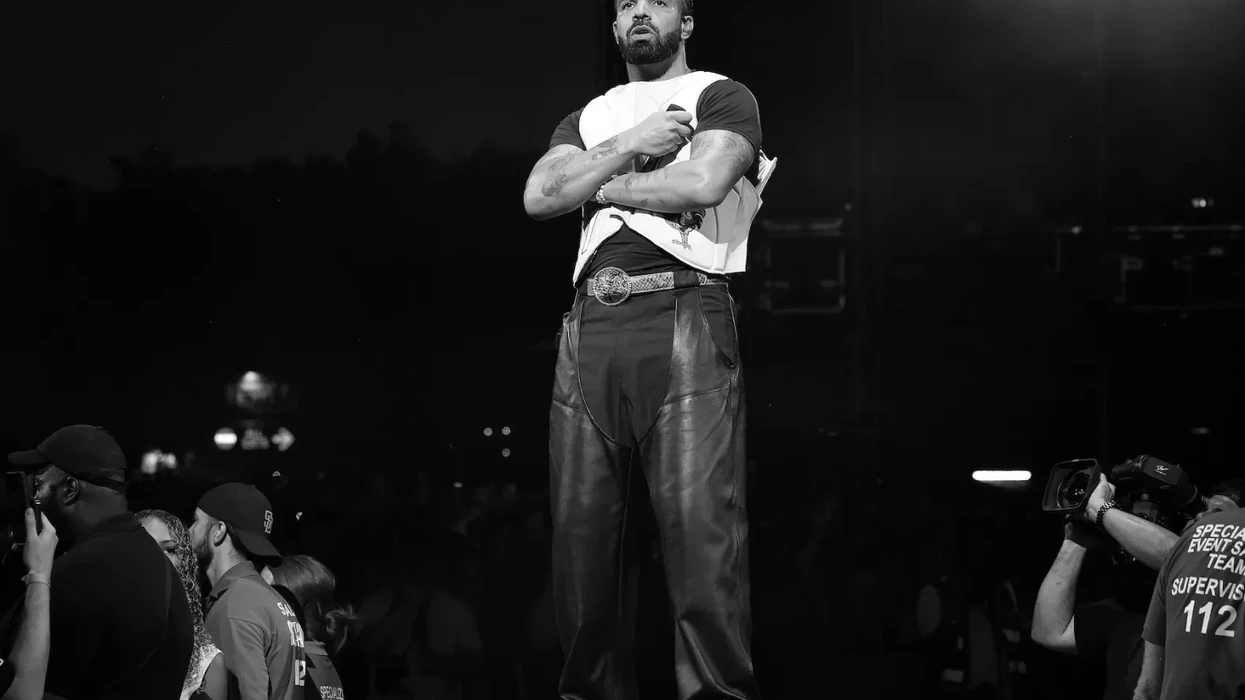


Drake onstage in Toronto last year
Everybody Likes Drake Again. That Means We’re Healing
Not to be dramatic or anything, but not too long ago, listening to people talk about Drake, you’d think he would never top the charts again. But here we are: With Iceman, he’s broken his own record, earning a 13th week atop Billboard’s Top R&B/Hip-Hop Albums chart on Sept. 5, surpassing Take Care’s 12-week run more than a decade ago. The achievement comes after the great rap civil war of 2024, which was framed as everything from a referendum on Drake’s character as a human being to a cleansing of what popular radio host Ebro would describe, in February 2025, as “a sickness in the game.”
Again, not trying to be dramatic, but even if you were skeptical of the discourse circa 2024, it is a bit shocking to hear the public’s recent re-embrace of Drake. Consider how far the frenzy around the most salacious allegations on Kendrick Lamar‘s “Not Like Us” extended. There was Christopher Alvarez, a disabled journalist, being dragged into conspiracy theories. There was the woman from the resurfaced concert footage, now 31, having to publicly dispute the creepy significance strangers had assigned to an onstage kiss from when she was 17. Drake said in his lawsuit against UMG that the threats had forced him to pull his seven-year-old son out of school.
What now feels like the absurdity of the moment registered as something deathly serious at the time. By September 2024, Lamar was releasing the ominous “Watch the Party Die,” just days after his Super Bowl halftime performance was announced. Oh, also, a major talking point in American culture a year and a half ago was whether one of the biggest superstars in the world would be publicly branded a pedophile during the Super Bowl.
In what world would any celebrity recover from that?
Except, with time, the online frenzy surrounding the Drake and Lamar feud reads more like a mass-psychosis event than a cultural reckoning. The music, oddly enough, often seemed secondary to the certainty of everyone discussing it. “Not Like Us” was a veritable hit, absolutely. But its cultural dominance became bound up in a widespread vilification of Drake that curdled online, where the most damning interpretation of anything could quickly become the accepted one. For a while, even putting on a Drake song could feel like something you had to explain, as if listening amounted to taking a position on the allegations.
That this all happened in 2024 is meaningful. This was right in the peak of Elon Musk’s reconstruction of Twitter, privileging rage bait and engagement tactics that helped misinformation disseminate like fact. It was also the beginning of AI tools becoming sophisticated enough to produce convincing-sounding tracks. Even before Drake released his first response, “Push Ups,” AI-generated response tracks were circulating across social media. And so, in many ways, the well of public opinion was already poisoned.
Listeners’ recent embrace of Drake feels settled in a broader cultural shift brewing since 2024. The beef, in hindsight, feels like a dying vestige of whatever people want to call “Woke 1.0”: a particular faith that exposing the right person could amount to a cultural transformation. For a moment, defeating Drake seemed to promise something about the future of hip-hop, about who would belong in it and what it would tolerate.
There were obvious holes in the argument, namely who exactly these arbiters of culture were and why they were uniquely qualified to speak for the entirety of Black people, questions that Drake pokes at on “Ran to Atlanta” from Iceman. Still, these were never even supposed to be binding philosophical truths in the first place. To hear levelheaded commentators discuss it, this was all simply entertainment — two of the genre’s greats duking it out. Even one of the beef’s catalysts, Metro Boomin, echoed the sentiment, lamenting how online fans had turned the battle into something sinister. Hell, even Jay-Z said something similar before himself tossing a few jabs at Drizzy in a freestyle at the Roots Picnic this year. But the artists themselves supplied the allegations. The ability to raise those stakes and then retreat into “simply entertainment” was part of the dynamic, too.
Even so, how it all devolved into a pseudocultural reckoning says more about the environment fans exist in today than it does about either Drake or Lamar. In the years around the beef, shocking revelations about Diddy as well as the global elite’s ties to Jeffrey Epstein have become folded into the background, alongside a sense that accountability remains selective. This atmosphere of collective powerlessness offers one explanation for the conspiratorial thinking at the heart of Lamar versus Drake. A frustration with an increasingly degraded world and dwindling resources to change it means outrage can mobilize an enormous number of people very quickly, with little holding them together once the moment passes.
The language of exploitation and cultural extraction gave the battle a purpose that seemed to extend well beyond either rapper. But even if you took the least charitable opinion imaginable of our Canadian hitmaker, what was supposed to happen after Drake was defeated? The industry whose supposed wickedness Drake allegedly embodied carried on selling the spectacle itself.
What everyone was caught up in was an appetite with a longer history than the social media platforms now feeding it. Lance Oppenheim’s new film, Primetime, returns to Chris Hansen and To Catch a Predator, a television format that made public humiliation feel like a public service. The connection is in the experience offered to the audience. The viewer could enjoy the confrontation with the reassuring sense that watching served some larger good. Never mind if anything that was unfolding on screen amounted to justice.
In the historian Anton Jäger’s book-length essay Hyperpolitics, published earlier this year in English, he describes how the past decade’s surge of political feeling has coincided with a continuing withdrawal from communal life. More isolated digital environments can fuel extraordinary mobilization without the actual community organizations that might turn it into something tangible. Negating Drake, then, became a gesture in itself. A means of signaling a broader dissatisfaction with the direction of hip-hop culture. Where the problems extend to technology and the demoralizing margins of streaming music, for a while it felt good for people to just wrap it all up in one word: Drake.
But on Iceman, it’s hard to take the idea of Drake as an evil force within hip-hop very seriously, even as he himself makes an effort to lean into the role of the villain. Drake’s music is most potent when it’s aimed at the masses, even if he swears his nice-guy days are over. This is the Degrassi kid turned global superstar rivaling Taylor Swift, after all.
Now, with Fear of Missing Out, Drake’s cryptically announced project slated for release this week, we’ve entered a second kind of Drake Renaissance. However delusional it seems, there was a moment when it felt somehow wrong to play Drake. His return to the top of the charts suggests a good deal of people were eager to get back to listening.