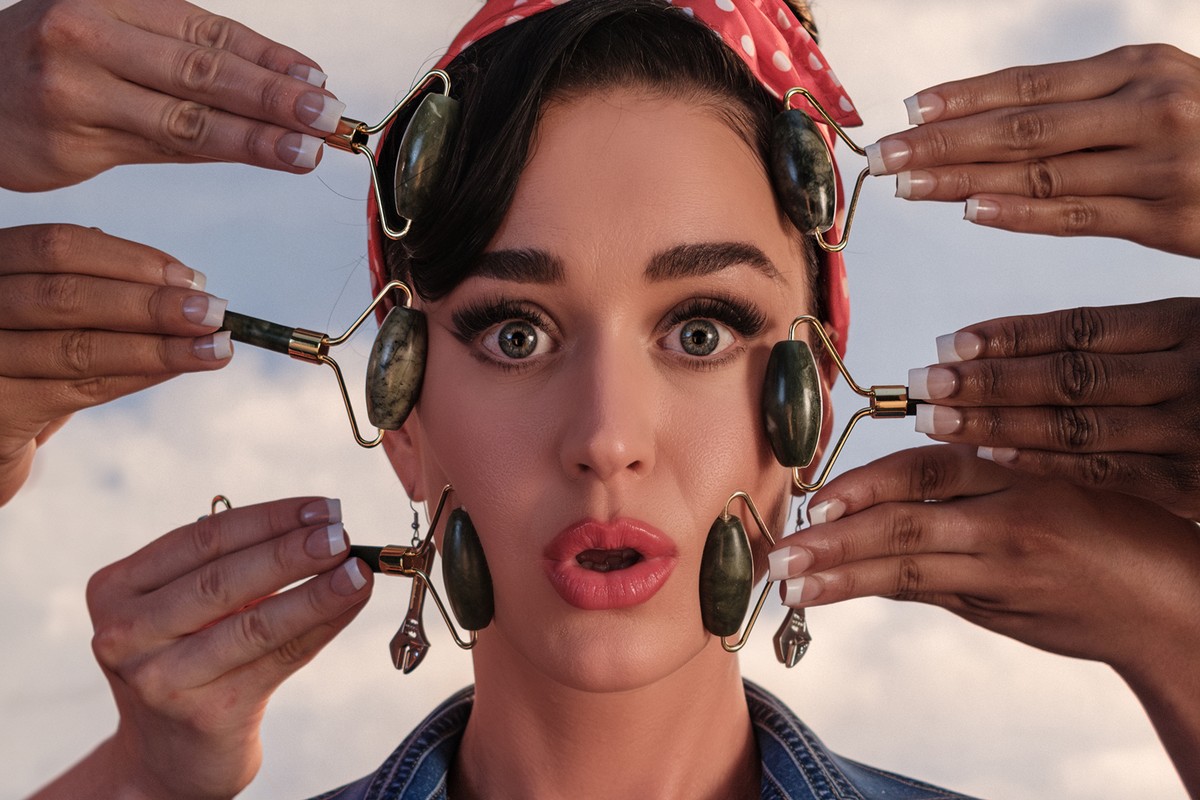

Of all the pop-culture questions we thought we’d be asking this summer, “What was Katy Perry thinking?” probably wasn’t high on anyone’s list. But here we are with “Woman’s World,” a fairly generic pop banger about female empowerment. Fine idea, but rarely has someone so misread the room. Crammed with cartoonish, fleshy pop-pinup imagery, the video was in line with Perry’s earlier, Day-Glo clips. But this one was widely savaged for being heavy-handed, empty of meaning, stereotypically sexualized, or out of step with the way women present themselves on record and in videos. (Seeing the controversial Dr. Luke’s name in the credits didn’t help, either.) In a video posted on her Instagram, Perry pushed back, insisting the whole thing was meant as satire and “a bit sarcastic” and “very slapstick” — even, apparently, the moment when she sticks a gas pump into her backside.
If Perry meant to mainline herself into the cultural conversation, mission somewhat accomplished. But the video also triggers something she and her team probably didn’t intend. It certainly recalls the main-character role she played in one of the great pop moments of recent memory — that sublime period, roughly 2008 to 2013, when she, Lady Gaga, Rihanna, Kesha, and many more commandeered and reinvigorated pop, practically competing with each other for who could come up with the wildest, most creative, and jacked-up single. The craving for attention felt in the “Woman’s World” video (it practically screams: “I’m still relevant!”) is a jarring acknowledgement of just how far off that period now is and how pop and the world around Perry have changed.
But first, let’s revel again in what an astounding era that was. Maybe it was the arrival of Barack Obama in the White House, and the relative youth and idealism he suggested; maybe it was the thirst for undeniably addictive pop after a decade when exciting developments in hip-hop and a new onslaught of indie rock acts had dominated. Back in 2008, little else had the club rush of Gaga’s debut, The Fame; its one-two-three punch of “Poker Face,” “Paparazzi,” and “Just Dance” recalled the heady time of Madonna’s conquest, the days when hooks mattered more than melisma overkill. Two years later, we got Perry’s Teenage Dream, whose first four tracks — the title tune, “Last Friday Night (T.G.I.F),” “California Gurls” and “Firework” — were a hit parade unto themselves.
For a few years, you could turn to whatever outlet you used to hear pop (SiriusXM’s two Top 40 channels, in my case) and hear one inventive and undeniable record after another: Gaga’s “Bad Romance,” her and Beyonce’s unrelenting “Telephone,” Adele’s “Rolling in the Deep” and other singles from 21. Even Gotye’s sulking “Somebody That I Used To Know” sounded like the commercial record Peter Gabriel declined to make after “Sledgehammer.” (“No, you didn’t have to stoop so low/Have your friends collect your records and then change your number” is a breakup-song line only a record geek could love.) From the singing to the production, the songs were commanding and alive. Just as in the prime Motown era, the height of bubblegum and disco, the synth-pop boom of the Eighties, and the boy-band and Britney era of the late Nineties, we once again found ourselves in a moment when pop felt utterly confident in its ability to intoxicate us all.
As most of that list shows, that moment truly was a woman’s world. Rihanna’s cascade of singles were themselves a one-person array of sound. The sky-high “Diamonds” didn’t sound anything like “Stay,” the most moving power ballad of the time, which in turn didn’t sound like anything like the pumped-up “Don’t Stop the Music” or the stuttering grind of “S&M.” Each one of those records was sonically and vocally different from the one before, but you never doubted they all emerged from planet Rihanna. (If and when she ever releases a proper greatest hits compilation, it’s going to be killer.)
Rihanna’s “S&M” also managed to slip the phrase “chains and whips excite me” into the Top 40, a risqué ploy not confined to that song. Hits of that time were especially brash. Kesha’s “Tik Tok” and “We R Who We R” and Perry’s “Last Friday Night (T.G.I.F.)” — parties at rich dudes’ houses, but on record —were unabashedly hedonistic and loving it. Carly Rae Jepsen’s 2012 hit “Call Me Maybe,” one of the last great salvos from that time, didn’t hide its desire for the guy in the ripped jeans.
As anyone who studies pop knows, music is cyclical, so it was only a matter of time before that era would begin to sputter out. Starting with parts of 2011’s Born This Way and into 2013’s Artpop, Gaga’s music became overtaken with musical tchotchkes that cluttered up her records, and she briefly lost the plot. Perry’s 2013 single “Roar” felt strained compared to the effortless charm of her Teenage Dream era (although it works terrifically in the musical & Juliet, based around the catalog of another contemporary master, Max Martin). Rihanna has been laying musically low for nearly a decade now; maybe she realized a cultural moment was ending and headed for the exits. Hip-hop has again asserted its creative dominance, and the rise of a new wave of female indie stars, most prominently the Boygenius gang, has made much of what preceded it suddenly feel bombastic and unsubtle.
It’s telling that one of the prime songs of the summer of 2024 has a shimmery pulse, a wink-wink lightheartedness, and a cheesecakey video. But it’s not “Woman’s World” — it’s Sabrina Carpenter’s “Espresso.” Carpenter’s song is more of a hypnotic dance track than one of the fully formed, modern-Brill-Building songs of that earlier pop era. But the video doesn’t feel as if it cost zillions, another aspect of “Woman’s World” that feels out of step, and it signifies that pop is in the hands of a new generation. Now let’s see if it can reach the transcendent highs of the era that, for a long moment, made Katy Perry someone worth vibing to.





 Matt Collyer of The Planet Smashers