
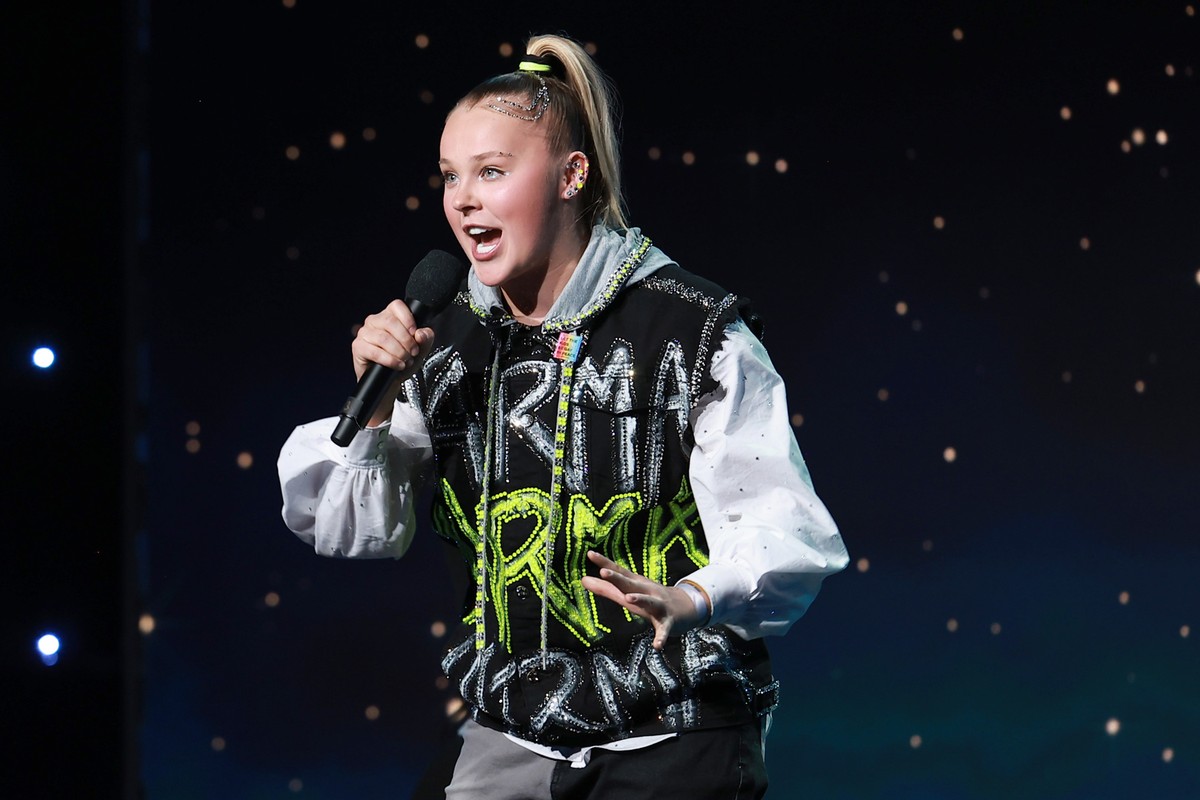

In early April, JoJo Siwa debuted a glaringly different new look: She showed up at the iHeartRadio Awards in a black and silver superhero-esque costume with makeup that made her look like she was in a Kiss cover band. Gone were her signature hair bows and her blindingly colorful outfits. For all intents and purposes, Siwa was kicking off her own Reputation era — even channeling the dark palette from Taylor Swift’s sixth studio album, which has become synonymous with rebellion. It was supposed to be an “edgier,” more “mature” rebrand — and as she teased in the lyrics of her reintroduction single, “Karma,” she wanted to prove that she had evolved into a “bad girl.”
Of course, it wasn’t exactly a smooth transition. In the lead-up to “Karma,” an Auto-Tuned dance-pop number teeming with relationship regret, the Dance Moms alum faced incessant backlash over allegedly co-opting the track from Miley Cyrus (she denied it). Then came the accompanying music video, where she emerged from the ocean like a sea monster and dry-humped another woman. It was less “edgy” and more, in a broader sense of the creative, conceptually “cringe.”
With her new EP, Guilty Pleasure, Siwa strives to flip her image and share a more authentic, queer version of herself. But it’s never been an easy feat for child stars to make a radical revamp. As artists like Selena Gomez, Demi Lovato, the Jonas Brothers, and Miley Cyrus (whose Bangerz era is what Siwa cited during her own transformation) transitioned into adulthood, they often opted for a certain “shock” factor and hypersexualized image to transform the public’s perception of them. (Who can forget when Cyrus twerked with Robin Thicke and a foam finger at the 2013 VMAs?)
However, Siwa is struggling here. That may be in part because of a few missteps she’s had leading up to the release of Guilty Pleasure. Siwa drew criticism for saying that she’d invented “gay pop,” a comment she eventually walked back. With Guilty Pleasure, she does not invent an entire genre, but she does add to pop music’s queer canon. The five-track project will likely be featured, sampled, and remixed by DJs in gay clubs for the next decade, among a litany of “gay pop” artists like Kesha, Lady Gaga, and Lil Nas X. Still, a lot of the music lacks the exact authenticity Siwa seems to crave.
Co-written by Meghan Trainor and DJ White Shadow, the EP’s title and focus track “Guilty Pleasure” isn’t exactly personal, but it’s a somewhat promising, bombastic electro-pop number that offers more pop personality in its music video, which is Siwa’s irrefutably camp “Guilty Pleasure House.” (In it, she sports bedazzled teddy bears on her head and throws around power tools in sequin-emblazoned construction wear.) “Balance Baby,” however, is meant to flaunt Siwa’s brand of provocative versatility (“I like twirlin’ in a ballroom, twerkin’ in the bedroom/Switch it on the daily, I got balance, baby”), but it lands as something manufactured for a RuPaul’s Drag Race challenge.
On “Yesterday’s Tomorrow’s Today,” Siwa attempts to embrace the “carpe diem” mentality in what feels like a pop parody. “Yesterday’s tomorrow’s today/Before you know it, you’ll be dead/Or at best, you’ll be old and gray/Yesterday’s tomorrow’s today,” she sings over a confounding sea shanty melody. “Choose UR Fighter” is the most sonically compelling track on the EP, as Siwa chases after a propulsive new-wave sound and reflects on her missteps in choosing past lovers without sugarcoating the way she feels about them: “Some of my exes are ugly/Some of my exes are vain/Some of ’em held me like heaven/But pleasure don’t make up the pain.”
But overall, Guilty Pleasure is less a rebrand and more Siwa’s identity crisis — an attempt to claw her way out of child stardom like many before her have needed to navigate. For now, she’s stuck in the awkward space of pleasing herself and appeasing her fans.

Jay-Z performing at the Stade de France in Saint-Denis in Paris.
Jay-Z Deserves the Super Bowl Halftime Gig
Where’s the love? Jay-Z asked that question 25 years ago, in the chorus of one of many songs in his catalog that still move audiences today. If he performs “Heart of the City” as part of his Super Bowl halftime show next February, those indignant bars are sure to be a highlight: “First the Fat Boys break up, now every day I wake up, somebody got a problem with Hov…” It would be an appropriate choice, too — because then as now, any time Jay-Z notches a new achievement, people find a way to complain.
The jokes and nonsense started almost as soon as the first rumors trickled out that Jay, whose company Roc Nation has executive-produced the Super Bowl halftime show since 2019, might be choosing himself to headline next year’s show. “Jay-Z just Dick Cheney’d himself for the Super Bowl,” Puck‘s Matthew Belloni quipped on X last week, alluding to the time that the late prince of darkness, who’d been asked to run the vice-presidential search committee for George W. Bush’s 2000 campaign, put himself on the ticket. (Super hip and current reference, and not at all apples-and-oranges.) Others pointed to TMZ reports that pop stars like Harry Styles and Justin Bieber had been asked first. “How are they the frontrunners, and he end up in the front?” Cam’Ron, who’s delighted in trolling Jay for many years, wondered aloud on his podcast. “Out of all the people on the roster, they couldn’t pick nobody else?” asked Cam’Ron‘s co-host, Ma$e.
These critiques miss the point, which is that Jay-Z is one of the best choices for a high-profile gig like this. He’s a superstar with a comparable level of name recognition to any other A-lister in music. He has a deep stack of classic songs going back decades. And he’s a highly skillful live performer who knows his way around a stadium stage, as he’s spent this year reminding people on his Jay-Z 30 tour. He tore down Yankee Stadium three nights in a row this summer; just last week, he rocked SoFi Stadium, which happens to be the same place where the 2027 Super Bowl is being held. He held the crowd’s attention with ease at all of those shows, and though there were plenty of glittery guests — that’s a given at a Jay show, and it will surely be true at the Super Bowl, too — he did it mostly through the force of his own magnetic energy. Let’s state the obvious here: Jay-Z is really, really good at rapping. We’re talking about one of the slickest, sharpest talkers in the history of words, someone who made it to the top through a sustained act of myth-making, then kept going. Are we seriously asking whether he can handle a 15-minute televised performance?
And yeah, there’s a touch of self-congratulation in the way he appointed himself. So what? Praising his own gifts is arguably Jay-Z’s greatest talent of all. He made a fine art out of self-applause. He told his story again and again, retracing the steps from Marcy Projects to the corner suite, and he made us believe. It would almost be insulting to the audience if he didn’t give himself the gig at some point.
Pop culture observers in recent years surely remember the backlash to Super Bowl headliners like Kendrick Lamar and Bad Bunny — all of it at least culturally conservative, and much of it frankly just racist. The blowback to Jay’s announcement is mostly coming from other quarters, at least for now (let’s just wait to see what the right-wing swamps make of this one). But it’s disappointing in a different way. Jay-Z has spent his career expounding hip-hop as a mainstream commercial force. He’s not a businessman, he’s a business, man. But he’s also an artist. He’s made huge amounts of money, and gotten himself into the rarefied rooms where he even has the ability to give himself a gig like this, by spinning his experiences into compelling narrative art, one verse at a time. Let’s not lose sight of how impressive his life’s work really is. Jay-Z is not some random C-suite bro, and he’s definitely not Dick Cheney. He’s one of the greatest rappers of all time, by any measure. He’s earned that Super Bowl spot.