
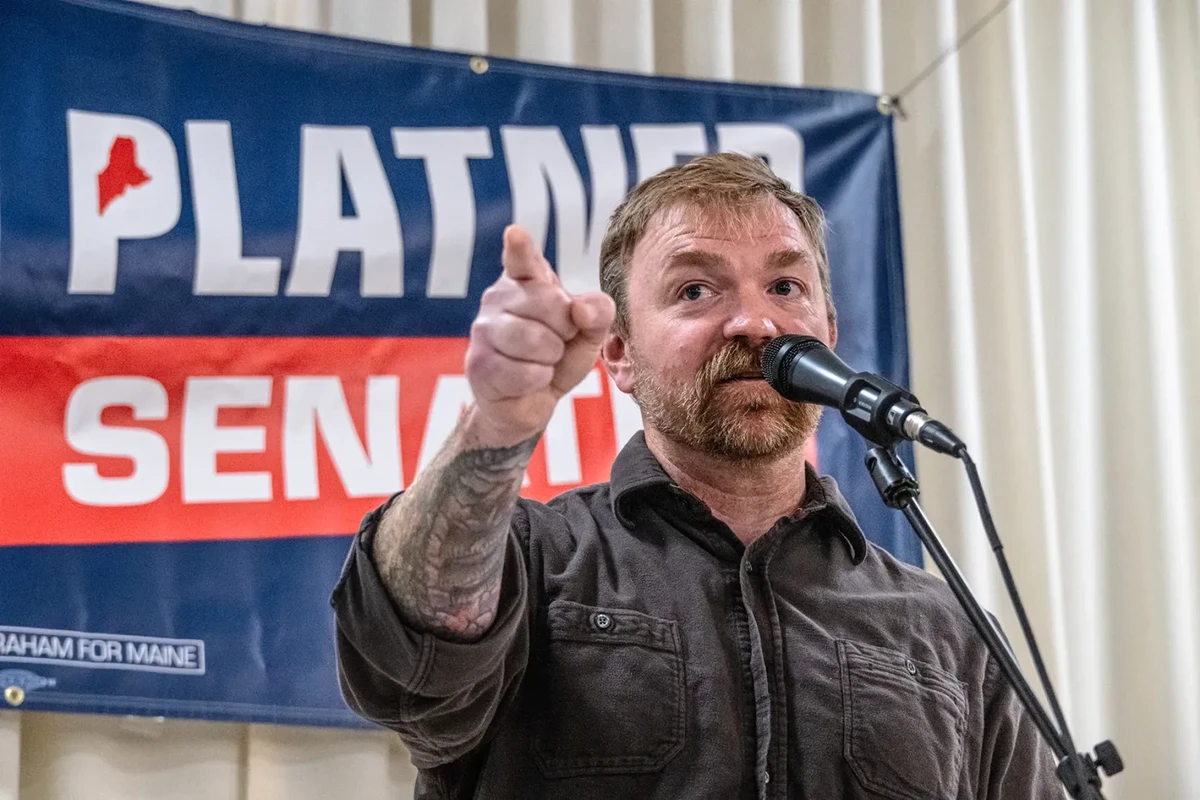

It’s official: the Democrats are heading to the midterms with an oysterman from Maine.
Graham Platner, the dark horse candidate who bulldozed his way past Governor Janet Mills, the Democratic Party’s preferred candidate for Senate, won the state’s barely contested primary on Tuesday night despite a laundry list of scandals and controversies. Unless those crises compound enough to force Platner to drop out of the race, he’ll go to the polls in November as the Democrats’ best hope for retaking the Senate, in a highly competitive race with incumbent Senator Susan Collins.
“I’m humbled and proud to officially be your Democratic nominee for the U.S. Senate to take on Susan Collins and the billionaire class she represents. Together, we will win this seat back for working Mainers,” Platner said in an X statement. “Thank you, Maine.”
Platner’s road to the nomination hasn’t been easy. With little institutional backing, Platner started his campaign with an open appeal to frustrated voters on social media. Platner’s ease on camera and plainspoken message quickly captivated viewers around the country, and the resulting flood of small-dollar donations made him an actual factor in a race that most assumed would be handed to Mills. Senator Bernie Sanders endorsed Platner in August of last year, bringing a political legitimacy to his campaign and aligning him firmly with the kind of outsider, against-the-machine politics that Sanders has represented inside the Democratic Party.
At the end of April this year, Mills suspended her campaign, clearing the way for Platner’s nomination. She remained on the ballot in Tuesday’s primary, but garnered only 18.7 percent of the vote versus Platner’s 74.7 percent.
But Platner’s past has consistently reared its head. In October of last year, Platner faced intense criticism when he revealed that he had gotten a tattoo of a Nazi symbol during his time in the military. Platner mostly weathered that scandal, blaming the poor decision on youth and ignorance, and had the tattoo covered up.
Reporters digging into Platner’s past also discovered a long history of uncouth and politically incorrect social media posts, including a lengthy archive of Reddit posts. He has also come under fire for more recent indiscretions, including extramarital sexting and reports that he had behaved in an “unsettling” manner in past relationships.
The biggest question in this race is whether there are more damaging stories for Platner that have yet to be revealed. His campaign, thus far, has made the calculation that none of the scandals have been fatal. But Platner is already slipping in some polls, with one putting his lead over Collins at just a few points, 51-49 percent, as of early June. And Collins, who has represented Maine in the Senate for nearly 30 years, has consistently outperformed bad polling when it comes down to the actual election.
The latest polls are still fresh, and we have a long way to go before November. If Platner keeps his nose clean and campaigns hard, the numbers may come back up. But either way, there will be no easy win for Democrats come November: the hardest part of Graham Platner’s career is yet to come.









 Apple Maps, August 30, 2026

Pete Hegseth gestures after giving a State of the Force address at Marine Corps Base Quantico on Sept. 30, 2026 in Quantico, Va.
Pete Hegseth’s ‘Warfighter’ Crusade Isn’t About Killing
Pete Hegseth, to his credit, understands one truth about the world: the military’s job is to kill people.
Hegseth, the newly rebranded “Secretary of War,” is obsessed with showcasing clean-cut troops trained to do just that. He refers to it as “lethality,” a word that he used twice in his roughly hour-long State of the Force speech on Wednesday, which laid out his vision for this new, more-violent military: a force of fit, unified “warfighters,” unburdened by the bureaucracy and norms of the past.
“No more diversity quotas, no more gender pronouns, no more identity months,” Hegseth said, pacing back and forth on stage. “Only the warrior ethos.”
If that wasn’t enough, he doubled down moments later.
“We are no longer the woke department or the weak department,” Hegseth said, stumbling over his words slightly. “No fanny, no fatties, no trannies, no beardos, no weirdos, no wimps, no radicals. Just warriors. Just tough, ready, committed troops.”
To do this, Hegseth thinks, the military needs to work out. He wants every soldier doing physical training every day. He leads group workouts at the Pentagon, hops in on PT, does pullups and pushups and flexes his muscles. This is all, broadly, fine for a Defense Secretary to do. Go ahead, engage with your troops. (Less normal, perhaps, is his obsession with monitoring troops’ testosterone levels.) But Hegseth’s CrossFit crusade isn’t really about killing.
By any objective measurement, the U.S. military is plenty good at killing. We have more bombs and more planes and more ships and better-trained and equipped troops than any country in the world. The “warrior ethos” Hegseth is so obsessed with is the relic of recruitment videos from the peak of the War on Terror, the years of bearded operators with ropy muscle covered in Kevlar fabric, who kicked in doors and sniped off heads and got their hands dirty. Those guys still exist, of course. They haven’t gone away. If they’re needed again, they will be there.
But combat doesn’t look like that anymore.
On the same day that Hegseth delivered his speech, the U.S. formally withdrew from Iraq, one of America’s last active presences in the wars of occupation that defined the military for the past two decades. War is different now. It is fought with drones and cruise missiles from the decks of ships in the Persian Gulf and dusty air-bases outside of the glittering megacities of America’s Middle Eastern oil merchants. Does every soldier involved in this need a perfect waist-to-shoulder ratio? Does it physically impede America’s interests abroad to have diversity, equity, and inclusion policies? Has the existence of trans servicemembers ever stopped the U.S. military from killing even a single person that it wanted to kill, anywhere in the world, at any time?
Hegseth, I think, would say yes. He has a personal chip on his shoulder. The “woke” elements of Army bureaucracy once removed him from service at Joe Biden’s inauguration because he has a tattoo on his arm that reads “DEUS VULT,” a common rallying cry for a very particular kind of extremist Christian nationalism. But most rational observers, people who are clear-eyed about America’s unparalleled ability to Blow Shit Up, can recognize that all of these arguments are battles of cultural semantics that have basically nothing to do with the military’s ability to kill. With respect to “lethality,” the U.S. military is pretty much fine. If you doubt this, ask an Iraqi.
Hegseth’s relentless focus on violent language and imagery is largely a marketing tactic for what is a more holistic cultural and political shift. Hegseth does not want a military that is indicative of America’s cumbersome, bureaucratic state apparatus in the same way that Trump is relentlessly focused on cutting red tape and federal “waste.” There are certainly inefficiencies in the federal system, but much of that bureaucracy exists for precisely the reason that Hegseth and Trump want it gone: it is a check on unitary power. Hegseth wants a united, homogenous military of soldiers who share his cultural prejudices, who share his bloodthirsty ethos, and who share his religion. In the State of the Force speech and many other recent public appearances, Hegseth has quoted scripture and explicitly referenced his Christian faith, a tacit assumption that he expects the men and women in uniform below him to be Christian. He wants a force that, in his own words, does not buy into the “fake news” media’s “disingenuous headlines about deployment lengths, patently false claims of low troop morale or flat-out propaganda.”
A more malleable military is also a better business opportunity. The Trump administration has been terribly effective at streamlining the process by which they can redistribute money to the oligarchs they choose. The so-called Department of War is no different. In his speech, Hegseth announced an initiative called “Project Meridian,” a sort of tech incubator for military contractors that will be run by Elon Musk, Palmer Luckey, and, bizarrely, Newt Gingrich, who Hegseth said would be joined by “hand-picked private sector leaders.”
“Their work will be focused on discovering, developing and fielding the weapons and systems that our children and our grandchildren will need in their lifetimes without any creative limitations or restrictions,” Hegseth said. “On any future battlefield, from under the earth to beyond the moon, our American warriors will be armed with absolute technological superiority because we will have the foresight to prepare today for tomorrow.”
That’s the window dressing. There’s truth there, of course: the military does have a lot of work to do to adapt to the new forms of warfare playing out in Ukraine. Battle has shifted. But what Project Meridian represents is a shift to a faster, less regulated version of the military industrial complex. There will be less oversight. The money will move where Trump and Hegseth want it to, delivered to the tech barons and traditional defense contractors who best curry favor with the administration. This is for the good of the soldier, regardless of what Hegseth says. It does not make us more deadly. It just makes a select few — some of whom aren’t even American — that much more rich.
After all, that’s the goal, right? A prosperous, united, Christian nation, led by titans of industry who bow only to a single leader who can reshape the world on a whim. No fatties, no weirdos, no radicals. No dissent, crucially. Dissent is traitorous. As soldiers, as civilians, even, all we should think about is how to kill. Hegseth and his hand-picked private sector will handle the rest.