
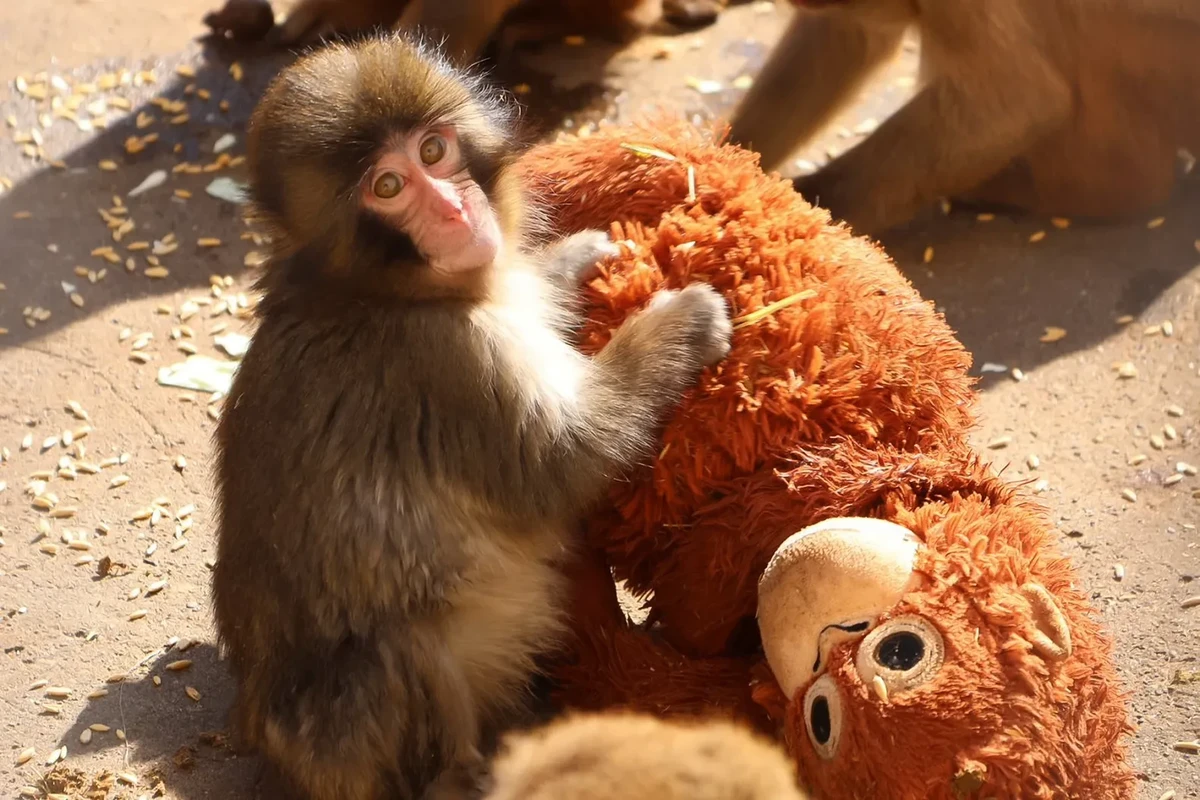

If the internet had eyes, all of them would currently be trained on the Ichikawa City Zoo in Chiba, Japan, where a rejected baby monkey has become an unlikely international star. While animal videos are common fodder online, there’s something about this tiny little monkey that I just can’t stop thinking about. And I’m not the only one.
Punch, or Punch-kun as he’s called in Japanese, is a seven-month old macaque monkey. He was born in July, but after a difficult and long labor, his mother rejected him, according to zookeepers at Ichikawa City Zoo. Punch was raised by staff, who nursed him until he was able to fend for himself. But when it was time for Punch to be reintroduced to the rest of the monkeys, things didn’t go so smoothly. Many of the other monkeys on “monkey mountain,” as the enclosure is referred to, refuse to allow Punch into the social circle. There’s nothing wrong with him, but as a baby reared with staff instead of inside the group of monkeys, the others just really hate Punch’s vibe. He’s awkward! It’s not his fault!
As if Punch’s story couldn’t get sadder, zookeepers gifted the lonely little monkey a stuffed orangutan toy from Ikea for comfort. As if a sad tiny monkey who’s lonely and doesn’t have any friends wasn’t enough, now I’ve got to watch him drag around a toy that’s practically the same size as him? Are you fucking kidding me?
In the weeks since Punch reached viral status, internet users have been absolutely obsessed with tracking his social progress and integration with the rest of his fellow monkeys. Photos and videos of Punch in the enclosure have racked up millions of views and comments as people dedicate their time and emotional wellbeing to the small downturned face. That means obsessively watching clips as Punch drags his stuffed animal around in the dust, fails to approach another group of monkeys, or eats alone in a corner with his only friend, a $19.99-plus-shipping-and-handling stuffed animal. But it also means people — including me — are absolutely bursting with outrage every time something appears to go even the slightest bit wrong for him.
On Feb. 19, cameras trained on Punch captured another monkey grabbing him by his neck and dragging him across the ground, following as Punch escaped shrieking and sought refuge in the arms of his fuzzy plushy. The response was immediate. Users on X and TikTok begged zookeepers to take Punch to safety. (Zookeepers have maintained he is safe and being watched carefully.) Others threatened the monkeys that wouldn’t let Punch join their posses. There was a common refrain about buying Punch a gun. PETA is even getting in on the action — using Punch’s virality to decry zoos.
The psychological appeal of Punch is readily apparent for even the least inquisitive of people. Small animal? Check. Cute and easy-to-anthropomorphise face? Check. Heartbreaking circumstances? Check. A single friendship that rivals the plot of a Disney short? Check. Add in a name that calls to mind the potential for physical violence on monkey mountain and it’s like Punch was always meant to become the focus of millions. The immediate nature of social media also means that it feels like minute-to-minute updates of Punch’s wellbeing are almost inescapable online. If he tries to approach a group or runs from a fight, people know almost immediately. But acknowledging that I am being emotionally manipulated by my amygdala doesn’t keep me from feeling every emotion when I see that tiny little monkey drag his stuffed toy around the yard.
While content about Punch has centered around his worst moments, he is, in fact, making progress. Through the zoo’s account on X, zookeepers update Punch’s fans on his journey of integrating back into the group. Even the Feb. 19 dragging incident wasn’t an instance of unprovoked bullying, zookeepers said, but a chastisement from an adult monkey who most likely felt that her baby was annoyed by Punch’s efforts to hang out. According to zookeepers, it was the monkey equivalent of telling him “don’t be mean.” Punch has a ways to go before he’s fully an accepted member of the troupe, a process that will continue to be tracked by hordes of people. But zookeepers are positive that Punch is slowly ingratiating himself in the group, and are encouraging his fans to keep their spirits up.
“While Punch is scolded he shows resilience and mental strength,” zookeepers at Ichikawa City Zoo said in a statement Friday. “When you observe these disciplinary behaviors from other troop members toward Punch when he tries to communicate with them, we would like you to support Punch’s effort rather than feel sorry for him.”
In recent days, Punch has been seen climbing on at least one adult and had his fur groomed by another, indications that he’s slowly capturing hearts of his fellow primates. Punch might be down for the moment. But he’s certainly not out.
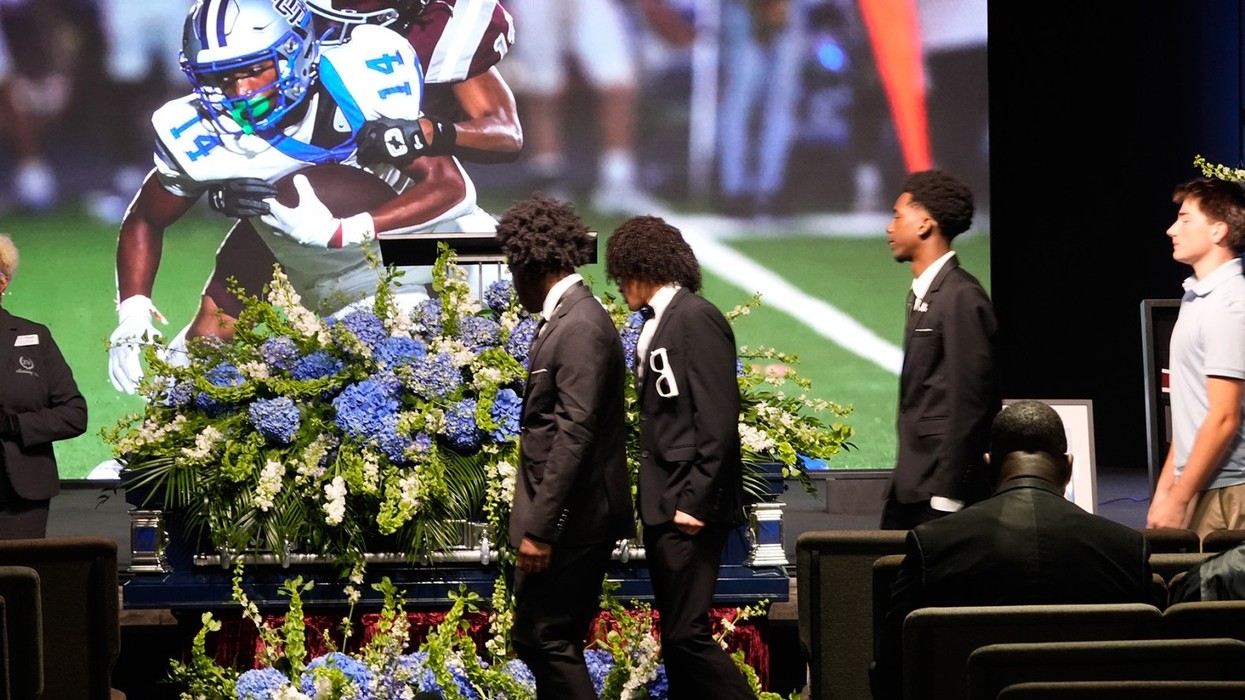
 Christine Wonsley with her husband, Elmore (second from left), attorney Ben Crump (left), and Rev. Al Sharpton (right), during a memorial service for her son Nolan Xavier Wells.Gerald Herbert/AP

Donald Trump and FIFA President Gianni Infantino stand as Spain celebrates its World Cup victory, on July 19, 2026.
America Got the World Cup It Deserves — Good and Bad
For the past six weeks or so I’ve been having a recurring fight with my friends. The dispute is over whether or not it’s ethical to support the U.S. national team in the World Cup.
To the vast majority of people reading this article, this is an absurd question: of course you can and should support the United States Men’s National Team, you weirdo. And look, I’m with you. But despite the fact that my friends are pompous dorks who are no fun to watch the game with, the question they raise is valid: Are our national teams avatars of the administration in power, or of the people and promise of that country?
If you believe the former, then yeah, it’s pretty fucking weird to support the USMNT. In doing so, by that thinking, you’d be engaging in a sort of athletic nationalism on behalf of a country run by Donald Trump, the most corrupt president in history, who forced the Iranian national team to flee across the border immediately after the final whistle of each of their games, whose federal police have shot numerous civilians dead in the street during a brutal immigration crackdown, who has started a war and supported a genocide while covering up his close personal friendship with the most notorious pedophile in modern history.
I mean just look at him. On Sunday he waddled down onto the field to present Spain with their trophy, lingering on stage with the victorious team as they tried to celebrate. The presence of Mexican President Claudia Steinbaum and Canadian Prime Minister Mark Carney did little to dilute the image of Trump standing next to his crony Gianni Infantino, grinning at all the trappings of their power, hands caressing a trophy they’d done nothing to earn, lingering well past his cue to leave Spain to their glory. This World Cup, literally, had Donald Trump’s fingerprints all over it.
And yet, this was one of the most thrilling, beautiful World Cups in recent memory. That’s America, baby — contradictions abound.
Over the past five weeks of the greatest athletic competition on Earth, we’ve seen games that will literally never leave my memory. The final, which I attended yesterday in New Jersey, was remarkably forgettable — a 0-0 draw until the 106th minute, with Spain dominating every second of play and yet unable to score, undone time and time again by their insistence on tricksy passing and the personal heroics of Argentina’s goalkeeper Emi Martinez. The rest of the tournament, however, delivered. Cabo Verde, refusing to lose until the very last moments of the first knockout round, battling back again and again against both teams that would eventually play in the final. The sheer dominance of France’s Kylian Mbappe in front of goal, scoring at will, rivaled only by the aging GOAT Leo Messi and the Norwegian warlord Erling Haaland. England’s heroic stand at the Estadio Azteca in Mexico City, 45 minutes in the rain, a man down, holding out for the win and singing “Wonderwall” with what felt like half the stadium when it ended. Off the pitch, too: the Algerian national team being welcomed with open arms by Lawrence, Kansas; Scottish braves drinking Boston dry and partying wildly with Haitian fans that overcame so much just to be at the tournament. In Mexico, of course, the World Cup was everything, and its fans threw joyous South Koreans pumped full of tequila into the air, and celebrated in the streets with opposing fans even after their hard-fought defeat to England.
For the United States, what the 2026 World Cup was — what our team was, what our fans were, what our performance as hosts was — is a reflection of two things at once: what our nation is and what it can be.
Our star striker, Folarin Balogun, was born here by accident, a citizen only because of a birthright system that our president is currently trying to erase. We have Ricardo and Giovanni and Freeman and Zendejas. We have another striker whose name is Haji, for goodness sake. I look at that team and I see the country America can be, one in which any soul born in or living within our arbitrary borders can become part of a great national project that seeks to improve the lives of everyone it can. And yet, I can also look at that team and see a reflection of what the country is, because there is an anchor around its neck. When Balogun was — albeit unjustly — suspended for a crucial match, Trump himself stepped in. Cronyism saved the day and got Balogun reinstated, but ruined the fragile harmony the team had enjoyed. On the pitch against Belgium, they came apart. Temperamental star Christian Pulisic tried to go alone and then quit, aging defender Tim Ream’s legs failed him when he needed them most, a young goalkeeper slipped and fell when he had no good options for support.
What more can you say about a team, about our country? The team is an entity that is capable of more but still has so far to go, that is vulnerable to the same forces of avarice and selfishness and fear that plague our national identity writ large.
It’s possible to end the story there, to say good riddance to another failed year and fractured team. But I think that’s a mistake. I think if you believe that you haven’t really been watching. I think that’s also why it pissed me off so much that some of my friends wouldn’t root for the U.S. Yes, we have flaws, like every country involved in the tournament. Yes, our current team management and political government are filled with morons. But if you won’t put on the shirt you’re essentially opting out of our future. We can’t wait around for a better world, a better team, a better president, before we deign to lend our support. Progress only comes from effort, from caring, from believing in something more.
One of my favorite images of the World Cup was a crowd shot of the opening match against Paraguay in Los Angeles: every race, color and creed of American there is, all covered in red white and blue. It’s corny and trite, sure. But that’s what it’s all about. That’s why we’re here. You have to believe. The U.S. won that game 4-2. In four years, we’ll be even better.