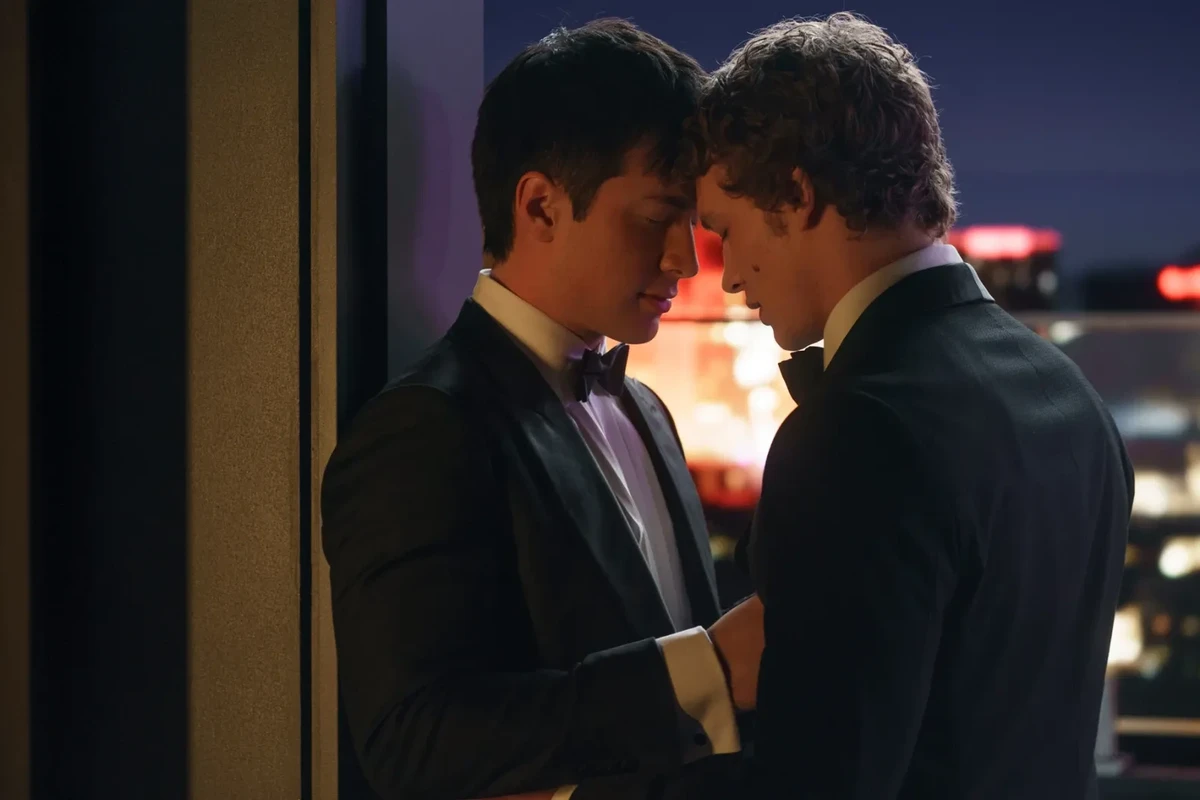

A puck floats through the air. Blades wait frozen on the ice. And the eyes of two lovers keeping their years-long relationship secret from family, friends, and the thousands of cheering fans around them meet in the middle of a National Hockey League game.
This is the world of Heated Rivalry, a queer hockey romance novel that has gone from an if-you-know-you-know treasure to one of the most popular shows on HBO Max. By some measures, it’s been an unlikely journey. Created by the Canadian streaming service Crave and starring relative newcomers Hudson Williams as Shane Hollander and Connor Storrie as Ilya Rozanov, the adaption of this BookTok hit follows two professional hockey players as they navigate a secret relationship in the midst of a highly publicized athletic rivalry. Its defining draw appears to be the multiple steamy, NSFW scenes that occur every episode, and since the series’ Nov. 28 premiere, Heated Rivalry has become a word-of-mouth sensation. It has remained in HBO Max’s Top 10 shows, racked up millions of interactions and mentions on social media, and driven such high demand for the book that physical copies are out of stock on Amazon. Heated Rivalry is a hit. But even the people responsible for making it aren’t entirely sure why.
Heated Rivalry creator Jacob Tierney is best known for co-writing and directing the offbeat cult-favorite sitcom Letterkenny (and executive producing its popular spinoff Shoresy). A love story might not seem like his milieu, but Tierney tells Rolling Stone he became obsessed with Heated Rivalry after offhandedly checking out the audiobook. He thought it would be a quick read to help fix his pandemic-induced short attention span — and as a gay man, he’s always down to read a queer story. Now, he calls it his “gateway drug” into the world of romance.
Unlike your typical binge watch, Heated Rivalry takes place over an almost nine-year span, often jumping months or years at a time during each episode. But the central story remains fixed on the relationship between hockey stars Hollander and Rozanov. Because the two are widely known as professional nemeses, they can’t actually hang out or mimic anything even close to public friendship. Instead, most of the book’s action develops in secret encounters the men have between games, sponsorship events, and award ceremonies. On the ice, they’re enemies. But behind closed doors, Hollander and Rozanov can’t keep their hands off of each other.
 (L to R): Connor Storrie as Ilya Rozanov and Hudson Williams as Shane HollanderHBO
Tierney says that he always felt a sense of ownership over the book, a feeling he thinks many readers share by the time they turn the last page. After reading it and exploring other works in the genre, he still thought of it as “his” book. So when he read a Washington Post article about how popular romance was becoming — an audience of mainly female readers that Hollywood wasn’t taking seriously — he knew he wasn’t alone. And when the article mentioned Heated Rivalry by name, he immediately called up one of his producing partners. “I was like, ‘I think we have to option a bunch of gay hockey porn,’” Tierney says. “Because if somebody else does it, I think I will be very upset.” His next step: sliding into author Rachel Reid’s Instagram DMs and begging to option her book.
“That was the beginning of it,” Reid tells Rolling Stone. “We had a Zoom call the next day to talk about his ideas, and that’s when I really got a good sense of how much he loved these books, how much he understood them and the characters, and how important it was for him to get the story right. I felt really confident after that this was going to be told correctly.”
Both Tierney and Reid say the show moved quickly once it was greenlit in 2024. But the road to that point was incredibly long and drawn out, mostly because Tierney refused to make any concessions to TV executives about dialing down the show’s sex scenes. While there’s no full-frontal nudity in the series, the material is what Tierney calls “defiantly sexual,” using careful camera angles, strategically arranged limbs, and moody lighting to hide genitalia while painting a pretty clear picture of exactly what’s happening.
“I’m a gay man and this is a gay show. [The smut] and the story are not separate,” Tierney says. “It’s about two people learning about who they are and what their relationship is through fucking. The only times they’re being honest with each other is when they’re having sex. Otherwise, it’s loads of bluster. It’s loads of pretending. It’s loads of two people who don’t, frankly, understand what they’re feeling and who don’t really get it takes a long time for their emotions to catch up to what their bodies are doing.”
While the show might seem to have come out of nowhere, the popularity of Heated Rivalry didn’t emerge from a bubble. Since the Covid-19 pandemic, hockey romance has been one of the fastest-growing niches in the online book community — to the point where it’s created some PR nightmares for actual NHL teams. Heated Rivalry is one of eight hockey romance books Reid has published since 2018. But she tells Rolling Stone the genre has exploded in a way she never expected when she started. She knows people love hockey romances — she just can’t pinpoint exactly why.
“One of the main reasons I’ve heard from readers outside of Canada is that hockey is a sport they don’t have a lot of knowledge about, so it’s kind of relaxing. It’s almost like science fiction — it’s a sport that doesn’t seem real,” Reid says. “It’s a violent sport that’s very emotional and passionate. And that makes it seem intriguing to people and a good setting for romance.”
It’s unclear how much of the show’s success is coming from book fanatics versus those discovering it organically on HBO. But Storrie, one half of the leading duo, says messages and online comments from old and new fans seem to point to the popularity coming from the palpable chemistry between himself and Williams. He says that the show wouldn’t be possible without his new friendship with Williams, especially given the show’s primary shooting location: one character or the other’s bed.
“We have to be literally on top of each other for so long and take it seriously and trust each other and remember the choreography,” Storrie tells Rolling Stone. “It makes it so much easier when you really like and respect the person and also feel understood by them.”
In its Peak TV era, HBO has leaned into the risqué only in its more highbrow or prestige titles — think Euphoria, The Wire, Game of Thrones, or The Sopranos. But Heated Rivalry, with its seemingly scrappy budget and unknown cast, feels like a relative outlier, something you’re likelier to find next to The Hunting Wives in Netflix’s catalogue than on the cable giant that just gave us moody awards-bait like Task and The Pitt. (Perhaps the move presaged Netflix’s just-announced purchase of HBO Max parent company Warner Bros. Discovery.)
From a showrunner’s perspective, Tierney doesn’t feel any pressure to dissect exactly what has made Heated Rivalry take off. Nor does he feel the need to justify the sweaty and steamy situations in which his two main characters find themselves. He’s just grateful that he got to make a show that feels true to the book that got him out of a reading slump — and excited to find out who else will join his league.
“The baked-in audience that loves these books, they don’t love these books despite the sex. They love these books because of the sex,” Tierney says. “It’s because of how [the sex] reflects real intimacy for these characters. Also there’s no horny TV anymore. Why can’t this be fun and sexy? Why not?”

 Hoyt Richards as a young man.