


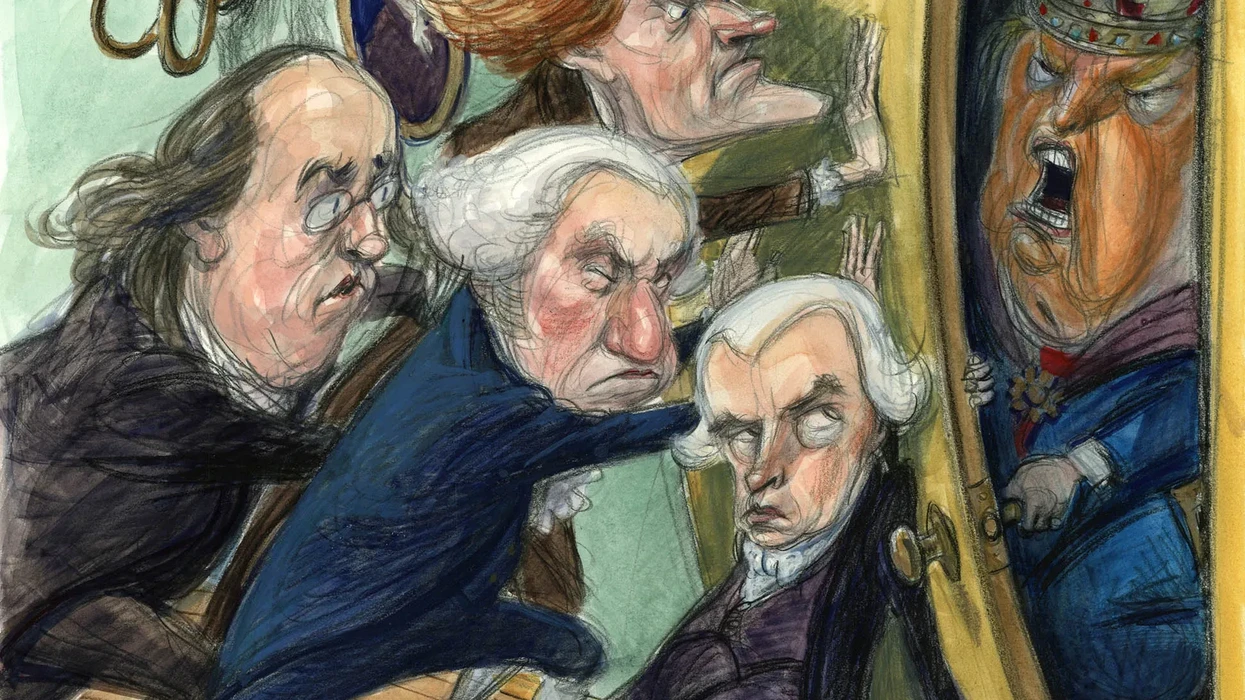
Even before Donald Trump addressed the press in the aftermath of a shooting at the White House Correspondents’ Dinner, large swaths of the online right had decided on a course for messaging: The shooting proves why the president’s potentially unlawful White House ballroom project must be completed.
It’s a nonsensical line of reasoning. For starters, the White House Correspondents’ Dinner is not an event organized or hosted by the White House — the president attends as an invited guest. On top of that, the planned ballroom would only fit about half the guests of the dinner, which can boast upwards of 2,000 guests. Even amid reports that Secret Service security was more relaxed than in previous years, the agency’s protocols worked to neutralize the gunman. It should also go without saying that the president regularly leaves 1600 Pennsylvania Ave. to attend public events, and remaining cloistered in the complex at all times is not an option.
Yet, dozens of high profile conservative commentators responded to the shooting by demanding the ballroom be embraced.
Those figures included Meghan McCain, the daughter of former Arizona senator and presidential nominee John McCain; Jack Posobiec, a prominent ethnonationalist conspiracy theorist turned White House stenographer; LIbs of TikTok, the anti-trans, anti-LGBTQ hate account run by Chaya Raichik; and a slew of other accounts boasting collective millions of followers posted basically the same message.
A few hours after the shooting, Trump appeared in the White House press briefing room and all but made the talking point official. “I didn’t want to say this, but this is why we have to have all of the attributes of what we’re planning at the White House. It’s actually a larger room and it’s much more secure. It’s drone proof. It’s bulletproof glass. We need the ballroom,” Trump said. “That’s why Secret Service, that’s why the military are demanding it. They’ve wanted the ballroom for 150 years for lots of different reasons.”
In a subsequent Truth Social post, the president wrote that “this event would never have happened with the Militarily Top Secret Ballroom currently under construction at the White House. It cannot be built fast enough,” and called for an ongoing lawsuit to block the construction of the structure to be dismissed.
And that really cuts at the crux of the matter. Trump’s ballroom — and much of the self-aggrandizing renovations and projects he’s been forcing onto Washington, D.C. — are noncompliant with federal laws and regulations governing construction on public buildings.
Trump tore down the East Wing of the White House after initially claiming it would not be harmed by his ballroom project. The demolition took place without the approval or review of the National Capital Planning Commission, the congressionally authorized executive agency which oversees federal construction. The National Trust for Historic Preservation sued the administration twice in response.
Last month, U.S. District Judge Richard Leon put a temporary stop on construction, writing that the president could resume his plans as soon as Congress “blesses this project through statutory authorization.”
“The President may at any time go to Congress to obtain express authority to construct a ballroom and to do so with private funds,” Leon wrote, as the legislative branch retained “authority over the nation’s property and its oversight of government spending.” A D.C. appeals court allowed construction to resume while the administration challenges the ruling, but in the aftermath of the shooting, Trump’s Department of Justice is outright attempting to bully the National Trust for Historic Preservation into dropping their lawsuit — accusing them of placing the president’s very life in danger by challenging him.
Acting Attorney General Todd Blache wrote in a Sunday letter to the attorneys representing the trust that “the White House ballroom is essential for the safety and security of the President, his family, his cabinet, and his staff. When the White House ballroom is complete, President Trump and his successors will no longer need to venture beyond the safety of the White House perimeter to attend large gatherings at the Washington Hilton ballroom.”
“Put simply, your lawsuit puts the lives of the President, his family, and his staff at grave risk,” Blanche added. “I hope yesterday’s narrow miss will help you finally realize the folly of a lawsuit that literally serves no purpose except to stop President Trump no matter the cost.”
They’re seemingly enlisting the help of lawmakers and influencers to get it done. Several social media users and outlets noted the swarm of right-wing influencers who posted demands for the ballroom’s completion within minutes of each other — and using nearly identical language. Accusations of a coordinated messaging campaign between the users and the White House circulated online.
Prominent lawmakers on Capitol Hill have also joined the chorus. House Speaker Mike Johnson told Fox News on Monday that the ballroom will be “a solution” to whatever problem the president imagines he is solving. “It’ll have seven-inch thick glass, so it’ll be a very safe environment to do events like that. We need a place like that and the president keeps pointing it out.” The House Speaker seems uninterested in actually exerting the approval power of Congress, as doing so would mean recognizing that the president has been operating illegally on this and a half dozen other projects for months.
There are a myriad of reasons why the claims being made about the ballroom’s necessity are exaggerated, but in the context of the White House Correspondents’ Dinner, the First Amendment implications cannot be discounted. The dinner takes place outside of the White House because, at least in its conception, it is supposed to highlight the independence of the press. They decide the venue, the guest list, the speakers, and the president attends and (ideally) subjects himself to some good-humored roasting. Placing the dinner — and other events like it — within the confines of the White House would inherently give the president and his staff far more control over who can attend, what they can say, and whether or not it takes place at all.
For an administration already obsessed with controlling how the press covers them, and punishing those whose coverage they do not like, it’s a dream come true.





 Construction of the proposed White House ballroom seen from the Washington Monument on May 17, 2026.Graeme Sloan/Getty Images
 Donald Trump greets Vladimir Putin on Aug. 15, 2025 in Anchorage, Alaska.Andrew Harnik/Getty Images
 Dana White, Mark Zuckerberg, and
 Donald Trump along with members of his family at the Sunday Night fight.
 Diego Lopes (shown) defeats Steve Garcia by KO.
 Cheryl Hines and Robert F. Kennedy Jr.
 Jim Jordan and Stephen Miller
 Some of the active members of the military who were picked to attend the fight.
 Justin Gaethje after defeating Ilia Topuria.
JD Vance attends the celebration of the Passion of the Lord on Good Friday, at St Peter’s Basilica in the Vatican on April 18, 2025.
What Does JD Vance Believe?
JD Vance has spent his adult life explaining himself to America and yet still can’t explain himself to himself. Communion is his second memoir and, theoretically, is about Vance’s conversion to Catholicism. However the crucial revelation does not occur in the Vatican or a French cathedral. No, it happens in a bleaker place: Hollywood, USA.
God had given me a unique perspective, and I learned a few things. The first is that the social competition I saw at Yale Law School replays itself all the way to the top. The Hollywood super-agent Ari Emanuel invited me to his pre-Oscar party. It was the best people-watching experience of my life. At one point in the night, someone motioned to a group entering the room and observed, “The p***y patrol”— the name our fellow guest used for Leonardo DiCaprio’s crew —“just arrived.” They caused a commotion, drank a lot, and departed before I could even catch a glimpse of Leo.
I’m not sure if Vance will ever be president, but he is already the Mayor of Humblebrag. Yale, Entourage guy, Leo, and the pussy patrol (tastefully asterisked). All in 104 words! There are more insights on the next page. Still at the party, Vance spies a billionaire — not Peter Thiel, Vance’s personal billionaire — yukking it up with Matt Damon and Denzel Washington. Vance turns to a new friend who he describes as a “minor celebrity.” His straw friend makes an observation.
“Look at them, man. It’s high school all over again. The awkward kid laughing too hard at the popular kid’s jokes. The girls floating around them. The dork paying them too much attention; the cool kid kind of ignoring them.”
Vance offers a three word kill-shot.
“He was right.”
Oh, brother.
AFTER A TERRIFYING CHILDHOOD, Vance’s adult life has been a series of express pass rides on the water slide of ambition courtesy of the American establishment. The Marines. Yale Law School. Silicon Valley and Hollywood. Creepy billionaire. (Peter Thiel kicked in $15 million to Vance’s Senate campaign.) He now lives at Number One Observatory Circle, the 9,000-square-foot office residence of the vice president of the United States, where the U.S. Navy takes care of him and his family.
Still, Vance wants you to know all those institutions suck. It doesn’t scan, as the poets say. All politicians are bullshit artists, but you have to be able to sell the bullshit. Vance wants you to believe he is of the elite but is anti-elite.
This is a heavy lift.
Vance is the youngest vice president since Richard Nixon and, well, there are some parallels. (Nixon told Henry Kissinger in 1972 that “the professors are the enemy.” Vance gave the line a shoutout in his 2024 GOP convention speech.)
Nixon became vice president at 37; Vance at 40. Both never stopped believing the elites looked down on them. Nixon eventually admitted the cost of that grievance in a speech to his staff right before resigning in 1974.
“Those who hate you don’t win unless you hate them. And then you destroy yourself.”
JD Vance needs that embroidered on a throw pillow. Nixon’s real tragedy wasn’t Watergate. That was just the final scene. His downfall was two decades in the making, a car wreck in slow motion as a talented man is slowly consumed by resentment until every moral rationalization made sense. Nixon ruled by persecution confirmation and it brought him down.
Reading Communion, I kept waiting for Vance to acknowledge that temptation in himself. In a decade, Vance has gone from the kid everyone roots for to a Trump-conjoined demagogue lying about Haitian immigrants, repeatedly stating he does not give a fuck about Ukraine or childless Americans. His story starts as a heartwarming tale of a young man who scrambled to safety via the traditional ladders of American escape. Now Vance is napalming the ladder and telling the poor folks below that it is better to burn.
Vance wants you to believe that Communion is about one man finding God. It’s not. It’s about what happens when religious conviction collides with a cult of personality. Vance argues that God must come first. Vance’s political career suggests he doesn’t believe his own faith.
Vance, a former atheist, portrays his new religion as thoughtful and ritual-bound, a thinking man’s Christianity shaped by Augustine and Aquinas. Catholicism requires patience, humility, and faith in unprovable truths. Augustine, Vance’s chosen patron saint, developed the idea of the ordo amoris — the proper ordering of loves. Politics, ambition, nation: all are worthy, but none should ever displace God.
That’s not Donald Trump.
Catholicism teaches humility and kindness. Trumpism prizes loyalty to the supreme leader. It rewards grievance over mercy, and prizes total victory over virtue. Catholicism asks believers to become better people. Trumpism asks you to bitch-slap your enemies.
It’s a conundrum for Vance. Let me take you back to the Old Testament class I took with the Jesuits at Loyola University of Chicago. In Exodus, the Israelites arrive at Mount Sinai after escaping slavery in Egypt. Moses climbs the mountain to receive the Ten Commandments. The Israelites lose patience waiting for his return. They grow antsy and aggressive. They tire of waiting on a God they cannot see and melt down their gold and construct a golden calf — a familiar idol representing power and certainty.
Moses returns and, boy, is he pissed. He destroys the calf in a fury and kills 3,000 of his wayward followers. The Israelites did not abandon religion. They traded a God who demanded patience, humility, and obedience for the quick fix. That’s the universal temptation — not to stop believing, but switching your faith to something loud, immediate and angry.
I thought about the golden calf while reading Vance’s Communion and, yes, Donald Trump’s love of all things gold meant I did not have to stress my brain.
On the page, Vance embraced Augustine’s insistence that no earthly pursuit — ambition or power — can rank above God. In real life, Vance serves as John the Batshit, evangelizing Trump, a man that demands idolatry. His commandment is singular: loyalty or death. (Just ask John Cornyn and Bill Cassidy). Trump is not a politician to his MAGA followers. He is the alpha and omega.
In the Sermon on the Mount, Jesus proclaims, “No one can serve two masters. Either you will hate the one and love the other, or you will be devoted to the one and despise the other.”
Jesus never met JD Vance.
VANCE’S STORY IS FAMILIAR by now: absent father, drug-addicted mother, raised by his Appalachian grandmother in Middletown, Ohio. Hillbilly Elegy became a conservative touchstone because it told a classic Republican story — a poor white kid rescued by grit and a profane Mamaw who preached personal responsibility.
“Never be like these fucking losers who think the deck is stacked against them,” she told him. “You can do anything you want to.”
The Vance of Hillbilly Elegy rejected conspiratorial thinking. He lamented relatives who questioned Barack Obama’s citizenship, embraced Alex Jones’ 9/11 theories, or insisted the Sandy Hook massacre was a government plot. During his book tour, he called Donald Trump’s 2016 campaign “cultural heroin” for the white working class and tweeted:
“Trump makes people I care about afraid. Immigrants, Muslims, etc. Because of this I find him reprehensible. God wants better of us.”
Less than a decade later, things had changed.
During the 2024 campaign, Vance targeted the Haitian community in nearby Springfield, Ohio, just 50 miles from Middletown. He posted that “illegal immigrants” were draining public services and that reports showed people were abducting and eating pets. Trump amplified the claim — “They’re eating the cats and the dogs” — and Haitians in Springfield received threats and harassment. None of it was true. The Haitians were in the United States legally under Temporary Protected Status. (The Supreme Court later allowed the administration to end those protections.) Jesus’ Parable of the Good Samaritan is about compassion for the outsider whom society despises. Vance cast the Haitians as the Bad Samaritans.
He didn’t retreat when CNN challenged him on his false claims.
“We’re creating a story,” Vance said. “Meaning, we’re creating the American media focusing on it.”
Vance kept creating stories once he became vice president. Renee Good was shot to death by ICE in Minneapolis on January 9 while driving around an agent at less than five miles per hour. Vance called Good a “deranged leftist” and told reporters it was “a tragedy of her own making.” Neither statement was true and Vance didn’t care.
Someone else might care. Jesus says in Matthew 25:40, “Truly I tell you, whatever you did for one of the least of these brothers and sisters of mine, you did for me.”
SO WHAT HAPPENED to JD Vance? He answers that question more honestly in Communion than he realizes:
“I am permanently terrified that things will unravel. My life quite often feels like a fairy tale, and I am certain that soon the story will end.”
That passage resonated with me. My Navy pilot father was an ardent Catholic, he went to Mass every day. Then, he was killed when I was 13. It’s hard to believe life can’t collapse overnight once you’ve seen the long black car idling in your driveway. People who grow up that way crave stability. They will cling to any anchor.
One of Vance’s priests recognized that impulse in Vance’s relationship with his wife. All of his life, the priest noted, Vance drifted from desperately relying on someone — first his grandmother — and then claiming he didn’t need anything from his loved ones.
“Your grandmother was your savior… But you can’t treat Usha like a savior. She isn’t your savior. Jesus is.”
The need for a savior explains Vance’s political transformation. He has implied that his walkback from being anti-Trump accelerated after Hillbilly Elegy was attacked as victim-blaming and as a betrayal of Appalachia (Vance never lived in Appalachia). Faced with that criticism, he could have engaged it — or sought a different kind of salvation. He sought out Donald Trump.
Trump’s central promise has always been simple: None of this is your fault. You have been betrayed, and I will smite your enemies. Whether Vance truly believes that message or simply finds it politically useful is impossible to know. But Communion recalls that Mamaw despised televangelists who fleeced desperate believers and the worshippers who collapsed at a preacher’s touch.
She might be disappointed to discover her grandson has become a little of both.
VANCE HAS ONLY BEEN a Catholic for seven years, but that hasn’t stopped him from attacking two popes and telling American Catholics not to look to the Vatican for political guidance. In Communion, he also rejects the Church’s teaching that bad actions can lead to Hell, arguing instead that our eternal destiny is predetermined by God. It’s a convenient exception for Vance who is still smiling after his Haitian immigrant and ICE in Minneapolis remarks. If you believe there are no consequences for cruelty, there is no reason to practice Christian charity.
In 2021, Vance went on Tucker Carlson’s Fox News show to lament Joe Biden and “a bunch of childless cat ladies who are miserable at their own lives and the choices that they’ve made and so they want to make the rest of the country miserable, too.”
I listened to that interview again recently and couldn’t help remembering the time I watched Carlson interview Vance during the 2024 campaign in Hershey, Pennsylvania. They reminisced about how they first met.
“We were at some massive bankers’ conference,” recalled Vance.
“I feel dirty just thinking about it,” replied Carlson, whose father married into the Swanson frozen-food fortune.
Most Americans would probably take a cat lady over a venture capitalist.
Vance now admits the remark was “one of the dumbest I’ve ever said.” (Coincidentally his approval with American women is a dismal 35-55 percent.)
He insists he was trying to say that American culture discourages people from having children by teaching them that career success is more important.
It’s a curious argument coming from someone whose own striving produced a fortune estimated at roughly $12 million.
Yale introduced Vance to Amy Chua, who connected him with the agent who launched Hillbilly Elegy, and to Peter Thiel, who financed much of his venture-capital career. Vance himself writes that Chua “deserves the most credit for this book’s existence.”
You could say the elite saved JD Vance. Now, he is Peter in the Garden of Gethsemane. He denies knowing them at all.
I guess that’s easier than examining your own culpability. Vance rails against education elites dismembering the American family, but his boss’ actual policies suggest the problem is not cat ladies or striver culture. The United States remains the only Western democracy without universal health care. Trump and Vance have cut federal Medicaid spending and oppose paid leave legislation. Meanwhile, Trump and Vance hawk tariffs that have sent the cost of housing skyrocketing even higher. (Trump said last week he didn’t care if he ever signed the bipartisan housing bill sitting on his desk.) I’d argue that America’s obsession with striver culture is less about ego and more about needing to make a fuck ton of money to afford kids in Vance’s America.
IN 2021, VANCE GAVE a speech urging conservatives to reject the institutions that made him. Speaking at the National Conservatism Conference, he called components of American education “satanic” and urged conservatives to “honestly and aggressively attack the universities in this country.” He later praised Viktor Orbán’s campaign to bring Hungary’s universities under government control.
“I think his way has to be the model for us,” Vance told The European Conservative in an interview. “Not to eliminate universities, but to give them a choice between survival or taking a much less biased approach to teaching.”
The interview was less journalism than a friendly promotional chat with Rod Dreher, the conservative writer who helped introduce Hillbilly Elegy to evangelical readers and later attended Vance’s Catholic baptism. Dreher became one of Orbán’s most enthusiastic American advocates, eventually moving to Budapest to work for the Danube Institute. He admired Orbán precisely because he used state power to build institutions that could outlast his own government.
“One of the reasons that the Orbán government is building up all these institutions… is because he knows he’s not going to be prime minister forever,” Dreher explained. “And he wants to have some sort of deep state built that will be able to survive whoever is coming.”
If you’re wondering how Vance can denounce America’s “deep state” while applauding Orbán’s version, welcome to the Matrix.
The inconsistency is personal, too. In one chapter of Communion, Vance criticizes parents who sacrifice family for ambition. In the next, he describes the relentless travel that defined his own career. This past April, he left his wife and his young children at home to become one of Orban’s most useful idiots. He traveled to Budapest and campaigned for Orbán five days before Hungary’s election.
“Prime Minister Orbán has been one of the great defenders of Western civilization,” Vance declared. “I’m here to help Hungarian Prime Minister Viktor Orbán however I can.”
It didn’t help. Orbán lost in a landslide, Dreher quietly returned to the United States, and Vance added another entry to his odd streak of unfortunate timing. Only weeks earlier he had visited Pope Francis after criticizing the Vatican’s immigration posture in Communion. Francis died the following day.
Maybe JD Vance should stay home more.
ONE OF THE FEW THINGS I remember from my Jesuit education is Saint Augustine’s teaching on just and unjust wars. Augustine believed that a nation has a duty to defend peace and punish wickedness if the cause is righteous. Vance knows Augustine’s teachings well. He chose him as his patron saint before his baptism and mentions him nine times in Communion, but, strangely, there’s no mention of Augustine’s ideas on just wars in his book.
Maybe Vance blew off that week of catechism. Ukraine’s defense against Putin’s invasion is a textbook case of a just war. Vance did not give a shit. As Russian soldiers amassed on the Ukraine border, Senate candidate Vance told noted theologian Steve Bannon that “I gotta be honest with you, I don’t really care what happens to Ukraine one way or another” before pivoting to saying he was more concerned with keeping fentanyl out of Ohio.
It wasn’t a passing thought. As a senator, Vance vehemently opposed a $60 billion aid package for Ukraine in 2024.
“I remain opposed to virtually any proposal for the United States to continue funding this war,” wrote Vance in The New York Times. He reasoned, “Ukraine needs more soldiers than it can field, even with draconian conscription policies. And it needs more materiel than the United States can provide.”
The bill passed the Senate easily, but we know what happened next. The Trump-Vance ticket was elected in November 2024. The following April, shortly after his Hungarian trip, Vance and Trump met with Ukraine president Volodymyr Zelensky in the Oval Office. The press was let in and Vance started pumping up Trump’s ego. He blamed Putin’s invasion of Ukraine on Joe Biden.
“What makes America a good country is America engaging in diplomacy,” said Vance. “That’s what President Trump is doing.”
Zelensky did a spit take. Trump had infamously vowed to end the Russian-Ukraine war on his first day, but this was proving difficult since Vladimir Putin showed zero interest in negotiations.
“What kind of diplomacy, JD, are you speaking about,” asked Zelensky. What do you mean?”
Zelensky’s pushback sent Vance — who has never visited Ukraine — into an apoplectic fit. He accused Zelensky of not being grateful for American aid, claimed he was not interested in a propaganda tour of Ukraine and advised him to “say thank you.” All of this re-animated Trump, who started barking “you don’t have the cards” at Zelensky.
Sixteen months later, Vance and Trump have been proven comprehensively wrong. Putin still shows zero interest in a negotiated settlement. Meanwhile, Zelensky’s hole cards must have been a pair of aces as Ukraine has hit Russia with a series of devastating drone attacks that puts his country in a much stronger position than when he was harangued in the Oval Office.
Vance did finally remember his “Just War” Catholic doctrine when it came to Trump’s war on Iran. After the war started, Pope Leo tweeted that God “is never on the side of those who once wielded the sword.’
Vance responded by urging the pontiff “to be careful when he talks about matters of theology.”
He then pulled out his old friend St. Augustine.
“When the pope says that God is never on the side of people who wield the sword, there is more than a 1,000-year tradition of just-war theory,” Vance said at a Turning Point USA gathering at the University of Georgia. “How do you say that God is never on the side of those who wield the sword?”
Vance’s remarks were made shortly after Pope Leo made a pilgrimage to Algeria and the ancient site of Hippo where Augustine served as bishop for 34 years. The National Catholic Reporter dryly added some context.
“Before becoming a bishop, Leo was head of the global Augustinian religious order inspired by the life and teachings of the saint; he wrote his doctoral dissertation on St. Augustine’s understanding of authority.”
It was not a match between equals.
YOU DON’T HEAR JD Vance talk about Ukraine much these days, but he still has a soft spot for Putin, whose authoritarian regime consistently has citizens falling out of windows. In Communion, Vance writes about his trip to the 2024 military summit in Munich. He gleefully recounts arguing with a Russian dissident that, actually, Vladimir Putin was quite popular in Russia, dismissing the dissident and the rest of Europe for not being willing to confront “uncomfortable truths.”
Vance returned to Munich in 2025, this time as vice president. The Europeans braced for more rhetoric about how they needed to pay their fair share for their own defense. Instead, Vance launched a cultural war.
“The threat that I worry the most about vis-à-vis Europe is not Russia, it’s not China, it’s not any other external actor. What I worry about is the threat from within, the retreat of Europe from some of its most fundamental values — values shared with the United States of America.”
Vance’s examples of European decline were breathtaking in their hollowness and hypocrisy. He complained about Romania’s recent re-run of their elections after documented evidence of Russian interference.
“We must do more than talk about democratic values. We must live them,” said Vance. (Last month, Vance told Bill Maher that the 2020 election was stolen from Trump by technology companies “that were quite literally censoring negative information about the left and promoting negative information about the right.”)
“We shouldn’t be afraid of our people,” said Vance. “Even when they express views that disagree with their leadership.” (The Trump-Vance administration spent 2025 threatening to cut off funding to universities that did not curtail anti-Israel/pro-Palestinian protests during Israel’s destruction of Gaza and grabbing foreign students in the United States on legal visas and deporting them for the crime of questioning American foreign policy.)
Vance’s moral elasticity — not one of Christ’s teachings — became clearer in June as Trump directed him to end the administration’s misadventure in Iran. Vance tossed aside his belief in the Judeo-Christian alliance being the basis of Western Civilization, telling Israel to shut up and understand “Donald J. Trump is the only head of state in the entire world who is sympathetic to the nation of Israel.”
Vance began saying nice things about the Mullah infidels in Tehran. “If you guys want to change your relationship with the United States, we will change our relationship with Iran,” said Vance. “That’s the offer, and we’re going to have to see if they meet us there.”
You could charitably say Vance was operating from a position of Christian forgiveness regarding Iran when he flew to Switzerland and signed a memorandum of understanding ending the conflict. That lasted all of two weeks. Back promoting Communion, Vance admitted to a conservative podcaster that it was actually all about the money changers.
“I think what the president’s told us to do is use this MOU to sort of refill the world’s oil economy, to refill some stocks, and then to see where the hand is,” said Vance.
And then he smiled.
THE JD VANCE PORTRAYED in Communion has his priorities straight. His loves are properly ordered: God, family, country. But you can’t just profess your faith, you have to live it. Repeatedly, Vance’s loyalties collide and there’s one clear winner. It isn’t Augustine’s God. It’s Donald Trump.
Last month, Vance made a visit to the Richard Nixon Foundation. He did not come to bury the disgraced ex-president, but to praise his fellow elite-obsessed forefather.
“If Watergate happened today, it would be about a 12-hour story,” said Vance with a smile. He believes Nixon was brought down by deep state forces “not all that different from what the same groups of people, the same institutions tried to do to Donald Trump in the first Trump administration.”
Vance left unsaid the reasons why Watergate would barely last a news cycle in 2026, so I’ll do it for him. The Trump-Vance administration’s record of illegal ICE raids, crypto graft, and rampant lawfare makes Watergate corruption look quaint by comparison, teenagers running a three-card monte on the subway.
Vance didn’t mention this. He just grinned and offered another observation.
“Young senator, vice president, writes some bestselling books, is hated by the media. It kind of sounds like JD Vance.”
Jesus wept.
Vance’s spiritual journey is now complete. God may be in his heart, but Donald Trump sits on the throne.