

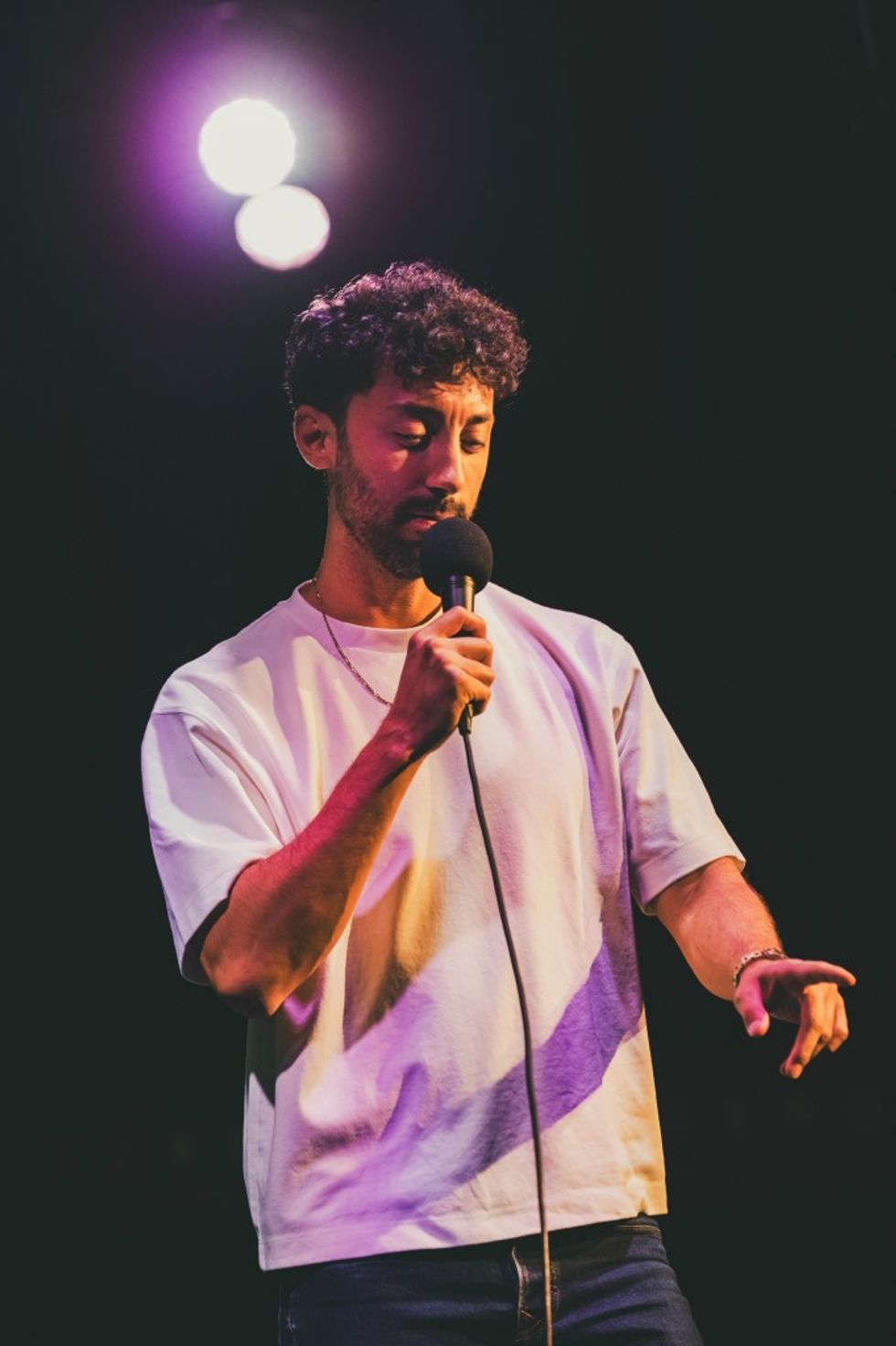
When Morgan Jay was cast on a prime-time TV show, he thought he’d finally gotten his big break.
A musical comic since 2007, Jay was sure his 2019 multi-episode appearance on NBC’s Bring the Funny would take his career from long nights and low pay to ticket sales and maybe even the hour-long comedy special of his dreams. While singing about the intricacies of modern dating and strumming along on guitar made fans of judges Chrissy Teigen and Kenan Thompson, it didn’t even “move the needle” on his career, says Jay, 37. Then, when the Covid-19 pandemic hit, he started posting clips of his crowd work — ad-libbing with audiences at old shows — and things took off. One clip blew up, Jay says. Then another. Before that, when he opened a 30-seat backyard gig, half the audience was there to see him.
“I never really wanted to be doing social media. First, you had to post on YouTube, then it was Facebook, then Instagram, then TikTok, and then it was ‘You got to be on Clubhouse.’ How many things I gotta do, bro? It was a little daunting,” Jay says. Now, he has 2.8 million followers and is in the midst of a largely sold-out comedy tour across the U.S.
When dance-heavy app TikTok went mainstream during the pandemic, an unintended side effect was an explosion of the app’s comedy landscape. For the first time, starving artists had what they usually fought for tooth and nail: time, money, and energy to create. On a good weekend of stand-up, a comedian might gain 20 new followers from several performances. In comparison, Jay’s following grew by 300,000 basically overnight.
Social media has long served as a digital audition ground for mainstream careers — there’d be no Lonely Island or Bo Burnham without YouTube, no Chloe Fineman without Instagram. But with this fresh platform — revolutionary not just for its ease of use, but also its short format and access to massive audiences — a newer question has also emerged: Is a traditional career still what these comics want?
When Kendahl Landreth first watched an episode of I Love Lucy, she knew she wanted to be a comedian. After fan-girling over her high school’s improv team (she calls them “my ‘NSync”), she took classes at the Upright Citizens Brigade, but her character work didn’t bring her stand-up success; it was TikTok audiences who fell in love with her comedic Midwestern sketches. Now, with 2.6 million followers, Landreth still does live shows, but her full-time job is creating content — one, she says, she’s grateful to have.
“It feels like such a wild thing because I was so used to performing for two people at a bar,” says Landreth, 24, who lives in Los Angeles. “I did five improv shows a week, and no one would show up. So to be able to have millions of people watch comedy I make is so bizarre. I’m a very proud content creator.”
“I used to perform for two people at a bar,” says one comic. “To have millions watch is bizarre.”
Even with more comics joining the app every day, TikTok’s reception in comedic institutions hasn’t gone as smoothly as some might hope. Take, for instance, the meteoric rise of comedian Matt Rife, who spun his strong jaw and viral TikTok crowd-work clips into 18 million followers, a Netflix special, and a sold-out world tour. On TikTok, he’s a veritable star, but mainstream comedians like Gary Gulman and Marc Maron have dunked on him (Maron dubbed him “the It boy of shitty comedy”), criticism that often overreaches to denigrate TikTok’s entire comedy scene. For comedy-focused creators, it can mean having to break through preconceived notions about the app before they can be accepted in mainstream places.
Nimay Ndolo doesn’t even call herself a comedian, even though her 2.4 million followers regularly tune in to her TikTok to watch her Gilbert Gottfried-esque, profanity-laden rants about world events, fashion, and sex. But she notes that even though comics who come up through legitimate programs might be more welcomed in the community, the label of creator gives her access to far more revenue streams, including ads, podcasting, and collaborations.
“Are [TikTok comedians] the trash of the public-facing media? I don’t know,” says Ndolo, 29. “But there is a sort of negativity involved with being an internet person.” Stricken by what she calls “quirky Black-girl syndrome,” Ndolo is no stranger to the kind of pushback that influencers can get in comedy spaces, especially when stand-up might not be a creator’s forte. But, she says, that kind of “resistance” can’t stand forever. “I do understand creators wanting to distance themselves from that. But you don’t have to shit on it. Personally, if people ask me, I tell them, ‘I’m out here,’ you know? I’m an internet bitch.” (She has noticed that her humor doesn’t always translate across platforms, like when a recent TikTok about moving to New York went viral on Twitter: “I called my apartment a hellhole, and people said, ‘Oh, no. You called the neighborhood a hellhole!’ And I tried my best to explain, but that just didn’t work.”)
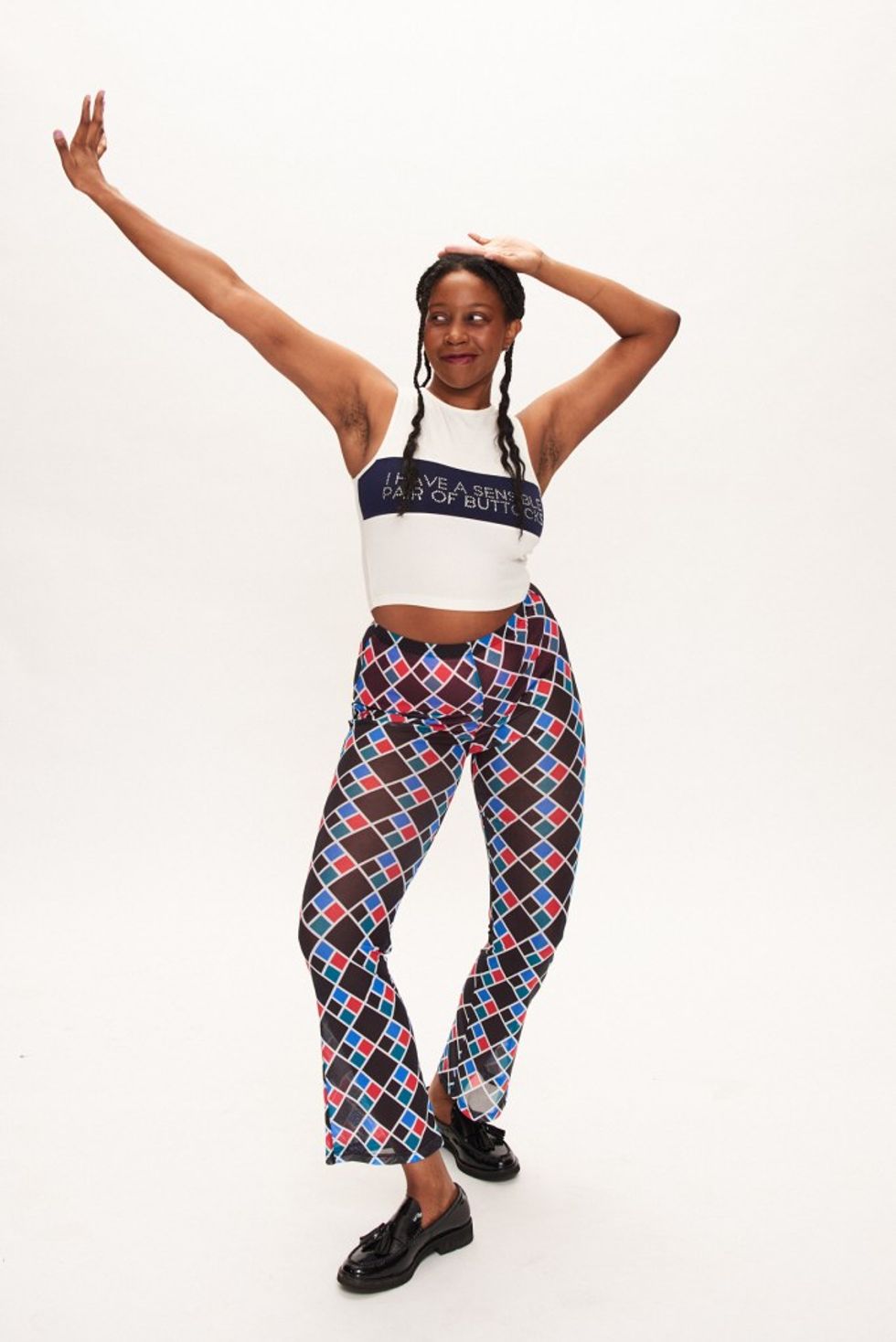
Not all comics want to spin their TikTok fame into an occupation selling their lifestyle. For Stanzi Potenza, who runs a satirical TikTok page about death, politics, and religion, building a career in comedy in New York sounded fun. Being able to pay for her epilepsy medication even after she lost her mom’s health insurance sounded better. And with 4 million followers on TikTok, being a content creator gave her the financial freedom to pursue stand-up.
“All of a sudden, I went from living at home with my mom in Boston to moving across the country to Los Angeles and financially having access to all these things that I didn’t think was possible,” Potenza tells Rolling Stone. “A lot of people don’t get to become the artists that they want to be because they financially can’t do it. TikTok gave that opportunity to the common person.”
While TikTok comedians are fighting for legitimacy in the comedy world, older institutions are beginning to actively embrace the evolving landscape. The Second City in Chicago — known for churning out alumni like Chris Farley, Tim Meadows, Stephen Colbert, and Amy Poehler — is building out its curriculum to include more instruction on social media platforms like TikTok. Its artistic director, Jen Ellison, tells Rolling Stone that comedy institutions like hers can only stay afloat by “inviting in” the changes apps like TikTok bring to the comedy space.
“[Comedy] is an evolving art form. It responds to the culture that it is in,” Ellison says. “So of course it’s going to find its way into social media. I think that not evolving the curriculum and not evolving towards digital content, TikTok, and any other app that comes down the line is a mistake. We’re still in the process of sort of rebuilding things at Second City.”
And even for comedians who don’t consider themselves only content creators, TikTok can still serve multiple purposes, as both a day job and a connective lifeline. Taking the advice of her therapist, Paige Gallagher used her TikTok account, which at that point had just 40 followers, to overcome writer’s block during the pandemic and work out new material for her stand-up and sketch-comedy group. It netted her more than 1 million followers, new collaborators, and a major career breakthrough. Gallagher attributes the popularity of her content — and other TikTok comedians like her — to people’s desires to open the app and laugh at something everyone has experienced. Not surprisingly, her most popular character is a passive-aggressive mean girl who rules the coop during high school, only to peak before adulthood.

“Relatability, and a little bit of the dark-sided humor, is something that I have always found comforting and funny when I’m seeking out comedy,” Gallagher says. “Shows or movies allow people to feel like they can go into this fantasy world, but TikTok is an amazing place for relatable comedy. I think that’s the biggest thing that it has.”
The connectedness of thousands of people laughing and sharing their own similar experiences has an allure even Gallagher herself isn’t immune to. After the recent death of her boyfriend, her account unexpectedly allowed her to connect with others who were grieving.
“I posted a ‘Get Ready With Me to Go to My Boyfriend’s Funeral’ video,” she says. “And I sort of tried to be real, but also be a little bit funny. It’s just the way I cope with things. And the amount of messages that I have gotten since then has been overwhelming. This app [has] created a community that feels real and feels close and genuine. If I didn’t have my online community, my grieving process would have looked a lot different.”
Jay notes that following his TikTok success, he no longer feels a need to reach for some of his previous goals, like that long-desired comedy special. “I’m never going to do [a comedy special] more than 30 minutes again,” he says. “Artists shape art … but audiences also have a say. And in a world where it costs $100 to go see somebody live, when they can spend an hour at home scrolling through TikTok with their girlfriend cuddling, what do you do? I wanted so bad to have that hour on Netflix or HBO. But seeing the joy and the immediate feedback that I get when I see these crowds, and I’m making a good living, all the things I thought I wanted kind of faded away.”
A comedian’s path to the stage has always been a struggle, but we’re in a brand-new world now, one where social apps like TikTok don’t just build new comics from the ground up — they’re changing what future careers in comedy can look like. And right now, the most coveted gig in the world might just be on people’s personal screens.
“Change is hard for human beings,” Ndolo says. “YouTubers were gross until YouTubers were cool. Reality-TV stars were gross until they were cool. This is just the normal cycle of what happens. Now we’re in the age of resistance. Ten to 15 years from now, those of us who are still around won’t be experiencing this backlash. It’s about knowing your audience well and knowing that they came to you for a certain purpose. They came to laugh. I make them laugh.”

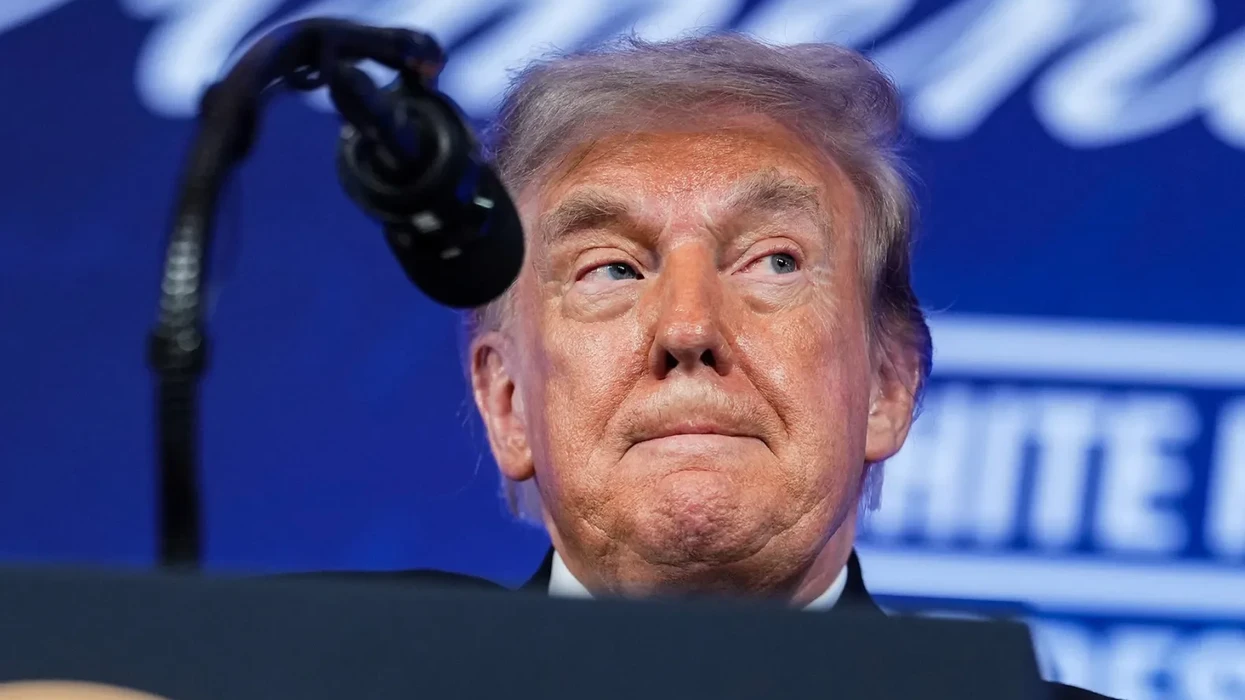

Donald Trump and FIFA President Gianni Infantino stand as Spain celebrates its World Cup victory, on July 19, 2026.
America Got the World Cup It Deserves — Good and Bad
For the past six weeks or so I’ve been having a recurring fight with my friends. The dispute is over whether or not it’s ethical to support the U.S. national team in the World Cup.
To the vast majority of people reading this article, this is an absurd question: of course you can and should support the United States Men’s National Team, you weirdo. And look, I’m with you. But despite the fact that my friends are pompous dorks who are no fun to watch the game with, the question they raise is valid: Are our national teams avatars of the administration in power, or of the people and promise of that country?
If you believe the former, then yeah, it’s pretty fucking weird to support the USMNT. In doing so, by that thinking, you’d be engaging in a sort of athletic nationalism on behalf of a country run by Donald Trump, the most corrupt president in history, who forced the Iranian national team to flee across the border immediately after the final whistle of each of their games, whose federal police have shot numerous civilians dead in the street during a brutal immigration crackdown, who has started a war and supported a genocide while covering up his close personal friendship with the most notorious pedophile in modern history.
I mean just look at him. On Sunday he waddled down onto the field to present Spain with their trophy, lingering on stage with the victorious team as they tried to celebrate. The presence of Mexican President Claudia Steinbaum and Canadian Prime Minister Mark Carney did little to dilute the image of Trump standing next to his crony Gianni Infantino, grinning at all the trappings of their power, hands caressing a trophy they’d done nothing to earn, lingering well past his cue to leave Spain to their glory. This World Cup, literally, had Donald Trump’s fingerprints all over it.
And yet, this was one of the most thrilling, beautiful World Cups in recent memory. That’s America, baby — contradictions abound.
Over the past five weeks of the greatest athletic competition on Earth, we’ve seen games that will literally never leave my memory. The final, which I attended yesterday in New Jersey, was remarkably forgettable — a 0-0 draw until the 106th minute, with Spain dominating every second of play and yet unable to score, undone time and time again by their insistence on tricksy passing and the personal heroics of Argentina’s goalkeeper Emi Martinez. The rest of the tournament, however, delivered. Cabo Verde, refusing to lose until the very last moments of the first knockout round, battling back again and again against both teams that would eventually play in the final. The sheer dominance of France’s Kylian Mbappe in front of goal, scoring at will, rivaled only by the aging GOAT Leo Messi and the Norwegian warlord Erling Haaland. England’s heroic stand at the Estadio Azteca in Mexico City, 45 minutes in the rain, a man down, holding out for the win and singing “Wonderwall” with what felt like half the stadium when it ended. Off the pitch, too: the Algerian national team being welcomed with open arms by Lawrence, Kansas; Scottish braves drinking Boston dry and partying wildly with Haitian fans that overcame so much just to be at the tournament. In Mexico, of course, the World Cup was everything, and its fans threw joyous South Koreans pumped full of tequila into the air, and celebrated in the streets with opposing fans even after their hard-fought defeat to England.
For the United States, what the 2026 World Cup was — what our team was, what our fans were, what our performance as hosts was — is a reflection of two things at once: what our nation is and what it can be.
Our star striker, Folarin Balogun, was born here by accident, a citizen only because of a birthright system that our president is currently trying to erase. We have Ricardo and Giovanni and Freeman and Zendejas. We have another striker whose name is Haji, for goodness sake. I look at that team and I see the country America can be, one in which any soul born in or living within our arbitrary borders can become part of a great national project that seeks to improve the lives of everyone it can. And yet, I can also look at that team and see a reflection of what the country is, because there is an anchor around its neck. When Balogun was — albeit unjustly — suspended for a crucial match, Trump himself stepped in. Cronyism saved the day and got Balogun reinstated, but ruined the fragile harmony the team had enjoyed. On the pitch against Belgium, they came apart. Temperamental star Christian Pulisic tried to go alone and then quit, aging defender Tim Ream’s legs failed him when he needed them most, a young goalkeeper slipped and fell when he had no good options for support.
What more can you say about a team, about our country? The team is an entity that is capable of more but still has so far to go, that is vulnerable to the same forces of avarice and selfishness and fear that plague our national identity writ large.
It’s possible to end the story there, to say good riddance to another failed year and fractured team. But I think that’s a mistake. I think if you believe that you haven’t really been watching. I think that’s also why it pissed me off so much that some of my friends wouldn’t root for the U.S. Yes, we have flaws, like every country involved in the tournament. Yes, our current team management and political government are filled with morons. But if you won’t put on the shirt you’re essentially opting out of our future. We can’t wait around for a better world, a better team, a better president, before we deign to lend our support. Progress only comes from effort, from caring, from believing in something more.
One of my favorite images of the World Cup was a crowd shot of the opening match against Paraguay in Los Angeles: every race, color and creed of American there is, all covered in red white and blue. It’s corny and trite, sure. But that’s what it’s all about. That’s why we’re here. You have to believe. The U.S. won that game 4-2. In four years, we’ll be even better.