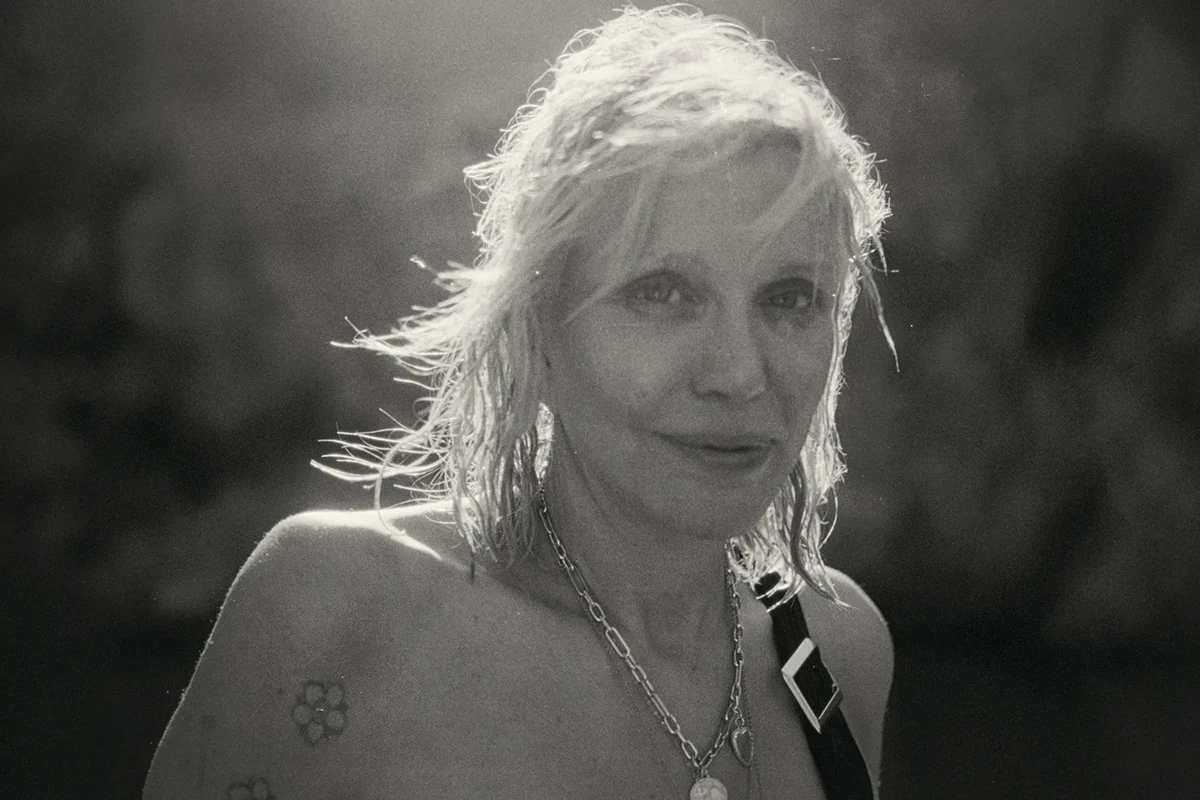

Courtney Love knows what you think about her. She’s heard the names you’ve called her as well as the praise you’ve heaped upon her, the spurious accusations and the salacious rumors, the questions about her sanity and well-being. She’s even watched some of the TikTok videos people have made that revolve around her, though she drew the line at one where she was allegedly getting sodomized by Satan. These kinds of things still affect her, Love admits. But she doesn’t have time for that negative shit now. Love has a batch of songs she’s writing, studio time she’s booked, a producer — Butch Walker — who’s there to give her the space and time to get back what Love calls her “sea legs.”
Still, the singer knows the stories and the histories that will follow her to her dying day, the ones that precede her when she walks into a room and linger like an expensive perfume or cigarette smoke when she exits it. Ms. Love would like to set the record straight. More than a few records, to be honest. And filmmakers Edward Lovelace and James Hall have turned on their cameras and handed her a mic so she can do just that.
Antiheroine, the new doc on Love that premiered last night at Sundance, doesn’t come to bury the former frontwoman of Hole, the equally famous wife of a famous rock star, and the songwriter whose gifts have too often been shoved into the backseat while the headlines about her behavior took the wheel. It’s not exactly here to praise her either, for that matter. The movie just wants to let Love rule for a few hours, and give her the chance to control the narrative regarding her past, her present, and her future. Mostly her past. And damned if Love isn’t willing to talk, sometimes candidly and other times in maddeningly vague terms, about all the hell she’s gone through to get to right now. The fact that the former outweighs the latter is what makes this cine-confessional worth checking out. It’s Courtney (Largely) Uncut and (Totally) Unfiltered.
Following Love around as she gingerly works her way through making her first new album in 15 years and chatting at length with her in London apartment, Lovelace and Hall are both impartial observers and an audience for the contemporary version of the Courtney Show. Now, Love is older, clean and sober, more forgiving, more willing to make stability a priority. Antiheroine does offer several snippets of her new material, and though Love has lost the “raging howl” that defined her singing — after we briefly see her tackling “Violet” at a karaoke bar, she laments about no longer screaming like she used to — her voice is still filled with grit, edge, hard-earned grace. One song, titled “Liz Taylor Blue,” sounds great. Both Michael Stipe and Melissa Auf der Maur contribute vocals to several other tracks. When, not if, this record comes out, it should signal a whole new creative chapter for her.
Yet Love remains determined to frame her own story after decades of having others dictate it and dissect it and distort it in the worst possible ways. Not that she didn’t invite chaos and self-destruction into her life. (“She’s been pilloried,” Stipe notes, before adding, “Sometimes for good reason.”) But as the dozens of clips of media coverage attest, the truth was often a casualty of war. So Love breaks out the old notebooks and photos, the gig flyers and mementos, and reminisces.
The running commentary is raw, ragged, and feels like it’s coming from a place where Love doesn’t give a fuck if she comes off good, bad, ugly, or worse. Her childhood in San Francisco was rough, and marked by a lack of boundaries around substance abuse; her dad gave her LSD when she was four, and the first time she had a drink was when she was 10, after her stepfather purposefully got her drunk. A stint in juvenile hall didn’t help her combative nature, but a silver lining came in the form of a counselor giving her Patti Smith’s “Horses.” She soon ended up in Liverpool at the moment punk broke, seeking and finding misadventures. Julian Cope taught her how to enter every room like she was already a star. A chance to watch Echo and the Bunnymen rehearse galvanized her even further. “I didn’t wanna fuck these guys,” she says. “I wanted to be them.”
When Love got back to San Francisco, she was determined to chase rock stardom by any means necessary. Her brief experience as the frontperson for Faith No More proved to her that she needed to call the shots and not be bound by the needs of the testosterone-laden. She relocated to Los Angeles. An ad for musicians influenced by “Big Black, Sonic Youth, and Fleetwood Mac” only received one response. It was from guitarist Eric Erlandson, and despite the “females only” disclaimer, Love took him on. Others were recruited. She stripped during the day, in order to get money for instruments and other band needs, and they rehearsed incessantly. Soon, the first iteration of Hole was born. The Sunset Strip was deep in its hair-metal phase, so Love made sure she became “the freaky chick you had to see after-hours.” These were the Pretty on the Inside years, and as concert footage attests, she was fearless and ferocious and in-your-face. The first time she screamed into a microphone, her first thought was: “I’m home.”
Love had enlisted Kim Gordon to produce that first Hole album. During a 120 Minutes interview in which the two showed up to promote Pretty, host Dave Kendall asks if Hole has any future touring plans. Love mentions that they’re planning a series of shows with Nirvana slated for the following spring. It’s the first mention of the man who’d become her husband. Love recalls that she and Kurt Cobain had been “flirting for close to a year” before that. The first time she saw him sing, the band was performing “Sliver” at a gig. By the time he got to the line “I woke up in my mother’s arms,” she’d fallen hard for him. Enter: the age of Kurt and Courtney It Couple Soap Opera.
Antiheroine covers all of that period from Courtney’s inside-the-storm perspective, and like so much of the doc, it’s equal parts thrilling and painful to hear. Yes, it covers everything from that infamous, infamously fucked-up Vanity Fair cover story to the suicide note. They did drugs, then didn’t do them, then did them again. There were a lot of flash bulbs and a lot of darkness. Mostly, however, this chapter is a reminder that, first and foremost, it was a love story. They adored their child. They were creative collaborators. She gave him ideas for lines and provided a good deal of the female energy that runs through In Utero. He gave her a deeper appreciation of melody that led to the breakthrough that was Live Through This. What happens next is no less gutting or tragic today than it was 32 years ago. But given that Hole’s album hit stores the same week (!) as her husband’s death, Love processed the grief, or rather didn’t fully process it, by playing live. If you saw them during this period, you witnessed a the band operating at peak intensity. It also felt like witnessing an exorcism.
Love credits Milos Forman for pulling her out of the spiral that happened during and after this period, and her role in The People Vs. Larry Flynt helped the public look past (somewhat) her checkered past. This is the era of Hollywood Glam Movie Star Courtney, and both Love and her old bandmates — Erlandson, Auf der Maur, and drummer Patty Schemel all recorded new audio interviews for the doc — point out that fame is a drug. Celebrity Skin follows, and so does the eventual alienation of anyone Courtney thinks is holding back her ascent into the stratosphere. Which, in her eyes, is virtually everyone. Public meltdowns and further plunges into the abyss become way too common and, in her words, “normalized.” Her daughter Frances Bean eventually files for emancipation. Things get extremely bad. “If you ever wanna nuke your life,” Love tells the filmmakers, “smoke crack.” That sentence is loaded in more ways than one.
It’s moments of blunt, borderline-brutal honesty coming directly from the source that make this whole endeavor such a necessary counterpoint to all of the mythology that’s sprung up around Love, and speaks to an accountability which she’s arrived at on the way to accepting herself. The Courtney that we see here is a woman unabashedly in her autumn years — “One of the most transgressive things you can do is to be a woman aging in public,” she says — and wiser. Still a work in progress, but also a person not willing to go gently into the dying light. There are a number of questionable choices that the doc makes in terms of aesthetics, and a late black-and-white sequence featuring Love swimming by rocks is filmed in a way that makes you anticipate a disclaimer about consulting your doctor before using some sort of new pharmaceutical.
But when Antiheroine keeps it simple and maintains a focus on the subject speaking her truth, it doesn’t just offer the inside scoop on what happened to the girl with the most cake. The movie gives you a portrait of a survivor. Love, regrettably, couldn’t make the Sundance premiere. But given the reception the movie got at the Eccles theater once the credits rolled, we wish she had. There was a lotta love in that room for her.

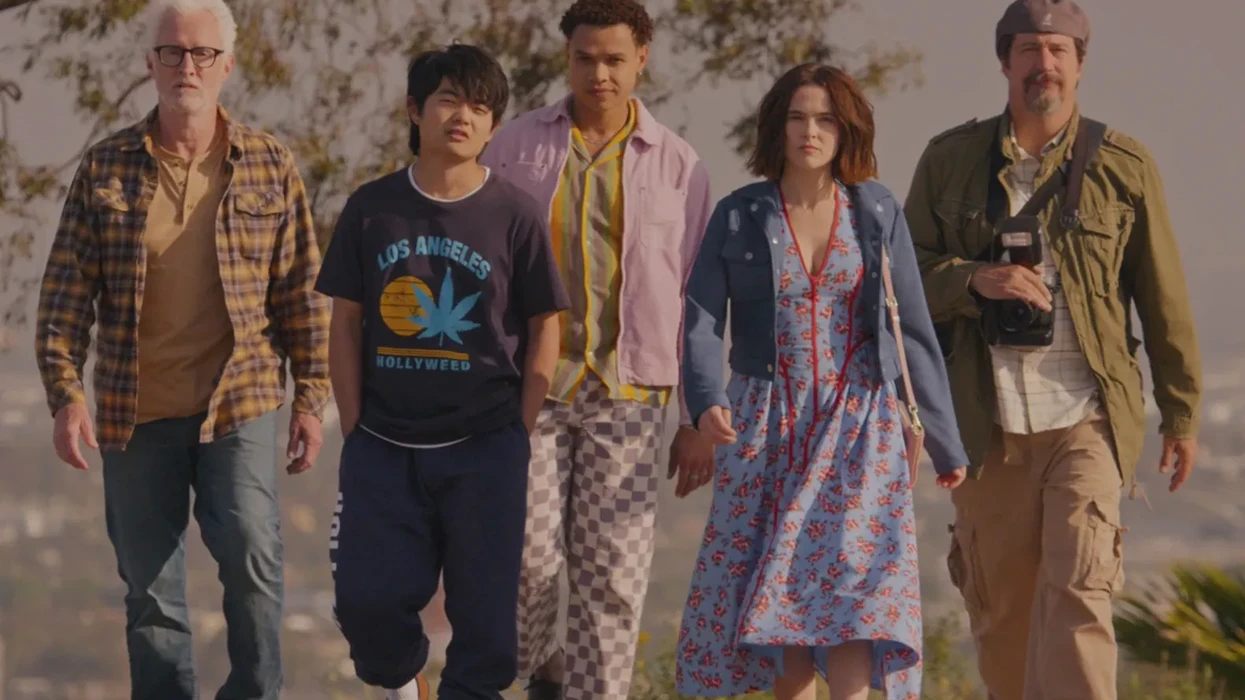
 That one dude from that TV show in ‘Gail Daughtry and the Celebrity Sex Pass.’ Sony Pictures Classics
 Dwayne Johnson in ‘Moana.’
 Margera sneaking up on his dad, Phil, in a segment from the MTV show Jackass.MTV
 Margera (left) with Ryan Dunn, who died in a car crash in 2011.MTV
 Johnny Knoxville and Margera in 2002’s Jackass: The Movie.©Paramount/Everett Collection
 Wolfson, in a scene from Best and Last, has stayed close with the whole cast (from left, Wee Man, Dave England, Preston Lacy, Jasper, Knoxville, Chris Pontius, and McInerney). “I cherish any time I get with them.”Sean Cliver/Paramount Pictures
 Wolfson (with, from left, Chris Pontius, Eric André, and Eric Manaka) getting “scorpion Botox.”Sean Cliver/Paramount Pictures