
Jack Thorne finds it ironic now, but the first copy of Lord of the Flies he ever read was technically stolen.
His mother was a substitute English teacher — known as a supply teacher in the U.K. — and had a school copy of author Henry Golding’s seminal book about a group of schoolboys stranded on an island who quickly lose their sense of right and wrong on a bookshelf at home. “I was a terrible sleeper as a kid, so I would pick up books and read them through the night,” Thorne tells Rolling Stone. “I started reading this book, and I was utterly compelled.”
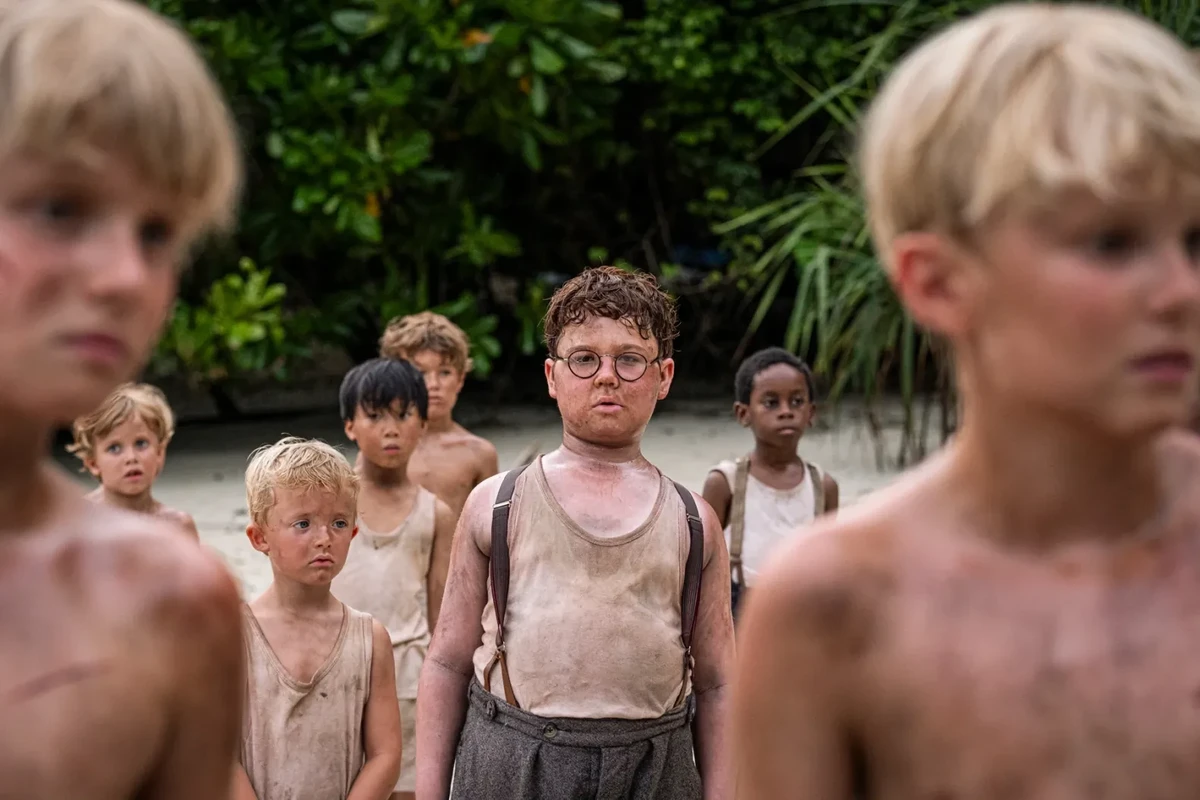
Now, that obsession is the first television adaption of Lord of the Flies, out now on Netflix. Since its publication in 1954, Lord of the Flies has become one of the most well-known novels in the canon of British literature for its nuanced exploration of human nature. The AP English-class staple revolves around a stranded group of boys who attempt to create order while waiting for rescue and instead fall into violence and chaos. There’s Ralph (Winston Sawyers), who’s elected leader; Piggy (David McKenna), the responsible intellectual who emphasizes order; Simon (Ike Talbut), the comic relief; and Jack, (Lox Pratt) the often-cruel but charismatic voice of chaos within the group. The story is full of religious subtext, childhood anger, and corrupting groupthink, and has inspired everything from original film adaptations like 1963’s Lord of the Flies to ambitious reinterpretations like Showtime’s Yellowjackets. Now, it’s Thorne’s turn — but the writer tells Rolling Stone the most modern thing he could think of a TV adaptation that’s as true as possible to Golding’s original work.
“We’re living in a really exciting time in terms of television, where we can be specific and local, and people can take global stories from it,” Thorne says. “It’s a form unlike any other in that its vocabulary is so strange. And if you lean into that strangeness, beautiful things erupt from it.”
Prior to Lord of the Flies, Thorne co-created the hit series Adolescence, an Emmy-winning limited series about a teenage boy radicalized by manosphere content online and eventually convicted of murdering his female classmate. But while audiences might expect another excoriation of masculinity, Thorne’s Lord of the Flies finds its edge by doubling down on the sweetness of young boyhood.
“When I was a kid, I hated Jack and saw him as a very black-and-white character. I knew who he was on the playground — that person who would happily damage me. And when I read the book, I just saw that cardboard cutout of evil,” Thorne says. “Through my twenties, through my thirties, I started to see the tenderness with which Golding wrote him.”
Out now on Netflix, Lord of the Flies begins with chaos. A group of British schoolboys is on a plane when it crashes on a tropical island. None of the adults on the plane survive. The group devises a plan to keep order, which includes using a conch shell to call meetings and delineate when a person wants to speak. You want to speak — you hold the conch. They start with building shelter, finding food, and keeping a signal fire constantly lit to draw in rescuers. But as the days drag on, factions form and the group devolves into anarchy, violence, and rage.
The new series spends each of its four episodes centering on the story of a different boy in the group. Ralph, Piggy, Simon, and Jack all have different instincts when faced with a sudden lack of adults. But Thorne says while each of the boys represents clear archetypes, he doesn’t think the show is just about human nature. For him, it’s about playing pretend going terribly wrong.
“Lord of the Flies is about boys in a time of war who are being socialized by ideas of bravery and manhood and rage and hate. They are then reflecting these stories as they arrive on this island,” Thorne says. “They’re trying to act like grown-ups and work out what grown-ups would do. And unfortunately, the grown ups that they’ve spent time with or been absent from are grown-ups dealing with their own damage.”
The series was filmed in Langkawi, Malaysia, immediately after filming on Adolescence wrapped in England, which Thorne says made it impossible for the two projects to not speak to each other. There were 40 young actors on the island, many of whom had auditioned for the main four roles but hadn’t been chosen. Thorne notes that the difficulty of managing such a large group in order to get filming done actually added to the realistic nature of the series.
“When you’ve got a big group scene of adults, the adults play that scene when you say ‘action.’ When it’s a group of kids on a beach, actually getting them to concentrate for that length of time is complicated,” Thorne says. “There’s a beautiful scene in episode one where these young kids are just playing with sea snails on the beach. [Director] Mark [Munden] literally filmed them playing like a documentary. That’s not scripted. That’s what they wanted to do.”
When Adolescence was released in 2025, the series drove months of conversations around the radicalizing nature of the manosphere, an online subculture that glorifies violent and dehumanizing rhetoric against women. So it’d be an easy next step to use Lord of the Flies and its setup to double down on cruelty, violence, and bloodshed. But Thorne says while both Adolescence and Lord of the Flies tackle the power of influence, the new show also aims to explore how much kindness the boys tap into as easily as brutality.
“One of my favorite scenes in the show is Jack climbing up [a steep cliff] to try and get a piece of aircraft. Jack becomes paralyzed, terrified, and he’s not able to come down. And then Roger comes up after him and Morris is standing at the bottom, and they’re both really concerned for him,” Thorne says. “These are boys that are capable of monstrous acts, but in that moment, it’s this quiet love. They don’t talk about it. They just are there for each other. And I think it’s really important to show those aspects of Morris and Roger and Jack at the same time as you show them dancing on a boy’s body.”
When writing the television version of Lord of The Flies, Thorne thought a lot of his own son, Elliot, a 10-year-old he describes as a “complicated ball of love.” But while the show is inspired by and stars children, Thorne firmly believes that kids aren’t the only ones who have things to learn from this new version of the age-old story.
“Golding wrote this at a time of horrific extremism. And as a society, we’re seeing real complications arise in our world that might lead to quite barbaric consequences,” Thorne says. “Children are a reflection of us. How can we expect our next generation to build a better world, if what we’re teaching them is hate?”





 Exterior image of the Lucas Museum of Narrative Art Lucas Museum of Narrative Art
 Matthew Kroening/Lucas Museum of Narrative Art
 Star Wars props of Darth Maul and General Grievous Iwan Baan/ Lucas Museum of Narrative Art


 Anthony Ippolito stars as Sylvester Stallone in I PLAY ROCKY, from Amazon MGM Studios. Photo credit: Claire Folger © 2025 Amazon Content Services LLC. All Rights Reserved.


 The Pretenders photographed at Toad's Place in New Haven, Connecticut on March 25, 1980.


 McCollough in Los Angeles, 2023 Pete Lee


 Reggie Watts during The Late Late Show With James Corden in 2016 Terence Patrick/CBS/Getty Images
 McCollough with sister Colleen Courtesy of Colleen McCollough