
It was the casual giraffe cameo that broke me.
You will have your own OMG WTF moment of no return, your own personal crossing of the Rubicon regarding Michael, the much-heralded (by its producers) biopic on Michael Jackson, in the same way you have your own favorite Jackson song. Maybe it’s one of his early hits with the Jackson 5, the band that the seven-year-old Michael was in with his brothers. Or possibly a track from his 1979 smash solo album Off the Wall, or the juggernaut follow-up, Thriller, or the last of his Quincy Jones collaborations, Bad. Unless it’s a deep cut, you’ll likely hear a large snippet of your go-to M.J. jam before the end credits of this film, given that the Jackson estate is literally banking on your fond memories of hearing the King of Pop’s music at the expense of other, more complicated thoughts around him.
- YouTube youtu.be
But back to the giraffe. By this point in director Antoine Fuqua’s retelling of Jackson’s story from creative cradle to, well, way before his reputational grave — the film conspicuously stops at 1987 — we’ve seen the young Michael (Juliano Valdi) practicing with his siblings in Gary, Indiana, and clearly distinguishing himself as a child prodigy with a soulful falsetto. We’ve watched Joe Jackson (Colman Domingo) rule over the household and Michael’s delicate psyche with an iron fist, a hair-trigger temper, and a leather belt always in reach. We observe Michael recording with Motown, and basking in the much-needed positive affirmation from surrogate father figure Berry Gordy (Larenz Tate). There will be montages, legions of them, but we’ll have seen the first of many as the Jackson 5’s mega-bop “ABC” overtakes the Beatles’ “Let It Be” for the Number One spot on the charts in 1970.
We have sped through the Seventies, in which Joe has established his Jackson Inc. empire in Encino, California, and Michael has already begun hanging out with a menagerie that ranges from llamas to rats. There is a scene of young M.J. explaining to his family that the large rodents aren’t just best known for dragging pizza slices down subway stairs, but are beautiful, loyal creatures. That the filmmakers didn’t score it to “Ben,” the title track to Jackson’s 1972 album that doubled as a theme to the rat-revenge horror movie of the same name, is a missed opportunity. The sequence is set in 1971, a year before both the song and the movie came out, but look, it’s not like accuracy is this film’s main objective. The biopic has got other, far more pressing concerns on its mind, like the multitude of dollar signs floating before its eyes.
 Juliano Valdi, center, and the rest of the Jackson 5 in Michael Lionsgate
We have met the adult Michael Jackson (Jaafar Jackson, a.k.a. Michael’s IRL nephew), ready for emancipation and a chance to get the new music in his head on wax. We have met Bill Bray (KeiLyn Durrel Jones), Michael’s security guy, so omnipresent in the film that he could be considered a co-lead. We’ve met Quincy (Kendrick Sampson), and Katherine Jackson (Nia Long), the lone island of sympathy and sanity in the Jackson mansion, and a computer-generated version of Bubbles the chimp that is the stuff of nightmares. More important, we the viewers have been introduced to the most saintly corporate lawyer to ever walk God’s green earth, John Branca (Miles Teller). The fact that Branca is a producer on the film has nothing to do with his portrayal as the human version of the pet llama that loves Michael unthinkingly and unconditionally. Also, so far as we know, the llama never visited Jackson in the hospital after that Pepsi commercial went horribly awry — we’ll get to see that, too — and gave him a stuffed Mickey Mouse doll, which Branca does in the movie, so bonus points for Branca.
Having impressed his client in a meeting by saying he believes M.J. is destined to become the greatest, biggest, most unstoppable pop star in the world, Branca is then tasked with liberating Michael. Joe is lording over his fiefdom from his den, designed in perfect Don Corleone-chic decor, when his fax machine buzzes to life. The lawyer has fired the patriarch from his self-appointed job of being Michael’s personal manager. Colman Domingo’s performance, easily the most compelling and psychologically complex element within Michael, has already been pitched somewhere between “King” Richard Williams and Richard III. Never mind that his mustache is modest — he’s essentially been twirling it for over an hour. When he sees his world crumble courtesy of a single piece of fax paper, a parade of emotions plays across his face. Betrayal! Righteousness! Sorrow! Angst!
And then, right as Joe’s already prevalent rage is on the precipice of going nuclear, a CGI giraffe nonchalantly strolls past a third-story window in the background.
 Colman Domingo as Joe JacksonCourtesy of Lionsgate
It’s this mix of the head-spinning and the jaw-dropping, the ridiculousness that aches to be sublime and ends up being the purest distillation of camp, that characterizes Michael as a whole. Yes, we know, haters are gonna hate, etc. And fans, the ones who are willing to view any suggestion that Neverland wasn’t Eden with a Ferris wheel as an attack, will treat this blockbuster-level biopic as a victory lap. And the people who are invested in Jackson’s legacy are going to make a lotta money off its version of Michael as a victim of horrific abuse and emotional blackmail by his monstrous pops, who, despite it all managed to become a beloved global superstar.
We were never going to get a real biopic of Michael Jackson, of course. There are too many contradictions, too long a list of things that require confronting, too much gray area to reconcile. Better to just blindly celebrate a universally recognizable back catalog and let Mike Myers do a “Coffee Talk”-level imitation of Walter Yetnikoff, right?
That doesn’t mean, however, we were destined to get a movie where Michael plays a game of Twister with Bubbles, regularly drops platitudes like “Music can bring everyone together” (can we get a fact-check on this?), and moonwalks away from anything remotely resembling a deeper look. You may have heard that the film was delayed because of issues around allegations and lawsuits and settlements, and that Fuqua had filmed an FBI raid on Neverland that would have clearly leaned heavy on the side of Jackson over the accusers. That had to be scrapped for legal reasons, though it’s hinted that such sequences may show up in potential sequels. Given what happens after 1987, maybe the Jackson Cinematic Universe is best left as a one-off endeavor.
This isn’t really a biopic. This is the Passion of St. Michael, rendered with great fidelity to and emphasis on both Jackson’s undeniable suffering and equally undeniable talent. Jaafar Jackson does bear an uncanny resemblance to his late uncle, and clearly knows how to replicate his signature moves, his physical fluidity, his beaming smile reserved for fans, animals, and hospital residents. But watching Michael’s greatest hits — the Motown 25 showstopper, the “Thriller” video choreography, the gang-member summit turned dance rehearsal that begets “Beat It” — reproduced with such stunning accuracy is, frankly, a little depressing. You’re reminded of the first time you heard Jackson’s music, and how overwhelming the hooks, the production, the chops, the sheer energy that characterized his live performances and videos earned him the title the King of Pop.
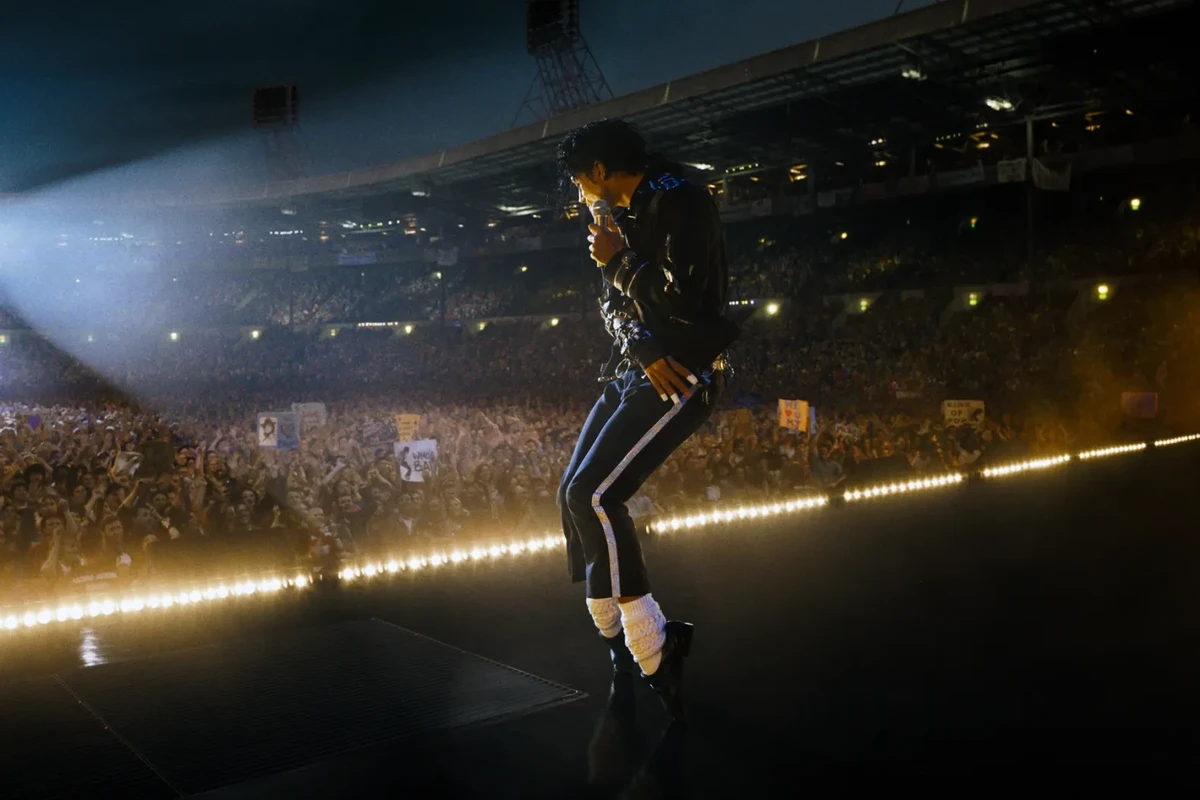
And you’re also reminded that such things are still tainted, even if the movie twists itself into knots to circumvent such thinking, and the level of innocence required to listen to those hits is long gone. “His story continues” declares an end title card, as the echoes of a London stop on the Bad tour fade on the soundtrack. To paraphrase a Jackson song: Please stop. We’ve had enough.