
Skip to content
Search

Chris Grey

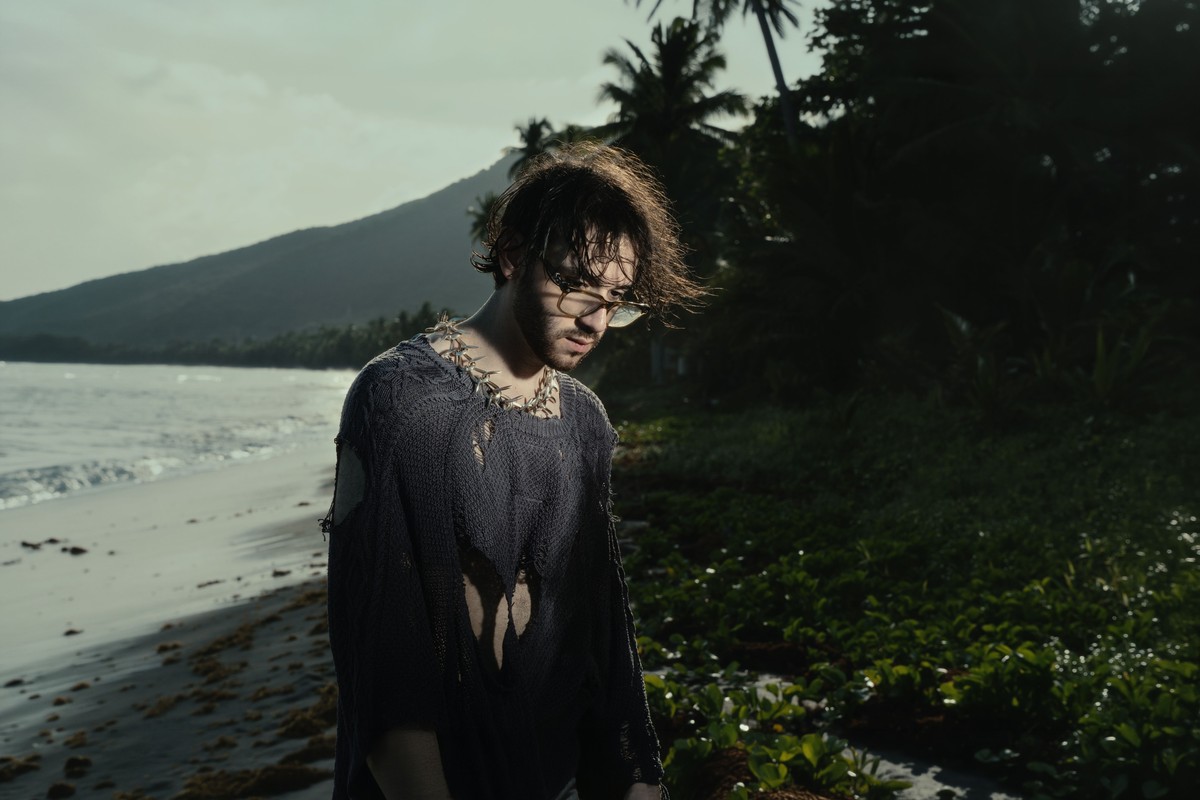
He built his sound in isolation, then watched it travel everywhere. Now, he’s figuring out what to hold on to.

Chris Grey

Chris Grey

Max Durante

The first signs of “Let The World Burn” taking off didn’t come in a neat, trackable way for Chris Grey. It showed up in bits and pieces. A random gym video, an anime edit, someone flipping the song into something that didn’t even feel like the original anymore. Within days, it had moved far beyond anything he could’ve planned, landing in corners of the internet he wasn’t aiming for in the first place.

That loss of control is something Grey seems comfortable with, mostly because of how controlled everything is on his end. His process starts alone, building ideas from scratch, shaping them layer by layer before anyone else hears them. He’s not jumping between ten people in a room or chasing quick outputs. It’s slower, more internal, and it shows in the way his music holds together.


Even when the songs get intense, nothing feels accidental. There’s emotion, but it’s held in place. The instinct is to push things as far as they can go, then step back and figure out what actually needs to stay. That balance between going overboard and pulling it back is what gives his records their weight without letting them fall apart.

Now, with more people finding his music through moments he didn’t manufacture, Grey isn’t trying to repeat the formula. If anything, he’s sticking to the same approach, letting the process lead instead of trying to keep up with where the internet takes things next.

Your music feels very intentional from a production standpoint. How much of that world are you building yourself?

Almost entirely. I produce most of my records alone, and even when I bring in collaborators, I’m still guiding the overall direction. I actually started out producing before I ever really focused on writing or singing, so that foundation is core to how I work. There’s something addictive about hearing a fully realized version of an idea that started in your head.

“Let The World Burn” really took off online and brought a lot of new listeners in. What did that moment show you about how people are discovering your music now?

I think it showed me how fast things can move in this current moment and how little control you actually have over where a song goes once it’s out. In the span of a week, it went from being another song in my catalog to one of the biggest songs in the world. It was definitely a whirlwind to catch up to that. It’s been cool to watch all the different communities that have embraced that song. One of my favourite things to watch was seeing how different communities made it their own and put the song in completely different worlds. Gym communities, anime, BookTok, Stranger Things edits, K-Pop edits, relationship videos, and car edits, just to name a few. It stops being your song at that point. I think all the covers were a big part of that, too. Hearing people reinterpret it in their own way made it feel bigger than just me.

Your music leans into darker, almost cinematic textures while still sitting in R&B and pop. Where did that instinct to build something that layered come from?

I’ve always been drawn to songs that feel like they evolve and escalate, and by the end, it’s almost overwhelming in a good way. Growing up on artists like Queen, Ozzy Osbourne, and Michael Jackson, there was always that sense of scale and drama in the production. I think I’m always chasing that. My process is usually to take things too far, stack too many elements, push it emotionally and then carve it back until it still feels big but focused.

Your songs carry a lot of emotional intensity, but the production is very controlled and precise. How do you balance those two sides when you’re making music?

I don’t really see them as separate. The production exists to serve the emotion of the song; if it’s not doing that, the song isn’t working. In that case, either I scrap it or I rework it. A good example is “Wrong.” The original demo had a four on the floor drum groove, and something just felt off. I didn’t immediately know why, but after sitting with it for most of a year, I went back in and shifted it to more of an R&B/trap groove. It completely changed how the emotion came across.

When your sound is this distinct early on, is there ever pressure to stick to it, or are you actively trying to push against it with new work?

I’m aware of it, but I don’t feel boxed in by it. I think what helps is that it’s a sound I love and still feels authentic to me. So it’s not like there’s a completely different genre I’m itching to make but can’t. That being said, I want to keep things fresh and as a creative, I think making something that sounds new is always more exciting. Going into uncharted territory. I think collaborations, especially across genres, can be a way to explore that.

When you think about the future of music in Canada?

I think it looks brighter than ever. Canadians have been dominating the charts lately, and I don’t think that will stop anytime soon. I would love to see more infrastructure for those artists to stay in Canada if they want to. I’ve talked to a lot of Canadian artists who felt like they needed to move to LA to keep moving forward. I haven’t felt the need to leave personally, but I think the next step for Canada is building an environment where artists don’t feel like they have to to compete globally.

Can you share details of the projects you’re working on in 2026?

The honest answer is I don’t know exactly and I’m kind of excited by that. I have a blank canvas right now, which I haven’t had in a while. I’ve been making music without overthinking where it fits, and I want to let that process shape what the next project becomes instead of forcing it too early. I do know I want to bring in some new collaborators and see what comes out.

More Stories

How to Attend a Concert and Not Ruin It for Others
Gabrielle Ravet for Rolling Stone

How to Attend a Concert and Not Ruin It for Others

Back in 2013, we took it upon ourselves to remind music fans that it’s our duty to remain at least somewhat civilized when we attend concerts. We weren’t asking people to stop drinking, dancing, and having fun. We just wanted them to stop acting in super obnoxious ways that annoyed everyone around them.

Sadly, the world didn’t listen. In fact, 2013 seems like a quaint and respectable age now that we’re all living in the twisted dystopian hellscape of 2025. Cellphones were hardly a novelty back then, but most people could at least remember a time back then when they weren’t surgically attached to our hands 24/7. Instagram was fairly new, TikTok was barely a glimmer of an idea in the collective mind of the Chinese Communist Party, and the pandemic hadn’t robbed us of basic social norms that we used to obey when we left our homes.

Keep ReadingShow less
Madonna Finds a Nonstop Groove on Her Best Album in 20 Years
Rafael Pavarotti*

Madonna Finds a Nonstop Groove on Her Best Album in 20 Years

“People think dance music is just superficial,” Madonna announces early on her excellent new album, Confessions II. “But they’re all wrong. The dance floor is not just a place. It’s a threshold, a ritualistic space where movement replaces language.” That’s the threshold where Madonna has spent her whole life. Ever since she blew up in the Eighties, pop’s queen of queens has devoted her career to proving how complex, how dramatic, how ecstatic a dance floor can be.

On Confessions II, Madonna returns to the floor, the place where she always goes to rediscover herself. It’s a sequel to one of her most beloved albums, Confessions on a Dance Floor, her 2005 collaboration with the London disco master Stuart Price. But it’s also her best album since the original Confessions 21 years ago. It’s a 64-minute nonstop groove that flows like a club-DJ set, each song fading into the next, drawing from all over the history of dance music. You might hear a flicker of “I Feel Love” here, or “Apache” there, but it’s a history lesson that she turns into her musical autobiography.

Keep ReadingShow less
Bob Dylan Hired a New Guitar Player, but Big Questions Linger

Dylan onstage in 2023. He debuted his latest guitarist, Joel Paterson, in Austin on Monday.

Gary Miller/Getty Images

Bob Dylan Hired a New Guitar Player, but Big Questions Linger

Bob Dylan‘s June 29 show at the Moody Amphitheater in Austin was supposed to just be a standard stop on a long tour that’s scheduled to run through the end of the year. But after guitarist Doug Lancio left the band two weeks ago, replacement Julian Lage had a prior commitment in Brooklyn that night, and second guitarist Bob Britt suddenly quit the group with a “Sayonara Bobby” Facebook post a couple of days earlier, nobody knew who may be joining Dylan, bassist Tony Garnier, and drummer Anton Fig that night.

In the fan community, speculation ran wild: Might Jimmie Vaughan step into the void? Would Lancio return? Was there any chance that a beloved past member of Dylan’s group like Larry Campbell or G.E. Smith would come back for an encore run? Was there a scenario where Dylan, Garnier, and Fig play as a Ben Folds Five-style trio? Could Britt pull a reverse “sayonara” and come back to help Dylan out of his jam? And would Dylan have just one guitarist in the band for the first time since the John Jackson days of 1991, or might we see the debut of two new members?

Keep ReadingShow less
What Will Be Taylor Swift and Travis Kelce’s First Dance Song?
Kevin Mazur/Getty Images

What Will Be Taylor Swift and Travis Kelce’s First Dance Song?

Taylor Swift is not the kind of girl who is going to pick just any song at her wedding. So when it comes to the big first dance, you know it will be deeply meaningful and meticulously planned out. “You would think that I had been the type of person who would have obsessed over the idea of a wedding my whole life,” she said last year after her engagement, “but I actually never thought about what I would ever do or what I would want until I met the person.” Sure, Taylor, sure.

As a pop superstar, she can practically guarantee a live rendition of whatever classic she wants from just about any living musician. She’s also been a huge fan of several songbooks, showing love for everyone from Carole King to the National. There’s still a lot up in the air about the wedding of the decade century, and we’ve got burning questions about all of it, including if it’s even happening this weekend. But as we presumably get closer to the big day, we compiled a list of top song selections we think could make the first dance cut.

Keep ReadingShow less
YG Gets Brutally Honest at ‘The Gentlemen’s Club’
Brandon Almengo*

YG Gets Brutally Honest at ‘The Gentlemen’s Club’

In an interview posted on his YouTube account prior to the release of his seventh album, The Gentlemen’s Club, YG recalled a conversation he had with Kendrick Lamar about the importance of quality control. “I’m telling him about what I was doing, like putting out albums just to get out the deal ’cause my deal [with Def Jam] was fucked up,” he told his interviewer, DJ Hed (YG is now signed with 10K Projects through his 4Hunnid imprint). “[Kendrick] was like, ‘Bro, you ain’t never supposed to do that. You gotta give it your all every time.’”

Indeed, The Gentlemen’s Club signals a renewed focus on building narratives with his distinctively aggressive Bompton persona. It evokes his famed run from over a decade ago, when the rapper rose to stardom with 2014’s My Krazy Life and 2016’s Still Brazy by revitalizing the kind of street-conscious perspectives that the West Coast has long produced, from Ice Cube to the late Nipsey Hussle (who co-starred with YG on his deathless anti-Trump anthem “FDT”). But YG hasn’t scored a major Billboard hit since 2018’s “Big Bank.” His music in recent years has been typified by high-carb, low-nutrition radio bait like “Go Loko,” a bizarre number where he and Tyga shuffle along with Speedy Gonzales-styled accents, and “Toxic,” which lifts Mary J. Blige’s “Be Happy” nearly wholesale. (To be fair, his 2019 “Slide” collaboration with H.E.R. is romantic and enchanting.) In 2025, YG signaled a return to less irrelevant work with “2004,” a startling confession where he reveals he was sexually assaulted at 14 by a woman older than him. “Ever since that day, I’ve never looked at shit the same,” he rapped. Yet the stakes around his career can’t help but feel lower now.

Keep ReadingShow less