
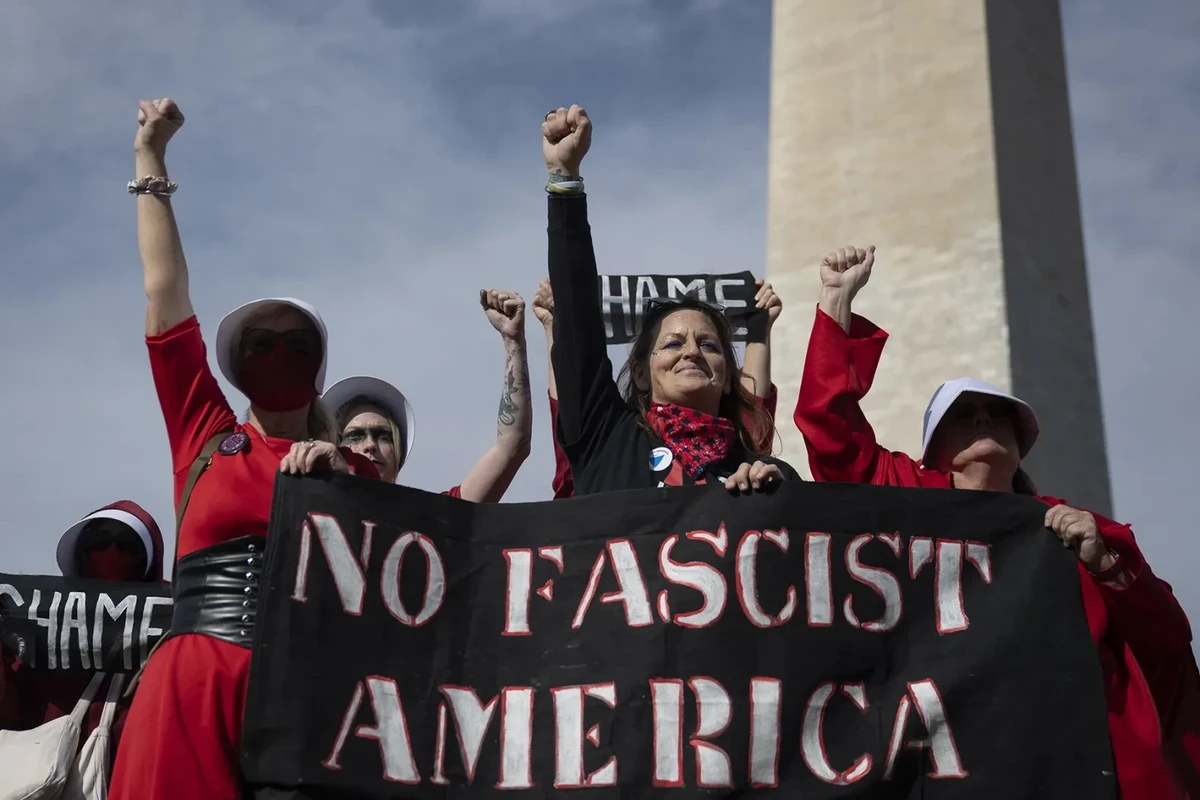

On the bright, clear morning of Nov. 5 in Washington, D.C., the anti-fascist hordes gather near the base of the Washington Monument. Many are gray haired and kind of frail looking; few are wearing all black, and almost none are masked. Some dance around in inflatable animal costumes, and a contingent dressed as handmaids in dark-red robes and white bonnets carry signs that read “Shame.”
Milling through the crowd near a stage on the south side of the monument is Sunsara Taylor, exuding the slightly frantic air of someone who’s just arrived at her own party. Taylor is a leader and co-founder of Refuse Fascism, the group that organized today’s protest and the march through the streets of the capital that will follow. If you’re thinking it might be an unnerving moment to be the most visible representative of an organization that spells out its anti-fascist intentions right there in its name, you wouldn’t be wrong.
In late September, about six weeks before the protest at the Washington Monument and two weeks after the assassination of far-right activist Charlie Kirk, the Trump administration released a National Security Presidential Memorandum it claimed was intended to counter domestic terrorism and organized political violence. The memo, known as NSPM-7, laid the blame for Kirk’s killing, as well as other occurrences — including a shooting at an ICE facility in Texas, a supposed spate of “anti-police” riots, and attempts on the lives of Supreme Court Justice Brett Kavanaugh and Donald Trump himself — on “violent and terroristic activities under the umbrella of self-described ‘anti-fascism.’”
Here at the Washington Monument, they look somewhat less fearsome than advertised.
NSPM-7 is hardly the only example of the administration blaming a host of evils both real and imagined on anti-fascism, or “antifa.” There have been executive orders, a televised roundtable discussion at the White House, congressional hearings, and countless media appearances during which the president, his Cabinet members, staff, and surrogates have conjured the phantom menace of antifa as the greatest threat to American freedom and security. After an ICE agent shot and killed Renee Good in Minneapolis in early January, the administration immediately labeled the unarmed mother a “domestic terrorist,” and the FBI began probing her past of so-called activist ties.
“It’s a strange time,” Taylor tells me. “That they’re seizing on the assassination of Charlie Kirk to further demonize and criminalize any opposition is totally out of the fascist playbook. The fact that the stakes just went higher doesn’t make us less determined. It makes us more determined.”
Taylor has dark-brown hair and owlish glasses, but she’s more fiery than bookish. We’re standing about 20 yards from a podium where, in the next hour, several speakers will address the rally, including National Organization of Women President Kim Villanueva; Michael Fanone, an ex-police officer who was attacked by pro-Trump rioters while defending the Capitol on Jan. 6, 2021; and Taylor herself. The crowd today will grow to somewhere between 1,500 and 2,000 people, decent numbers for midday on a Wednesday, but not exactly what Taylor was hoping for.
“We were aiming for hundreds of thousands or millions,” she says. “No Kings showed there’s that reservoir of people.”
 Sunsara Taylor (right, with Michelle Xai) is a leader and co-founder of Refuse Fascism.Juliana Yamada/Los Angeles Times/Getty Images
In mid-October, more than 2,500 coordinated No Kings rallies drew an estimated 7 million nationwide, and the vibe today — simultaneously festive and angry — echoes those events. But there are important differences.
For one, while No Kings’ turnout was impressive, its somewhat hazy goals — electing more Democrats in the 2026 midterms, promoting future rallies — struck some as insufficient. Refuse Fascism, on the other hand, has a clear, easily articulated aim, which is chanted by the attendees today and plastered everywhere including the orange T-shirts Taylor and most of the group’s volunteers wear: “Trump Must Go Now!” Today’s events are a launch for what Refuse Fascism’s leaders envision as a persistent siege of the nation’s capital featuring near-daily protests, which they hope will create a political earthquake that leads to Trump’s impeachment, resignation, or removal via the 25th Amendment.
“There’s no other solution than driving this regime from power nonviolently,” says Sam Goldman, who’s the emcee today and also hosts Refuse Fascism’s podcast. “No Kings didn’t have that demand.”
There’s something else that makes Refuse Fascism unique, which is a little harder to discern at first. When Taylor takes the stage, she opens by condemning the administration’s recent trampling of the rule of law, efforts to dismantle LGBTQ+ rights, and war on immigrants. Then comes a line you might miss if you’re not paying attention.
“The revolutionary leader that I follow, the architect of the new communism, Bob Avakian, has been warning of the rise of fascism in this country for decades,” she says. “If only people had listened.”
Refuse Fascism was first launched in late 2016, in part by members of the Revolutionary Communist Party, a group still active today that’s sometimes known as the RCP or the RevComs. Avakian, a former 1960s radical, is the RCP’s enigmatic 82-year-old founder and leader. Depending on who you talk to, the RCP is either the vanguard party that will one day lead the proletarian overthrow of the U.S. government, or it’s a moribund cult of leftist cranks grafting onto progressive causes in order to attract new recruits. In turn, Refuse Fascism’s diehards believe its RCP roots provide its leaders with the vision and audacity to label Trump a fascist and demand his removal. Detractors see the group’s connection to the RevComs as an albatross around its neck, hampering its ambitious agenda. Of course, the truth is likely not so binary.
 Bob Avakian (pictured in 2014), who founded the Revolutionary Communist Party, has ties to Refuse Racism.Courtesy of The Bob Avakian Institute
“You don’t have to be a communist, a revolutionary, a follower of Bob Avakian, or even someone who’s engaged his work to see there are horrific atrocities being carried out by Trump,” Taylor says. “Your vision of the future may be different than what I want, but none of our visions are going to happen if we don’t come together to prevent a fascist America.”
IT’D BE EASY TO DISMISS Refuse Fascism’s goals as unrealistic — and many do — but their strategy has worked before. The group’s leaders frequently cite the Arab Spring revolutions as well as protests in South Korea that resulted in the removal of two presidents during the past decade. As recently as December, mass demonstrations in Bulgaria led to the fall of the government there. But in all of those cases, overwhelming numbers were required. Erica Chenoweth, a professor of public policy at Harvard who has studied protest movements, formulated that if a nonviolent movement can draw 3.5 percent of the population, it’s likely to succeed. In the U.S., that translates to around 12 million people. No Kings’ numbers may provide hope for Refuse Fascism, but scaling up has challenges.
“How do you get the millions who came out for a one-day Saturday protest to come to the nation’s capital again and again?” Goldman asks.
The administration’s continued fearmongering about anti-fascism may be depressing participation. Victor Rivera, executive director of Beyond the Ballot, a Gen Z-led group that partnered with Refuse Fascism for the Nov. 5 protest, has noticed a number of young people support their goals but won’t share their names or contact info.
“There’s definitely a chilling effect,” he says. “Ordinary people are a little scared to exercise their constitutional rights.”
Refuse Fascism doesn’t conform to many of the shadowy antifa stereotypes. It’s aboveground with a well-designed website and active social media accounts. When the group organizes a rally, permits are procured. Supporters don’t arrive in so-called black-bloc formation. During the speeches at the Washington Monument, nearly every speaker emphasizes a commitment to nonviolence.
“The irony for us is that some of the groups who call themselves antifa actually have been attacking Refuse Fascism over the years,” says Andy Zee, another Refuse Fascism co-founder and leader. “All we can do is be true to our principles.”
Refuse Fascism began agitating to remove Trump from office before he was even inaugurated the first time. After 2016, the group organized its own protests and consistently showed up at others’. The group’s persistence attracted attention along with public support from, among others, Cornel West, Noam Chomsky, Chuck D, Gloria Steinem, and Alex Winter.
 Members of the Revolutionary Communist Party march from the South End to Boston Common during May Day in Boston, May 1, 1980.Tom Landers/The Boston Globe/Getty Images
Once Biden won in 2020, the group was largely mothballed, though it kept running its website and podcast. When Trump returned to office, Refuse Fascism came roaring back, and as the litany of his abuses of power swelled, their warnings began to look prescient.
Taylor and Zee both credit Avakian. As Zee puts it to me the week after the D.C. rally, “There isn’t another organization that has the analysis that this is a fascist regime, it’s consolidating very rapidly, that you can’t count on the normal processes of how this country is governed to redress this. Bob Avakian made that analysis. There wouldn’t have been a Refuse Fascism without that analysis.”
Avakian rarely makes public appearances these days or gives interviews, but he’s been a prolific writer, publishing more than a dozen books. In the 1960s, Avakian was active in the Berkeley Free Speech Movement and Students for a Democratic Society and worked alongside the Black Panthers. He founded the RCP in 1975, and by 1976, an FBI report labeled them “a threat to the internal security of the United States of the first magnitude.” After getting arrested at a protest of Deng Xiaoping’s 1979 meeting with then-President Jimmy Carter, Avakian was charged with felony assault of a police officer. The following year, he fled the country and applied for political asylum in France. That application was denied, and although the charges were eventually dropped, Avakian has lived in a sort of self-imposed semi-exile ever since. (I made multiple requests to interview Avakian and was told by his publisher that Avakian appreciated the interest but was unavailable.)
The RCP claims Avakian has synthesized a new, more scientific version of communism that represents nothing less than a “whole new framework for human emancipation.” He believes the country’s bitter partisan politics could soon create the conditions for a communist revolution led by the RevComs.
Refuse Fascism’s ties to the RevComs aren’t some deep, dark secret I’ve uncovered. Avakian features prominently on Refuse Fascism’s website. At one point during the Nov. 5 rally, one speaker, Noche Diaz, talks passionately about Avakian’s significance and the discomfort it causes other activists: “There’s people who say, ‘Oh, the RevComs, Bob Avakian, don’t work with them. They’re scary. They have a motive.’ I’ll tell you our motive: We’re going to defeat fascism.”
The issue some on the far left have with Avakian isn’t so much his ideas or motives, which overlap those of many communist organizations, but rather the way the RevComs deify him. The party’s website calls Avakian “the most important political thinker and leader in the world today,” and declares that “being a communist today means following Bob Avakian and the new path he has forged.”
 Activists with RevComs held the protest near MacArthur Park in December 2024 ahead of President-elect Trump’s planned wave of migrant deportations.Mario Tama/Getty Images
Several socialist and communist organizers I speak to are dismissive of the RCP. “The RCP, as a group, is somewhere between a sect and a cult,” says Max Elbaum, a longtime Marxist organizer and author of the book Revolution in the Air: Sixties Radicals Turn to Lenin, Mao, and Che. “Most of the left just ignores them.” As another veteran of the radical left puts it, “A lot of leftists tend to view rank-and-file members more generously, but in terms of the organization as a whole, there’s an avowed cult of personality around Bob Avakian.”
Zee has heard this criticism before. “People say ‘It’s a cult. You just worship him.’ Nobody worships him. That’s in violation of everything he’s had to say. It’s not about worship. It’s about objectively making an analysis, then acting on that analysis, testing it in practice the way any good scientist would.”
When I ask Taylor about the cult-of-personality charges, she doesn’t exactly deny them: “There was a cult around Obama. There’s a cult around Bernie. The only reason people get freaked out that there’s promotion of Bob Avakian is because he’s not of this system.”
Avakian himself, in a memoir published in 2005, recalls being pressed by someone who once asked him, “’Is there a personality cult around Bob Avakian?’” he writes. “And I replied: ‘I certainly hope so — we’ve been working very hard to create one.’” His point was that having a charismatic, visionary leader “is a good thing, not a bad thing.”
Not all of Refuse Fascism’s leaders are RevComs like Taylor and Zee.
“I’m not a follower of Bob Avakian,” Goldman says. “That doesn’t mean I don’t respect the 30 years of warning against the rise of fascism. We need a lot more of that.”
Although Refuse Fascism’s leaders are upfront about their ties to Avakian and the RevComs, they can get touchy about it.
“How much of this article is going to be about Bob Avakian and the RevComs?” Zee asks. “I’m not hesitating to answer because there’s nothing nefarious. Everything is aboveboard.”
Their sensitivities are understandable. Refuse Fascism has sometimes been portrayed as part of a bait-and-switch being pulled on Trump-hating progressives to lure them into the cult of Bob. It’s not that. The Refuse Fascism organizers I meet are sincere in their desperation to oust Trump. Those who are RevComs mostly come off as smart, well-meaning, and sensible, as long as they’re not talking about Avakian.
 Refuse Fascism protestors hold a rally around the Washington Monument on November 5, 2025.Celal Gunes/Anadolu/Getty Images
The question for Refuse Fascism is whether ties to Avakian are scaring off potential allies. Beyond the Ballot’s Rivera is convinced it has an impact.
“It did give us some pause,” he says. “We definitely don’t support everything they stand for, but on their main mission of combating the Trump administration, we share that goal.”
Fanone says that when Zee reached out to him this fall to ask if he’d work with Refuse Fascism, he agreed to for pragmatic reasons. “If you ask probably 75 or 80 percent of volunteers at these events, they don’t even know who the fuck Bob Avakian is. I literally just learned about Bob Avakian yesterday,” he says. “Listen, dude, some of these guys are a little strange. But they’re trying. They’re making tremendous sacrifices, standing out in the hot and cold all day, holding a fucking sign while the world walks past and looks at you maybe a half-step above a homeless person. But they’re willing to because they believe in what they’re doing.”
Zee acknowledges that Refuse Fascism’s connection to the RCP has been an ongoing concern. “I get calls all the time from people saying, ‘We could work with you — you’ve just got to dissociate from the RevComs.’”
In early December, Taylor posts a video to her Instagram account, decrying what she sees as a “concerted wrecking campaign against Refuse Fascism.” She describes “a cabal of haters and opportunists” trash-talking the organization, vilifying Avakian and the RevComs. She concedes it’s having an effect. Several people recently told her they’re “going to take a step back” from working with Refuse Fascism.
Everyone I speak to with Refuse Fascism endorse the organization’s big-tent approach to countering Trump. “Uniting all who can be united” is the phrase that’s repeated frequently. And certainly, Refuse Fascism’s more radical, more confrontational approach resonates for many frustrated progressives. So, if you believe they’re right about Trump and serious about getting rid of him, should their peculiar affection for an aging communist radical really matter?
IN MID-NOVEMBER, REFUSE FASCISM THEATRICALLY unspooled a roll of yellow crime-scene tape outside of the White House for the roughly 250 people there to hold. Zee tells me, “We didn’t have quite the number of people we needed.”
On Dec. 13, they try it again. The numbers are about the same. When Taylor addresses the crowd in the early evening, she’s dressed again in the orange T-shirt she wore at the Washington Monument the previous month, but this time it’s pulled over a heavy coat protecting against the encroaching winter chill.
“We do not have enough people right now — we know this,” she tells the crowd. Still, she believes in the strategy, believes in the movement, and has faith Refuse Fascism is showing people the best way, the only way, to defeat Trump’s fascist regime. In the coming weeks, as more evidence of the administration’s lawlessness and despotism piles up — the abduction of Venezuelan President Nicolas Maduro, the brazen killings of Renee Good and Alex Pretti by ICE agents in Minneapolis — Refuse Fascism will stage or join more protests, hoping to build the critical mass needed to finally achieve the long-sought goal spelled out on Taylor’s shirt.
As she tells the crowd in D.C., “There’s no guarantee we can win, but it is guaranteed that the biggest chance we have is directly, positively affected by the fact that we have been out here and we will continue to be out here.”

The Terrifying New Era of American Imperialism