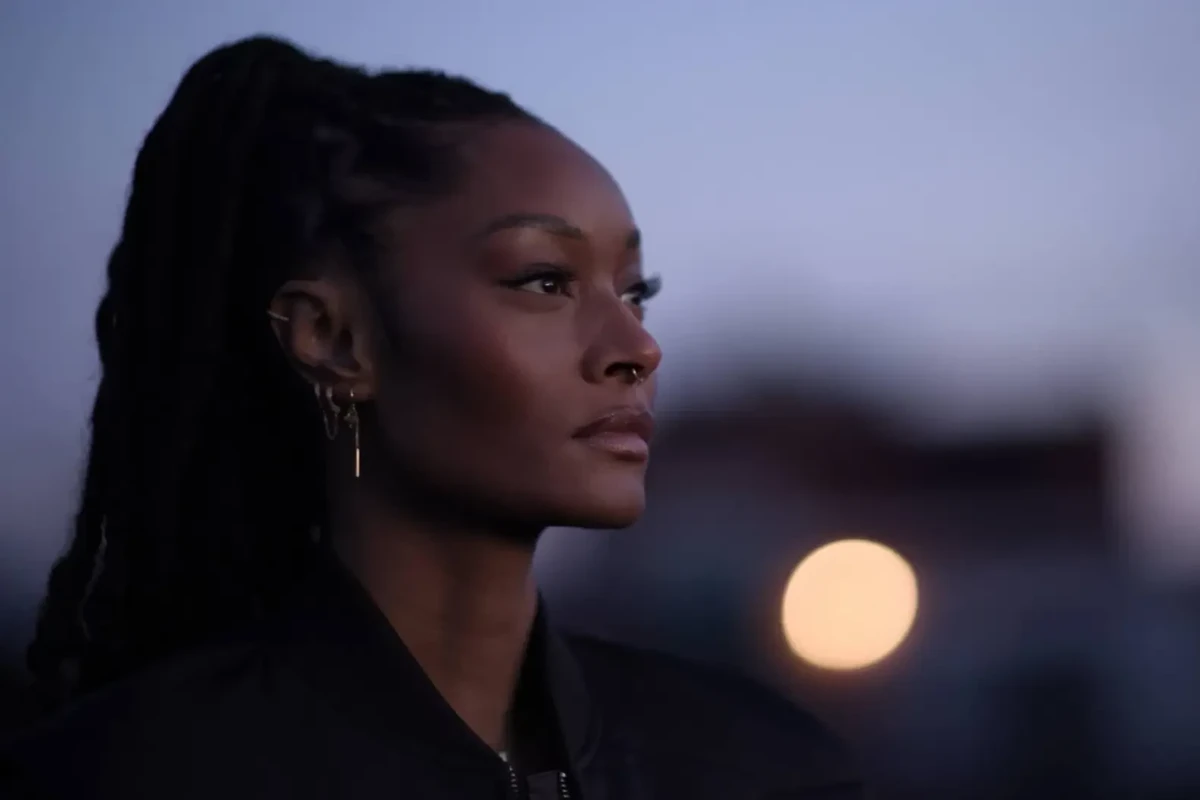

Dani Evans has learned to trust her gut instinct. It’s a habit she’s developed since the events that took place 20 years ago on America’s Next Top Model and after she walked away with the grand prize, only to learn that it had come with a hefty price. “If something within me is a ‘no,’ then I can’t give my attention to it, no matter what it is,” she tells Rolling Stone. “That’s how I’ve built my personal ethos.”
In 2005, Evans saw winning the hit reality TV show as a one-way ticket out of Little Rock, Arkansas. At the time, ANTM was an entertainment juggernaut. Evans says she knew the series — which had young models living under one roof and competing in high-stakes photo shoots to win a modeling contract — was made to humiliate the girls on-screen, but her brother convinced her it was an opportunity to fulfill her dreams as a model in New York.
When Evans was plucked out of thousands of hopefuls for Cycle 6 of ANTM, she was determined to win the coveted modeling contract, a magazine cover, and a fashion campaign. Yet as the season went on, both the challenges and requirements to stay on the show became increasingly outlandish. On one episode, she was told to get rid of her Southern accent, and in another, despite her repeated refusals, she was pressured into getting a dental procedure to narrow the gap between her two front teeth.
A new Netflix docuseries, Reality Check: Inside America’s Next Top Model, has revisited one of the most controversial episodes on the hit show that became a breeding ground of toxic behavior that perpetuated the very stereotypes it sought to challenge during its tenure on air from 2003 until 2018. The doc includes interviews with creator, host, and supermodel Tyra Banks, alongside the people who helped propel the show’s popularity including judges runway coach J. Alexander (Miss J), creative director Jay Manuel (Mr. Jay), and photographer Nigel Barker. Often, the most heartbreaking testimonies come from the models themselves, who share accounts of humiliation and trauma that took place in front of millions watching and left them unable to work in the industry after due to the show’s stigma.
“A gap in the African culture is viewed and revered as royalty,” says Evans, who is speaking publicly for the first time since the docuseries was released. Growing up, her mother instilled in her a sense of pride and confidence in her smile. “For me to love that about myself, that’s not an easy feat for a Black woman to get across to her Black daughter, but she was able to do that.”
Today, Evans has refused to let that time in her life define her. The model and businesswoman has since launched her own fashion line, Monrowe, creating a hat line rooted in jazz culture that has been worn by Stevie Wonder, Ava DuVernay, Keke Palmer, and Sarah Jessica Parker.
She is also set to release her memoir, with a title and release date yet to be announced, that chronicles her life, largely ignoring her time on ANTM, instead focusing on her childhood and her family, including her mother, who died in 2022. “It’s heavy, it’s messy, it’s complex, it’s beautiful, it’s bad, it’s funny, it’s all the things that make up who I am,” says Evans, who adds the book took her three years to write. She began documenting her stories after dissolving her modeling contract in 2021 and after her mother’s death. “I packed my things in storage in New York, and I’m still on this nomadic journey. I went to the jungle in Costa Rica, and that’s where I really started writing the book. It’s insane,” she says. “It discloses all of the things that people have wondered. It’s less about the modeling industry and it’s my story on the page.”
Evans caught up with Rolling Stone to share her side of the story — and what happened when the cameras turned off.
What made you want to tell your story now?
There was a turning point when my mother passed away. That was the greatest heartbreak of my life. And so picking myself off the ground and realizing that I needed to move differently in life and to show up differently for myself.
What lessons did your mother teach you that you use today?
To listen to my spirit and my soul and not do something because the crowd is telling me to do it. My mom at a young age always said to me — and I never I got it up until now — to take the road least traveled. If you’re on the beaten path, that means you’re on the wrong path. You need to go on the path that no one else has forged, where there are no footprints. She really cultivated the ability for me to trust myself at such a young age. And again, I did not listen to her, and so I got into a lot of things that I shouldn’t have, a lot of heartbreaks, a lot of lessons learned. But now that she’s on the other side of the veil, as I like to call her, my spirit guide, now I get it. I’m understanding the lessons.
How have you been feeling after the release of the docuseries?
First and foremost, that production and the director, showed me and my truest authenticity. I gave them who I am, but no one has control over what’s edited. I don’t even have control over this interview, right? So I can hope that what I’m saying is going to be used in a context that I’m giving it to you. Definitely a sense of relief knowing that I was seen during the time that I filmed, I was heard and understood in a way that I was presented on the documentary that was true to who I am.
And then there was this whirlwind of what came after. Because the world has their own opinions, and they create their own narratives. Because I gave eight hours of my truth, but obviously only snippets and sound bites were given, but those sound bites were intentional, they were powerful, they were heard and felt. But again, people are going to always create their own narratives.
So, now I’m sitting with what do I want to address, if anything, when it comes to the collective narrative that’s being spoken about or construed. Do I leave it where it is and then just continue to forge my path and the lane that I want to go in when it comes to my career?
That’s where I’m at right now and that’s another reason why I haven’t given a talk interview yet, because I’m just not gonna just jump out and be like, ‘No, that wasn’t [what] he said, he said this, and she said.” That’s just not my my character, my personality. I’m really just sitting with, what do I want to do now that everything is out in the open?
It goes back to what you said. Does it serve you on the path you are now forging?
Totally. It’s because what I’m not gonna do is get caught in like a Top Model bubble. Never have I ever been about that. Because I’m not going to be typecast in this Top Model thing forever. There’s a whole other world that I’m building simultaneously.
When you’re looking back at what happened on America’s Next Top Model — the pressure to get the dental work, to change your accent — how do you feel about it now, versus how you felt about the experience when you were in it?
Really great question. I’ll start with the voice piece first, because I was actually thinking about this a few days ago — the irony of how I was constantly criticized about how I sound and now, that’s the one thing that the world wants for me. I’m super into astrology, and a lot of this for me astrologically, has a lot to do with the way my chart is set up. … A part of my life’s path and journey is finding my voice and being able to speak from a place of truth and alignment without caring how anyone else feels about it. Looking back at it, I see that this was a part of my journey. Yes, for sure, it hit on some triggers within me. To be on national television and be mocked. It’s not easy. It has nothing to do with age — I don’t care how old you are, that’s just hard. But I knew that I wasn’t going to let that define me and I also was wise enough at that young age to know that they have to have some sort of storyline.
How did you feel after the visit to the dentist?
With the gap – in short, just disappointment. I just felt bamboozled because it wasn’t something that was discussed ahead of time. I was set up, right? So apparently Tyra told production to let me know that production wants me to get my gap closed. When [the episode] aired, it made it seem like Mr. J told all of us in that group that we were going to the dentist. When he says [to the effect of], “And Danielle, you’re going to get that gap closed” — that is a voice over. I’ve never spoken that before. That is a voice over. He never said that that to me in person. So, the first time that I heard about my gap needing to be closed was after [going to] the dentist. Now, the dentist himself did ask me if I wanted to close it, and I said, “No.”
It wasn’t until that next day, or maybe the following day, when we had that next elimination. I walked forward, and Tyra was like, “Why did you not get your gap closed?” I was like, “You didn’t tell me to get my gap closed?” [She said,] “Yes, I did.” So her and I had it back and forth in real time. Then she looks off camera where production sits at Ken [Mok, Executive Producer of ANTM] and I look at him too, and he’s just … almost a Kanye shrug, like, “Gotcha.” And that’s what angered me, because I was like, “Now this is where the game starts.” It’s not just the way that I sound. I knew how it was going to play on TV, which is like this defiant girl that said no and didn’t want to get her gap closed.
When we aren’t filming, especially during elimination days, we had to go into what’s called a holding room. There’s no cameras in a holding room, this is while the judges are deliberating. We can’t talk. We get in trouble if we talk and there’s no cameras present. So after that bit during judging, we’re sent to a holding room and Ken comes in there, and he asked to see me. And I’m pissed at this point. He and I then had a back and forth, and I was like, “How come you didn’t tell me or have somebody tell me that’s what she wanted me to get done?” And his whole thing was just, “I’m just here to figure out what it is that you’re going to get done. Are you going to get your gap closed?” And I was like, “If I say no, you’re going to go downstairs and tell [Tyra] that, and my ass is going to be sent home.” I was being forced in that moment to make a decision. That’s how that played out. It didn’t feel good.
I’m beyond it, and I’m past it, but when I’m asked about it, that’s my truth. The story’s not going to change, because it’s my truth. So I’m not speaking it from a place of anger, it’s coming from a place of remembering. You can speak about a situation or things that have happened in your life from a previous timeline, and even if you do cry, it doesn’t mean that you’re not healed from that. You’re remembering. My heart goes out to that young Danielle that went through that and had to navigate that. It doesn’t mean that I’m still holding on to something that happened 20 years ago,
In the doc, Tyra says she apologized but then also defended herself as being in between “a rock and a hard place.” What was your reaction to that?
A little late. I felt she had to in that moment. There was a lot that was said on that call, a lot, and it just did not make sense to me. There are times within our lives where we might do something to another person or cause harm or inflict pain or hurt someone’s feelings. And in that moment, we might not understand the gravity or the weight that our actions cause another person. But after so many years go by, it seemed random. It was very much, “Why are you doing this now and what am I supposed to do with this information?” It’s like saying to somebody, “I saw when you got obliterated, or hit by that car. When I saw you bleeding out on the street, I drove by you, and I looked at you bleeding out, and I kept going.” What is that person supposed to do that information? She knows that I did not take that lightly.
Has she reached out at all to have a one-on-one conversation?
Tyra called me summer 2020 to give voice to why she had me close my gap. She told me to keep in contact with her, but I just I don’t desire to do that.
How are you feeling right now, in this moment?
I feel great. I’m in a great place within myself. In my own life, it feels like I’m starting over, which is a great place to be. I always speak my truth from a place of reclamation and not from a place of retaliation. That’s super important for me. So again, me speaking my truth is not indicative of something that I’m holding on to. I know that there’s a lot of healing in speaking my truth, even for the collective. I’ve had an outpour of love and people expressing how the documentary and the things that I said on the documentary are helping them heal or has helped them reclaim parts of themselves. If my story is helping to mend something within another person, Im going to continue to share my story. It won’t be limited to ANTM. I’m so much more than that.
 Marty Reisman in 1948 Bettmann Archive/Getty Images