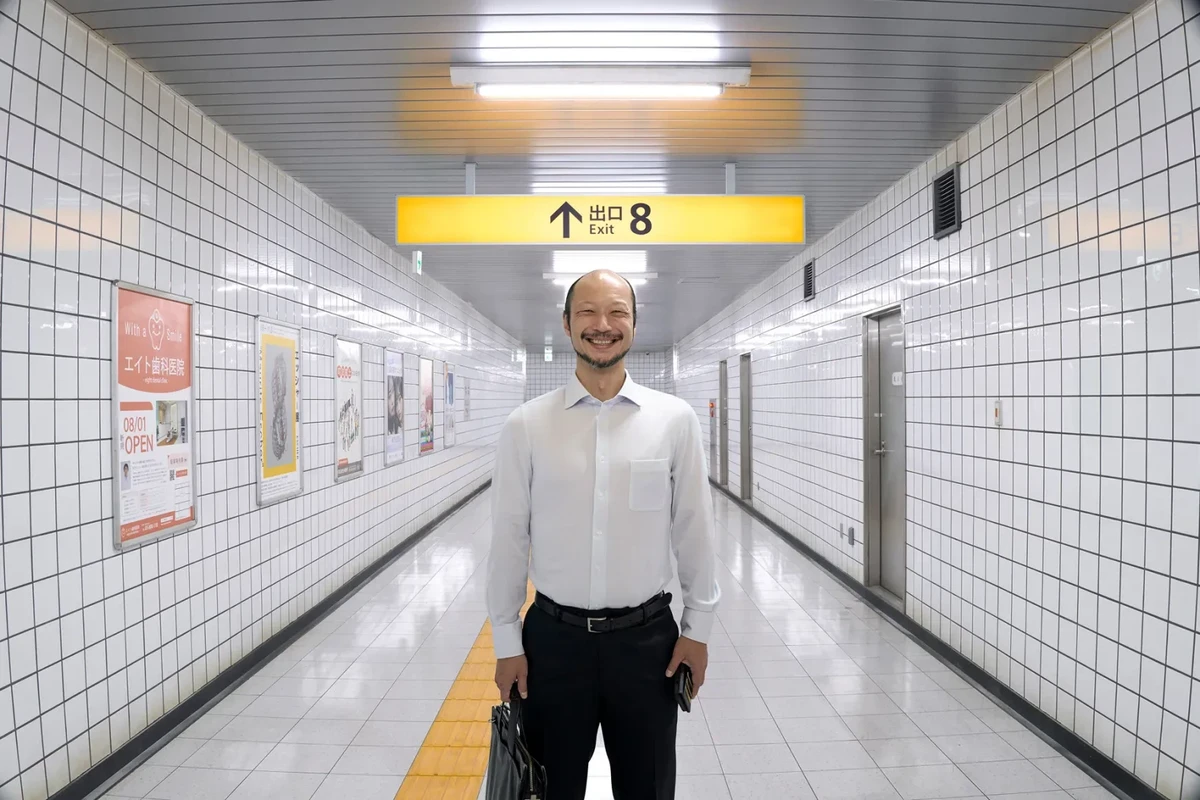

Go up the stairs, and turn the corner. You’re at one end of a long subway corridor — the kind of bland, generic space citydwellers tread through day in and day out. The walls and floors are colored in the overlit, antiseptic white associated with Kubrick films and Apple stores. A man with a briefcase strolls toward you and passes you on your right. A sign hanging from the ceiling points toward an exit. Posters for dentist offices and museum exhibits line one side; three metal doors on the other. Walk to the far end. Turn left. Make a right. Follow the arrows. A yellow sign informs you are on Level 1.
Turn the corner again, and… you’re in the same corridor as before. Same man with the briefcase. Same sign. Same posters. Same doors. Make the same left, then the same right. If you’re lucky, the yellow sign says you’re now on Level 1. If you’re unlucky, it still says Level 0. But now, there are also a set of “rules” next to it. You’ll once again find yourself in the same corridor. Pay close attention to your seemingly nondescript surroundings. If things appear “normal,” proceed forward. Should you see an anomaly — anything that seems different or off from that initial Point-A-to-Point-B trek — turn around immediately. Despite reversing course, you’ll end up in the same place. Round and round you’ll go. Do this successfully enough times, and you’ll eventually make it to Level 8, where the outside world awaits. Fail to heed the instructions, and you’ll be trapped in this urban purgatory with no way out.
This is the premise of The Exit 8, a Japanese video game made by Kotake Create that, as the millions who played it will attest, turns a commuter’s endless circling into a thrilling, maddening first-person-shooter minus the shooting. It wasn’t the kind of gameplay that screamed no-brainer movie adaptation, which did not stop filmmaker Genki Kawamura from making one anyway. And, in what can only be described as a minor miracle, he’s not only completely translated the eerie feeling of the source material with both fidelity and enhanced it with a narrative of sorts (as well as dropping the qualifier). Kawamura has also given us a genuinely genius take on the waking existential crisis that is 21st century living. Hell is no longer other people. It’s being stuck in a perpetual reset, a forever-glitching matrix, an endless sensation of slowly going nowhere again, and again, and again.
That, of course, and the occasional ghostly presences, unsettling cries, and blood dripping from the ceiling. Kotake Create’s game threw a number of different anomalies at players, ranging from the innocuous (wait, wasn’t that door handle originally off to the side instead of dead center?) to creepy-as-fuck (wait, why did that door suddenly creak open and what’s lurking in the darkness behind it!?). The movie occasionally replicates the first-person P.O.V. but adds in a third-person Virgil, in the form of the Lost Man (Kazunari Ninomiya). When we meet him, he’s just another anonymous guy on another anonymous subway, ignoring a yuppie prick yelling at a mother with a fussy baby. Better to simply scroll through his phone and turn up the volume in his headphones. The fact that he’s listening to Ravel’s “Boléro” — a song that keeps repeating a two-part melody and becomes more rhythmically intense as its goes along — is a preview of what’s to come.
When his reverie is interrupted by an urgent phone call from his girlfriend and he’s forced to start thinking about a world outside of his digital cocoon, Exit 8 introduces the closest thing it has to a storyline. Should he stay or should he go? The irony is that the station itself is the one really calling the shots, forcing the Lost Man to amend the question: Can he stay or can he go? Exits are not a right, but a privilege. They must be earned.
 Kazunari Ninomiya and Naru Asanuma in ‘Exit 8.’Neon
Once our tour guide realizes the metaphysically impossible scenario he’s stuck in, he begins to memorize every minute detail and dutifully ticks off everything whenever he enters a new déjà vu round. A fan of the game, Kawamura has said he wanted to make viewers feel like both a player and a spectator — the walkthrough vibe is strong here — and he’s unafraid to toggle and fiddle with P.O.V.s for effect. (The filmmaker’s previous movie, a 2022 adaptation of his own novel A Hundred Flowers, brilliantly uses perspective to replicate the mindset of an elderly woman suffering from dementia. We highly recommend you check it out ASAP.) He’s also included a host of elements that fellow Exit-heads will recognize, notably the Walking Man; he’s played by theater actor Yamato Kochi as the world’s most disturbingly gleeful RPC, and that preprogrammed smile will haunt your dreams. He, too, is given a backstory of sorts, which adds an extra tragic element to the proceedings. Let’s just say that every decision you make counts.
Once an unnamed boy (Naru Asanuma) shows up and the Lost Man realizes that this mysterious kid is not an anomaly, Exit 8 begins to adds elements of pathos and paternal anxiety to its free-floating paranoia. You eventually come around to the fact that Kawamura has been slyly fashioning a parable hidden in plain sight, which just happens to be in the guise of a modern horror flick paying homage to The Shining, Ugetsu, and several other dread-conjuring cinematic touchstones. By the time we loop back to our starting point, passivity is no longer an option. You enter this unlikely, but undeniably extraordinary take on a video game ready to be spooked. You exit it with the sensation that you’ve just witnessed a waking nightmare perfect for Tokyo commuters and Brooklyn sad dads alike.





 Antonio Banderas’ character, Chef, is an amalgam of several mentors from Bourdain’s life. Seacia Pavao/A24
 Johnson (left) with Sessa on set Seacia Pavao/A24



 Erroll Shand in Evil Dead Burn.Warner Bros. Picture
 That one dude from that TV show in ‘Gail Daughtry and the Celebrity Sex Pass.’ Sony Pictures Classics