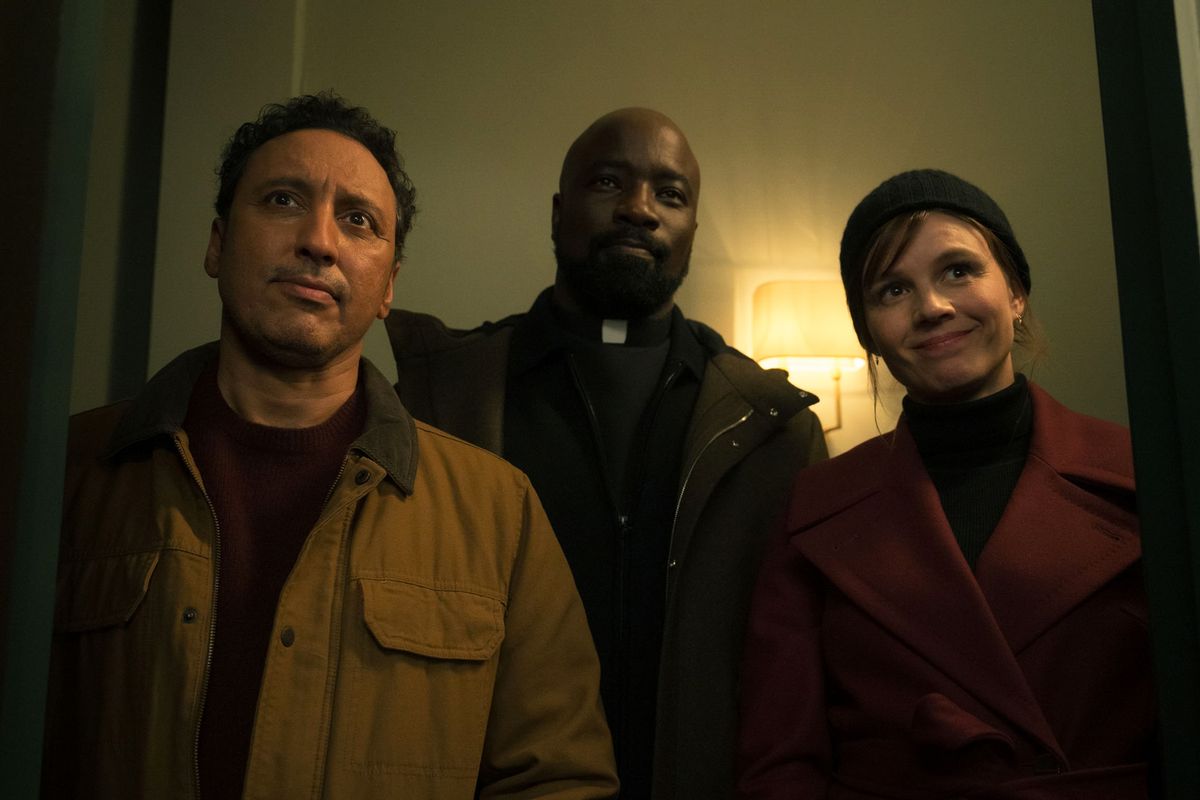

In a recent episode of Evil, Kristen (Katja Herbers) asks her colleagues Ben Shaki (Aasif Mandvi) and David (Mike Colter), “Do you ever think the world’s getting weirder?” Ben argues that the world has always been weird, and David adds that it seems weirder, “only because we expect it to be normal.”
It’s a perfectly understandable conversation to take place between the trio — respectively, a psychologist, a tech contractor, and a priest — who work for the Catholic Church, assessing seeming instances of demonic possession to see if an exorcism is required or if there’s a more mundane explanation for things. Evil began life as a relatively straightforward CBS network procedural drama — The X-Files with a more metaphysical bent. Its creators, the husband-and-wife duo of Robert and Michelle King, had previously made The Good Wife and The Good Fight, legal dramas that went to deeper and odder places than their format and homes would suggest. The hope was that at some point, their corporate bosses would let the Kings’ freak flag fly.
And, boy, did they, albeit after a change of venue. The show had already grown stranger by the end of its lone season on CBS, including Kristen murdering a serial killer to prevent him from harming her or her four excitable daughters. (And who would possibly want that to happen, since the girls’ loud, overlapping dialogue became one of TV’s most consistent comic pleasures of recent years?)
But when Evil became a Paramount+ exclusive in its second, it leaned way the Hell into the implications of its presence. While some mysteries still led to instances of atypical but still clearly human behavior, more and more often the series presented devils, angels, and other Biblical concepts as absolutely, frighteningly real. Ben took an elevator ride to Hell. The team’s nemesis, the smug Leland Townsend (Lost‘s Michael Emerson, having the time of his life), seduced Kristen’s mother Sheryl (Christine Lahti) and recruited her into a corporation whose middle manager was a furry demon. David began working for a secret Vatican society known as “the Entity,” and was periodically tempted by a fork-tongued demon who looked like Kristen in a Catholic schoolgirl uniform. And the team was frequently assisted by Sister Andrea (Andrea Martin), an elderly nun with the gift to recognize evil in all its forms, and who frequently spent episodes chasing after demons with gardening shears and other sharp implements while her colleagues looked on, oblivious.
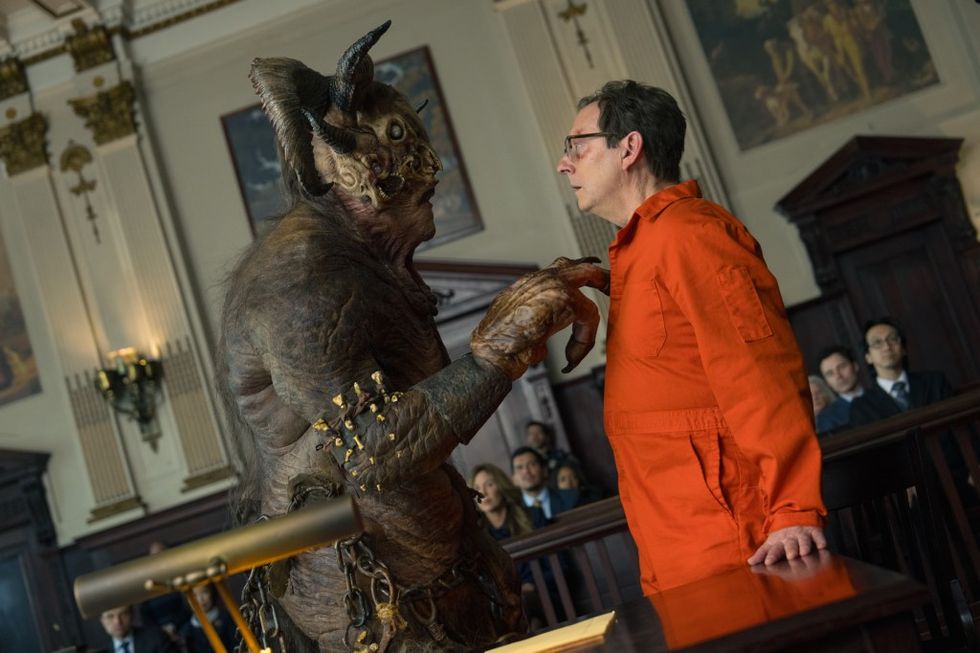
Every episode played as if the Evil writers were daring one another about what they could get away with showing. By that, I don’t mean in terms of censorship, since the move to streaming eliminated that concern, and allowed Herbers to curse early and often (just as Christine Baranski did when her character segued from Good Wife to Good Fight). Rather, Evil seemed determined to push the boundaries of how many utterly disgusting and/or ludicrous ideas they could squeeze in each week and not lose all hold on the emotional reality for the characters. A few episodes back, the great comic actor Richard Kind, playing a judge overseeing Leland’s kidnapping trial, invited a key witness into his chambers and casually chopped her head off with a sword, because he was secretly working for Leland’s Satanic masters. If you could travel back in time and read that sentence to someone watching the show’s first few episodes on CBS, they would not believe Evil would eventually be capable of such a moment — at least, not without it seeming wildly out of character. By the time it happened, it made perfect sense, while also being hilarious and wonderful.
Much of the credit for the series’ ability to visit all these surreal places goes to the cast, and particularly to Katja Herbers. The Dutch-born actress had been playing small but memorable TV roles in shows like Manhattan, The Americans, The Leftovers, and Westworld in the 2010s, but Evil allowed her to demonstrate an incredible amount of range within a single role. In the early days of the series, David is the believer, Ben the skeptic, and Kristen — who sends her girls to Catholic school but is agnostic herself, and wary of working for an organization with a long history of abuses(*) — is the moderating influence. As Herbers demonstrated her versatility, the show treated Kristen more and more as the wild card, who could turn on a dime from sensible maternal figure to wicked force of nature. Her full-throated amusement at so many of the series’ plot developments — including Leland stealing one of her eggs from a fertility clinic in an attempt to birth the Antichrist — gave the audience license to just go along with the latest ridiculous plot twist. Yet she provided real emotional gravity whenever the show demanded it, preventing Evil from ever getting too high on its own supply.
(*) Perhaps not coincidentally, the series seemed much more comfortable confronting the dark side of the Church once it moved to Paramount+ full-time. Last week’s episode had a long and thoughtful scene where Sister Andrea and Father Frank (Wallace Shawn) discussed dwindling church attendance and what felt to them like the impending death of all organized religion.
Even the structure of the series itself grew stranger over time. The second season featured a largely silent episode set at a monastery. Episode titles would for a while be accompanied by demonic pop-up books. With The Good Fight, the Kings had already played around with how deep into episodes they could play the opening credits sequence, often unrolling it long after anyone might have even remembered it was still coming. For Evil, they added a new wrinkle, offering different warnings about what might happen if you click on Skip Intro. A few episodes back, it promised, “Skip the intro and the show will be canceled. Oops.”
Which brings us to this week’s series finale. In February, Paramount announced that the fourth season would be the last one, but that the Kings would be allowed to film four additional episodes to wrap up the story. As a meta element, one of the concluding subplots has the Church abruptly deciding to end the assessor program, much to our heroes’ befuddlement. “I thought we were successful,” says Ben. David replies, “We were. But I don’t think it matters anymore.”
Team Evil threw every last wild idea they had into this mini-season, including the aforementioned beheading-by-Bing-Bong. Even in the concluding episode, “Fear of the End,” the show manages to find a Case of the Week structure on which to hang the larger arcs, with one last instance of technology (the girls’ VR goggles, confiscated by Kristen back in Season One) being used to further weaken humanity and make us feel isolated from one another. (Throughout four seasons, the Evil writers didn’t have much trouble illustrating how thin the line is between toxic human behavior and the work of actual monsters from Hell: one of Sheryl’s first assignments when she began working with Leland was to push a new and particularly useless form of crypto.)
But the episode also feels more rushed than it should, particularly in resolving the war between Leland and Kristen. The vibes throughout are pristine, like a sequence where the assessors get drunk and recall past adventures. In the end, though, the very anonymity that allowed the Kings and their colleagues to make Evil so weird, and so great, came back to bite the series here at the end. If Evil were a bigger deal, it wouldn’t have had to wrap things up so quickly. But if it were a bigger deal, it likely wouldn’t have had the freedom to become a show whose loss hits far harder than I ever would have expected when I watched the first episode back in 2019. Evil only seems weird now because we once expected it to be normal. And we’re so much better off for that change.
The series finale of Evil begins streaming August 22 on Paramount+.

 Jeremy Strong and

 Douglas, far right, with his family circa 1965 (from left): brother Joel, half-brother Peter, stepmom Anne, half-brother Eric, and dad Kirk.Hulton Archive/Getty Images
 Kirk Douglas visiting a 24-year-old Michael on the set of Hail, Hero! in 1969. Bettmann Archive/Getty Images
 Douglas with his son Cameron at the 2024 Vanity Fair Oscar Party in Beverly Hills. Kevin Mazur/VF24/WireImage
 With Glenn Close in Fatal Attraction. Paramount Pictures