
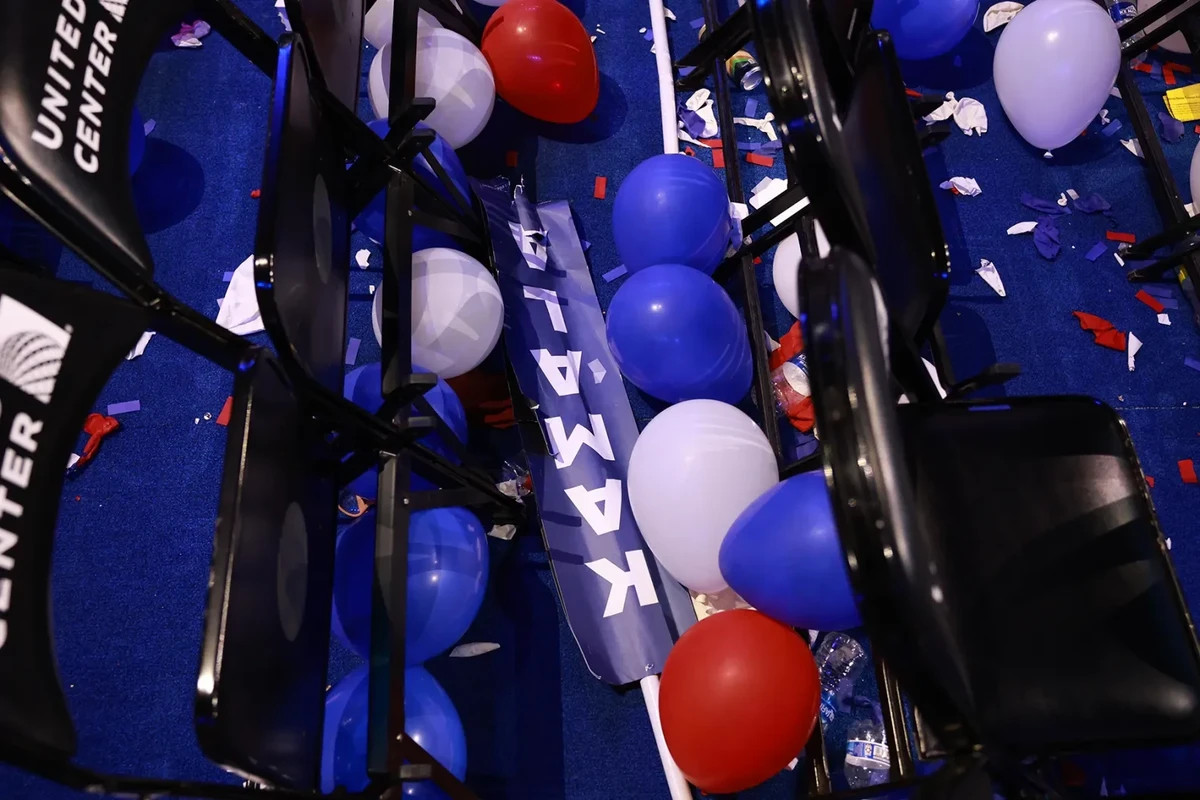

Autopsies are inherently messy, but any forensic scientist would lose their license if they left as much blood splattered around the room as the DNC’s 2024 election report.
The process was chaotic from the start — a report commissioned, left unfinished, hidden by the top brass and then, when scooped by CNN’s Edward-Isaac Dovere, suddenly released into the world riddled with crimson annotations that alternately disavowed and apologized for the shoddy product. This combination of defensiveness and reflexive apology is a perfect encapsulation of the problems facing the Democratic Party.
This is a shambolic shame because there is a real need for a data-driven analysis of what went wrong in 2024. Democrats need to deal with the uncomfortable fact that the party lost an election to an unhinged felon and two years later their approval rating somehow remains lower than Donald Trump, even while the president’s approval is in freefall because of rising costs, unprecedented corruption, chaotic government, an unpopular foreign war, and daily assaults on the Constitution.
The Democratic brand damage is deep and needs to be addressed. But there is a strong impulse toward denial in part because an honest assessment might offend someone, somewhere — and because Democrats look likely to benefit from the pendulum swing of politics by making the gains in the midterms.
These expected wins will give our republic the necessary checks and balances to get through Donald Trump’s disfigurement of American democracy. But they won’t be enough to break the fever in our polarized politics.
Especially with the rollback of the Voting Rights Act in the South and demographic shifts from blue states to red, Democrats need to rebuild the big tent and win back swing voters in swing states that have abandoned them over decades. That’s not all. They need to field a new brand of rural and red state Democrats, as well. To do this, they’ll need to drop the self-righteous ideological purity tests that preoccupy online debates and get back in the business of persuasion beyond the base.
In one of the few useful sections of the half-baked 2024 election report, the anonymous author analyzes the ticket splitting that occurred in the crucial swing state of North Carolina, where now Governor Josh Stein outpaced Kamala Harris’ campaign by a solid 8.5 points.
Yes, this success was aided by the Republican nominee Mark Robinson describing himself a “Black Nazi” with a love of online porn that rivaled his love for Trump. But the autopsy argues that Stein’s strength was rooted in his decision to “focus less on abstract issues and identity politics, and connect with voters on the issues they say matter most, including the economy, disaster relief, and addressing housing affordability.”
This sentence is worth unpacking, as it’s the only place in the report that uses the phrase “identity politics” — which is one more time than the report mentions Gaza or Joe Biden’s age.
Blue Rose Research has published some of the most honest and challenging analysis of Democrats’ problems to date (and should be commissioned to redo this report). One of their most searing statistical condemnations — explained in an essential interview between Blue Rose’s David Shorr and the New York Times’ Ezra Klein — is the fact that Democrats lost ground with young voters and in communities of color. Hispanic moderates in particular swung 23 points away from Democrats between 2016 and 2024. Moderate Asian-American voters swung 11 percent against Democrats in that same time frame. Despite promising mass deportations, Trump actually won the votes of foreign-born immigrant citizens. A focus on identity politics is not achieving its intended goal. As a leading Democrat from the Obama White House once told me, “We appeal to voters as members of groups, but people don’t vote as groups — they vote as individuals.”
As the autopsy explains, “millions of Americans are suffering from poor access to health care, manufacturing and job losses, and a failing infrastructure, yet continue to be persuaded to vote against their best interests because they do not see themselves reflected in the America of the Democratic Party.”
Until Democrats face the hard truths of why folks don’t see themselves reflected in their vision of America, they are going to keep coming up short.
This disconnect is compounded by a core problem: Democrats score best on the issues that voters say they care about least — like LGBTQ policies, climate change, abortion, child care, and student debt — while Republicans maintain a reputation for being strong on cost of living, inflation, crime, taxes, national security, and border security.
All these issues are important, but there is a hierarchy of needs in people’s lives, and Republicans have a better brand perception when it comes to dealing with the fundamentals that apply broadly in day-to-day life for most Americans, with the exception of health care. For Democrats, the lesson is that if you don’t get the big things right, the small things don’t matter.
The next Democratic Congress and the next Democratic president are going to need a relentless focus on getting shit done — proving that government can work again for working people and deliver results that they can see and feel in their own lives.
Making sure that people see results is not just a communications problem, but it does require disrupting the consultant industrial complex. Buried on page 40, the autopsy points out the absurdity of the fundraising hamster wheel that delivers donor dollars to broadcast and cable ad buys: “In the current media ecosystem, Republicans own and Democrats rent,” it says. “Democrats pay for seasonal access to the networks, stations, platforms, and newspapers owned by Republicans or right-wing entities, to advertise and communicate with voters. … In a sense, Democrats are funding right-wing media to buy more properties and expand their ability to drive partisan perspectives.”
This is true. Democrats need to build their own long-term influence infrastructure instead of defaulting to broad-based cable TV ad buys and mailers. It would be far more effective to identify and target persuadable voters where they live — on their phones, on YouTube, and on social media platforms — in order to reach the right voters with the right message at the right time, as opposed to the essentially analog spray and pray model still in place today because consultants get 10 percent of the buy. It is an arena ripe for disruption.
To win back the middle of America, Democrats need to focus on rebuilding the middle class and the middle of our politics. They need to project strength, reclaim patriotism, and ditch identity politics in favor of focusing on affordability and the economy. Rather than defending a broken status quo, Democrats need to be the party of change and reform, modernizing government to help hard-working Americans get ahead, and delivering on the promise of putting the national interest over all special interests.




 A Canadian flag flies along the waterfront of Lake Ontario, on Aug. 27, 2026. Cole Burston/AFP/Getty Images


Trump Is in Freefall — But Can Dems Do the Work to Actually Win Back Voters?
The party must focus on the issues Americans actual care about instead of catering to special interests