
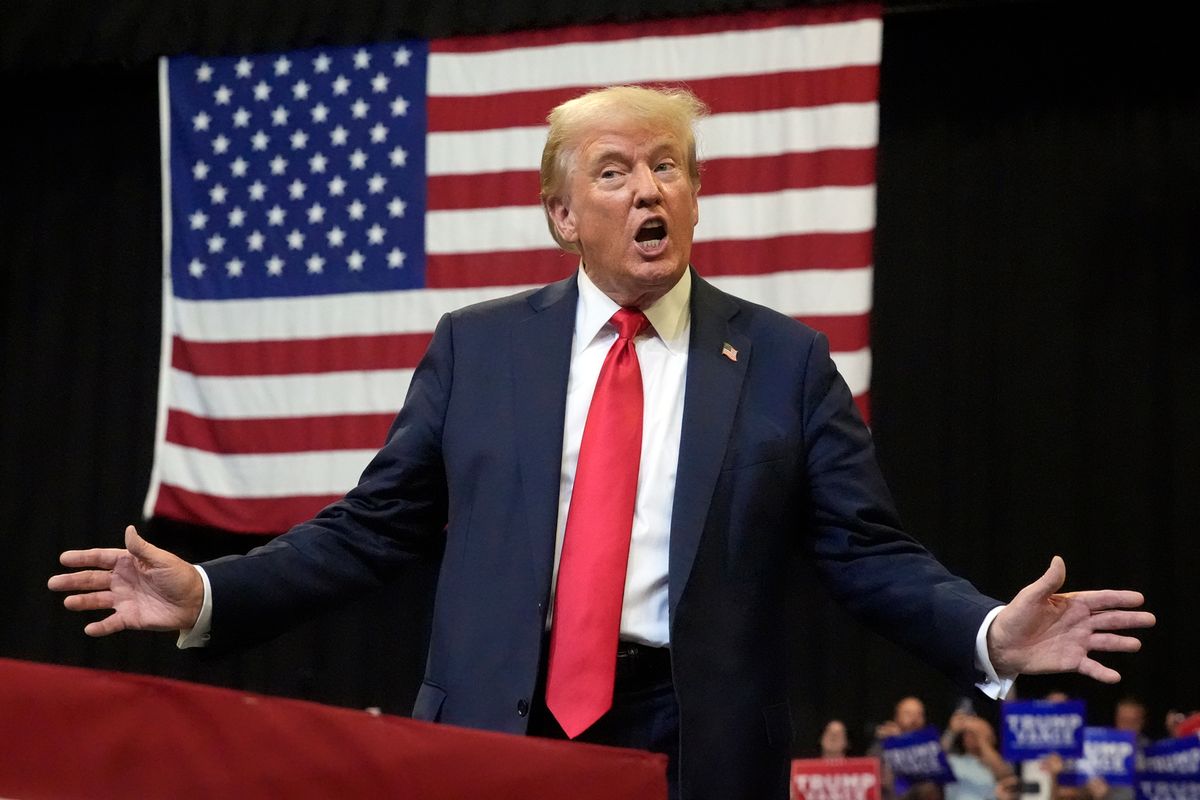
In July 2016, then-candidate Donald Trump called on the Russian government to hack the emails of his Democratic rival, Hillary Clinton. It wouldn’t be long before the scandal of Russian election interference would dominate headlines for much of the campaign and Trump’s presidency. And Trump has since claimed that his public call — for Russians to “find the 30,000 emails” so that “our press” could have a field day — was somehow a joke.
But in the intervening years, the former and perhaps future leader of the free world has provided ample evidence that he wasn’t, well, joking at all. In a 2019 interview with ABC, the then-sitting president explicitly stated that “I think I’d take it,” when asked if he would accept dirt on a political opponent that was offered up to him by a foreign power. Trump only added he’d “go maybe to the FBI” if he thought “there was something wrong.”
Today, the shoe is entirely on the other foot, with Trump and his campaign now the victims of an alleged foreign hacking and leaking operation during the most crucial months of a close American presidential contest. This time, it doesn’t seem to be Russia. Team Trump is pointing the finger at Iran; Rolling Stone has yet to independently verify that claim. The FBI is investigating the alleged hack.
According to two sources familiar with the matter, the Trump team has been scrambling to assess the extent of the damage, and how, exactly, the apparent hacking may affect different facets of the Trumpworld elite, not just the presidential campaign’s staff. “It’s very scary stuff,” one source close to Trump, who has been communicating with campaign officials in recent days about the alleged hacking operation, succinctly notes to Rolling Stone.
Trump campaign spokesman Steven Cheung claimed in a statement that Iran was responsible for the apparent hack of a senior campaign staffer’s internal communications. No outlet has published any leaked documents yet. Cheung preemptively criticized any journalists who dare to report on them.
“Any media or news outlet reprinting documents or internal communications are doing the bidding of America’s enemies and doing exactly what they want,” he said.
That’s a radical departure from 2016, when Trump openly called on Russia to hack and release Clinton’s emails. “Russia, if you’re listening, I hope you’re able to find the 30,000 emails that are missing,” Trump said at a press conference. “I think you will probably be rewarded mightily by our press.”
Russian actors reportedly targeted Clinton’s campaign and personal office on or around that same day. Trump argued the source of the Clinton campaign materials shouldn’t matter — the content was more important. In October 2016, Trump complained that the hacked emails released by WikiLeaks were not getting enough coverage from reporters. “Very little pick-up by the dishonest media of incredible information provided by WikiLeaks,” he posted on X (formerly Twitter).
The Trump campaign did not respond to a request for comment on Monday asking whether the former president still believes that it is acceptable for media outlets and political candidates to cover and highlight a campaign’s internal documents or communications if they were hacked.
News of the hack comes at a time when Trump is mired in the final two-and-a-half-month blitz of his 2024 crusade to retake the White House. It’s an election with remarkably high stakes for the American public — and for Trump personally. The outcome of the race between him and Vice President Kamala Harris won’t merely decide whether Trump gets a chance at implementing his increasingly authoritarian vision for the nation. Election Day in November could very well determine whether or not Trump ever faces actual prison time.
And it’s in this environment in which a foreign actor, allegedly the Iranian government, is trying to mess with Trump’s electoral chances at returning to power. Iranian officials are still furious with Trump for, among other things, blowing up Qasem Soleimani, and have wanted vengeance for years.
However this alleged attack by Iran on the Trump team’s private communications shakes out, it will be done in the shadow of years of MAGAland openly gloating and mocking elite Democrats for getting breached by Russian hackers.
For instance, in December 2016, senior veterans of the Trump and Hillary Clinton campaigns gathered at Harvard University, to make first-draft-of-history-style presentations for the assembled crowd and journalists. With the wounds of 2016 still fresh, the event quickly devolved into chaotic sniping, insults, and hurt feelings. At one point, when the issue of Russian election interference, which was designed to help Trump win, came out, Trump lieutenant Brad Parscale told the lineup of Clinton officials that there was such a thing as two-step verification for email accounts… and that maybe Democrats should try it.
Years later, in the lobby of what was, at the time, Washington, D.C.’s Trump International Hotel — just walking distance from the Trump White House — this reporter caught up with Parscale about what he said to the Clinton senior staff. He smiled, recalled that it was a “funny” line that he trotted out, and reveled briefly in his trolling of Trump’s political nemeses.
Things are different now.



War Is Peace: Trump’s Regime-Change Reversal
As American and Israeli rockets fly into Tehran, with the stated goal of regime change, anyone who bought into the self-evidently absurd idea of “Donald the Dove” ending America’s forever wars ought to be suffering from a bloody form of buyer’s remorse.
It was always bullshit. But that’s what the Trump team was selling hard. Take human ghoul Stephen Miller’s tweet days before the election: “Kamala = WWIII. Trump = Peace.”
The Trump team reads George Orwell’s 1984 like an owner’s manual and so of course “war is peace.” Their undermining of NATO and the dismantling of American alliances in favor of a “might makes right” foreign policy executed by a sycophantic kakistocracy is a guarantee of more war amid autocratic power grabs worldwide, with a side order of corrupt crony capitalism to profit from the chaos.
If you voted for Trump and believed him, this is on you. And that includes self-styled Palestinian peace activists who thought that Biden and Harris were the worst of all possible worlds and stayed home. We will no doubt see protests for the innocent lives lost in these strikes — but I’d have a lot more time for those folks if they were also seen protesting the estimated 20,000 to 30,000 Iranian lives snuffed out by murderous mullahs in the last few months alone.
The Islamic Republic of Iran has been despotic and dangerous from its inception. The Iranian people have been oppressed and denied basic freedoms for decades. But this is an extreme example of a war of choice. The American military strikes against Iran’s nuclear weapons facility last year were justified because Iran cannot be trusted with a nuclear weapon. That is true. But the much trumpeted total obliteration of those facilities is apparently not true — or so goes the justification for this war. And don’t forget that it was Trump who pulled the U.S. out of an Obama-era deal to stop Iran from developing weapons — arguing absurdly that the imperfect anti-nuke deal needed to be blown up to stop Iran from developing a bomb. Iran’s subsequent progress toward a bomb then created the rationale toward these strikes. This is a self-inflicted state of emergency. Peace is war and war is peace.
Pity the willful dupes in Congress who deluded themselves into thinking that Trump deserved the Nobel Peace Prize. They’ll probably rationalize that he would’ve been peaceful if he got the honor. Now it will be read as a cautionary tale for not sucking up. The chairman of the Board of Peace is now bored of peace. While Rand Paul remains admirably consistent, it’s Lindsey Graham who is pirouetting around the Senate floor while the Gimp Speaker Mike Johnson is unable to speak for the basic constitutional principles of separation of powers let alone authorization to go to war.
If you’re feeling shell-shocked trying to keep up with Operation Epstein Distraction, get ready for the inevitable next crisis — regime change without a plan for replacement. This is what the Trump administration did in Venezuela — kidnapping the socialist dictator Maduro but keeping his regime in place in exchange for crude oil access. The opposition is still in exile and its leader María Corina Machado gave her Nobel Peace Prize to Trump in exchange for exactly nothing.
One of the clear lessons of history is that if you don’t win the peace, you don’t win the war. The Saudis and their Sunni allies will back the U.S. and Iran because they hate the Shia Iranians (who, incidentally, are not Arabs), but beyond removing the Iranian regime, the plans for replacement and stabilization seem TBD — and with Trump’s inability to stay focused on anything beyond his immediate self-interest, solid plans are unlikely to emerge. Maybe a leader will come from the underground opposition; maybe it will be the Shah’s son, who has been living in the U.S. waiting for a restoration like many members of the diaspora. The upside is that Iran has a distinguished history and an accomplished Persian culture: The Islamists don’t represent the entirety of the people of Iran and never have.
But the path ahead will be messy at best. It will require concerted effort and civil commitment, not just an open call for private investment from Mar-a-Lago members. If the United States is now kidnapping and killing dictators without direct provocation, it establishes a dangerous precedent which will come back to bite us after demolishing our moral authority in the world.
It is the unexpected effects, the cascades of consequence where we cannot always plan ahead, that cause most responsible statesmen to try to keep the peace. But Trump has the carelessness of a rich-boy bully who can always buy or bluster his way out of trouble. He’s a con man who has found his ultimate mark in his followers, who fool themselves into thinking that a reflexive liar is the one man with the courage to tell the truth.
Perhaps the most prominent example is the vice president himself — a bright guy who not that long ago compared Trump to Hitler and a deadly narcotic but then convinced himself that careerism demanded an abrupt conversion. After all, he endorsed Trump less than two years ago with this very serious column headlined “Trump’s Best Foreign Policy? Not Starting Any Wars,” explaining, “He has my support in 2024 because I know he won’t recklessly send Americans to fight overseas.”