
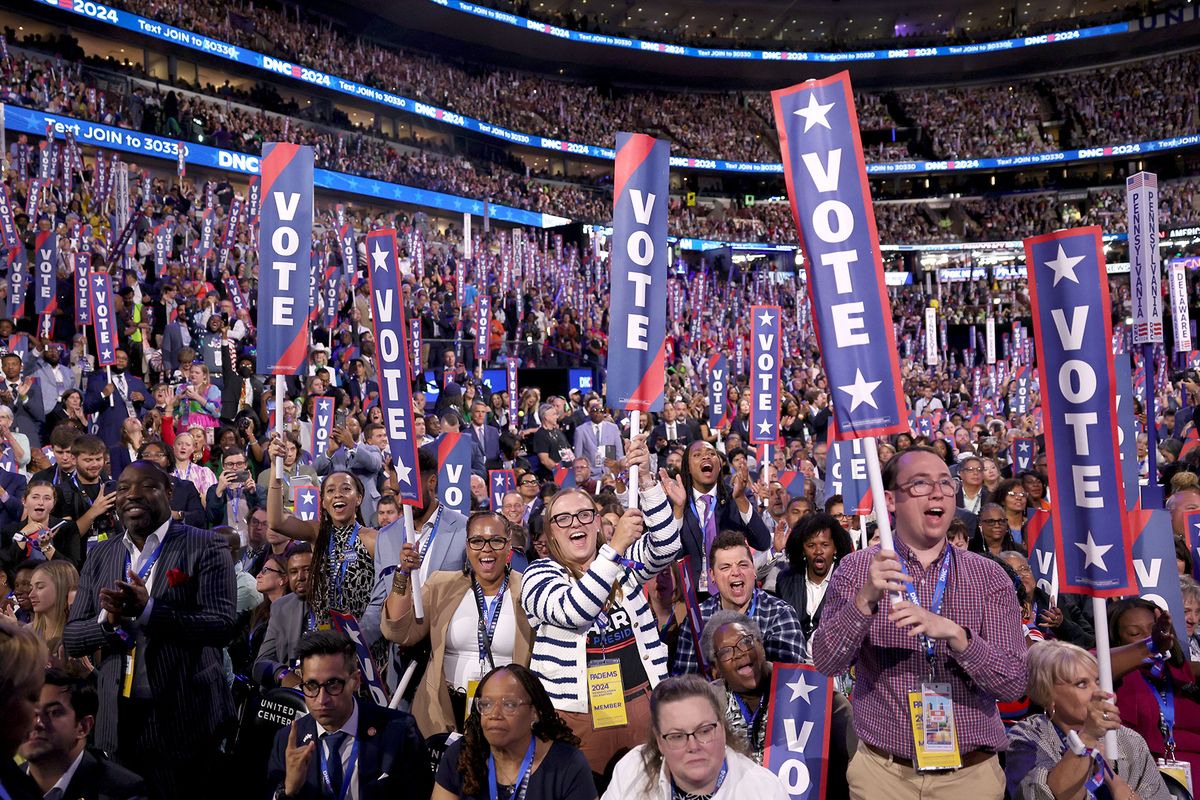
CHICAGO — You could hear the bass from the warehouse at the end of a deserted street from blocks away. Inside, influencers hoisting “Hotties for Harris”-branded coconuts and “Walz on the Beach” cocktails were twerking to a remix of Tinashe’s Nasty Girl on the dance floor, while their friends posed for photos on the “Property of J.D. Vance” couch. Across town, young Black and brown activists and staff for Kamala Harris, Barack Obama, and Joe Biden crammed into a pop-up dance club blaring house music at The Second City comedy theater on W North Avenue.
“The highlight of the party was seeing the current [Consumer Financial Protection Bureau] director get down on the dance floor to Chicago house music legend Derrick Carter,” says Brad Jenkins, a former Obama White House official and a Second City board member who organized the Tuesday event. “And also seeing Congressman Gabe Amo of Rhode Island just be himself and get down and dance — the whole night was a night of joy.”
Former President Obama had concluded his speech just hours earlier at the United Center, and throngs of Democratic staffers and elected officials were doing what attendees (and, to be fair, media people…) at these types of decadent, cash-and-sponsorship-drenched nominating conventions always focus on as the clock inches closer to midnight: snagging every opulent party invite they could. But even at the constellation of different themed late-night parties, some of which spilled over into the 4 a.m. hour, the rowdy conversations and rejuvenated optimism were peppered only very occasionally with a small sense of, well, dread.
“I think the vibes are ahead of the polls,” said one person who works with Democratic causes. “I think it’s good to be happy, but [we] need to make sure everyone still recognizes the actual state of things.”
Even with Vice President Harris’ recent uptick in the battleground-state polling, the presidential contest between her and former President Donald Trump — who is running on a blatantly authoritarian, almost cartoonishly brutal platform of MAGA revenge and abuses of power — remains confined to razor-thin margins. At this time, for so much of the Democratic Party elite and rank and file, this race is still the No Country for Old Men election, as in: “What’s the most you ever lost on a coin toss?”
“We have to keep things in perspective,” Jenkins adds. “That’s why we threw that party for all those young staff and organizers. They’re going to be the ones not sleeping, and traveling the country, and knocking on all the doors, and doing all this shit while we’re bedwetting and sharing memes. We win elections because of those kids…I mean, this election is going to be really, really close… The memes are nice, but memes don’t win elections.”
Earlier that day, inside a warren of hotel conference rooms and ballrooms at McCormick Place — the Democratic convention hall — group after group unveiled internal polling that portended the tectonic shift that had taken place in the 2024 campaign over the last month, especially in battleground states.
A pollster for EMILY’s List, the powerful pro-choice Democratic Super PAC, presented reporters with a survey, fielded eight days after Kamala Harris was named the nominee. Between July and August, they found, enthusiasm among voters in battleground states has jumped 47 points, with 79 percent of likely voters reporting they were excited to vote in November. The shift was even more dramatic among young women 18 to 44, a group that experienced a stunning 57 point jump in enthusiasm after President Joe Biden dropped out of the race.
“Kamala Harris erased the enthusiasm gap,” said pollster Jill Normington. A few doors over, the Gen-Z group Voters of Tomorrow was touting polling of their own that detected a similar phenomenon: “massive” growth enthusiasm among voters age 18-29, with more than two-thirds now reporting that they were excited to vote in November.
But even with that enormous shift in enthusiasm, Biden had been losing so badly that the net effect, essentially, puts Harris roughly neck-and-neck with Trump in the race overall. Chauncey McLean, president of Future Forward, one of the super PACs supporting Harris’ bid, said something to that effect this week. “Our numbers are much less rosy than what you’re seeing in the public,” McLean said.
All across Chicago on Tuesday, blissed-out Democrats sporting Brat-green wristbands and swilling coconut-rum cocktails were basking in a strange, new feeling: pure, uncut cockiness that they had this thing locked up — a confidence that, it bears noting, was at odds with the polls themselves. The vibes were so good — so different from what they had been just a few weeks ago — that it almost felt like Democrats had temporarily repressed the potential horror of a Trump restoration. Political staffers from D.C. who had worried just a month ago that their jobs might be purged, Project 2025-style, were now able to speculate giddily on the prospect of expanding the child tax credit.
The good vibes carried over to the United Center where red-white-and-blue blinking bracelets lit up the venue and, just as the roll call was getting underway, Lil Jon bust into the aisles, belting “Turn Down for What,” his megahit collab with DJ Snake. By the time the Obamas took the stage, the United Center felt like it was going to bust loose from its foundations and levitate from the sheer weightlessness of Democrats’ collective spirit.
In this moment, Democrats are not cowed by finger wagging critics telling them to cut out the dick jokes and the couch-fucker cracks. Democrats are trolling Trump — projecting taunts on Trump Tower Chicago, skipping over to Wisconsin and filling Milwaukee’s Fiserv Forum during their own convention just for kicks, making jokes about the size of Trump’s… crowds to an audience of 12.9 million at-home viewers — with abandon.
In their convention speeches Tuesday night, both Obamas gave a nod to the reality that while the feelings are stellar, the presidential race is deadly close.
“Yes, Kamala and Tim are doing great right now. They’re packing arenas across the country. Folks are energized. We’re feeling good,” Michelle Obama said. “But there are still so many people who are desperate for a different outcome… No matter how good we feel tonight, or tomorrow, or the next day, this is still going to be an uphill battle.”
On Tuesday at least, there wasn’t time to worry about that: there were too many parties. For now, Democrats are still soaking it all up.

War Is Peace: Trump’s Regime-Change Reversal
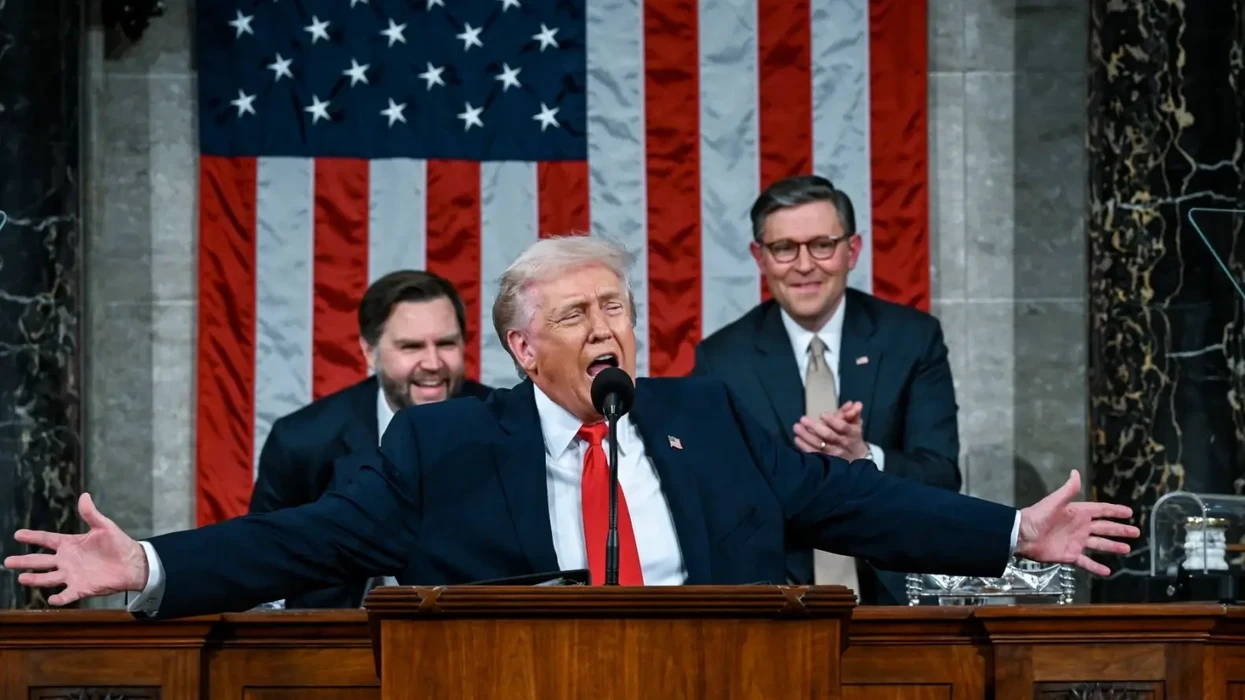
As American and Israeli rockets fly into Tehran, with the stated goal of regime change, anyone who bought into the self-evidently absurd idea of “Donald the Dove” ending America’s forever wars ought to be suffering from a bloody form of buyer’s remorse.
It was always bullshit. But that’s what the Trump team was selling hard. Take human ghoul Stephen Miller’s tweet days before the election: “Kamala = WWIII. Trump = Peace.”
The Trump team reads George Orwell’s 1984 like an owner’s manual and so of course “war is peace.” Their undermining of NATO and the dismantling of American alliances in favor of a “might makes right” foreign policy executed by a sycophantic kakistocracy is a guarantee of more war amid autocratic power grabs worldwide, with a side order of corrupt crony capitalism to profit from the chaos.
If you voted for Trump and believed him, this is on you. And that includes self-styled Palestinian peace activists who thought that Biden and Harris were the worst of all possible worlds and stayed home. We will no doubt see protests for the innocent lives lost in these strikes — but I’d have a lot more time for those folks if they were also seen protesting the estimated 20,000 to 30,000 Iranian lives snuffed out by murderous mullahs in the last few months alone.
The Islamic Republic of Iran has been despotic and dangerous from its inception. The Iranian people have been oppressed and denied basic freedoms for decades. But this is an extreme example of a war of choice. The American military strikes against Iran’s nuclear weapons facility last year were justified because Iran cannot be trusted with a nuclear weapon. That is true. But the much trumpeted total obliteration of those facilities is apparently not true — or so goes the justification for this war. And don’t forget that it was Trump who pulled the U.S. out of an Obama-era deal to stop Iran from developing weapons — arguing absurdly that the imperfect anti-nuke deal needed to be blown up to stop Iran from developing a bomb. Iran’s subsequent progress toward a bomb then created the rationale toward these strikes. This is a self-inflicted state of emergency. Peace is war and war is peace.
Pity the willful dupes in Congress who deluded themselves into thinking that Trump deserved the Nobel Peace Prize. They’ll probably rationalize that he would’ve been peaceful if he got the honor. Now it will be read as a cautionary tale for not sucking up. The chairman of the Board of Peace is now bored of peace. While Rand Paul remains admirably consistent, it’s Lindsey Graham who is pirouetting around the Senate floor while the Gimp Speaker Mike Johnson is unable to speak for the basic constitutional principles of separation of powers let alone authorization to go to war.
If you’re feeling shell-shocked trying to keep up with Operation Epstein Distraction, get ready for the inevitable next crisis — regime change without a plan for replacement. This is what the Trump administration did in Venezuela — kidnapping the socialist dictator Maduro but keeping his regime in place in exchange for crude oil access. The opposition is still in exile and its leader María Corina Machado gave her Nobel Peace Prize to Trump in exchange for exactly nothing.
One of the clear lessons of history is that if you don’t win the peace, you don’t win the war. The Saudis and their Sunni allies will back the U.S. and Iran because they hate the Shia Iranians (who, incidentally, are not Arabs), but beyond removing the Iranian regime, the plans for replacement and stabilization seem TBD — and with Trump’s inability to stay focused on anything beyond his immediate self-interest, solid plans are unlikely to emerge. Maybe a leader will come from the underground opposition; maybe it will be the Shah’s son, who has been living in the U.S. waiting for a restoration like many members of the diaspora. The upside is that Iran has a distinguished history and an accomplished Persian culture: The Islamists don’t represent the entirety of the people of Iran and never have.
But the path ahead will be messy at best. It will require concerted effort and civil commitment, not just an open call for private investment from Mar-a-Lago members. If the United States is now kidnapping and killing dictators without direct provocation, it establishes a dangerous precedent which will come back to bite us after demolishing our moral authority in the world.
It is the unexpected effects, the cascades of consequence where we cannot always plan ahead, that cause most responsible statesmen to try to keep the peace. But Trump has the carelessness of a rich-boy bully who can always buy or bluster his way out of trouble. He’s a con man who has found his ultimate mark in his followers, who fool themselves into thinking that a reflexive liar is the one man with the courage to tell the truth.
Perhaps the most prominent example is the vice president himself — a bright guy who not that long ago compared Trump to Hitler and a deadly narcotic but then convinced himself that careerism demanded an abrupt conversion. After all, he endorsed Trump less than two years ago with this very serious column headlined “Trump’s Best Foreign Policy? Not Starting Any Wars,” explaining, “He has my support in 2024 because I know he won’t recklessly send Americans to fight overseas.”