
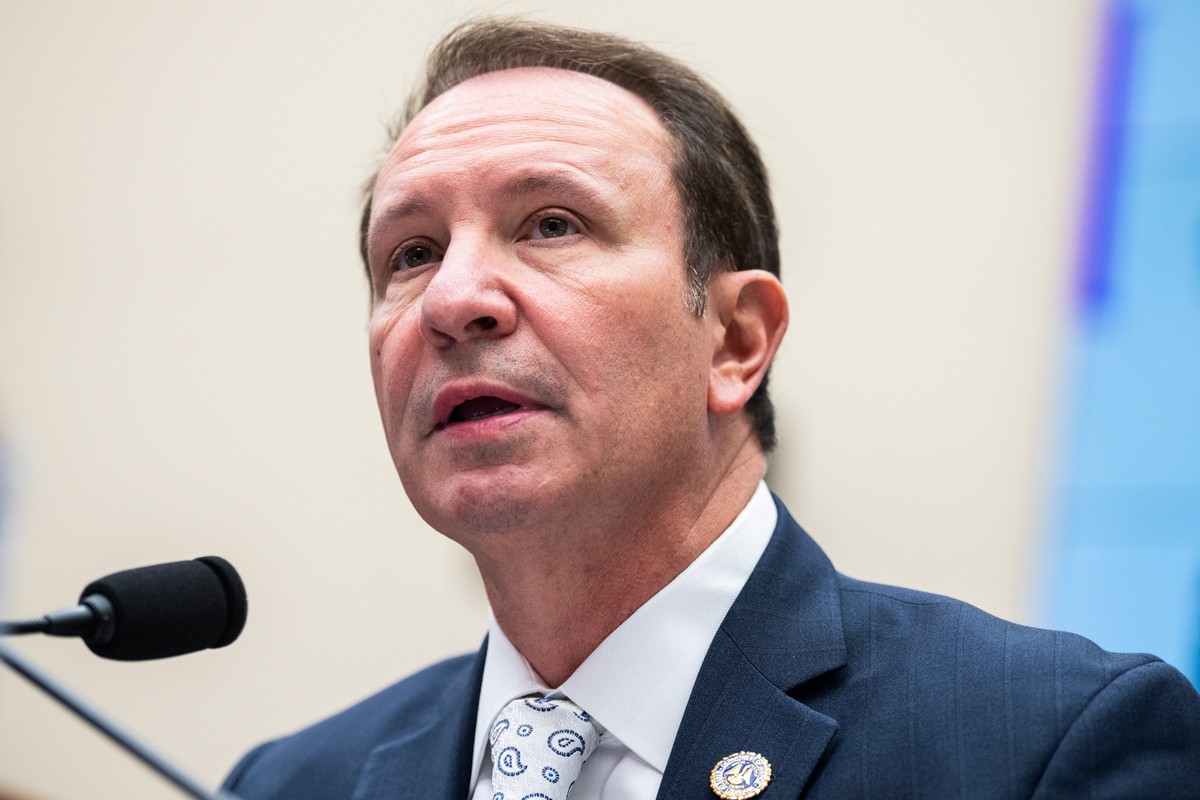

While defending Louisiana’s controversial new legislation requiring the Ten Commandments be displayed in all classrooms, including K-12 schools, colleges, and universities, Republican Gov. Jeff Landry and Attorney General Liz Murrill on Monday unveiled sample posters that feature liberal icons, including the late Supreme Court Justice Ruth Bader Ginsburg and Hamilton playwright Lin-Manuel Miranda.
Louisiana passed its Ten Commandments law in June. The American Civil Liberties Union and other advocacy groups have filed a lawsuit arguing that the law violates “the separation of church and state and is blatantly unconstitutional.” At a press conference Monday, Murrill said she and the governor are requesting a federal court throw out what she describes as a “premature” lawsuit against the state, because the plaintiffs don’t claim to have seen any displays of the Ten Commandments yet in classrooms, so they “cannot prove they have any actual injury.” The state attorney general further argued the ACLU cannot show that every Ten Commandments display would be unconstitutional.
As examples, Landry and Murrill displayed large sample posters that Murrill said are “plainly constitutional” and could be placed in public school classrooms. There were a variety of posters, one targeting young children with classroom safety rules, one depicting Speaker Mike Johnson alongside a photo of the bust of Moses which is displayed in the House of Representatives.
Some of the posters seemed designed to make the Ten Commandments displays more palatable to liberals — or perhaps to bait them. Two have a quote from Ginsburg about great documents that provided the world “fine ideals and principles,” including the Ten Commandments and the Declaration of Independence.
Justice Ginsburg’s granddaughter Clara Spera says Louisiana is “misleading the public” by using Ginsburg’s quote, which was from a paper she wrote in 1946 when she was in eighth grade.
“The use of my grandmother’s image in Louisiana’s unconstitutional effort to display the Ten Commandments in public schools is misleading and an affront to her well-documented First Amendment jurisprudence,” Spera tells Rolling Stone in an email. “By placing the quote next to an official Supreme Court portrait of her in judicial robes and a jabot, Louisiana is misleading the public by suggesting that Justice Ginsburg made the statement about the Ten Commandments being among the world’s ‘four great documents’ while serving as a Supreme Court Justice.”
Spera, who is a reproductive rights attorney, cites McCreary County v. ACLU, where Ginsburg joined the majority opinion that held that Ten Commandments displays in Kentucky courthouses and public schools violated the Establishment Clause of the First Amendment. She continued “To me, and to others familiar with Justice Ginsburg’s legal writings and philosophy, there is no doubt that my grandmother would find that Louisiana’s effort to require public schools to display the Ten Commandments is a violation of the Constitution.”
Other posters have alternate commandments posted next to the Ten Commandments, such as one that displays Martin Luther King Jr.’s commandments of non-violence.
“There was this explosion of horror when the governor signed the law,” said Murrill. “I think that was a great overreaction and every one of these posters illustrates that.”
Murrill said the state’s Department of Justice sees these Ten Commandments posters as “teachable moments” for children.
One such teachable moment for school kids includes a side-by-side of Charlton Heston as Moses and a picture of Lin-Manuel Miranda from Hamilton. The Ten Commandments are placed next to the Ten Duel Commandments from the Broadway musical, which detail the rules of a gunfight at dawn. “Get some pistols and a doctor,” says one line. “Count 1, 2, 3, 4, 5, 6, 7, 8, 9, 10 paces. Fire!”
Yes, these duel commandments are placed next to the biblical decree: “Thou shalt not kill.”
The posters “show different ways that we can comply with the law and it isn’t going to cause the whole Constitution to cave under the weight of the law,” said Murrill. Under the Louisiana law, the Ten Commandments must be depicted “in a large, easily readable font,” and the poster can be no smaller than 11 by 14 inches. Posters will be donated to classrooms to be displayed.
At the press conference, Landry was asked about atheist parents who might not want their children to see the Ten Commandments at school, “If they find them so vulgar, tell the child not to look at them,” he replied.
“I did not know that the Ten Commandments was such a bad way for someone to live their life,” said Landry. “Many religions share and recognize [them] as a whole, so, really and truly, I don’t see what the whole big fuss is about.”
Landry has previously said he “can’t wait to be sued” for the Ten Commandments law, which he signed in June. Landry has also stated he thinks if the Ten Commandments had been displayed in Thomas Matthew Crooks’ classroom, he may have not attempted to assassinate former President Donald Trump. The legislation is scheduled to take effect in January 2025.
“The First Amendment of the U.S. Constitution protects everyone’s religious freedom.” Alanah Odoms, executive director at the ACLU of Louisiana, told Rolling Stone in a statement. “The Louisiana Legislature cannot impose its religious beliefs on our children and families. Forcing all public-school students to follow the state’s version of the Ten Commandments, regardless of their own beliefs, is unconstitutional. We will not back down from this fight and eagerly await our day in court.”
In 1948, the Supreme Court ruled in Everson v. Board of Education that “the First Amendment has erected a wall between church and state.” In 1962, the high court said officially-sponsored prayer in school was unconstitutional. When Louisiana tried to enact a law saying evolutionism and creationism should receive “balanced treatment” in science classes, the Supreme Court struck it down in 1987. However, recently, the court’s conservative supermajority in 2022 ruled in favor of a Christian public school football coach who prayed with his students, blurring the line between church and state at schools.
Murrill says she perceived the state legislature passing the Ten Commandments law as a statement that legislators and the people they represent are frustrated. “They are frustrated with the lack of discipline in our schools,” she said. “They’re frustrated with the inability of the whole system at this point to impose some rules of order, and so they went back to one of the original lawmakers who was Moses.”
Murrill said she believes the law will help “advance the education mission” in the state. Louisiana’s educational system is ranked one of the lowest in the nation, coming in at 40.
Landry, who was previously attorney general, became governor of the state in January. Under his watch, the state has passed a slew of conservative educational bills, including the Ten Commandments law, a “Don’t Say Gay” bill, and a measure allowing private school tuition vouchers.
This story has been updated to include comment from Clara Spera, Justice Ruth Bader Ginsburg’s granddaughter.




War Is Peace: Trump’s Regime-Change Reversal
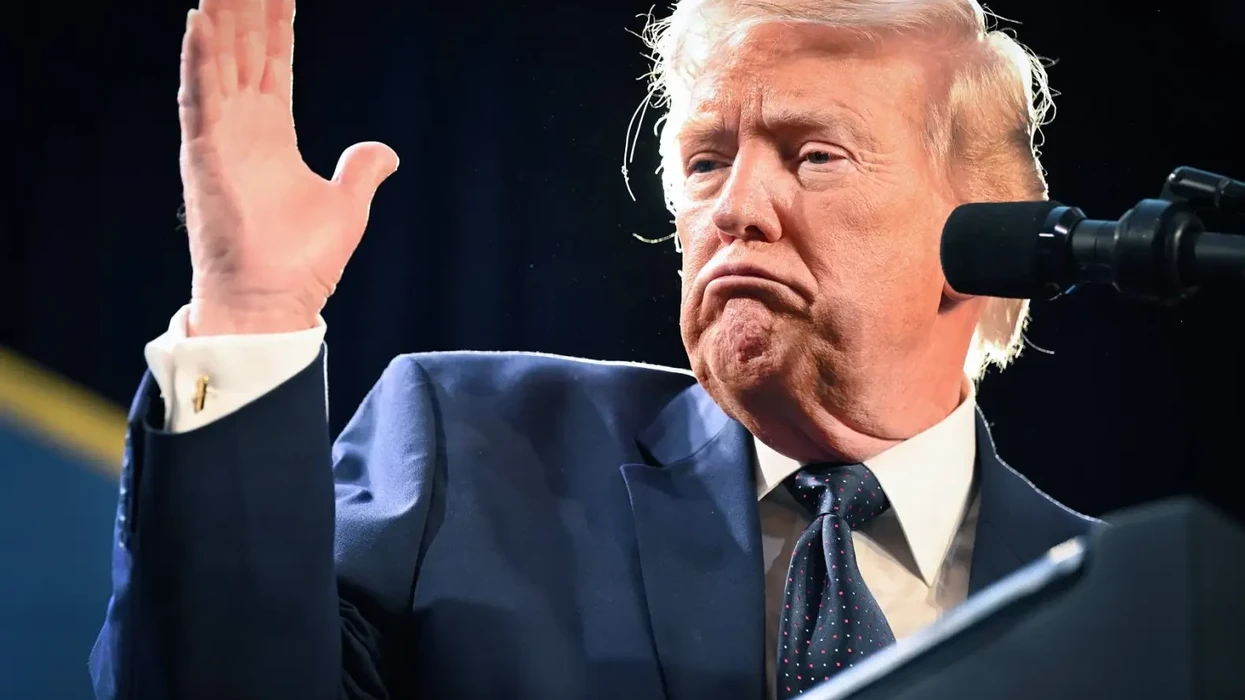
As American and Israeli rockets fly into Tehran, with the stated goal of regime change, anyone who bought into the self-evidently absurd idea of “Donald the Dove” ending America’s forever wars ought to be suffering from a bloody form of buyer’s remorse.
It was always bullshit. But that’s what the Trump team was selling hard. Take human ghoul Stephen Miller’s tweet days before the election: “Kamala = WWIII. Trump = Peace.”
The Trump team reads George Orwell’s 1984 like an owner’s manual and so of course “war is peace.” Their undermining of NATO and the dismantling of American alliances in favor of a “might makes right” foreign policy executed by a sycophantic kakistocracy is a guarantee of more war amid autocratic power grabs worldwide, with a side order of corrupt crony capitalism to profit from the chaos.
If you voted for Trump and believed him, this is on you. And that includes self-styled Palestinian peace activists who thought that Biden and Harris were the worst of all possible worlds and stayed home. We will no doubt see protests for the innocent lives lost in these strikes — but I’d have a lot more time for those folks if they were also seen protesting the estimated 20,000 to 30,000 Iranian lives snuffed out by murderous mullahs in the last few months alone.
The Islamic Republic of Iran has been despotic and dangerous from its inception. The Iranian people have been oppressed and denied basic freedoms for decades. But this is an extreme example of a war of choice. The American military strikes against Iran’s nuclear weapons facility last year were justified because Iran cannot be trusted with a nuclear weapon. That is true. But the much trumpeted total obliteration of those facilities is apparently not true — or so goes the justification for this war. And don’t forget that it was Trump who pulled the U.S. out of an Obama-era deal to stop Iran from developing weapons — arguing absurdly that the imperfect anti-nuke deal needed to be blown up to stop Iran from developing a bomb. Iran’s subsequent progress toward a bomb then created the rationale toward these strikes. This is a self-inflicted state of emergency. Peace is war and war is peace.
Pity the willful dupes in Congress who deluded themselves into thinking that Trump deserved the Nobel Peace Prize. They’ll probably rationalize that he would’ve been peaceful if he got the honor. Now it will be read as a cautionary tale for not sucking up. The chairman of the Board of Peace is now bored of peace. While Rand Paul remains admirably consistent, it’s Lindsey Graham who is pirouetting around the Senate floor while the Gimp Speaker Mike Johnson is unable to speak for the basic constitutional principles of separation of powers let alone authorization to go to war.
If you’re feeling shell-shocked trying to keep up with Operation Epstein Distraction, get ready for the inevitable next crisis — regime change without a plan for replacement. This is what the Trump administration did in Venezuela — kidnapping the socialist dictator Maduro but keeping his regime in place in exchange for crude oil access. The opposition is still in exile and its leader María Corina Machado gave her Nobel Peace Prize to Trump in exchange for exactly nothing.
One of the clear lessons of history is that if you don’t win the peace, you don’t win the war. The Saudis and their Sunni allies will back the U.S. and Iran because they hate the Shia Iranians (who, incidentally, are not Arabs), but beyond removing the Iranian regime, the plans for replacement and stabilization seem TBD — and with Trump’s inability to stay focused on anything beyond his immediate self-interest, solid plans are unlikely to emerge. Maybe a leader will come from the underground opposition; maybe it will be the Shah’s son, who has been living in the U.S. waiting for a restoration like many members of the diaspora. The upside is that Iran has a distinguished history and an accomplished Persian culture: The Islamists don’t represent the entirety of the people of Iran and never have.
But the path ahead will be messy at best. It will require concerted effort and civil commitment, not just an open call for private investment from Mar-a-Lago members. If the United States is now kidnapping and killing dictators without direct provocation, it establishes a dangerous precedent which will come back to bite us after demolishing our moral authority in the world.
It is the unexpected effects, the cascades of consequence where we cannot always plan ahead, that cause most responsible statesmen to try to keep the peace. But Trump has the carelessness of a rich-boy bully who can always buy or bluster his way out of trouble. He’s a con man who has found his ultimate mark in his followers, who fool themselves into thinking that a reflexive liar is the one man with the courage to tell the truth.
Perhaps the most prominent example is the vice president himself — a bright guy who not that long ago compared Trump to Hitler and a deadly narcotic but then convinced himself that careerism demanded an abrupt conversion. After all, he endorsed Trump less than two years ago with this very serious column headlined “Trump’s Best Foreign Policy? Not Starting Any Wars,” explaining, “He has my support in 2024 because I know he won’t recklessly send Americans to fight overseas.”