
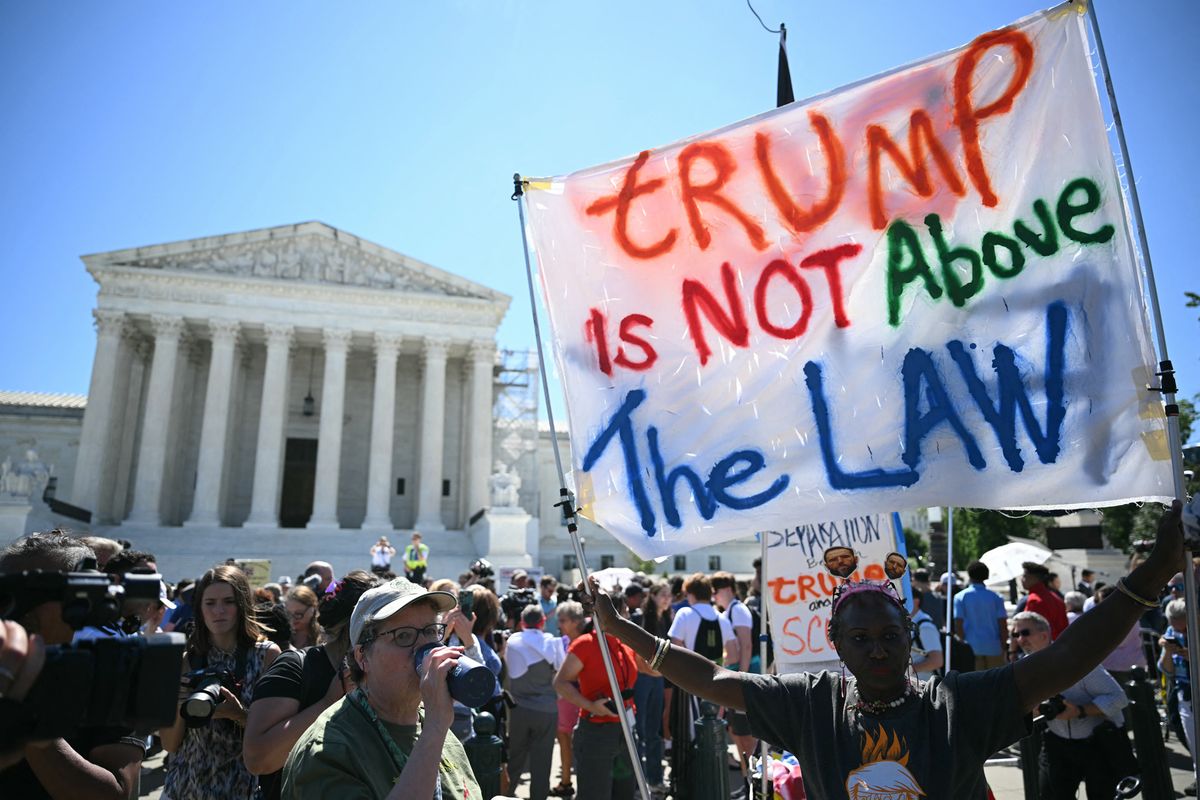
Donald Trump spent years being bitterly mad at a Supreme Court majority and a conservative legal movement that did not work hard enough to help him steal the 2020 presidential election. But ahead of the 2024 election, the court seems to be making up for his troubles. The high court has issued a series of rulings boosting Trump’s presidential campaign — with none more consequential than its immunity decision Monday.
“It’s like Christmas,” a conservative attorney close to Trump tells Rolling Stone on Monday afternoon.
According to three sources familiar with the situation, the Supreme Court’s landmark ruling on Trump’s expansive presidential immunity arguments was a far bigger victory for Team Trump than they ever expected. But the former president and his inner circle aren’t content to stop at victory-lapping. Plans are already in motion to use this new, historic court decision as a legal shield to help a potential second Trump administration implement his extreme policy agenda with less concern for rules and laws, sources with knowledge of the matter say.
For months, Trump and his legal and political counselors were predicting that the court would reject Trump and his attorneys’ claims of “absolute” immunity — which Trump’s lawyer claimed would apply even if the president were to order the assassination of a political rival. Still, the Trumpworld elite were banking on partial victories: They figured the case would keep his federal election-interference trial off the calendar until after the 2024 election (when, if he wins, Trump’s Justice Department could make the case go away), and were hopeful that the highest court in the land would bless some level of presidential immunity from prosecution.
But on Monday, Team Trump got significantly more than they were asking for, to the point that various lawyers and other allies close to the ex-president were genuinely, pleasantly shocked, the three sources say. Many of them — including Trump’s political lieutenants, lawyers, and members of his government-in-waiting — were surprised as they read the decision’s rather broad interpretation of immunity for a U.S. commander in chief’s “official” acts, believing the John Roberts court had inched much closer to Team Trump’s argument of total immunity than they had thought possible.
Others, including some Republicans who immediately began texting Trump directly about their elation over the decision, were thrilled that the Supreme Court’s ruling also specifically started pulling teeth out of Special Counsel Jack Smith’s Jan. 6-related criminal case against Trump.
The majority’s decision established three categories of presidential activity with differing levels of legal immunity. The court held that a president enjoys absolute immunity for official acts taken within his constitutional responsibilities, presumptive immunity for all of his official acts, and no immunity for his unofficial acts.
In its decision on Monday, the court also explicitly held that Trump’s efforts to have allies like Assistant Attorney General Jeffrey Clark in the Justice Department help to overturn the election represented official acts and thus qualify for “absolute immunity.”
It remains for U.S. District Court Judge Tanya Chutkan to rule on whether some of Trump’s actions fall within his official duties and can be subject to prosecution — including his efforts to pressure Vice President Mike Pence to reject the count of electoral votes, to put forward slates of fake electors in battleground states, and pressure state officials to try to stop the electoral process.
The dissent by the Supreme Court’s liberals mirrored the disbelief of the Trump camp. The court’s “expansive vision of presidential immunity” is greater than that imagined by the Founders or “even President Trump’s lawyers,” Justice Sonia Sotomayor wrote for the three-judge minority. Sotomayor noted that Trump’s attorneys had argued to the court that a president who had been successfully impeached and convicted for high crimes and misdemeanors could face criminal prosecution. Under Monday’s ruling, she wrote, even a president removed from office by Congress “would be entitled to ‘at least presumptive’ criminal immunity for those acts.”
“Should we send John Roberts a muffin basket?” one person close to Trump joked Monday afternoon.
Lawyers outside the Trump orbit believe he still faces some danger in the Jan 6. case, which has been remanded to Judge Chutkan.
“I think that Judge Chutkan will not have a great amount of difficulty finding that most of the actions for which Donald Trump was indicted in the January 6 case were things that he did in his personal capacity,” Claire Finkelstein, a law professor who directs the Center for Ethics and the Rule of Law at the University of Pennsylvania, tells Rolling Stone. “I think most of the charges will stand at the end of the day.”
But Finkelstein says that the decision to send the case back to district court is “significant” in the timing: “The trial will not get underway until, almost certainly, until after the election,” she says. And Finkelstien describes the decision as creating a “sea change” in the powers of the presidency that “strikes at the heart of the whole idea of checks and balances,” and poses a danger to the health of our democracy — particularly should Trump win reelection.
Already, the sources familiar with the situation add, lawyers and advisers to the former and perhaps future president are planning on incorporating Monday’s Supreme Court decision into court arguments and documents in Trump’s criminal cases brought by prosecutors in Georgia and at the Department of Justice. Trump has long argued that what he’s been charged over — whether he was working to steal an election he had clearly lost, or hoarding a trove of classified government documents at his Florida club and estate after his White House term — represented “official acts,” and several of his lawyers and aides view the ruling as useful to their claims.
Furthermore, two of the sources familiar with the situation tell Rolling Stone, several Republicans and MAGA diehards who have been closely advising Trump on policy for a potential second administration had another reason to celebrate on Monday. In the hours after the court ruling came down, these Trump loyalists privately noted to one another how this Supreme Court-blessed interpretation of presidential immunity for “official” acts could be helpful to them in making a possible second Trump term as aggressive and as extreme as possible, no matter what laws there are on the books.
Trump and much of the GOP elite’s agenda for a second term includes prosecuting and potentially imprisoning an array of political enemies, deploying active-duty troops to Democratic-controlled cities whenever he wishes to bring “order,” and invading and bombing Mexico.
In a press briefing on Monday, Brookings scholar Norm Eisen, a former co-counsel for the House Judiciary Committee during Trump’s first impeachment, called the decision “a startling expansion of presidential immunity that goes far beyond anything we’ve ever seen or contemplated in American history.”
Norman Ornstein, an emeritus fellow at the American Enterprise Institute, offered a stark warning in response to a “reckless” decision he argues goes far beyond “blowing up” the trial for Trump’s role in Jan. 6. “If Trump is elected again,” Ornstein writes, “he can invoke the Insurrection Act, use the military to shoot down peaceful protestors, and be immune from any penalty.”
Finkelstein, the Penn law professor, tells Rolling Stone this is a real danger of presidential immunity. “This is going to be a disaster for the chain of command,” she says. Under the court’s ruling, presidential immunity does not extend beyond the White House. “That means that the troops who he’s ordering will not be immune. The court has now put them in a terrible position, because if they are ordered to fire on protesters, they will be committing a crime, but he won’t.”
These warnings of the dangers of an unchecked Trump presidency were echoed by members of Congress. “This decision has set the stage for an unchecked dictatorship” by Trump in a second term, said Rep. Jerry Nadler (D-N.Y.), warning that Trump has been transparent in his goal “to weaponize the presidency to seek revenge on his political opponents.”
While not offering specific warnings about a potential return to the White House by Trump, the two dissents, written by Justices Sotomayor and Ketanji Brown Jackson, offer stark warnings about how a future president could escape criminal accountability for dark and violent abuses.
“In every use of official power,” Sotomayor writes, “the president is now a king above the law.” Sotomayor argues that the immunity the court has now guaranteed to presidents “lies about like a loaded weapon” for any chief executive to wield — to advance “his own interests, his own political survival, or his own financial gain.”
Worse, Jackson writes, “the majority incentivizes all future presidents to cross the line of criminality while in office.” That’s because a president can now “commit crimes in the course of his job even under circumstances in which no one thinks he has any excuse,” she writes. “The law simply does not apply to him.”
Jackson continues that “the seeds of absolute power for presidents have been planted” — with “grave consequences for the rights and liberties of Americans.” Indeed, the sweep of potential malevolent conduct that can no longer be prosecuted, according to the court’s liberals, is astonishing. Sotomayor imagines a president who in his official capacity, hypothetically, “orders the Navy’s Seal Team 6 to assassinate a political rival? Immune. Organizes a military coup to hold onto power? Immune. Takes a bribe in exchange for a pardon? Immune. Immune, immune, immune.”
Jackson underscores the threat of unaccountable presidential criminality, writing that even a president “who admits to having ordered the assassinations of his political rivals” or “indisputably instigates an unsuccessful coup” is now likely in possession of a get-out-of-jail free card. Sotomayor underscores the “twisted irony” that the president charged with “faithful execution” of the nation’s laws “can break them with impunity.”
Jackson warns that the majority will enable the president to “become a law unto himself.” Sotomayor warns that the “majority’s message today” is: “Let the president violate the law” and “let him use his official power for evil ends.”
The court’s ruling has also prompted a series of dire warnings from senior Democratic lawmakers about the implications of the court’s ruling for future presidents to evade accountability for abuses of power.
Sen. Dick Durbin (D-Ill.), the chief Democratic whip in the Senate, warned that the majority’s opinion meant that presidents “may be immune from abusing the levers of government to overturn an election or engage in other misconduct.” Durbin called out the court’s explicit prohibition on prosecuting Trump for his attempt to pressure the Justice Department into overturning the election as a threat to the institution’s tradition of independence from politics. By granting future presidents broad immunity to pressure the department into what would otherwise be illegal acts, the court “stripped the Justice Department of its valued independence and undermined its commitment to the rule of law,” he said.
Sen. Sheldon Whitehouse (D-R.I.), the top Democrat on the Senate Judiciary Committee, warned that the decision “will cause even greater wreckage than Bush v. Gore” and that it has “essentially made the president a monarch above the law.”


 SACHA LECCA
 SACHA LECCA
 SACHA LECCA
 SACHA LECCA
 SACHA LECCA




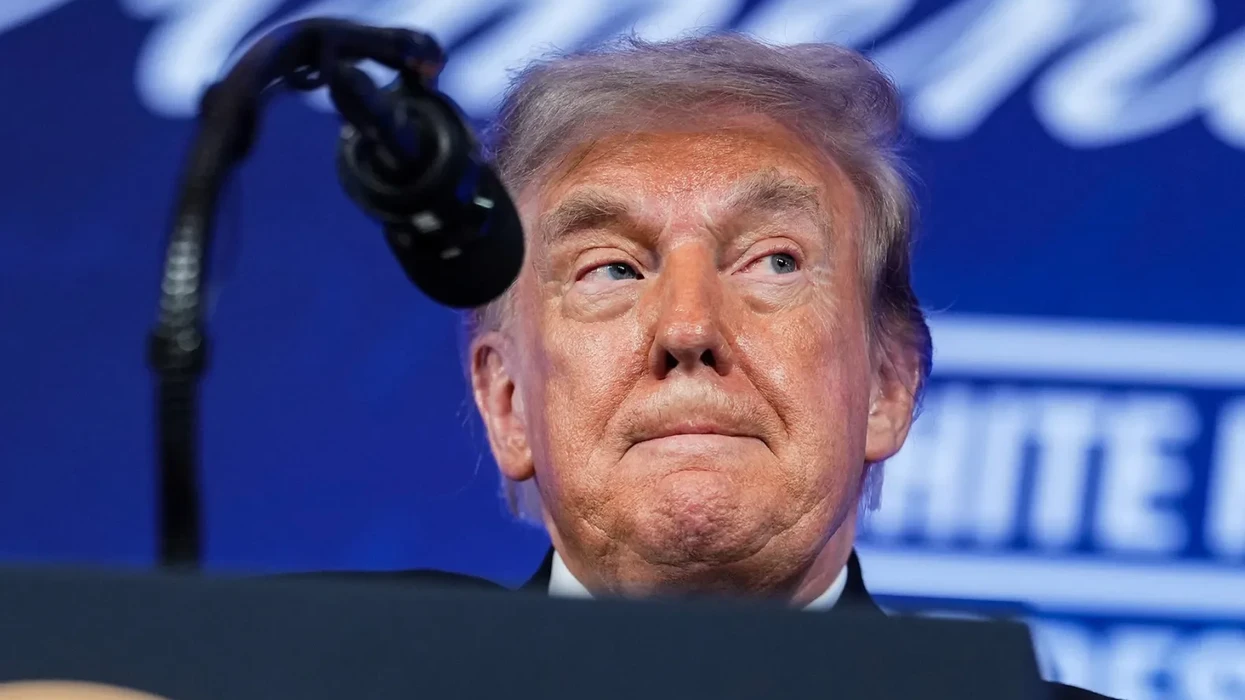
Donald Trump speaks in front of the American flag at the White House, on May 12, 2026.
It’s the Corruption, Stupid
Let’s say it plainly: There has never been a president as corrupt as Donald Trump. There is no close second in our history.
Take two days in May as Exhibit A. Americans just found out that in the first quarter of this year, Trump’s stock portfolio made 3,600 trades — an average of nearly 60 a day. This is a rapacious pace that would make a day trader on meth blush. Many of these appear suspiciously timed to benefit from actions approved by the president himself. For example, his Nvidia stock surged after Trump announced the company would be permitted to sell its cutting-edge AI chips to China. Similar suspiciously well-timed calls were made ahead of big government moves involving other companies, from Intel to Palantir to Boeing. The Trump Organization says all trades are made by a third-party investment advisor. If so, they appear to be psychic.
But the apparent insider trading scam being run from within the Oval Office is small change — merely millions of dollars — compared to the self-dealing plunder of $1.8 billion tax-payer dollars being pushed through the DOJ and IRS.
There’s never been a sitting president who sued his own government for $10 billion. That’s because it’s absurdly corrupt. But that’s what Donald Trump did, arguing he had suffered damages from prosecutions pursued before he was reelected. Trump, like many of his supporters, persistently confuses persecution with prosecution.
The judge who heard the case convened an independent panel to review the suit, suspecting it might be a scam. Before the case could be dismissed, Acting Attorney General Todd Blanche — who had previously served as Trump’s personal lawyer — declared that the bogus suit would be preemptively settled, not for $10 billion, but for the symbolic sum of $1.776 billion, which Trump said will be distributed to persecuted political allies.
This is a shakedown. The president is compelling a Justice Department he controls to redirect money from taxpayers — that’s you — to his most fervent supporters. This slush fund will set off a cash grab among MAGA lawyers and be used to reward partisan fanatics who attacked the U.S. Capitol — and police officers — on his behalf.
If that wasn’t enough of a blatantly illegal use of presidential power, it was revealed that the “settlement” deal included a pledge signed by the acting attorney general that would ensure — in the hysterical all caps of a Trump tweet — that the government would be “FOREVER BARRED and PRECLUDED from prosecuting or pursuing” any tax claims, audits or related prosecutions against Trump, his family or their businesses. This is an attempt to get a permanent get-out-of-jail-free card for the Trump family — a license to steal.
All of this is insane. All of it is unethical, and much of it is illegal and impeachable — but our system was not designed to deal with a shamelessly self-dealing president, a spineless Republican Congress, and a complaint conservative Supreme Court that has refused to enforce the emoluments clause of the Constitution and ruled that Trump has immunity for actions he takes as president. That ruling may prove to be the most consequential — and most corrosive — act of judicial abdication in American history. Against this partisan-group think, individual acts of courage matter. So kudos to the top lawyer at the Treasury Department, Brian Morrissey, who at least had the integrity to resign rather than oversee this tax-payer funded plunder.
Just to close out the corruption-palooza, Trump announced that he would endorse the Lone Star State poster-boy of corruption, Texas Attorney General Ken Paxton, in his primary against incumbent GOP Senator John Cornyn. Paxton’s scandals include a truly buffoonish array of fraud and bribery charges that resulted in him nearly being impeached by the state legislature. But corruption is a feature, not a bug, of Trumpland.All this smacks of late Rome and you’d be forgiven for half expecting Trump will next appoint a horse to an open Cabinet position, with Republicans rationalizing the need for more equine representation. It is no more absurd that the cavalcade of Trump appointees refusing to say that Biden won the 2020 election during their confirmation hearings in the Senate. The decision to parrot unreality for partisan gain defines deviancy down.
But in the search for something hopeful to hold onto in dark times, you can find some comfort in the fact that corruption is often the thing that turns the tide against authoritarian-adjacent administrations. And there is evidence this is happening.
Trump’s billions in self-enrichment, his reflexive twisting of U.S. policy to sell out long-term national interests and enduring values, comes at a moment when nearly half of Americans say they are feeling extremely anxious about their own financial situation.
That anxiety is driven by the widening gap between Main Street and Wall Street, a gap set on fire by a trade war and a real war Trump started, which has no end in sight but promises to further raise energy prices, fertilizer prices, and strangle the global economy. While CEOs embrace the transactional nature of this president, kissing his ring and offering vigs, the situation is grim if you’re not lining up at the Trump trough. At a time when the super-rich are getting richer, everyone else is told to go to hell by the man in the White House.
These are precisely the kinds of conditions that turn people against an aging, autocratic president who shows contempt for the very people who put him in office. It is not just that Trump’s approval numbers have plummeted to the point where two-thirds of Americans disapprove of the job he is doing. It is that Trump, for the first time, is opposed by a majority of non-college-educated white voters — a.k.a. his base — and they feel betrayed because Trump is raking in billions of dollars while they struggle to pay rent and buy groceries. Trump has dismissed and discounted their concerns, turning a blind eye to the anger about rising costs that carried him back into the presidency.
Trump’s aim is to make his thievery so blatant that we collectively become numb to it and disfigure our democracy in the process. Once upon a time conservatives warned about the dangers of “crony capitalism” and corruption. Now they are silent and complicit. It is the temporary triumph of partisanship over principle. Patriotism demands that we reassert the basic American idea that no man is above the law and that our presidents are not kings.