
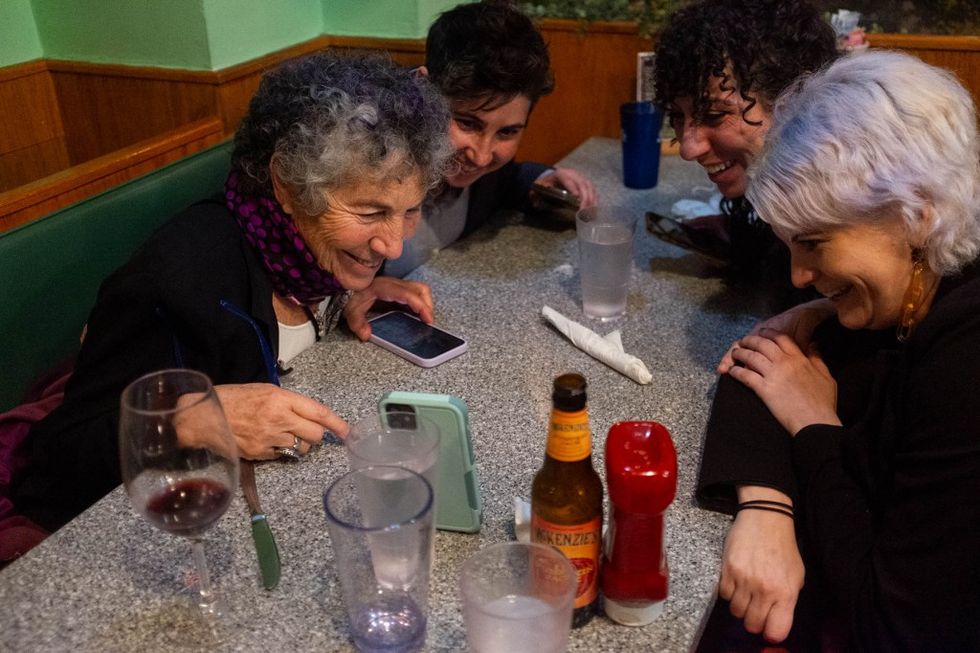
“I’m so nervous,” says Olivia, a photographer with Jewish Voice for Peace. “I’m so nervous.” She keeps repeating it. Olivia and about a dozen other activists are huddled in a cluster of booths in the Astro diner in midtown Manhattan. Cara, another JVP member, has propped up her phone next to a ketchup bottle so we can see a livestream of the action taking place a few blocks away at Radio City Music Hall: President Joe Biden, Barack Obama, and Bill Clinton, are onstage with Stephen Colbert, before a crowd of over 6,000 donors — some of whom paid more than $500,000 for front-row, VIP access — for an event the campaign says raised more than $25 million.
It’s the biggest bash of the election cycle so far, a chance for a beleaguered, historically unpopular president to surround himself with the trappings of political and cultural power in America’s greatest city. The people at the tables around me are tuned in for a different reason: They’re waiting for their activists inside the venue to try to bring the whole thing to a crashing halt.
In the past six months, Biden has weathered a persistent and vehement wave of protests, disruptions, and organized voting campaigns against his support of Israel’s brutal war on Gaza, following Hamas’ attack on Israel on Oct. 7. More than 32,000 Palestinians have been killed, millions have been displaced, and experts say the population is at imminent risk of famine.
As Biden cruises to a primary victory, activists across the country have mounted protest campaigns at the polls — instructing Democrats to vote “uncommitted” in states where that’s possible, or write in “cease-fire.” In Wisconsin last week, nearly 50,000 voters marked “uninstructed” on their Democratic primary ballots, a figure that almost doubles the margin Biden won the state by in 2020. Similar campaigns in Michigan and Minnesota also cleared that margin, signifying that voters in several key swing states can’t be taken for granted come November.
But the pro-Palestine movement’s most visible actions have been loud, growing protests in city streets, at national landmarks, and in closed-door meetings alike. On the East Coast, one of the most prominent protest groups is Jewish Voice for Peace, a nonprofit founded in 1996 as a counterweight to Zionism. These protests — screaming disruptions at speeches, attempts to block Biden’s presidential motorcade, banner drops at live events — are meticulously planned and organized.
At the Astro, you could cut the tension with a blunt diner knife. There’s half a plate of onion rings that everyone has forgotten. Jane Hirschmann, an activist who was turned away by security trying to get into the Biden fundraiser, is watching on another phone with her two daughters and a big glass of red wine. Nearly everyone is texting frantically — updating a group thread of photos and videos from inside Radio City, trying to sort out who’s who and where they are. The livestream cuts out for a moment.
“Did we lose it?” someone asks. “Well, if they cut the Wi-Fi in the building …” someone else says, right before the stream comes back on. Cara gets a message. “Both banners are in,” she says. Olivia and another activist try to make a tally of how many protesters they have inside the building: There are multiple groups involved, and no one is sure how many of their members managed to get through security. We’re nearing the moment of truth. “Are they waiting for a signal?” Olivia asks. “The signal is Biden talking!” someone at the next table over responds.
Then we hear it. On the livestream, which is being broadcast by an attendee in the Radio City orchestra pit, we start to hear shouting from one of the upper decks. The diner goes quiet, everyone bending closer to the nearest screen to hear. The first action was supposed to be a banner drop from the upper level, but the livestreamer is still facing the stage, so we’re going off sound cues broadcast in tinny quality through a shaky X feed. We can’t see the banner, but we get the gist of a chant. “LET! GAZA! LIVE! LET! GAZA! LIVE!”
The tension breaks but doesn’t fully subside. There’s more to come. Over the next 15 to 20 minutes, a succession of activists affiliated with Jewish Voice for Peace and several other groups takes turns shouting, chanting, or questioning Biden whenever he tries to speak. Jay Saper, one of JVP’s organizers, tells me they want the disruptions solely focused on Biden — opposing him whenever he speaks, forcing him to confront the issue head on. It doesn’t take long for them to get results: Colbert, the event’s moderator, breaks into a discussion of Gaza as security ejects one group of disruptors.
“Excuse me, Mr. President. For people who are watching at home on the feed, you may not be able to hear, but there’s some protesters here. There are some protesters here who are no doubt related to the protests we saw across the street,” Colbert says. “There are people outside, and people in this room, I’m sure, who have passionate divisions about what the best course of action is for the crisis in Israel, in Gaza right now. What do you believe the United States’ role should be going forward to ensure the most peaceful and prosperous future for the people of Israel and for Gaza?”
The question is almost certainly planned, scripted, and prepped-for, and Biden’s response is boilerplate: After telling security to “let them go,” he offers up a call to “get more food and medicine” into Gaza, mourning that there were “too many innocent victims, Israeli and Palestinian.”
“But we can’t forget, Israel is in a position where its very existence is at stake,” Biden continues. “You have to have all those people. They weren’t killed. They were massacred. They were massacred. And imagine if that had happened in the United States and tying a mom and her daughter together, pouring kerosene on them, burning them to death. It’s understandable Israel has such a profound anger, and Hamas is still there. But we must, in fact, stop the effort that is resulting in significant deaths of innocent civilians, particularly children.”
The answers onstage aren’t good enough for the group in the diner. “Oh come ON!” someone yells, when Obama follows Biden with more platitudes. But their people are in the room, determined to have their say.
Getting to this point took a lot of work. The action was organized by JVP and a coalition of groups, including the Palestinian Youth Movement and Adalah Justice Project; each worked their connections to wealthy individuals, who purchased tickets and then transferred them to the volunteers. A week before the fundraiser, the coalition had around 55 seats inside Radio City Music Hall secured for planned disruptors. But the day before the event, activists with tickets started getting emails from the Biden campaign, informing them that the campaign was “unable to accommodate” them at the event and would refund their tickets. “This decision is final,” the emails read. The emails continued on Thursday morning, just hours before the event. Saper, one of JVP’s lead organizers for the evening, was denied a ticket; so was Sarah Koshar, another organizing lead.
Jane Hirschmann and her daughter Nell Hirschmann-Levy were issued tickets. They, too, received rejection emails, but before the event, they try their luck in line anyway. When they reach security, however, they are directed to what event staff call the “Solutions Tent,” where they are told that their names are not on the approved list of attendees. “The solution was kicking me out,” another disruptor who tried to gain attendance says, laughing.
The Biden campaign had clearly anticipated that this might happen. In early March, NBC News reported that the team organizing the Radio City fundraiser was “discussing whether to hire a private company to vet attendees.”
“Thousands of supporters who are deeply invested in protecting democracy and believe in a future without the chaos and violence of Donald Trump attended [the] historic fundraiser,” Biden campaign spokesperson Daniel Wessel tells Rolling Stone in a statement. “It was closed to those who had previously disrupted or we had reason to believe would disrupt the event.”
Wessel adds, “President Biden believes making your voice heard and exercising your First Amendment right is part of being an American — unlike Donald Trump, who threatens protesters with violence and wants to jail people who disagree with him.”
Some of the aspiring disruptors weren’t hard to find: Several of those attempting to enter the Radio City event had been arrested at previous actions targeting Biden. Protesters arrested at a Feb. 2 disruption who attempted to block the Biden motorcade from traveling through New York’s Upper East Side had their court dates set for Feb. 26; the Biden campaign returned to New York that day for a fundraiser and also taped an episode of Late Night With Seth Meyers. Saper says many of the activists went straight from their court appearances in downtown Manhattan to 30 Rock to protest Biden, and some were arrested again in a highly publicized action in the NBC building’s lobby.
On the day of the fundraiser, as more rejections roll in, the disruption coalition scrambles to figure out who they would actually have inside Radio City. The coalition has two banners, painted on thin sheets of canvas sewn into the lining of different attendees’ jackets. A few hours before the doors open, Saper briefs the small cadre of disruptors who still had a shot at getting inside in a corner of Central Park, before the group splits up and goes through the line in small groups of ones and twos to avoid attracting more attention. Disruptors are instructed to wear “wealthy Democrat drag” to fit in.
Hirschmann wears a Biden-Harris pin on top of her plum topcoat, which she jettisons to an attendee after security turns her away. Eventually, some of the coalition’s disruptors find their way in, among them David and Jeanie Dubnau, a couple in their 80s; Alice Sturmsutter, 76, a retired nurse; and Hannah Ryan, a photographer assigned to record the disruptions. All told, the coalition puts roughly 10 disruptors inside the event. Approximately 45 are turned away.
“They had tried so hard to not let us in,” says Sandra Tamari, executive director of the Adalah Justice Project, a Palestinian advocacy organization that helped organize the protest. “They are clearly scared of disruptors, they’re scared of being confronted with the fact that they are funding a genocide. It felt maybe in some ways it was pure luck that we could get some people in — but also a testament to the power of our moment and the size of our movement. They can’t track everyone.”
As Biden’s campaign has worked to contain the protests — and shield the president from them — fundraisers, including the Radio City bash, have been restricted to the traveling White House press pool. Rolling Stone and several news outlets were denied press access. But as the campaign moves into the general election contest, and Biden holds more public events, there are signs that the campaign will have to reckon with disagreement on a much more regular basis.
A closed-door meeting with Muslim American leaders last week landed with a thud when only six invitees showed up. The campaign’s last major public event, an abortion rights rally in Virginia, was dogged by protesters, as well.
Some of these events, like the Radio City infiltration or the mass street protests that jam up traffic in major cities, require significant time and attention from dozens of organizers to pull off. But Munir Atallah — an organizer with the Palestinian Youth Movement, which was part of the coalition for the Radio City event — tells me that disrupting the Democratic Party machine is easier than people think.
“What’s so profound about this style of disruption is that it’s very easy to organize, but it’s incredibly effective,” Atallah says. “All it really takes is you and your friend group deciding you’re pissed off.”
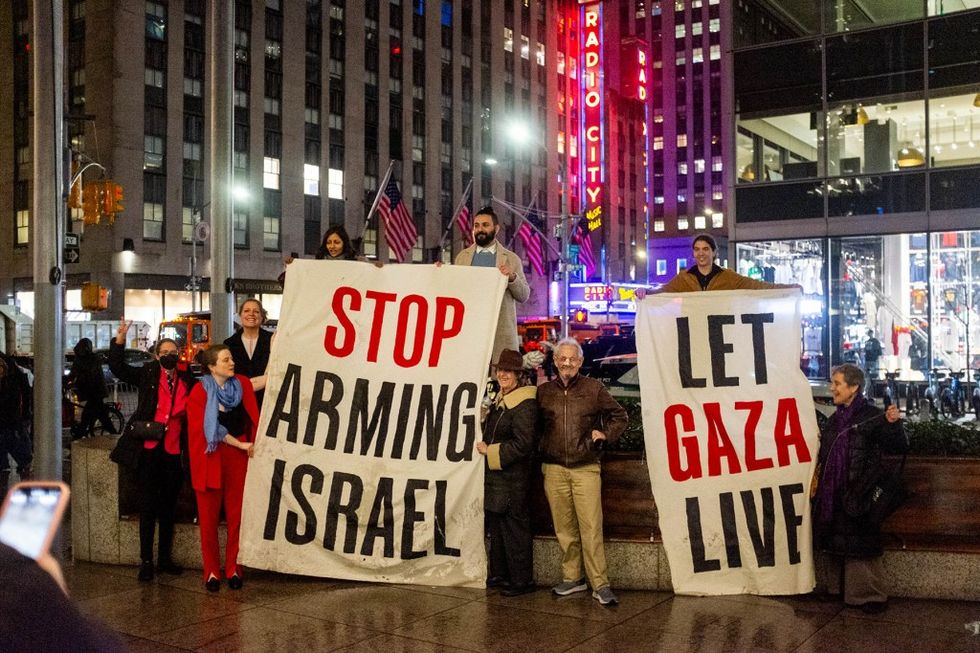
As the fundraiser starts to wrap up, the JVP leaders leave the diner and rejoin the protest outside of Radio City. The disruptors, ejected in mostly peaceful fashion from the event, meet us there — still holding their banners. Security pulled them from the event, but let them keep the props. The Dubnaus were some of the first to go, dropping a banner that kicked off a wave of subsequent disruptions.
“It felt a little scary getting up in a room with that many people,” David Dubnau says, as Olivia organizes the group for a photo with Radio City’s lights in the background. “When I thought about, ‘Well, gee, am I going to have the guts to stand up and do this?’ … I just thought of all the kids in Gaza who are getting amputation without anesthetic, and I thought, ‘Well, this doesn’t take that much courage.’”
The threat in all this action is implicit. The general election is coming, and Biden will almost certainly be the name on the ticket in blue — facing off against Trump. To the Democratic faithful, these public shows of disloyalty represent the dangerous possibility that naive idealists will hand Trump the presidency in November. The protesters don’t see it that way — they insist that if Biden doesn’t budge, it will be his fault alone if he loses the election.
There are some signs that the president’s position on Israel may be shifting slightly: Following the assassination of seven aid workers from the Washington, D.C.-based aid group World Central Kitchen, a reportedly “tense” conversation between Biden and Israel’s Benjamin Netanyahu resulted in news that an aid corridor would be opening in Gaza’s north. Biden stopped short, however, of threatening to condition arms sales. As of last week, he was still pushing Congress to approve the sale of more F-15 fighter jets to Israel.
As the little dramas of security screenings, banner drops, and shouted questions play out inside, a large crowd gathers across from Radio City, waving flags and chanting, craning their necks to catch a glimpse of event attendees waiting in line across the street, past a line of sanitation department garbage trucks parked in a defensive barrier on Sixth Avenue. They stayed there, in freezing early-spring showers, for the duration of the event, waiting to bird-dog the Biden donors as they leave. They scream “GENOCIDE SUP-POR-TER! GENOCIDE SUP-POR-TER!” at small gaggles of horrified attendees in fancy dress, scurrying toward the subway or cabs.
One protester makes the stakes clear: “Congratulations on helping to elect Trump!” It’s been a long night, but the crowd outside Radio City hasn’t lost its edge: They’re really going after anyone who walks by with a Biden-Harris lawn sign, passed out to attendees inside. “SHAME! SHAME!” one woman screams. The crowd outside, and the disruptors inside, want to make sure that supporting the status quo is anything but comfortable.
“What does it say about our society if nothing happens at that event, if everything goes on as usual?” says Atallah, the Palestinian Youth Movement organizer. “We have to disrupt and mark these events, to say that it’s unacceptable, what our government is supporting.”
As the last shell-shocked attendees filter off down midtown’s streets, the protesters are still there. The rain has been replaced by cold, biting wind; keffiyehs are pulled tighter around heads and necks. There’s another protest tomorrow, and Biden will surely be back soon. Odds are, the bird-doggers will be there, screaming for peace.