

He wrote the infamous Bush-era “Torture Memos.” Today, John Yoo and his work are — in the words of one source close to Donald Trump — seen as a “guiding light” by MAGA lawyers and other Trump lieutenants who are seeking to form the legal foundations necessary for making a second Trump administration as wrathful and as unchained as possible.
In the past several weeks, the conservative attorney and Berkeley law professor’s ideas have been increasingly discussed and influential within the presumptive 2024 GOP presidential nominee’s inner orbit, two lawyers close to Trump and another person with knowledge of the situation tell Rolling Stone.
Since late May, some attorneys and Trump confidants have briefed Yoo’s legal theories and writings directly to the ex-president, who in turn has privately lauded Yoo’s recent defenses of Trump in conservative media, particularly on Fox News. Nowadays, when Trump’s prominent ideological allies and other members of his government-in-waiting discuss the issues of expanding presidential authority in a potential second term, broad presidential legal immunity (now blessed by the U.S. Supreme Court), and wielding state power to punish Trump’s political enemies, Yoo’s name and work are frequently brought up, and at times incorporated into their own internal policy blueprints, legal drafts, and documents.
Yoo’s current stature among Trumpworld’s elite offers a preview to the kind of legal minds and reactionary thinking that would likely define a second Trump presidency, should the convicted felon and twice-impeached former president return to power. Yoo’s views on presidential authority include a dismissal of checks on executive power, an openness to authoritarian means and the embrace of brutal violence as an instrument of policy, and an explicit lust for swift revenge against Trump’s many political foes.
In other words, his decades of experience and philosophy fit perfectly into the ascendant retribution-fueled stage of Trumpism that the former president and his party are vowing to bring to the White House.
“This is a man who has a long record of disregard for the law and has a history of approving illegal and criminal activity including torture, and passing those off as legal opinions on behalf of the government,” says Christopher Anders, a senior attorney at the American Civil Liberties Union who spearheaded much of the human-rights group’s anti-torture work in Washington, D.C., during the Bush era. “John Yoo seems to now be publicly pushing a continuation of the kinds of lawless views of the law, and suspension of the rule of law, that he pushed through during the Bush administration that caused great damage to the country and put American soldiers in danger. And if that advice is followed now, it would certainly cause immense damage to any potential future Trump administration.”
The Berkeley law scholar served as a deputy assistant attorney general in the Justice Department’s powerful Office of Legal Counsel, where his extremist views of the presidential authority led him to bless torture as a legal and appropriate tool during the Bush administration’s “War on Terror.”
That worshipful attitude toward presidential power has now earned him a larger audience within a Trumpworld even more enamored with executive authority following the Supreme Court’s recent immunity ruling, which placed presidents above the law and virtually untouchable by courts or prosecutors.
“He knows how to get things done,” says one of the attorneys close to the former president who has talked to Yoo about policy and legal guidance in recent months. This source also praises Yoo’s May 29 piece for National Review, dubbing it “The Vengeance Memo,” as a reference to Yoo’s “Torture Memos.”
In the op-ed, titled “Trump’s Trial Has Already Damaged the Office of the Presidency,” the George W. Bush administration alumnus argues that to “limit and undo that damage and restore the rule of law, Republicans may have no choice but to respond in kind” to Democrats and Manhattan district attorney Alvin Bragg, whose office prosecuted Trump’s hush money case.
Yoo’s open embrace of Republicans using criminal trials for partisan score-settling earned the piece a wide audience in the upper echelons of Trumpworld, including the former president himself, according to the source.
After the article was published, Trump tapped out an enthusiastic, all-caps post linking to Yoo’s appearance on Fox News discussing his call for partisan prosecutions. It’s one of a number of cameos the legal scholar has made on Trump’s social media account over the past year where the president has praised Yoo’s criticisms of the criminal cases against Trump.
“I am bemused that Trump aides are saying that my writings have any influence in Trump’s inner circle,” Yoo wrote in an email to Rolling Stone on Wednesday night, adding: “I haven’t discussed these issues with anyone on the campaign or legal teams or Trump himself. I have written several books and many articles about the presidency, the Constitution, and the political system. Anyone who has read them wouldn’t be surprised by my [National Review] article or speeches about the Trump trials.”
Still, that hasn’t stopped lawyers and political operatives close to Trump — and the former president himself — from excitedly mining and boosting his work.
In the wake of Trump’s conviction in New York, Yoo’s zeal for hauling Trump’s political enemies into court on partisan criminal charges has only deepened. Prosecutors who dared to investigate and charge the former president “have to be prosecuted by Republican or conservative DAs in exactly the same way, for exactly the same kinds of things, until they stop,” Yoo said at a conservative conference earlier this month, according to Semafor.
“You have to retaliate against them in exactly the same way until you get some deterrence,” Yoo said, adding: “If we’re not going to become a banana republic, unfortunately we’re going to have to use banana republic means.”
That zeal for revenge on behalf of the former president has only further endeared Yoo to an administration-in-waiting bent on abusing the levers of government to exact vengeance on its political adversaries. Trump and his advisers have already spent significant time plotting ways to use the Justice Department to pursue district attorneys Alvin Bragg and Fani Willis, New York Attorney General Letitia James (D), and Special Counsel Jack Smith in retaliation for their cases against the former president.
Aside from their mutual public admiration, Yoo’s imperial view of a presidency with essentially limitless power earned him some notice from Trump during his administration.
In a 2020 article, Yoo criticized a Supreme Court decision which ruled that the Trump administration had improperly ended the Deferred Action for Childhood Arrivals immigration policy and claimed that the ruling, counterintuitively “makes it easy for presidents to violate the law.” Then-president Trump appreciated that conclusion so much, he raised it with White House aides, Axios reported at the time.
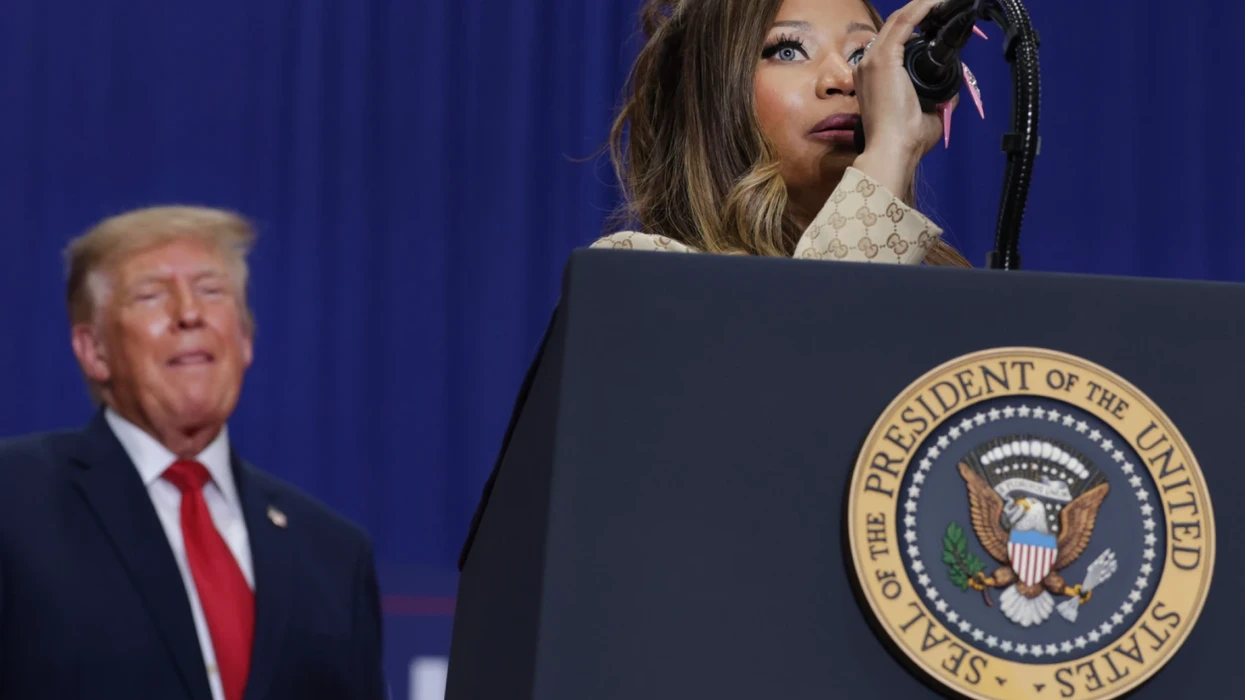
Donald Trump looks to an image of Michigan Democratic Senate candidate Abdul El-Sayed during a campaign rally on Sunday, Oct. 25, 2026, in Port Huron, Mich.
Republicans Are Driving the Most Racist Election Cycle in a Generation
In 2010, a splinter group of far-right Republicans known as the Tea Party summoned a red wave of Republican voters in Barack Obama’s first midterm elections, capitalizing on the remnants of the global financial crisis and troop surges in Afghanistan to help the GOP win 63 seats in Congress. The Tea Party wanted to be known as fiscal conservatives, but their darkest power was abject, open fury that the United States had dared to elect a Black man as president.
But 2010 was not, somehow, the most racist election in recent memory. It’s the 2026 midterms, thanks to the invective spewed by the man in the White House and the worst dregs of his movement around the country. With a war in Iran, skyrocketing gas prices, rampant inflation, and a burgeoning housing crisis, the GOP has no claim to fiscal conservatism this election cycle. Instead, all they have is race.
“There’s five hundred million Arabs in the world,” Health and Human Services Secretary Robert F. Kennedy Jr. said recently. “And yet they don’t produce science. They don’t win the Nobel Prize. They don’t win the Fields Prize. They don’t win the Wolf Prize. They don’t produce literature.”
RFK was making a barely veiled reference to the primary target of Republican racism this cycle: Michigan Senate candidate Abdul El-Sayed. El-Sayed is a muslim, and is sufficiently left wing so as to invite the ire of basically every faction of American politics, including centrist Democrats, centrist Republicans, and the far right, who have taken up the cause of cutting him down with particular zeal. Trump has joined in:
“If Abdul and the Democrats win, they will open the floodgates and invite hordes of jihadis to our shores, creating a nightmare of violence and terror until you cannot even have a Christmas,” Trump said at a rally in Port Huron on Sunday.
Trump has repeatedly issued some of the worst attacks against El-Sayed, repeating the claim that he is a member of the Muslim Brotherhood and calling him a “jihadist.” He has also gleefully mocked El-Sayed’s name at multiple campaign stops, and said over the weekend that he would “be the only senator that has to go through a metal detector before he is allowed to go in the Senate,” the implication, of course, being that he is a potential terrorist.
Vice President JD Vance, not one to be out-done, accused El-Sayed of “anti-white” racism, a familiar line of attack by members of the far right looking to mobilize economically disadvantaged white voters.
“Abdul El-Sayed, who maybe more than any Democrat running in the nation has engaged in the kind of explicitly anti-white racial hatred that has become common in the Democratic Party,” Vance said at a rally in Michigan on Tuesday. “I’d say that person should not be elected.”
The attacks on El-Sayed are shocking and crude, but they didn’t spring out of a vacuum. Racist dogwhistles — and more explicit attacks — have been common fodder for the GOP for decades, from Ronald Reagan’s popularization of the term “welfare queen” — a veiled attack on impoverished Black Americans — to Trump’s support of the Barack Obama birth certificate conspiracies. Some of Trump’s earliest political breakthroughs came on the back of demonizing Latin American immigrants and painting undocumented migrants as a boogeyman threatening the livelihoods of “real” Americans.
All these threads have come together in the second Trump administration, with the persecution of Haitian immigrants who were stripped of their Temporary Protected Status by the Department of Homeland Security, a campaign of terror across the heartland committed by Immigration and Customs Enforcement agents, repeated denigration of African countries in public speeches, and constant racist dogwhistles in official government communications. The Trump administration has raided the home of a sitting congresswoman, Somali-American Representative Ilhan Omar, reportedly as part of an investigation aiming to strip her of her citizenship. Trump has repeatedly suggested Omar should be deported, while making fun of her head coverings.
Trump’s racism has spread throughout the GOP, emboldening the most fringe candidates to take positions so blatantly bigoted that some squeamish members of their party are cringing. In Texas, Railroad Commissioner candidate Bo French recently doubled down on a racist post he made remarking on the number of Indian-American students at a recent University of Texas football game. Republican megadonor Elon Musk, a white South African born and raised under apartheid, has spent entire months this year posting incessantly about race, repeatedly returning to racist tropes to attack Democratic candidates as he pours money into attack ads in several states.
This kind of animus is the sign of a desperate party — one whose own consultants are already admitting might be “fucked.” The idea they’re selling to American voters is simple: Hate your neighbor, based not on what they say or do, but because of who they are. The problem is, most of their enemies are just as American as their marks, and no amount of rhetoric can cover up the fact that they’re here to stay.