
ODESA — When the team realized a drone was shadowing them, they immediately understood the danger they faced. They hoped the markings on their vehicles were visible, and that the drone operators could see the team was a group of aid workers, not combatants.
Those hopes evaporated when the drone attacked, dropping munitions that damaged one of the vehicles and severely injured an occupant. The other vehicle stopped, and the aid workers rushed to gather their wounded comrade, hoping to get him to safety. It was a race between unarmed humanitarians and implacable military machines — robotic hunters with lethal weapons directed by high-tech sensors — and losing it meant death.
The aid workers lost the race. Another drone attacked, killing the injured man and another team member. Despite protective armor and helmets, their wounds proved fatal. The remaining four aid workers managed to secure their comrades and fled, all suffering wounds in turn as waves of drones continued chasing them, until they successfully lost their pursuers and hid in a nearby structure.
This story isn’t from Gaza: It took place in Ukraine on Feb. 1, when a drone attack killed two French aid workers — Adrien Baudon de Mony-Pajol, 42, and Guennadi Guermanovitch, 52 — and wounded four more staffers from HEKS/EPER, a Swiss faith-based humanitarian aid group.
“These were some of our best, most experienced people in Ukraine,” says Bernhard Kerschbaum, the head of Global Cooperation at HEKS/EPER. “Their loss is devastating.”
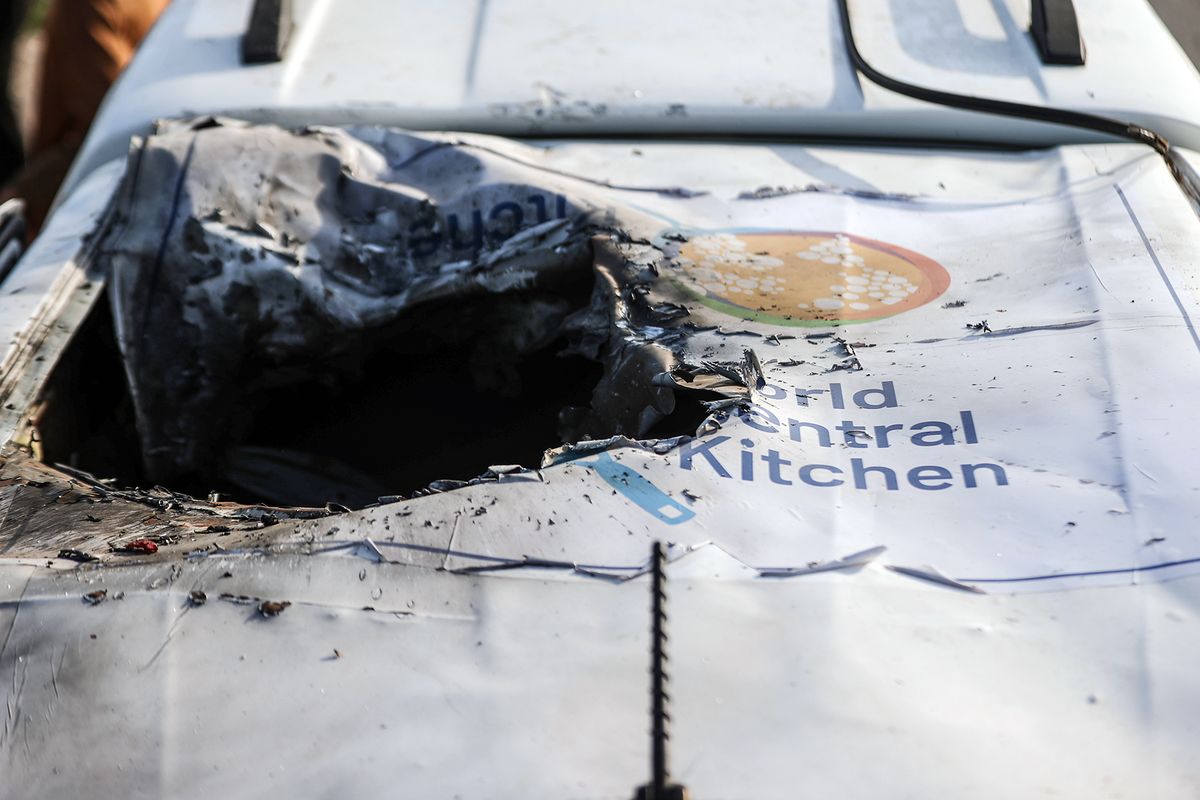
The attack by Israeli military forces that killed seven staff from World Central Kitchen (WCK) in Gaza on Monday followed a similar pattern: a team of aid workers pursued by a drone conducting a methodic and deliberate attack. All seven members of the WCK team were killed as they tried to escape, evacuating the wounded and the slain after successive strikes on three separate vehicles over the course of a mile, along a road designated as “accessible for humanitarian aid.”
The attack, which the Israeli military has called a “mistake,” set off a firestorm — likely due to WCK’s connection to José Andrés, the renowned chef and restaurateur who founded the nonprofit in 2010.
It’s easy to find similar “mistakes” elsewhere: Khartoum, Sudan on Dec. 10, 2023. Kabul, Afghanistan on Aug. 29, 2021. Idlib, Syria on Oct. 15, 2020. Indeed, attacks on aid workers are an increasingly common feature of modern conflicts, due in large part to advances in the lethality of weaponry and tactics used by militaries, but also because of a calculated dismantling of international norms and a lack of accountability for violence against noncombatants.
In 2023, the number of aid workers killed in conflict rocketed up to 260, a 120-percent increase over the previous year, according to researchers at Humanitarian Outcomes, an independent research group based in London. The group maintains the Aid Worker Security Database, which tracks global security incidents involving aid workers. One detail that jumps out in the data is a stunning 2,850-percent increase in the total number of aid workers killed by aerial bombardment in 2023 over the previous year — driven almost entirely by Israel’s brutal war in Gaza.
Last year was by far the most lethal for aid workers since the organization began compiling data — the next highest was in 2013, when 159 aid workers were killed. In the first three months of 2024, 60 aid workers were killed.
“Just by itself, the war in Gaza has seen 203 aid workers killed in six months,” Dr. Abby Stoddard, a partner at Humanitarian Outcomes, tells Rolling Stone. Apart from Gaza, South Sudan, Sudan, and Ukraine were the most dangerous locations in which aid workers operated last year.
In the grim accounting of the costs of war, it may seem morally specious to separate a specific class of noncombatant from the toll of conflicts that kill tens or even hundreds of thousands. Yet what makes attacks on aid workers especially pernicious is that these numbers represent not only the individual lives of the aid workers themselves, but increased danger to an exponentially larger at-risk civilian population suffering from the deleterious effects of war.
After all, the mission of humanitarians isn’t just to stay safe: It’s to deliver food, medicine, water and other aid. All humanitarian organizations must strike a balance between putting staff in harm’s way, and taking necessary risks to gain access to populations caught in the crossfire. Aid agencies are scrambling to adapt and navigate the increasingly perilous landscape for their personnel.
“It’s very difficult, and when they feel they no longer can strike that balance, they pull out,” Stoddard says.
When aid workers are killed, humanitarian organizations generally cease or pause operations. After the attack on its staff in Gaza, World Central Kitchen announced that it was suspending operations in Gaza. HEKS/EPER also suspended frontline activities in Ukraine after the lethal attack in February.
The conflict in Gaza, in addition to creating obvious risks for aid workers operating in an active conflict zone, has been notable for efforts by Israel and its allies to dismantle the organization responsible for providing aid to Palestinians — the United Nations Relief and Works Agency for Palestine Refugees in the Near East, commonly known as UNRWA.
The vast majority of aid workers killed in Gaza have been local employees of UNRWA, often killed while at home or off-duty, but also in the course of their work.
Israel has long criticized UNRWA and other U.N. agencies for an “anti-Israel” bias. After the Oct. 7 terror attack that killed more than 1,200, it directly accused several UNRWA employees of working for Hamas. The U.S. — which is the biggest donor to almost all U.N. agencies, including UNRWA — pulled funding for the agency based on Israel’s accusations. Congress later passed a law blocking any funds from being provided to UNRWA until March 2025.
This effectively dismantled the existing framework for delivering aid in Gaza.
“According to the Geneva Conventions, warring parties have legal responsibilities to facilitate humanitarian access,” Stoddard says. “Gaza is not the first conflict in which International Humanitarian Law has been violated, but it has had a resounding effect on norms. It also shows that the deconfliction system is failing.”
Aid organizations use a variety of methods to inform parties to a conflict about their activities, a process known as deconfliction. One of the most important clearinghouses for deconfliction is the U.N.-operated Humanitarian Notification System (HNS).
In Ukraine, aid organizations can use this system to inform both Ukrainian and Russian authorities about their facilities and the movement of teams conducting humanitarian operations near the frontlines.
In Gaza, aid organizations can also use HNS to inform Palestinian authorities and Israel’s COGAT, or Coordinator of Government Activities in the Territories, to keep the Israeli military apprised of their activities.
In theory, aid teams issue notifications — often including GPS data and timetables — via HNS or other established channels in advance of any movement. In the case of HNS, a notification is sent to Geneva, and from Geneva to coordinating parties on the ground, who inform local commanders in the relevant area about the impending movement of humanitarian aid workers.
So much for theory.
In practice, deconfliction is a messy and uncertain process, providing no guarantees that appropriate military personnel know about an aid team’s movements. In Ukraine, many organizations coordinate directly with local military authorities, as Moscow rarely acknowledges notifications about movements in Ukrainian-controlled territory. In Gaza, aid workers receive little information about who is being notified in which areas.
Over the past two decades, aid workers in several conflict zones have privately relayed to this reporter detailed accounts of coming under fire from belligerents despite issuing advanced notifications about their operations. In cases where there are no injuries or fatalities, there is an incentive to keep these incidents quiet — access to at-risk populations often requires cooperation with the same people shooting at aid workers.
Despite efforts by humanitarian groups to adhere to deconfliction protocols, there are instances of aid workers being killed by almost every armed party in every conflict, which tempts world leaders like Israeli Prime Minister Benjamin Netanyahu to brush such incidents off.
“Unfortunately in the past day there was a tragic event in which our forces unintentionally harmed noncombatants in the Gaza Strip,” Netanyahu said in a video address after the WCK attack. “This happens in war.”
Indeed, it does.
On Oct. 3, 2015, a U.S. Special Forces team working with Afghan government troops called in an airstrike on a hospital in Kunduz. The hospital, operated by Médecins Sans Frontières — also known as MSF or Doctors Without Borders — was a declared humanitarian site, known to U.S. and Afghan authorities.
This did not prevent an AC-130 gunship from bombarding the hospital at the request of the Special Forces team, killing 14 MSF staff, 24 patients and four bystanders in a sustained attack that “repeatedly and precisely hit” the facility, even after MSF staff desperately called government contacts while under fire, notifying Washington and Kabul that their forces were attacking a legally protected humanitarian aid facility.
The U.S. military offered ever-shifting accounts justifying the attack, but Washington eventually admitted culpability for the “mistake,” offering compensation to the victims and their families. The Pentagon conducted an internal investigation, which affirmed the government’s position that the attack was simply an accident. An independent investigation has never been conducted.
That most major militaries have killed aid workers needn’t obfuscate matters: Legally and morally, there is absolute clarity about the obligation to protect humanitarians in war. Less straightforward is why it’s becoming ever harder to keep aid workers safe.
Part of the answer is the numbers reflect the nature of current conflicts. The wars in Gaza and Ukraine, especially, are notable for the use of advanced drones and powerful munitions in built-up urban areas.
“One of our biggest concerns in any conflict is the use of explosive weapons with large payloads, especially those with a large blast radius or radius of lethality, as well as munitions that are delivered by barrage and cover a large area,” says Richard Weir, a senior researcher in the crisis and conflict division of Human Rights Watch. “The problem with these weapons is they create both large-scale immediate effects for civilians in terms of fatalities and injuries, as well as long-term secondary effects, such as damaged critical infrastructure.”
By far, the people most affected by explosive weapons in any conflict are noncombatants, Weir notes, pointing to research that shows “when explosive weapons were used in populated areas, over 90 percent of those killed and injured were civilians.”
“Munitions with wide-area effects increase the risk of disproportionate and indiscriminate harm to civilians,” Weir adds.
The death tolls in Gaza (estimated to be at least 30,000) and Mariupol (estimated to be between 25,000 and 75,000), where air-delivered munitions as large as 2,000-pounds have been used extensively, are testament to that.
In addition to employing rules of engagement which allow for the liberal use of explosive munitions and allow for the prioritization of destroying enemy personnel over protecting noncombatants, both Israel and Russia are also using tactics and technologies that put ever-increasing lethality into the hands of field commanders at lower and lower levels.
Modern militaries are endlessly working to shorten the “kill chain,” a concept that describes the process of identifying, tracking, targeting, and engaging enemy forces in the field. Creating an efficient kill chain increases the odds of destroying enemy units with stand-off or precision weapons, while protecting one’s own forces.
By flooding the battlefield with sensor platforms such as those carried by unmanned drones, military forces can be in a position to call up precision fires as soon as targets appear. This gives an enemy less time to react, but it also gives personnel less time to make decisions.
“There’s no way to predict how commanders will respond to a given situation,” says Samuel Bendett, an expert in drone warfare and unmanned systems at CNA, a federally funded research organization based in Virginia that focuses primarily on defense issues.
Shortened decision-making timelines and permissive rules of engagement increase the chances that non-military targets will be struck. That’s particularly true in conflicts like Gaza, where Israel is hunting Hamas fighters in the midst of civilians and civilian infrastructure. But it’s also true in Ukraine, where static frontlines and contested airspace mean Russia and Ukraine attack targets from extreme distances or with armed drones, often relying purely on electronic sensor data or dated visual intelligence.
“It’s likely that errors can take place as commanders face pressure to respond to tactical changes as quickly as possible,” Bendett says. “Some of this will be due to bad or incomplete intelligence. But some will also be human error, especially when dealing with technology that is becoming more and more sophisticated.”
Questions about targeting practices have become even more urgent in the wake of revelations, first reported by +972 Magazine, that Israel has been relying on an artificial intelligence system called “Lavender” to identify targets for the military.
“[Lavender’s] influence on the military’s operations was such that they essentially treated the outputs of the AI machine ‘as if it were a human decision,’” the report said, adding: “One source stated that human personnel often served only as a ‘rubber stamp’ for the machine’s decisions, adding that, normally, they would personally devote only about ‘20 seconds’ to each target before authorizing a bombing — just to make sure the Lavender-marked target is male.”
Bendett notes that reliance on such technologies will continue to grow: “And as humans will start to rely more and more on automated or AI-driven intelligence assistance, the likelihood of potential errors may also grow.”
There is no indication that the Israeli military used Lavender or automated targeting in the attack on WCK staff. An investigation conducted by an Israeli general cited human “errors.”
“Those who approved the strike were convinced that they were targeting armed Hamas operatives and not WCK employees,” Maj. Gen. Yoav Har-Even said in a statement. “The strike on the aid vehicles is a grave mistake stemming from a serious failure due to a mistaken identification, errors in decision-making, and an attack contrary to the Standard Operating Procedures.”
Multiple sources speaking to a variety of media outlets claimed that the video footage relayed by the drone was low resolution and grainy, and taken at night — a contributing factor to the “mistaken” identification.
Investigations into the February attack on the HEKS/EPER team are ongoing, and Russia has not released any specific information about the incident. But there are some details indicative of the scope of the danger faced by noncombatants, particularly aid workers who must operate near the frontlines.
“The survivors report that they were being hunted,” says Kerschbaum from HEKS/EPER. “It was an incredibly traumatic experience… We took all standard precautionary measures, but we simply weren’t prepared for the kind of environment that exists now.”
In the war in Ukraine, it is common for both sides to operate drones at a relatively high altitude, acting as reconnaissance or data transmission platforms, while coordinating multiple attack drones at lower altitudes. The number of reported drone attacks in frontline areas have increased from around 50 to more than 600 per month recently, according to Ukrainian military authorities.
Some Russian drones are able to track cell phones, and identify the unique International Mobile Equipment Identity of devices and their associated phone numbers — which will also indicate the country of origin of a device’s SIM card.
There are instances in which Ukrainian military units, international media, and aid workers have been targeted based on their cell phone emissions. Russia’s Ministry of Defense has also claimed to have targeted foreign mercenaries on multiple occasions — including a strike in Kharkiv in mid-January in which Russia said it killed dozens of French mercenaries, a claim disputed by Ukraine and France.
While it is unclear if the HEKS/EPER team was tracked because their electronic emissions indicated the presence of French nationals, several major international aid organizations notably issued guidance restricting the use of foreign SIM cards in areas near the line of contact in the wake of the February incident.
Kerschbaum says he does not have sufficient information to know if the team was tracked through its electronic emissions. “But we can not rule out the possibility,” he says.
However it happens, the killing of humanitarian workers has an immediate impact on aid deliveries.
While HEKS/EPER maintains a presence in Ukraine, the organization halted operations near the frontlines — areas where people are most in need of humanitarian assistance. The February incident also had a chilling effect on other organizations, while Ukrainian authorities increased notification requirements and tightened restrictions on the movement of aid workers in Kherson Oblast. Reduced access slows down the delivery of humanitarian assistance.
In Gaza, where WCK suspended operations, more than 1.1 million people face “catastrophic hunger,” warns the World Food Program (WFP). In the northern part of the territory, “famine is imminent,” the organization said on March 18.
The biggest challenge is access.
“WFP and our partners have food supplies ready, at the border and in the region, to feed all 2.2 million people across Gaza — but moving food into and within Gaza is like trying to navigate a maze, with obstacles at every turn,” said Carl Skau, WFP’s deputy executive director.
That the U.S. has now, in the wake of the WCK massacre, successfully pressured Israel to open a border crossing at Erez and use the Port of Ashdod to deliver aid to Gaza is encouraging, but it also demonstrates how unserious previous efforts have been to force Netanyahu’s government to permit access to humanitarian groups.
Humanitarian groups in conflict zones work under challenging conditions, managing risks unimaginable to most people. While politicians talk tough, it takes professional aid workers to determine needs, disentangle logistics, deliver aid, and save lives.
International law aside, that by itself should offer a compelling reason to keep aid workers safe.