
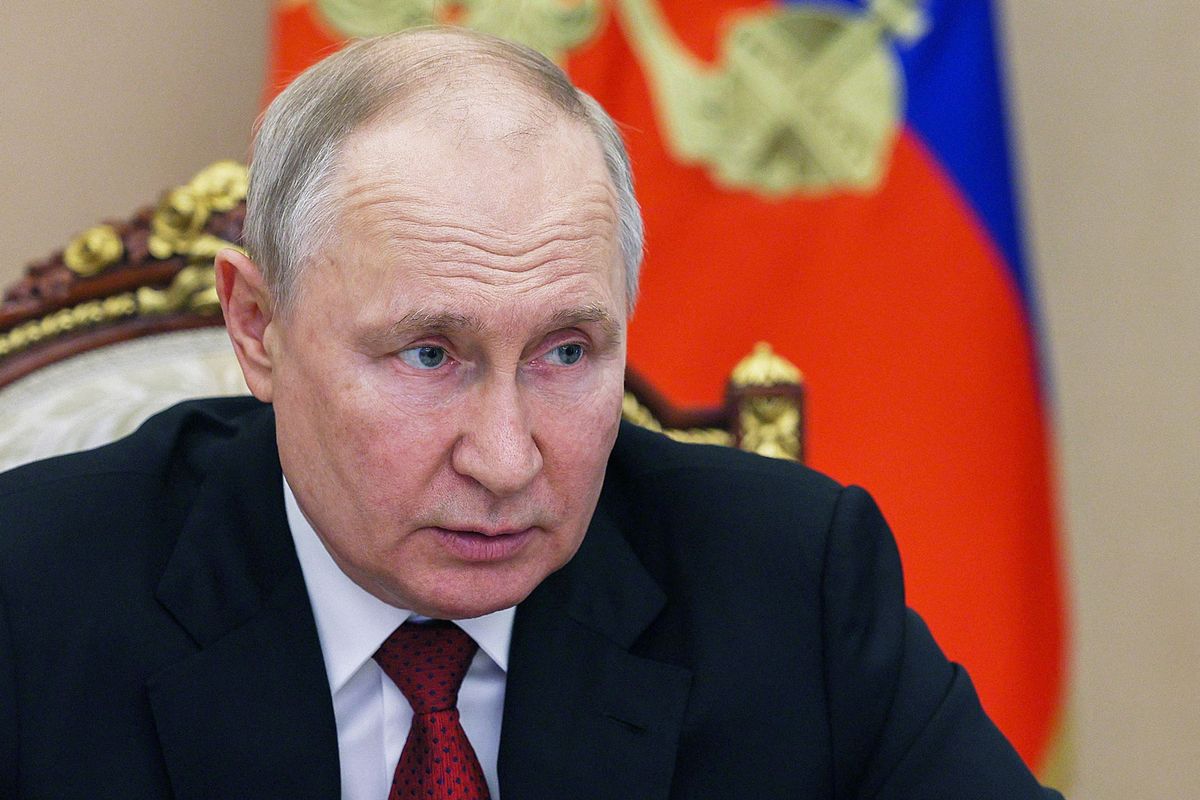

KYIV — Russian President Vladimir Putin is on a decades-long quest to restore his country to what he views as its rightful place in world affairs, and he is willing to crush anyone who stands in his way. Putin’s regime has ruthlessly consolidated power through murder and oppression, while using unfettered militancy abroad to expand the Kremlin’s reach.
Until recently, the West has largely accommodated Putin, deluding itself that engagement and dialogue would temper his remorseless thirst for control and appetite for conquest. Western inaction, infirmity, and addiction to cheap Russian oil and gas have allowed the dictator to prevail despite a series of wars, assassinations, terror attacks, and a deadly conflict in Ukraine that has killed hundreds of thousands.
The latest high-profile victim of Putin’s bloody repression of political opposition is Alexei Navalny, 47, a nationalist politician and anti-corruption campaigner who led a series of protests against Putin ahead of the 2012 election in Russia.
“Putin kills any potential political threat to his rule — and to a possible democratic future for Russia,” says Oleg Mihailik, a human rights lawyer in Ukraine. Before the 2022 invasion, the lawyer regularly worked with opposition figures and dissidents fleeing from Russia, Belarus, and other lands under Kremlin domination. Now, he primarily focuses on humanitarian aid in liberated territories.
On Friday, the Russian prison service announced that Navalny had been found dead in his cell in a high-security prison above the Arctic Circle in Western Siberia, where he was serving the latest in a series of sentences, after being tried on charges that human rights groups describe as a “sham.”
Navalny is survived by his wife Yulia and two children. Yulia Navalnaya said Friday, “I want Putin and his entire circle [to] know that they’ll bear responsibility for what they did with our country and my family and my husband.”
A spokesperson for the family said they would issue no additional comment while Navalny’s lawyer travels to Siberia to investigate. Russian authorities say the cause of death was a blood clot, but this has not been independently verified.
“Let’s make no mistake, Putin assassinated Navalny. He did so because Navalny was brave enough to stand up to Putin. He did so because Navalny offered the Russian people an alternative to kleptocracy and repression. This is a tragic day for Navalny’s family but also for Russia,” wrote Bill Browder, a financier-turned-activist responsible for the passage of landmark anti-Putin legislation in the U.S.
Called the Magnitsky Act, it individually sanctioned members of Putin’s inner circle for their involvement in the 2009 arrest, torture, and murder of Sergei Magnitsky, a tax advisor who worked with Browder in exposing high-level corruption.
Navalny also ran afoul of the authorities over his anti-corruption efforts. He first came to national prominence in 2008, when as an activist investor in multiple oil and gas companies, he led a crusade against bribery and corruption by trying to force companies to publicly disclose their financial records. By 2011, he had established a non-profit called the Anti-Corruption Foundation (ACF).
In the months leading up to Russia’s March 2012 election — in which Putin was set to win an unprecedented third term by flagrantly exploiting a constitutional loophole — Navalny became a key figure in mass protests in Moscow against the return of the former KGB officer.
There was cause for fear among those who joined the protesters. Over the course of his 24-year career at the highest levels of Russian leadership, Putin has ruthlessly eliminated critics and opponents of his regime.
As one might expect from a former KGB agent who served as a liaison with East Germany’s Stasi secret police in the 1980s, very few of the misfortunes that have befallen his enemies can be tied to Putin directly. Like Navalny, most of those who oppose Putin have died suddenly under murky circumstances.
When Yeltsin appointed Putin prime minister in 1999, it was in the hopes of finding a silovik — or strongman from within the security state — who could keep the resurgent communist party at bay while strengthening Russia’s nascent liberal democracy and market reforms.
Russia in the late 90s was beset by economic chaos, corruption, and security crises. Chechen militants were clashing with Russian forces in border areas, and had backed a separatist movement in Dagestan. Hardliners within the security services wanted to reassert control over the region, despite Yeltsin’s continued promises that there would be no new war in Chechnya; the first, ending in 1996, had been a disaster.
In August 1999, only a month after Putin became prime minister, Russia was rocked by a series of bombings targeting apartment blocks in Moscow, Dagestan, and Rostov that killed hundreds and wounded thousands. Three bombs were also discovered and defused before detonation.
Within weeks of the first bombing of an apartment building, the previously obscure bureaucrat Putin had become the plain-speaking commander-in-chief in a War on Terrorism, promising to “wipe out” Russia’s enemies in televised meetings with military commanders in the field.
His popularity soared.
By December, Putin became acting president, taking over as Yeltsin’s hand-picked successor.
In May 2000, when Russia held its first post-Yeltsin presidential election, acting-President Putin won easily. It was arguably the first peaceful transition of power in Russian history.
But skeptics immediately began asking questions about whether Chechen terrorists were actually behind the apartment bombings. Some suspected that the Russian security services had carried out false-flag attacks to bolster the candidacy of their chosen man: Putin.
Such a line of thinking was not without merit. On Sept. 23, 2000, residents of an apartment building in Ryazan, in central Russia, had reported suspicious men carrying sacks into the basement of their building. When police arrived, they discovered what appeared to be 300 pounds of explosives with a detonator and timer attached.
The device was defused by the local bomb squad, the head of which said the substance in the sacks had tested positive as RDX, a military-grade explosive. Local officials praised the residents and police for their vigilance in preventing a tragedy.
Descriptions of the suspects and their car were made public, and two men were quickly arrested. But there was a problem.
The suspects produced IDs showing that they were members of the Federal Security Service, or FSB, the primary successor agency to the KGB. After local authorities made phone calls to Moscow to verify that the men worked for the FSB, the suspects were released.
Later that night, Putin unleashed a devastating air campaign against Grozny, the capital of Chechnya.
The next day, FSB director Nikolai Patrushev brushed aside the incident in Ryazan as a “training exercise” that had never posed a risk to the public. The FSB said that the sacks had contained sugar, not explosives.
The wave of apartment building bombings attributed to Chechen terrorists stopped in the immediate aftermath of the Ryazan incident, but the questions started. In the early years of Putin’s presidency, Russian news media was still freewheeling and inquisitive. Investigative journalists immediately began to find flaws in the government’s story.
Official inquiries soon followed. Like the media, in the early 2000s, the State Duma — Russia’s lower legislative house created in 1994 — had not yet been brought to heel under Putin’s hand. Legislators and opposition parties remained chaotic-but-energetic participants in state governance.
Fears that the FSB was murdering Russian citizens in staged bombings prompted former Soviet dissident-turned-legislator Sergei Kovalev to form a public commission of inquiry in 2002.
It was now, with the Kovalev Commission, that Putin’s public opponents began to die. On April 17, 2003, Sergei Yushenkov, the commission’s vice chairman, was shot to death outside of his apartment in Moscow.
Four men were arrested, and based on the testimony of one of the suspects, the “mastermind” was found guilty. He maintained his innocence and tried to kill himself, before being transferred to Moscow’s notorious Lefortovo Prison.
However, FSB Lt. Col. Alexander Litvinenko soon went public with assertions that Yushenkov was killed because of his investigation into the apartment bombings. Litvinenko would later defect to the U.K. after publicly calling out corruption and links between organized crime, security officials, and the powerful oligarchs who rule Russia’s economy; he died on Nov. 23, 2006 — slain with polonium-laced tea, in the first-known case of assassination by radiation poisoning.
The list of Putin critics who have been murdered, died suddenly, or have nearly died is long: Lawmaker Yuri Shchekochikhin, felled by a “mystery illness” on July 3, 2003 — only days before he was set to travel to the U.S. and meet with FBI officials to report on corruption in the FSB; investigative journalist Anna Politkovskaya, shot by contract killers on Oct. 7, 2006; lawyer Stanislav Markelov and journalist Anastasia Baburova, shot to death outside a press conference on Jan. 19, 2009; Natalia Estemirova, a human rights activist kidnapped and murdered in Chechnya on July 15, 2009; whistleblower Alexander Perepilichny, whose sudden death while jogging in London on Nov. 10, 2012 has been called into question; oligarch Boris Berezovsky, dead of a mysterious suicide on March 23, 2013; physicist Boris Nemtsov, shot to death in Moscow on Feb. 27, 2015; former spy Sergei Skripal and his daughter Yulia, who barely survived being poisoned with the nerve agent Novichok on March 4, 2018; Yevgeny Prigozhin, who died in a plane crash on Aug. 23, 2023, after mutinying against the Kremlin over its handling of the war in Ukraine. There are dozens more lower-profile victims.
Navalny can now be added to the list. In many ways, he was one of the more critical threats Putin has faced during his rule. The 2011 protests that sealed Navalny’s status as a viable opposition figure in Russia were particularly galling to Putin, who viewed them as a continuation of the United States’ policy to undermine his rule.
“Our people do not want the situation in Russia to develop like it was in Kyrgyzstan or not so long ago in Ukraine,” Putin said at the time, referring to political protests that had resulted in Moscow-aligned politicians losing power.
To Putin, the protests were another attempt at a “color revolution,” part of a broader campaign of regime change pursued by Washington in Iraq, Libya, and elsewhere.
Navalny was arrested multiple times during the protests from 2012 onwards, often facing trial on drummed-up charges of financial misconduct. But he continued his political activism, organizing rallies, creating a political party, participating in elections, and producing documentaries critical of Putin and his cronies’ kleptocracy.
Despite numerous attacks — even twice being doused with a bright green antiseptic dye — and extensive bureaucratic interference aimed at keeping him out of politics, Navalny persisted. His ACF was branded a “foreign agent” and banned in Russia in 2019; he even survived an assassination attempt by poison on Aug. 20, 2020.
After being evacuated to Berlin for treatment and recovery, in January 2021 Navalny made the fateful decision to return to Russia to carry on the fight against Putin. His plane was diverted and he was arrested upon landing. Navalny spent the rest of his life in prison.
“He was a very brave man to return back to a totalitarian country, knowing he had no chance to survive there, and having every chance to become a powerful Russian opposition leader from abroad,” human rights lawyer Mihailik says — and he would know. In 2019 Mihailik was shot in the chest by a sniper, in an assassination attempt he believes was tied to his own anti-corruption activism. Mihailik survived, but the perpetrators were never caught.
Outside of Russia, public outrage at Navalny’s death has been swift.
“Putin tried and failed to murder Navalny quickly and secretly with poison, and now he has murdered him slowly and publicly in prison. He was killed for exposing Putin and his mafia as the crooks and thieves they are. My thoughts are with the brave man’s wife and children,” wrote Garry Kasparov, the former chess master turned anti-Putin critic.
With the death of Navalny, there are few prominent figures who have the gravitas and influence to rally significant public opposition to Putin: The closest may be the businessman Mikhail Khodorkovsky — once Russia’s richest man — who has lived in exile since 2013 and has been called the Kremlin’s leading “critic-in-exile.”
But Khodorkovsky is not in Russia. While Navalny’s courage and tenacity in returning home and risking a martyr’s fate are undeniable, it is an open question whether his death will have a lasting effect on Putin’s regime.
“This creates a significant political problem for the regime — they will have to deal with Navalny’s legacy,” observed Tatiana Stanovaya, founder of the Russian politics-focused R.Politik and a senior fellow at the Carnegie Russia Eurasia Center. “I have no doubt that very soon we’ll witness a significant wave of anti-Navalny repressions, raids after indignations in social networks, criminal cases, and arrests.”
Putin’s rule has now endured through five U.S. presidents — Bill Clinton, George W. Bush, Barack Obama, Donald Trump, and Joe Biden — and each administration found ways to appease, placate, or ignore Putin as he expanded his power internationally. Sanctions and strong words have done little to prevent him from achieving his goals.
Despite Biden’s 2021 promise that Putin would face “devastating consequences” if anything happened to Navalny, it isn’t clear that the U.S. has any more mechanisms to use as leverage against the Kremlin than it has already employed after the invasion of Ukraine.
For almost a quarter of a century, Putin has been responsible for the assassination of dissidents and political opponents at home and abroad; the systematic and deliberate targeting of civilians, aid workers, and journalists in several war zones; the brutal suppression of independence movements inside Russia; and the illegal annexation of territory in neighboring countries.
Although the International Criminal Court issued an arrest warrant for Putin over war crimes last year, and he has been branded an international pariah, the man who rules Russia may never be held to account for his atrocities — including his complicity in silencing Alexei Navalny.


 A Canadian flag flies along the waterfront of Lake Ontario, on Aug. 27, 2026. Cole Burston/AFP/Getty Images
Everybody Likes Drake Again. That Means We’re Healing