
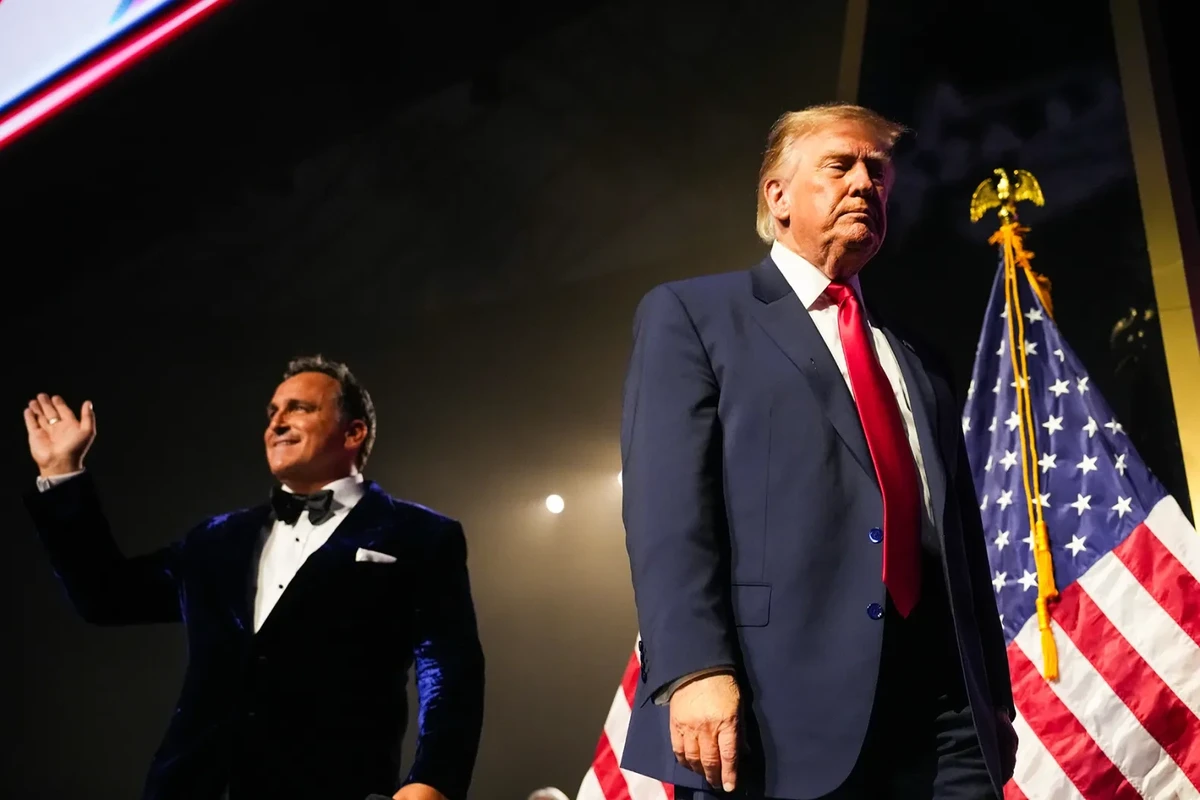

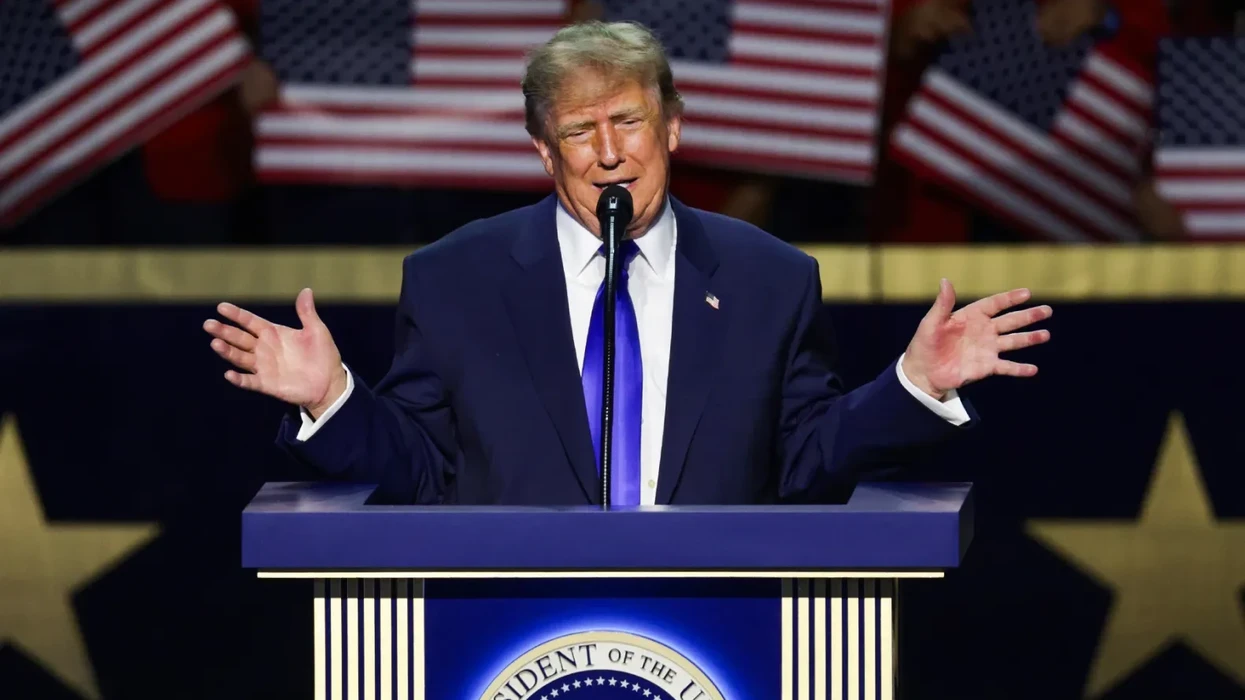
It’s 3:42 in the hot heart of Texas, and the floor of the American Airlines Center in Dallas is a blood-red miasma of dancing elephants. Under the moody crimson lights washing over the crowd at the first ever Republican (Midterm) National Convention, middle-aged peroxide blondes in sparkly American flag cowboy hats sway to the raspy belt of Bonnie Tyler’s “Holding Out for a Hero.” Men in suits and silver belt buckles and leather boots sheepishly bop the “KEEP THE MAJORITY” signs distributed by organizers. The stage is empty right now. Large, menacing images of Joe Biden, Nancy Pelosi, and Kamala Harris loom over the crowd. None of them are running this cycle.
If I look directly across the floor, toward the entrances to the still mostly empty box seats and nosebleeds, the bright white doorways catching the daylight of downtown Dallas are harsh and blinding. Outside the air-conditioned arena, there’s a fight raging. The GOP is at war with itself and its voters. The casualties of this political cycle — spiraling around Donald Trump’s war-ravaged, economically disastrous two years back in office — will likely touch every Republican state delegation.
But the president wants a party, and you can’t dance with the lights on.
Eighteen months ago Dallas would have been an auspicious location for this event. Trump, the keynote speaker for the first night of the two-day conference, made generational gains among Hispanics in 2024. Governor Greg Abbott promised to carve out five shiny new Republican House seats into the state’s electoral map. The Lone Star State had become the southern Mecca of the techno-conservative revolution looking to find roots outside of Silicon Valley. But the right’s gains among Hispanics have been erased, a Democrat is well-positioned to win a Texas Senate seat for the first time in decades, and one can’t help but notice the sense of panic permeating the GOP’s biggest party of the year.
 The first day of the 2026 Republican National Convention at the American Airlines Center, on Sept. 9, 2026 in Dallas, Texas.
Kevin Dietsch/Getty Images
It’s obvious what the president had in mind in pulling this party together. The scene feels like a pantomime of the 2024 nomination conference, held as Democrats scrambled to find their footing amid ever-intensifying concerns regarding Biden’s ability to govern, much less campaign, and just days after Trump narrowly survived an assassination attempt in Butler, Pennsylvania. This week, a large photo of the now-president and the bandage he was sporting over his ear during his nominating convention hangs conspicuously on one of the arena’s concourses. The one-year anniversary of the assassination of right-wing activist Charlie Kirk — which coincided with the second day of the convention — supplanted Trump’s close call with death as the avatar for leftist violence against persecuted conservatives. Republican after Republican trotted out the same lines of attack that propelled them to victory two years ago:
Killer migrants that rape and murder angelic young women. Leftist radicals looking to inflict police-free anarchy on American cities. The mutilation of children being subjected to horrific sex change surgeries. The threat of Sharia Law from Arab and Muslim Americans — like Zohran Mamdani, Abdul El-Sayed, and Hasan Piker — and the looming scourge of a communist, democratic-socialist takeover. Bread lines and authoritarianism are certain under Democratic rule, Donald Trump Jr. insisted. You may not be happy with us right now, but it could be so much worse.
“I’m not asking anybody to agree on every single policy of the administration; what I am asking you to do is to recognize the contrast with the radicals and recognize the achievements of the last 18 months,” Vice President JD Vance pleaded with the audience during his Thursday night keynote.
The president self soothes via adulation. Yet even in his own Wednesday night speech, Trump reluctantly acknowledged “it’s going to take a little bit longer than the midterms” to normalize the spike in energy prices caused by his ongoing war in Iran. He attempted to blame the ongoing affordability crisis on his predecessor and the Democratic Party. To his and the GOP’s frustration, voters — particularly independents — are not blaming it all on the opposition. They have handed Trump a historically low approval rating, and are tossing MAGA aligned Republicans out of Congress in primaries. The convention was nowhere near at capacity, despite local offers of free tickets and a lineup of MAGA favorites. In the absence of a clear argument for why voters should continue to trust the mercurial, impulsive, self-serving men dictating the direction of the party, Trump is turning to outright bribery.
 People of all colors listen as Donald Trump speaks on the first day of the Republican midterm convention.
Kevin Dietsch/Getty Images
“If the Republicans win, you win with us and you get $5,000. It will be called the Trump dividend. Congratulations,” Trump told the audience on Wednesday night. Vote Republican, you might get $5,000. It screams confidence in your prospects, does it not? Never mind that Republicans currently control both chambers of Congress, and that if this was about anything other than attempting to buy votes they could pass — or make a show of attempting to pass — the payments before the midterms. Never mind that Trump has repeatedly promised no-strings-attatched government checks that never materialize. Never mind that the tariffs that would supposedly fund the payments haven’t generated even a fifth of the revenue that would be required. Never mind that — as Senate candidate Ken Paxton was reminded in a live interview with Fox News’ Bret Baier — these people are supposed to be fiscal conservatives.
Even among the Trump-friendly crowd, there was a degree of skepticism. “I don’t think that a political promise should be made like that,” one woman told me. “The votes don’t come from being bought, so yeah, I’m a little disappointed.”
Two young men — locals who said they attended the conference mostly out of curiosity — said the promise was the “stupidest thing” they’d heard from a politician.
The promise crystallized the rot at the core of the convention: the party’s total inability to respond to the concerns of the voters they need to retain from 2024, and insistence on filling the void with culture war dog whistles and cult-like devotion to Trump. Several high-profile candidates seem to realize this isn’t a recipe for success this November. Maine Senator Susan Collins — facing a tight reelection battle in Maine — was conspicuously absent, as was Alaska Senator Dan Sullivan. Several candidates in critical House races considered potential tossups also ditched the president’s festivities, including Reps. Brian Fitzpatrick (R-Pa.), Maria Elvira Salazar (R-Fla.), Rep. Zach Nunn (R-Iowa), and David Valadao (R-Calif.)..
Those who did make their way to Dallas played second fiddle to the president, vice president, and members of the administration. Paxton, a host candidate caught in an incredibly tight race to preserve the last three decades of Republican dominance in Texas, became a punchline in Trump’s monologuing.
“I don’t like the way Ken Paxton dresses. I don’t really like the way Ken talks. I don’t really like the way he looks. I don’t like it,” Trump said of the attorney general, who has been nothing but subservient and loyal to his agenda. Paxton, perpetually putty faced and on the spot, made a halfheated attempt at a forced smile. It was not reassuring. The party honored him and his service to the MAGA movement by putting him in a forgettable time slot where he delivered a forgettable speech in which he highlighted Trump’s record over his own and warned that his opponent James Talarico “wants to transition your kids.”
Trump made fun of Paxton again while speaking on Thursday. “I said something yesterday, and I don’t know if he’ll ever talk to me again,” the president said before repeating the same insults.
Greg Abbott, who has governed the state for over a decade, promised to “fully ban Sharia Law in Texas,” a state with less than 500,000 Muslim residents within a population of 32 million. He promised to ban China, Iran, and Russia from buying land in the state — as if they were readily able to do so in the first place. “The Democrats running on the ticket in Texas, they’re gaslighting the public about affordability,” as if economic concerns and inflation aren’t the issues of top concern to Texas voters this cycle.
Republicans begged voters to preserve the Republican trifecta for just two more years. Just until 2028, then we can fight about who was at fault for the collapse of the economy, and the war in Iran, or the unraveling of our alliances. “Can we please, we’ve got to take care of business this November, then we’ll worry about what comes next,” Vance asked the audience at one point. His speech felt like the sort of address one would give once they won the nomination, the soft launch of ambitions beyond the vice presidency. But this is, and always has been, and for the foreseeable future will be, Trump’s party. No second in command will be permitted to outshine him.
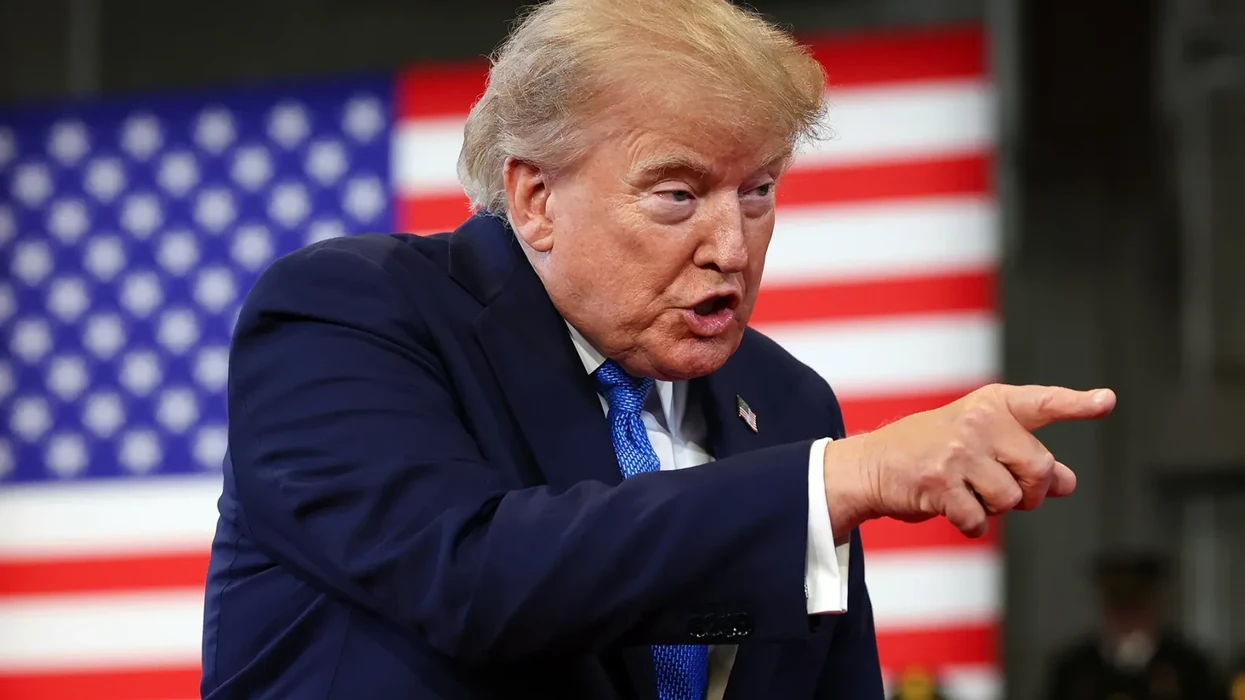
 Trump supporters at the Republican midterm convention.
Kevin Dietsch/Getty Images
Whatever glow Vance was basking in was quickly dimmed under the radioactive sun of the president. Who wrote himself into the second night of programming and — just to drive the point home — reiterated his first night demand that voters imagine that it’s him that’s on the ballot.
As Trump closed out the night, American tenor Christopher Macchio belted “Nessun Dorma” as a rain of red, white, blue, and gold balloons fell from the ceiling. The aria, performed in the third act of Giacomo Puccini’s opera Turandot, is a favorite of the president.
Trump smirked into the audience alongside Macchio as his voice arced towards its final crescendo. “Vincero, vincero, vincero.”
“I will win, I will win, I will win.” A declaration by the prince Calaf that he will secure the hand of the princess Turandot, whether she wants it or not. The chorus surrounding his avowal is that of Turandot’s subjects, lamenting fate.
Trump was totally alone onstage as he listened.



 A Canadian flag flies along the waterfront of Lake Ontario, on Aug. 27, 2026. Cole Burston/AFP/Getty Images
It’s Been 25 Years Since 9/11. Did the Terrorists Win?
I once had a conversation with Barack Obama about the nature of terrorism. This was during his second term, and he’d been going on for a few minutes about how Islamic terrorism wasn’t actually an existential threat to Americans, but rather a chronic and manageable risk. I was all too familiar with this argument, having conducted the interview with John Kerry in 2004, in which he said terrorism could be reduced to the level of a “nuisance” — a quote that blew up on him during the final weeks of the campaign. I found Kerry’s answer problematic then, and I had the same reaction when Obama said it. I asked him pointedly: What would have to happen for him to decide that terrorism was, in fact, existential? How about a suitcase nuke on a subway car? Then would he concede that terrorists were more than criminal gangs?
Obama didn’t hesitate. Terrorism would only reach the level of an existential threat, he told me, if Americans responded by abandoning their own values and turning on one another. There was nothing a bunch of homicidal zealots could do to destroy the most powerful country on Earth, but we could certainly destroy ourselves if we abandoned our constitutional protections in a fit of panic.
At the time, this struck me as something you might expect to hear from a constitutional-law professor, but not necessarily from the president of the United States. There was an intellectual fatalism about Obama I sometimes found disconcerting — a sense that he saw himself as a twig in the river of history, and it was up to the rest of us to change the current. I doubt he would dispute that assessment. But I thought often of that conversation a few years later, as the country careened into the Trump era. And as we pause now to reflect on the 25 years that have passed since the attacks of Sept. 11, I find myself thinking about it again.
Alternative histories are a tricky business, best left to novelists and sci-fi filmmakers. As a friend of mine in politics likes to say, mockingly, whenever such theories get floated: What if Hitler had won the Civil War? And yet, it’s hard not to see a direct line between the events of 2001 and where we are today — and to wonder how different the country might have looked had it never happened. On the eve of the devastating attacks on the World Trade Center and the Pentagon, George W. Bush’s young presidency seemed to be wobbling. Absent those attacks, he might well have been a one-term president, and he almost certainly would not have invaded Iraq. Nor would Democrats become backed into defending the entrenched war in Afghanistan as the “good war” — a way of differentiating their own response to 9/11 from Bush’s without sounding reflexively pacifist.
Without the economic shock of 2001, it’s unlikely that desperate policymakers would have looked the other way while lenders, underwritten by the government, turned the housing market into a casino, leading to the second massive blow of the decade: the market collapse of 2008. All of these things, in quick succession, destroyed what remained of the public’s faith in its governing establishment, leading directly to Obama’s stunning takeover of the Democratic Party and, later, to the election of Donald Trump.
The Trump I met in the late 1990s, while he was flirting with an independent run for president, held himself out as a centrist reformer, in the mold of Ross Perot. By 2015, when he started running as a Republican, Trump had fully embraced a reactionary, white-nationalist movement — a response to Obama, yes, but also to Bush, whose instinct in the months after 9/11 had been to speak out forcefully in defense of Muslim Americans, and whose support for liberalized immigration infuriated much of his party’s base. Trump’s core appeal then, as it is now, was rooted firmly in the nativist, anti-globalist backlash that emerged in 2001. (According to Pew Research, roughly 42 percent of Americans believe Muslims are having a negative impact on the country.) The animating idea of Trump’s second term is that white, English-speaking Americans are the only authentic Americans. It shouldn’t be controversial to say that he will twist or shred any page of the Constitution to enact this vision, since he really makes no effort to conceal it.
Nor is America’s hard turn away from pluralism and liberal democracy happening in a vacuum — far from it. In the past decade, similarly reactionary, anti-immigrant movements have rocked Britain and taken over Italy, and they now seem poised to wrest power in France and Germany. Maybe some of this would have happened without 9/11; the hollowing-out forces of globalization and automation were already fueling plenty of economic fury here and in Europe by the turn of the century, and the revolution in social media wasn’t far off. But there’s little doubt that the “War on Terror,” which became the first real foreign policy framework since the end of the Cold War, focused all of that anxiety toward an identifiable enemy, fracturing societies that had been held together by a 50-year consensus around personal liberties. If Obama were being honest, he’d probably say he told me so, and he’d be right.
IN THE MONTHS after 9/11 and before the invasion of Iraq, it was hard to get much perspective, and genuine patriotism mixed — as it always does — with a series of mindless gestures and clichés. Flag pins became mandatory even for reporters, peace songs were effectively banned, Republicans brought “freedom fries” and “freedom toast” into the lexicon to protest French misgivings about war. It became rote for politicians to say that the terrorists hated our way of life and we would never let them win. (To this day, when my dog snarls at some terrified Shiba Inu for no reason, I ask her why she hates freedom.)
Twenty-five years on, though, with the benefit of distance and experience, we can ask some questions we couldn’t ask then. And one of them is what the violent extremists who sent those suicide planes into our buildings really hoped to achieve. Did Osama bin Laden think he could win a holy war with America? Did we ultimately frustrate his script for the downfall of the West, or did we simply play our part?
Terrorism is, by its nature, asymmetrical. Whether it’s the Viet Minh under the French, or the IRA in Britain, or Al Qaeda, there’s an inherent understanding that the terrorist can’t win a conventional war against an obviously superior military force. What the terrorist seeks is destabilization of the status quo. His desperate act is an igniter in search of fuses; the goal is to set off a chain reaction inside the fortress that can’t be controlled, to disrupt order with chaos and see what shakes out. The terrorist knows this will likely cause his own people suffering in the short run, but that’s part of the point. He believes the occupier to be a soulless monster, and by reducing it to its basest instincts, he hopes to bare its nature to the world.
We’re seeing this play out, in real time, in Israel. The leaders of Hamas, their military options exhausted and their political goals slipping away, could not have been under any illusion that they would drive out the Israeli occupiers by savagely killing and mutilating more than a thousand innocent people. They must have hoped that Israel would react with blind fury and cruelty, resorting to the instinct for all-out annihilation that its leaders had long managed to suppress. Nearly three years later, Israel has tumbled from legitimatized power to international pariah, its politics riven by disunity, its moral authority in shambles. Do we think Hamas really cares that more than 70,000 of its own people have died in the carnage? Its repugnant leaders almost certainly consider that a cost worth paying in the broader context of history. What they have achieved, in political terms, has exceeded their most feverish dreams.
The Israelis should have looked across the Atlantic and learned something from our own experience. America on Sept. 10, 2001, was an unchallenged superpower at peace — vexed by social and economic divisions, yes, but still stable enough to survive a disputed election with its political consensus intact. A quarter century later, we find ourselves fighting a third unsuccessful war in the Middle East, our society more divided and our politics more poisoned than any time since the 1800s, a foundation of laws imperiled after 250 years of durability, immigrants hunted down like animals by masked agents, violence and extremism on the rise from both right and left, truth and intellectualism in retreat. This is not solely the fallout from Sept. 11, 2001, but it is the result of a series of events that, were you able to hit a rewind button and live it all again in reverse, would lead you directly back to that day. If bin Laden meant for his attack to be the first in a series of similarly epic crimes, then he was soundly defeated — no small achievement for American soldiers and spies. But if his goal was to destabilize America and bring out the worst of our nature, then he may have pulled off the most successful terrorist attack in history.
Over and over we told ourselves, in that agonizing moment, that the terrorists would never win. A quarter century later, it’s getting hard to argue they didn’t.