
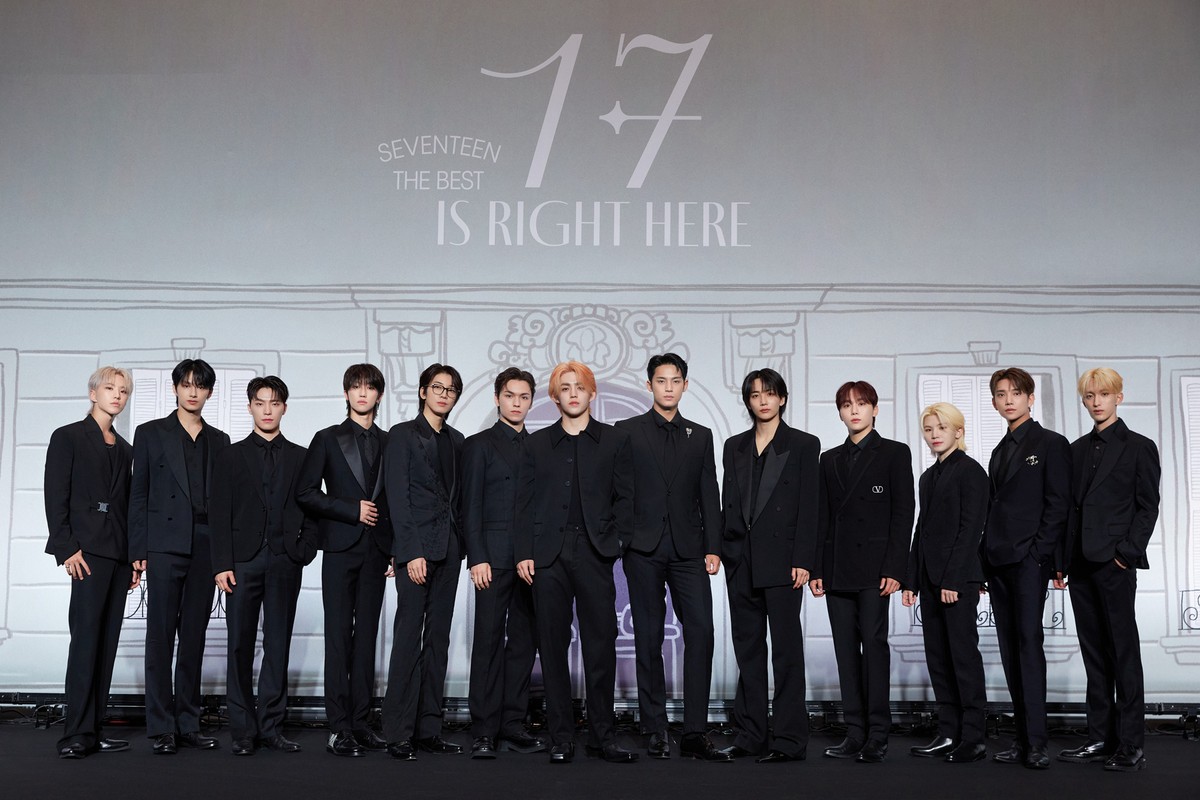

The 13 members of SEVENTEEN have been on their FOLLOW Tour since last summer, a tour that ranged from tear-jerking performances to ones that rip pants, and the encore leg (called “FOLLOW AGAIN”) is nearing its end. While the tour is close to wrapping, SEVENTEEN’s activities are not slowing down — the group has just released a new compilation album, 17 Is Right Here. With a run time of just over 96 minutes, the album features all of SEVENTEEN’s Korean language singles, Korean versions of their Japanese-language singles since their debut nine years ago, and four new songs. We’d be remiss not to mention that member Woozi is credited for both composition and lyrics on all 33 tracks.
The lead track, “Maestro,” pulls elements from previous songs to convey the message that the past is not just left behind, but rather a source of inspiration for SEVENTEEN as they evolve, a message the group shares as they approach a decade together. “Maestro” conveys how together, we can change the world and hold the power to orchestrate our own universe, a theme that is fitting for SEVENTEEN given how tight-knit the members are. The relationship that S.Coups, Jeonghan, Joshua, Jun, Hoshi, Wonwoo, Woozi, The 8, Mingyu, DK, Seungkwan, Vernon, and Dino have with each other is a key element to their success and longevity. Just as important is the gratitude they have for their fans, Carats, and how they’ve given the group 100 percent since day one nine years ago.
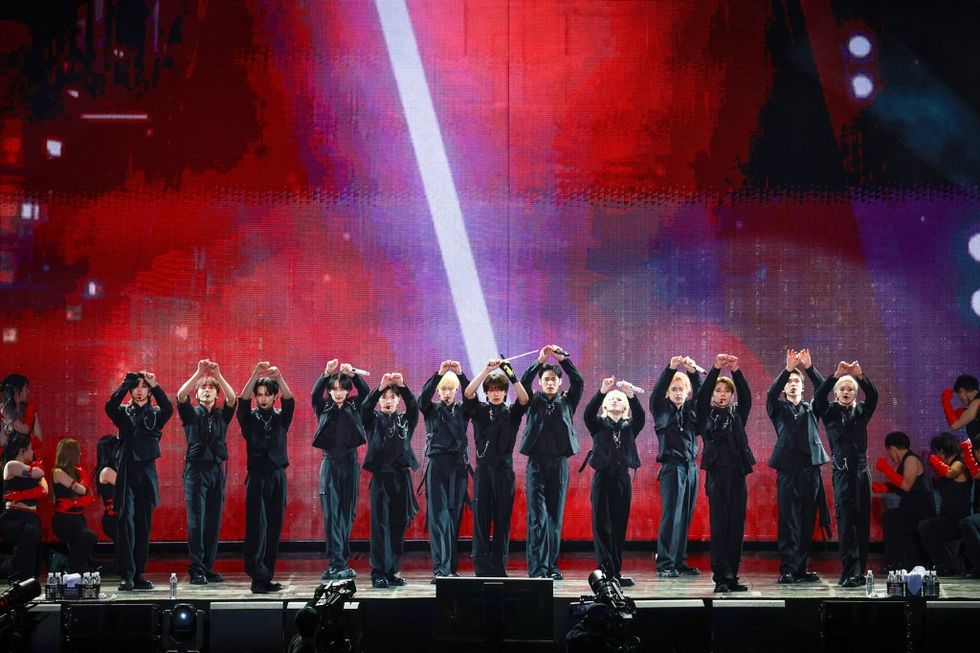
Rolling Stone caught up with Jun, Wonwoo, The 8, and Seungkwan over Zoom a few days before the highly anticipated Seoul World Cup Stadium, almost a year since we last spoke, to chat about the FOLLOW Tour, 17 Is Right Here, and anticipation for future shows in North America and Europe.
At the Seoul World Cup Stadium shows this past weekend, fans got to witness the very first performance of “Maestro,” and for those who missed it, Rolling Stone has the exclusive performance video below.
Let’s start with the tour! How has the FOLLOW Tour been?
Wonwoo: The FOLLOW Tour has been one where we’ve gone to many places and met with so many of our Carats, inspiring them but also getting inspired by them as well. The performances themselves were so enjoyable, it was such a positive experience overall.
Seungkwan: It was meaningful for us to have encore shows on top of that, and being able to perform as a full group, with members who may have been out sick all healthy and returned, made me feel great.
What, to you, sets FOLLOW apart from other tours you’ve done? Whether it’s how much you’ve grown since it kicked off last summer, or memories from FOLLOW that stand out to you?
Wonwoo: I don’t think I’ve looked back to evaluate how much I’ve grown with each tour, but as we do our performances, while on stage, we end up noticing how much each member has improved. As for special memories, we had a lot of time to eat good food all together. We got together in different countries, had good meals and spent quality time with each other. So that made it really enjoyable.
Seungkwan: As for things we wish we could have done — North America, Europe, [seeing] the Carats there. We weren’t able to see even more Carats out there, but I’m looking forward to the opportunity in the future.
Is there a special memory from the tour that stood out to you? Something between the members, an interaction with fans, or a moment you were particularly proud of.
Jun: For Follow Again [in] Incheon, there was a drone show for the performance of “April Shower.” It was really memorable and impressive. It contained the story of us and our Carats. It was impactful.
I actually had friends come over and watch the delayed stream of that show.
Seungkwan: Thank you.
Wonwoo: Well done! [Laughs.]
By the time people read this interview, the two Seoul shows will be done, and “Maestro” will be out. How is preparation going?
Seungkwan: At the Seoul concerts we’ll be performing “Maestro” for the first time. We’re really excited. And since it’ll be a performance just for the Seoul concerts, we’re going back and practicing more, especially since it’s a new song. We’re working hard to prepare. We’ll also be performing with our respective units. The unit songs are really good, too — I think the performances of the new songs will be a highlight of the concert.
What type of song is “Maestro” to SEVENTEEN?
Wonwoo: I think it’s a song that encompasses everything SEVENTEEN has done thus far. We pulled from previous lead tracks, and it’s a song that fits with us really well right now. It’s a song that captures the essence of SEVENTEEN as we are now.
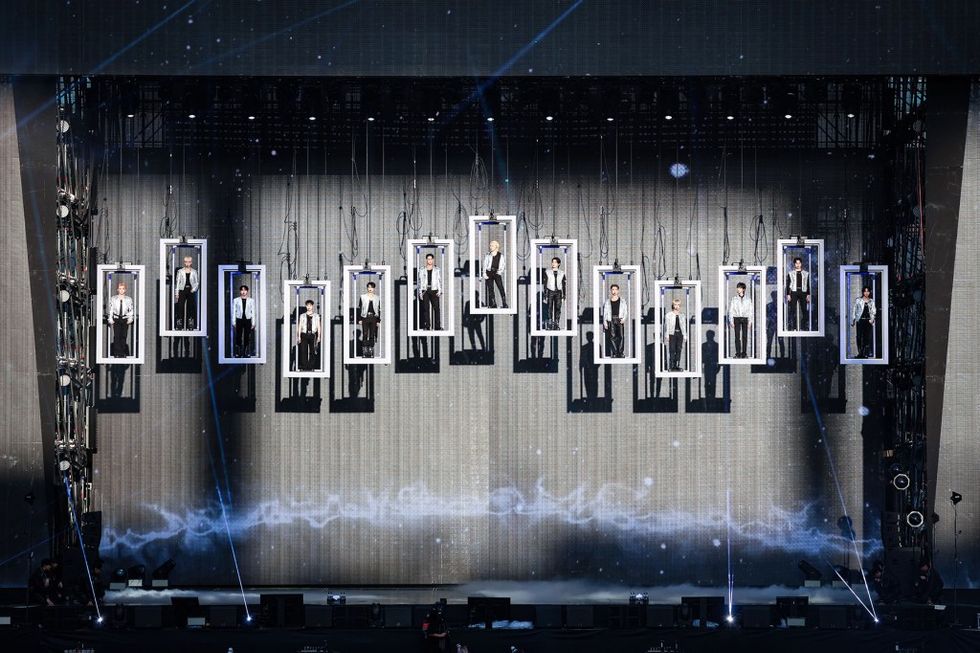
I had a chance to preview a choreography video for the song and noticed you have some moves in there that emulate actual conducting. How did you prepare for that? Did you have to research or watch real maestros?
The 8: We didn’t have to actually conduct, but the moves are similar to conducting movements. And we also portrayed personas of musical geniuses that go mad about their craft, so we included nuances from conducting throughout the performance.
So that being said, which member from SEVENTEEN fits this concept of a maestro best?
Jun: I think for the music video — we haven’t seen the final version yet, but The 8 and I actually discussed this before — Wonwoo was pretty impactful.
Seungkwan: In the music video, Wonwoo looks really cool.
Jun: When you see it, you’ll see the madness we’re referring to. [Laughs.]
Seungkwan: What do you think, Wonwoo?
Wonwoo: I think for “Maestro,” Woozi is definitely fitting. He produced it, and he is the most maestro-like member.
Seungkwan: I pick… Me, since I don’t think anyone else will pick me.
Wonwoo: [Laughs.] You’re right. We wouldn’t choose you.
Why not?
Wonwoo: [To Seungkwan:] You think you killed it again? [Laughs.]
Seungkwan: I just… think I look cool. I like me.
The 8: I choose Woozi as well, for the same reasons stated.
Wonwoo and The 8, you both also participated in songwriting for this album, for “LALALI” and “SPELL,” your respective unit songs. Can you share how that process was?
The 8: I had mentioned that I wanted to have raps in the performance unit’s song this time around, and with Dino, we specifically wrote the rap parts. It felt great to write as it’s been a while.
Wonwoo: I participated in “LALALI” by the hip-hop unit, and wrote very free-spirited lyrics.
Seungkwan: [Laughs.]
Wonwoo: It’s very free-spirited.
Seungkwan: But if you listen to the lyrics that Wonwoo wrote, you’ll hear a new voice of his, so I think it’ll be good to look forward to it. The Performance unit too, when looking from the perspective of the Vocal unit, they have been advancing musically a lot, and I think this new song is a high point of theirs. So Vocal’s is really great, the raps are good, and the Performance unit’s song is good — but I think above all, my unit’s “Cheers to Youth,” I think that song is good. It makes you happy when you hear it. To wrap it up, all three songs are good, but out of the three, I think “Cheers to Youth” is the best one. [Laughs.]
Jun: Honestly, all three songs are so different. I think personal preference plays a big part in which one you like most, so I think a lot of fans will be able to enjoy them.
What are you most looking forward to with this album?
The 8: I’m most looking forward to the performances. You can feel the beat in your heart. I’m excited to see how the fans react to our energetic performances, and seeing how much fun they are having when we look at them from the stage.
So there’s four new songs in the album, but many others that look back at your discography. From all of these songs, which song is the most special to you? I personally love “Mansae” and “Hot.”
Seungkwan: “Mansae” brings back memories.
Jun: Is “Fallin’ Flower” included?
Seungkwan: Yep! It’s in there.
Jun: Honestly [laughs] I’ve said it before too, but I really like “Fallin’ Flower.” It starts with a piano and when I hear that melody, I think it might just be personal preference, but I get really excited when I hear it.
Seungkwan: It’s a good song.
Wonwoo: “Adore U” for me. It’s a song that was with us from the start, so it’s a song I cherish.
The 8: “FML” for me. I like it the most. I think the lyrics are great, and the melody is also similar to what I normally like to listen to, so I think it’s a good song.
Seungkwan: For me… It’s hard… I will choose “Pretty U.” I have a four-part high note — for months I practiced really hard. I’m proud of myself. Do you know what I mean by “four-part high note?”
I know! Like IU’s famous three-part high notes.
Seungkwan: Yes! Exactly. [Vocalizes] “Ah, ah, ah, I’m in my dream…” It sounds similar too! [Laughs.]
What are you looking forward to doing once the Follow Tour wraps?
Jun: Even with the tour ending, we go straight into promotions for “Maestro,” so I don’t think it’ll feel like an end, but a new start. It’s also called FOLLOW AGAIN [laughs], and I really think our Carats can enjoy it to no end. So don’t think of it as the end, but just continue to enjoy it.
Wonwoo: It’s AGAIN, but does feel like a new start.
What about goals for the rest of the year?
Seungkwan: I want to be healthy. Have no one get hurt, stay healthy — it’s impossible to not get sick, but to be sick less. Those things feel more important than ever these days. I think we have to stay healthy for Carats to also feel at ease supporting us. Those are the goals. Of course, performing well, too!
Wonwoo: I want our members and our Carats to be healthy and happy. That’s the goal.




Taylor Swift at the Curb Event Center at Belmont University in Nashville, Tennessee.
Here’s to 20 Years of ‘Taylor Swift’
It’s strange to think the songs we used to sing from one of the most famous self-titled debut album’s turn 20 years old today. You know the ones I’m talking about. The song in the car, my favorite song, the whispered songs, “Mary’s Song,” “Our Song.” Twenty years ago, Taylor Swift invited the world into the one she built with these melodies.
Taylor Swift wasn’t just the singer-songwriter’s first album that turned her into a rising Nashville star. It was also the first chapter that sealed Swift’s future success as a superstar musician. Within a year of its release on Oct. 24, 2006, the LP debuted at Number 19 on the Billboard Hot 100, earned platinum status, and made hits out of singles “Tim McGraw” and “Our Song.” It’s the reason we’re here today, reflecting on two decades into a career so massive, even the curly-haired mess of a dreamer couldn’t fathom it at 15 years old. That teenager grew into a pop goliath, but it’s easier to fathom when you remember that it’s always been about the songs.
With Taylor Swift, a precocious teen met listeners in their own teenage heartache, their deep-seeded loneliness, and that overarching, painful desire to fit in with a collection of country-pop gems. Who hadn’t cried over an unrequited love the way Swift did on “Teardrops on My Guitar” or felt the chilling rejection apparent on “Cold As You,” or the thrill of finding a best friend who lets you show your true colors like on “I’m Only Me When I’m With You” or even known a friend who suffered from eating disorders as discussed on “Tied Together With a Smile”? Here was a voice singing these stories she’d written, each sigh and imperfect note, making the keen observation of the worlds that much more sincere. That’s what connected with audiences and began the success story that we know so well today.
Throughout her self-titled debut, Swift tapped into the country music songwriting tradition of reminding listeners she’s the one with the pen. On the banjo-driven jaunt, “Our Song,” she laments the fact that there is no song to sum up her rosy romance — until she “grabs a pen and an old napkin” and cements the slamming screen doors and surreptitious late-night calls into her own song. With the help of producer Nathan Chapman and co-writer Liz Rose, Swift learned to master this trick.
Her debut single, “Tim McGraw” is the real shining example of this. On its face, the track chronicles a fleeting summer romance, but the wistful tune turns into a knockout that cemented Swift into country music history when she offers a prescient promise, “I hope you think of me.” With that simple line, the musician showed the transportative power of music.
Taylor Swift is also the first time we heard of the tropes that still run through the singer-songwriter’s catalog. The little black dress in “Tim McGraw,” the front seat in “Our Song,” the rain scattered across multiple songs, the photographs in “Picture to Burn,” the numbers 89 and 87 on “Mary’s Song (Oh My, My My).” With every nano-specific detail, Swift built out her own cinematic universe.
You can hear Swift map out the world-building that would turn into her next 12 albums on the self-titled centerpiece, “A Place in this World.” Over an acoustic guitar, she quips, “I don’t know what I want, so don’t ask me” before declaring, “I’m just a girl, trying to find a place in this world.” That’s the kind of sassy, yet uncertain attitude she brought to her very first album. But really, she always knew what she was doing in some capacity, especially if the hidden or “A Place in This World” is any indication. The uppercase letters in a lyric booklet of lowercase ones spell out: “I Found it.”
In a fitting twist of fate, 2026 not only marks a major anniversary for Swift’s self-titled debut album, it’s also the first year she’s eligible to be recognized in two very prestigious institutions: the Songwriters Hall of Fame and the Nashville Songwriters Hall of Fame. By Monday, the girl who cried all those tears on her guitar will be both the youngest woman to be inducted into the Songwriters Hall, and youngest-member of the Nashville edition.
During her Songwriters Hall of Fame acceptance speech, Swift reflected on the power of her craft. “As writers, we can only hope to meet people where they are in their lives,” she said. Since 2006, when she was just a high school freshman with a habit of writing songs on her bedroom floor or in math class, she has done exactly that.