
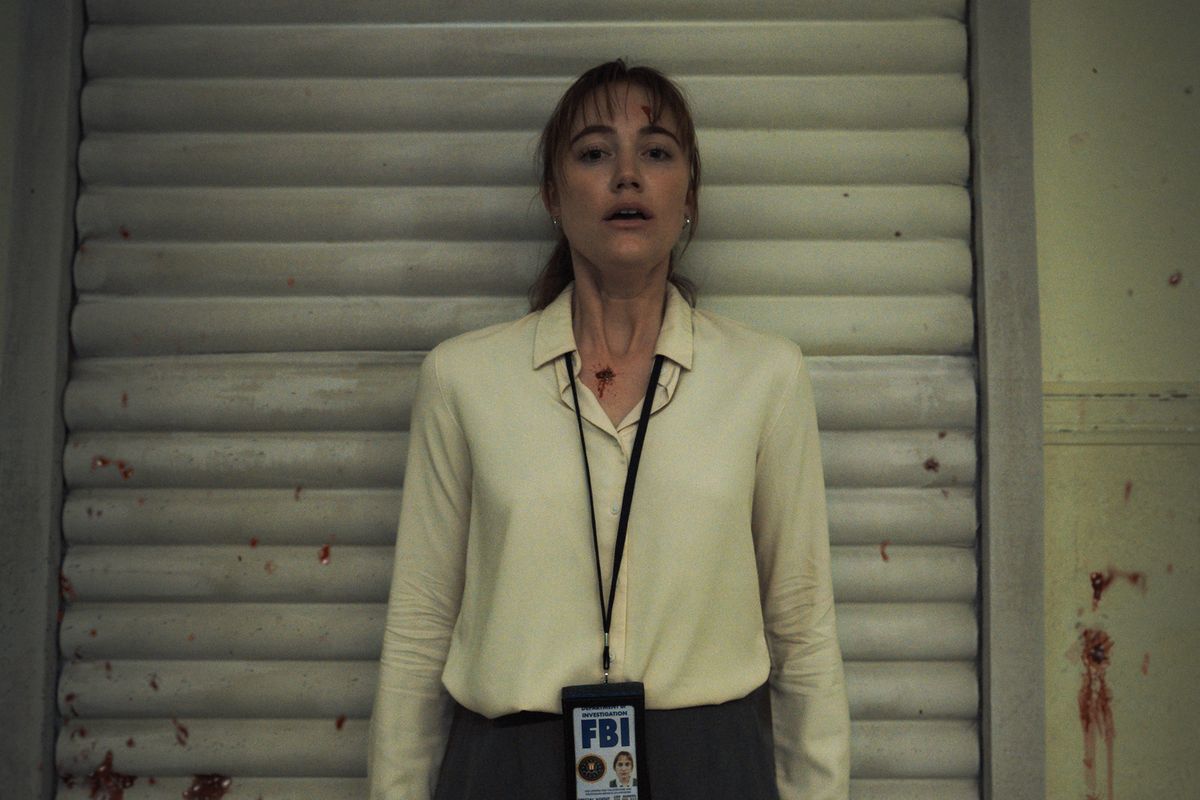

This summer’s runaway horror hit, Longlegs, opens not with a quote from the Bible or anything so mundane. Instead, the livid-red title card reads, “Well you’re slim and you’re weak/You’ve got the teeth of the hydra upon you/You’re dirty, sweet, and you’re my girl” — lyrics from glam-rock band T. Rex’s classic 1971 hit “Bang a Gong (Get It On).” And that’s not the only evocation of Marc Bolan’s influential Seventies project: T. Rex’s music and style are woven into the movie’s very fabric.
“Think of it like playing a piano: If the left hand is playing the plot, the right hand is playing the soul,” director Oz Perkins tells Rolling Stone. “The right hand is playing the spirit. The right hand is playing the art, the mystery, the wonder, the curiosity, the beauty, the glamor. So I’d say that the T. Rex stuff had nothing to do with the plot — but everything to do with the vibe.”
Longlegs has become a box-office behemoth since it premiered on July 12, perhaps due to pre-buzz that promised that it would shock, terrify, and haunt you for days after viewing. As Rolling Stone’s own David Fear writes: “It’s an unabashedly style-over-substance take on a particular type of modern horror story. This is less a serial-killer thriller than a feature-length nightmare vibe.”
Without getting too spoiler-y, the film follows rookie FBI agent Lee Harker (Maika Monroe) as she hunts a serial killer named Longlegs who has a penchant for ciphers and an uncanny ability to leave no trace. Families all over the country are dying at the hands of their patriarchs — who also mysteriously kill themselves — and Longlegs, Zodiac-style, takes credit.
In addition to writing in code, the serial killer (played by a deliciously creepy and campy Nicolas Cage) also has an affinity for T. Rex. He blares their music from the speakers of his car and sleeps under a poster of Marc Bolan, whom he also dresses like, in an off-kilter kind of way. According to Perkins, he was writing the script for Longlegs when he got into T. Rex. He’d heard of the band before, but after seeing a documentary about that era, he fell in love with the band’s 1970 single “Ride a White Swan.”
“It was one of those things was like, ‘Where’s this been all my life?’ So I started listening to it on pretty heavy rotation right as I was writing Longlegs,” he says. “When I’m writing something or creating something or developing something, I’m really trying to keep my ears open. I’m listening to T. Rex, and it’s just coming really loud and clear on that frequency. It didn’t feel like instantly a perfect match. But that’s the kind of weird mismatch that made it even more appealing to me.”
When he heard “Bang a Gong” — specifically the lyrics that appear at the beginning of the movie — he locked in. As those who have seen the film will know, it echoes a Bible verse that plays a big role in the plot, which (spoiler alert!) wanders into the realm of Devil worship: “And I stood upon the sand of the sea, and saw a beast rise up out of the sea, having seven heads and ten horns, and upon his horns ten crowns, and upon his heads the name of blasphemy.”
“It just became this weird synergetic thing that I leaned into,” Perkins says. “It was the perfect blend of Biblical, demonic poetry and glam rock.”
When he brought it all to Cage, the actor locked in immediately. “I said to him, ‘Look, Nick, I don’t know what this means to you. But I think it’s T. Rex.’ I didn’t even know what that sentence was. The music is T. Rex? That guy is T. Rex? I wasn’t sure what I meant by it,” Perkins says. “And he said, ‘That’s so crazy because yesterday, my oldest son who is learning to play the guitar, I played for him Marc Bolan’s backward guitar solo on “Cosmic Dancer.”‘ So totally apropos of nothing, he was listening to the same thing that I was listening to. It was like further proof from the universe that I was making the right choice.”
From there, the vibe of T. Rex and the ill-fated Marc Bolan — who died in a car crash in 1977 — took on a major role in the film. (More spoilers ahead, if you’re still concerned about that.) “It just ended up making sense that I would make [Longlegs] into this glam guy who had sort of had his life disrupted in the Seventies,” Perkins says. “He just wanted to be a glam-rock guy. He maybe plays a guitar kind of badly in his mom’s basement. And one day, his life changed, and he had to go to work for the Devil.”
As for what kind of work Cage’s Bolan-loving beast does? I won’t spoil that for you. Longlegs is currently in theaters.







Taylor Swift at the Curb Event Center at Belmont University in Nashville, Tennessee.
Here’s to 20 Years of ‘Taylor Swift’
It’s strange to think the songs we used to sing from one of the most famous self-titled debut album’s turn 20 years old today. You know the ones I’m talking about. The song in the car, my favorite song, the whispered songs, “Mary’s Song,” “Our Song.” Twenty years ago, Taylor Swift invited the world into the one she built with these melodies.
Taylor Swift wasn’t just the singer-songwriter’s first album that turned her into a rising Nashville star. It was also the first chapter that sealed Swift’s future success as a superstar musician. Within a year of its release on Oct. 24, 2006, the LP debuted at Number 19 on the Billboard Hot 100, earned platinum status, and made hits out of singles “Tim McGraw” and “Our Song.” It’s the reason we’re here today, reflecting on two decades into a career so massive, even the curly-haired mess of a dreamer couldn’t fathom it at 15 years old. That teenager grew into a pop goliath, but it’s easier to fathom when you remember that it’s always been about the songs.
With Taylor Swift, a precocious teen met listeners in their own teenage heartache, their deep-seeded loneliness, and that overarching, painful desire to fit in with a collection of country-pop gems. Who hadn’t cried over an unrequited love the way Swift did on “Teardrops on My Guitar” or felt the chilling rejection apparent on “Cold As You,” or the thrill of finding a best friend who lets you show your true colors like on “I’m Only Me When I’m With You” or even known a friend who suffered from eating disorders as discussed on “Tied Together With a Smile”? Here was a voice singing these stories she’d written, each sigh and imperfect note, making the keen observation of the worlds that much more sincere. That’s what connected with audiences and began the success story that we know so well today.
Throughout her self-titled debut, Swift tapped into the country music songwriting tradition of reminding listeners she’s the one with the pen. On the banjo-driven jaunt, “Our Song,” she laments the fact that there is no song to sum up her rosy romance — until she “grabs a pen and an old napkin” and cements the slamming screen doors and surreptitious late-night calls into her own song. With the help of producer Nathan Chapman and co-writer Liz Rose, Swift learned to master this trick.
Her debut single, “Tim McGraw” is the real shining example of this. On its face, the track chronicles a fleeting summer romance, but the wistful tune turns into a knockout that cemented Swift into country music history when she offers a prescient promise, “I hope you think of me.” With that simple line, the musician showed the transportative power of music.
Taylor Swift is also the first time we heard of the tropes that still run through the singer-songwriter’s catalog. The little black dress in “Tim McGraw,” the front seat in “Our Song,” the rain scattered across multiple songs, the photographs in “Picture to Burn,” the numbers 89 and 87 on “Mary’s Song (Oh My, My My).” With every nano-specific detail, Swift built out her own cinematic universe.
You can hear Swift map out the world-building that would turn into her next 12 albums on the self-titled centerpiece, “A Place in this World.” Over an acoustic guitar, she quips, “I don’t know what I want, so don’t ask me” before declaring, “I’m just a girl, trying to find a place in this world.” That’s the kind of sassy, yet uncertain attitude she brought to her very first album. But really, she always knew what she was doing in some capacity, especially if the hidden or “A Place in This World” is any indication. The uppercase letters in a lyric booklet of lowercase ones spell out: “I Found it.”
In a fitting twist of fate, 2026 not only marks a major anniversary for Swift’s self-titled debut album, it’s also the first year she’s eligible to be recognized in two very prestigious institutions: the Songwriters Hall of Fame and the Nashville Songwriters Hall of Fame. By Monday, the girl who cried all those tears on her guitar will be both the youngest woman to be inducted into the Songwriters Hall, and youngest-member of the Nashville edition.
During her Songwriters Hall of Fame acceptance speech, Swift reflected on the power of her craft. “As writers, we can only hope to meet people where they are in their lives,” she said. Since 2006, when she was just a high school freshman with a habit of writing songs on her bedroom floor or in math class, she has done exactly that.