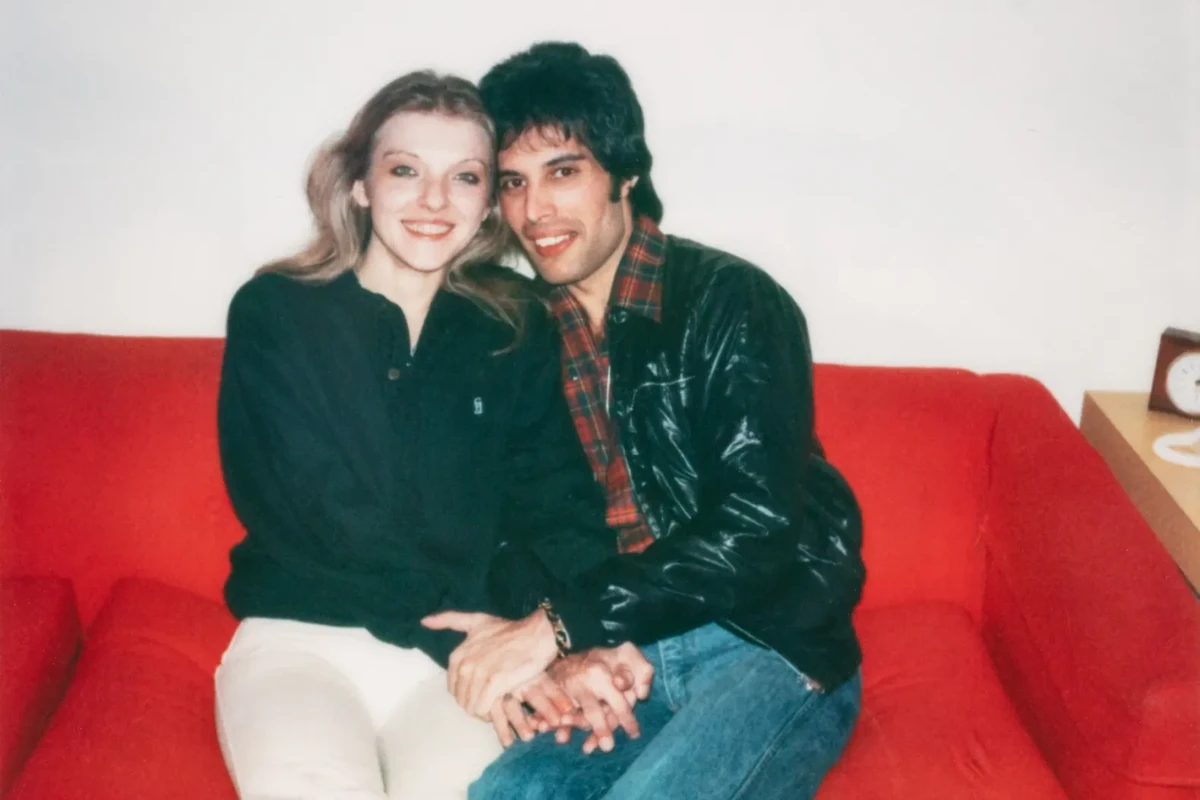

Three years ago, Mary Austin – Freddie Mercury‘s closeset friend who inherited the Queen singer’s home and most of his worldly possessions – made the difficult decision to finally part with the collection via auction. The items were breathtaking, including the handwritten lyrics to “Bohemian Rhapsody,” “Killer Queen,” “Stone Cold Crazy,” and “We Are The Champions,” in addition to his stage costumes, piano, and even the front door to his house. Not a single item was left unsold, and it grossed £39.9 million.
The items are now in the hands of private collectors, but the general public can experience it thanks to Austin’s recently released book A Life in Lyrics: The Official Creative Legacy of Freddie Mercury. It contains detailed photographs of the key items from the collection, and traces the story of Austin’s incredible friendship with Mercury. In this exclusive excerpt, Austin discusses her decision to part with everything, and the process of combing through the home and finding the treasures Mercury left behind.When Freddie died in 1991, he left me his cherished home, Garden Lodge, in Kensington, west London.
Garden Lodge was not to be a museum, he’d said, though it was filled with enough artefacts, antiques and works of art to warrant one. And while the idea of living among Freddie’s possessions felt almost overwhelming at first, I realized in time that he’d left me a memory box filled with love and joy. It was a source of great comfort as I grieved the loss of a man I loved very much. His sanctuary became mine. But time passes, and three decades on, I knew I had to decide how to steer what Freddie had left me into the future. The question was how.
It wasn’t an easy decision. But in the end, the answer was simple. Love.
Love had always been the thread that bound everything at Garden Lodge together. Freddie had loved the house itself and everything he’d filled it with, just as I had when he passed it all on to me. Almost everything in the house was antique; each piece carried a history of its own, the years at Garden Lodge forming just one chapter in a much longer story. I began to feel that sharing his collection with others would allow that thread to continue – it was time for his treasures to journey onwards.
After much thought, I decided to hold an auction. I felt Freddie himself would have liked the idea. I’d seen first-hand the joy he had got over the years from hunting down the perfect piece of art, porcelain or furniture for his home. There were dozens of auction catalogues still in the house, some with his handwritten notes about pieces he was interested in buying, or the prices they had sold for.
And so, over several months in 2022, myself and my two sons, Richard and Jamie, embarked on a journey of wonder and discovery, unpacking spaces that I had hardly touched in all my years living there. Investigating the loft, for instance, was like finding a door to a secret world. It was filled with the packing trunks we had used when Freddie moved into the house. Nestled beneath the rafters, they’d been slowly obscured by boxes of Christmas decorations and other belongings our family had accumulated over the decades we’d lived at Garden Lodge. I had a general sense of what the trunks contained, but I’d never looked inside them. Everyday life had a habit of getting in the way, and I was not ready to stir up memories I knew would be painful.
Slowly and carefully, we unpacked, catalogued and stored everything; until, one morning in early 2023, representatives from Sotheby’s – the London auction house based on New Bond Street, Mayfair, known for handling art, jewellery and important private collections – visited Garden Lodge. We had begun exploring what a sale might involve the year before, and this was their first time seeing Freddie’s collection in person.
Once they had left, the house fell quiet again, and my youngest son Jamie and I found ourselves in the sitting room of Garden Lodge. It is a particularly beautiful room. The house, with its distinctive brick exterior, was extensively renovated in 1908 for painter Cecil Rea and his artist wife, Constance Halford; huge windows overlooking the garden were added to the sitting room to create a light-filled studio. Freddie had also used that room creatively; it was where he often composed. His Yamaha grand piano stood where it always had, tucked against a wall about ten feet away from the windows, to protect it from sun-bleaching.
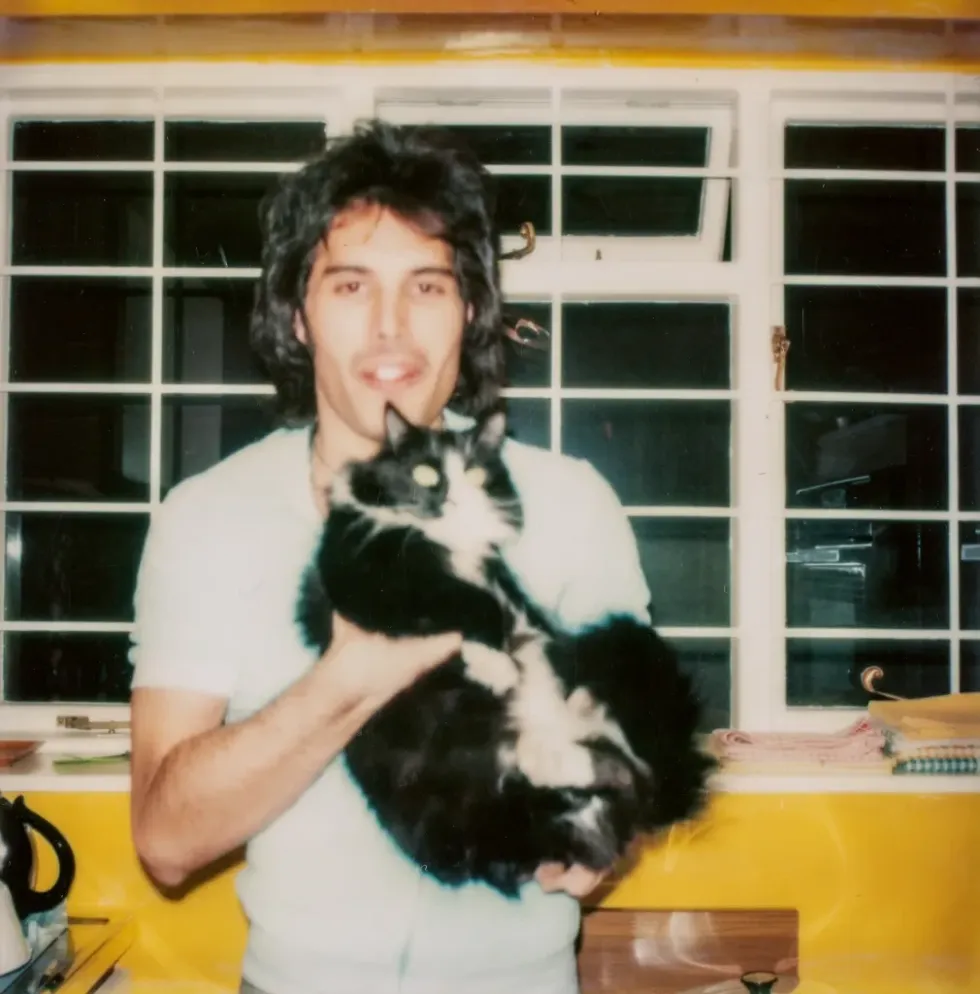 Courtesy of Mary Austin ca.rollingstone.com
We stood there, talking over the visit and how Sotheby’s had been particularly taken with a selection of Freddie’s lyrics. Jamie glanced around the room and said, ‘Can you think of anywhere we haven’t looked?’
Our attention went to the piano stool. Made of lacquered satinwood, with a seat upholstered in black-and-gold silk, it had been a favourite of Freddie’s for many years.
‘Have you looked in there?’ I asked.
Opening the lid, Jamie lifted out old childhood piano books to reveal a cavity divided into two neatly packed sections – Freddie was always meticulous. On one side were cassette tapes, the kind Freddie had used to record himself when he was writing, while the other half contained notebooks of lyrics, a black binder and a copy of a book called Chopin’s Musical Style, Chopin being a composer Freddie greatly admired. Within the binder we discovered lyrics and compositions written on loose sheets of British Midland Timesavers paper (the same paper he had used for ‘Bohemian Rhapsody’), including those for ‘We Are the Champions’ and ‘Somebody to Love’.
Carefully lifting everything out, Jamie found a final, ring-bound, yellow notebook, the sort you can buy in any stationery store, resting on the bottom of the compartment. Opening it, we found it contained the words for ‘Don’t Stop Me Now’. More than fifty years on from our first meeting, Freddie still had the capacity to surprise – and delight.
****
The auction of Freddie’s collection, in September 2023, was everything that we, as a family, together with the remarkable team at Sotheby’s, had hoped for: a celebration of Freddie’s life and work. Titled Freddie Mercury: A World of His Own, a pre-sales exhibition at Sotheby’s transformed the galleries into a celebration of his life, drawing more than 140,000 visitors.
Meanwhile, the sales themselves were comprised of six meticulously curated auctions, each achieving a rare ‘white-glove’ result, with every one of the 1,406 lots sold. Spanning art, jewellery, furniture, porcelain and costume, the collection expressed so many facets of Freddie’s layered, fascinating self, with many pieces finding new homes with collectors and fans across the world.
Among the lots were gifts from Elton John. When Queen were managed by John Reid, Freddie had become friendly with Elton, who was also managed by John. Elton and Freddie saw a lot of one another socially, and their friendship continued even after John’s time as Queen’s manager came to an end. They shared a love for gift-giving and exchanged many thoughtful pieces over the years. Elton’s gifts to Freddie included artworks, an onyx and gold bracelet, a Cartier ring and, later, Lalique vases. These were never grand for their own sake – they were personal and chosen with great care – and Freddie treasured them because they came from affection, not obligation.
Elton remained close to Freddie until the end. He came to see Freddie during his final months and still arrived with gifts, just as he always had. When the time came and those items were sold at auction, I donated the proceeds to the Elton John AIDS Foundation. It felt like a way of honouring the kindness between them and returning those gifts, in another form, to something that mattered deeply to Freddie.
Even more personal and illuminating than the antiques and collectibles were the lyrics, notes and musical workings we had found. They mattered so deeply to Freddie that we wanted to share them with his audience. In doing so, we hope to offer a clearer sense of the dedication and discipline behind the music, and of the painstaking work that went into bringing each song to life. That, in a nutshell, is the purpose of this book.
Freddie, as anyone familiar with his music will know, always insisted that his lyrics were about nothing in particular. He wanted them to remain open, allowing listeners to find their own meanings. Yet he was constantly writing, revising and drafting, and I’ve long felt that this process was a form of catharsis for him. Looking through the lyrics now, memories are inevitably sparked, and while I have always respected Freddie’s privacy, and will continue to do so, I hope to offer some context and a few insights into the man I knew, in celebration of his creative work. The one who sat at the piano and composed, who worked tirelessly to hone his craft, who got up in the night to scribble lyrics into notebooks; the man who envisioned Queen and carried that ambition even while working on a stall in Kensington Market, and who poured the same creative drive into everything he touched, from these lyrics to costumes, videos and the home he created around himself.
The world knew him as Freddie Mercury. But for me, the person captured within the pages of his lyrics, doodles and notes is Freddie Bulsara. This is the man I knew. And in sharing his work more widely, my hope is to honour a person who stood so humanely, and captivatingly, among us. To celebrate the magnificent creativity that was the core of Freddie.
Excerpted from the book A Life in Lyrics. Copyright © 2026 by Mary Austin. From Dey Street Books, an imprint of HarperCollins Publishers. Reprinted by Permission