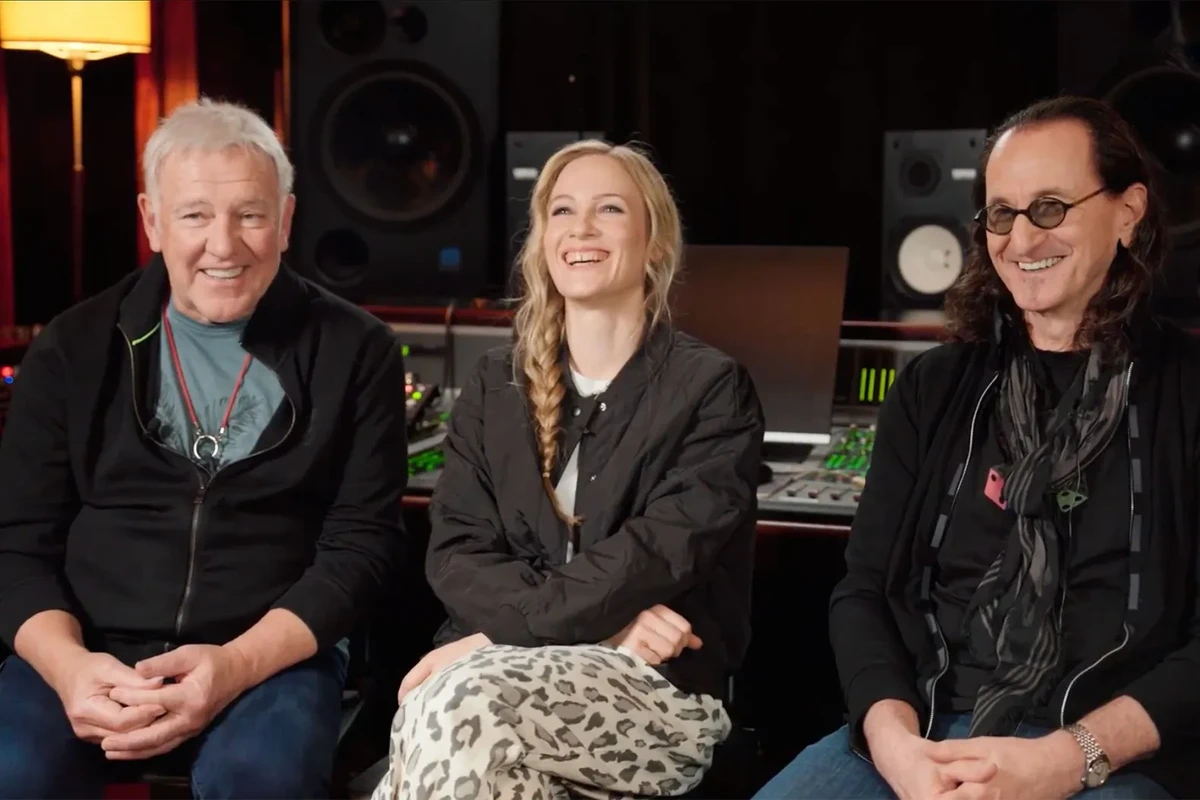

Soon after Rush's debut Los Angeles dates for the Fifty Something, Geddy Lee, Alex Lifeson and touring drummer Anika Nilles sat down with Rolling Stone for their most in-depth interviews yet on the band's miraculous return. (The band's new touring line-up in the wake of the 2020 death of drummer Neil Peart also includes keyboardist Loren Gold). Those interviews spawned a cover story in collaboration with Rolling Stone Canada — but there was even more from the conversations. Read Lee, Lifeson, and Nilles' joint interview below for the first time, or watch our new YouTube video..
Anika, I was reading that at some point you struggled with stage fright. I know that's probably something you had mostly overcome, but how does that play into the highest-pressure night of your life, night one of this tour?
Anika Nilles: I felt some pressure, but I was always focused on the music and get everything sorted, and I was trying to not let all the pressure come too much into my brain. But I also have some calming routines which I trained through the last six months, which were definitely helpful on the first night.
People noticed on the camera that you had a moment with your drumstick at the beginning of "Xanadu" that you miraculously recovered from without anyone hearing — a millisecond, and you didn't let it faze you. But what was going on in your head at that instant?
Nilles: Maybe, not fuck up this fill. And then I saw this stick flying around over the toms, and I just [caught] it back.
Geddy Lee: Nice one. When we were rehearsing, towards the early part of rehearsing, if one of us would make a mistake, we would stop and we'd play the song again. Towards the end of rehearsals, we began just to play through any mistake or whatever mishap that might happen, because we had to be prepared for that to happen during a show. You have to just push through it, so that was helpful I think.
When something like that happens but you recover so magnificently, does it actually add to your confidence? Or does it kinda add to your jitters for the rest of the show?
Nilles: No, I think it happens that you drop a stick, and as a drummer, you're used to it. You just take the next one as soon as you have the chance.
There's been much discussion about your first five days together, your first rehearsal, and that the final day was when you locked in on the feel. We talked about what it was like from their perspective. Anika, what was it like from your perspective? What did you need to realize to lock in?
Nilles: Good question. Actually, I think it helped a lot that we talked about Neil and about his playing and his playing style and how you felt it as musicians playing with him. So that definitely helped me to understand what I have to change and how I have to settle in. It was less what to play. It was really more about how to play it. And to adjust, it took me a little bit to understand it in detail. Also maybe because we didn't know each other.
Lee: Yeah. It was all so new for both of us.
Nilles: Yeah. Exactly. But I got it on the last day.
Lee: She did.
I also know that when you played with Jeff Beck he never told you to really worry about in any way replicating parts from the way previous people played with him. It was much looser. And so I wonder if there's also a mentality shift that had to take place.
Nilles: As I prepped for the first session, I wasn't sure if I should prep every little detail, like one-to-one, or if I have the main parts down but have some freedom here and there. So I came somehow prepared — in the way I would prepare. But after the first session, the path to go was way more clear and parts I have to focus on. But it was for sure different. Jeff is more improvisational in general, and I think Vinnie [Colaiuta] played never the same on a gig. So I had way more freedom. It was fewer compositions in the drum parts. It was definitely more improvisational in general, which is the huge difference to Rush and Neil compositions on the drums.
Alex and Ged, what did you guys learn about the drum parts to Rush songs that maybe you hadn't quite grokked until you had to communicate them to someone new?
Lee: We were learning what Anika was learning. We were realizing how different Neil's feel is from other styles of play. So through Anika's experiences, we were understanding Neil's composition better and better. And sometimes Anika would write me and say, "What time is this part in?" And I would go, "Fuck, I don't know!" So I would go back and listen to it, and I would count it out. And I realized that we wrote parts as musical passages, and we would do a weird musical passage in an odd time signature, but we wouldn't need to count what that time signature was, 'cause we would just glue a bunch of phrases together and we knew it intrinsically. We knew it inherently. And whenever we rehearsed it, we just rehearsed the part. So having to explain that to Anika was really hard for me, and I had to go back and say, "Well, wait a second. Let me listen." And then I would say, "Well, I think there's a bar of eight or a bar of six." She'd go, "Well, I think it's all in seven," or it was the other way around I think. So it was a re-education for me.
Lifeson: And it was more apparent how Neil, by spending so much time, he would just shift his weight so subtly on the front or the back and consistently, like just leaning this way or just leaning this way. That's all in between the big stuff. And it becomes really the glue, the basic glue that keeps everything all together. And that became much more apparent.
Lee: And the cymbal work. And how in that first rehearsal, some of the cymbals you were using were just… so wrong. They were just so wrong. Who would have thought? Never seen it. That the wrong cymbal would affect the way a song sounds so drastically. So that was a re-education for me. Or an education, not a re-education.
I noticed in the two soundchecks I saw that you did "Subdivisions" both times. Is there something about that song that's especially tricky?
Lifeson: It's seemingly a simple, straightforward song, but it isn't. The drum arrangement is very complex.
Ever shifting, right?
Nilles: It is a lot of subdivisions. It's a lot of counting. A lot of different shifts here and there. You don't hear it. It sounds so natural. And you think it's straightforward, except— it totally is not.
Lifeson: But when I play the guitar part, for example, my guitar part is very straightforward. But when I'm standing in front of Anika, I hear all of this movement that rolls to the entire song. It's fascinating from that perspective when you're standing there hearing it and the drums are behind you. And that feel that goes on.
I think these guys said that they kind of thought of that song as relatively straightforward because they were just so used to it, and you were like, "It is not."
Lee: Yeah, because so many of the parts sound the same. Right? But they're not played the same by the drums. So for her, at first, she had to let the song get into her DNA to understand the second time we play that part, for Alex and I, it's the same part, same notes, but— not for her.
Geddy once talked about how early on, Rush was thinking about more math than groove, and then by the '80s and '90s started to think more in terms of groove. But the thing is, you do all of Rush's catalog. So what's it like for all of you to have to switch between the different bands that this one band really has been?
Lee: For me, it's refreshing. I really like that we're doing that because the set keeps changing and keeps giving your brain a rest from one style to another, so one style doesn't become oppressive, you know? It's like when we play "[Passage to] Bangkok," I can't wait for the middle section 'cause I know I can just turn around and lock in with Anika 'cause it's the weirdest part. I mean, people don't realize, I don't think, how weird that part is. It's like we're riding a camel, that song. And it's really fun. So that's from my perspective. I don't know from a drumming perspective. It must be really difficult to keep shifting gears.
Nilles: Actually, especially on that song and that section, it's the most chill section for me because I just play 4/4 and you guys have to flip around.
Lee: Oh, we have to move around, yeah.
Nilles: You have to do the work.
Lee: We have to do the counting.
Neil was becoming influenced by Stewart Copeland and reggae and all sorts of other things. Listening, you must have realized, "Oh, I'm doing a whole different thing for these songs."
Nilles: Yeah, it was definitely a shift in styles while preparing all the songs. But especially with the '80s era, I felt immediately the most connected because I love the '80s.
Anika, Jeff Porcaro was one of your big heroes, right? There is another band from the '70s who in their own way are seen as the pinnacle of technical intensity, which is Steely Dan, who Jeff played with. I've never heard whether you guys are fans of that band, or what your take is.
Lee: I'm a huge fan of Steely Dan. Almost named my daughter Aja after that record. I love that record so much. I wore it out. So I was a big Steely Dan fan.
Lifeson: And has there been anybody more versatile than Skunk [Baxter]? I mean, so many styles in his playing and intelligence.
Lee: What amazed me about Steely Dan was how commercial they were. At the same time, just fucking really complex and interesting, you know? They were the exception of the rule that proves the rule, whatever that expression is, you know? They were able to be challenging, to think like jazz artists, and yet produce music that was easily consumed. So I think that's a kind of amazing feat.
As the '70s turned into the '80s, you took on some of that, which is compressing that complexity into something slightly more accessible.
Lee: Yeah. From 14 minutes to 7. [laughs]
Anika, with Jeff as one of your kind of home bases, were there things from his style that seemed like they were congruent with Neil? Or did all the lessons you learned from someone like him have to be kind of tossed out the window or put aside?
Nilles: I have to say, I always listen to music and play it along with music. And Jeff was the first drummer I really checked out a little bit more in detail. But in general, I have to say I always just got inspired by drummers. I sneaked into a specific groove and tried to make it my own, but I always slide it off in a different direction — with my own ideas, so I cannot really say that I studied a drummer. I never did that otherwise.
Until this.
Nilles: Yes, exactly. Until this. And that's a whole different thing, you know? And now I don't know, I have a little bit of Neil in me. We'll see how that progress because that's the first time I really, really studied, and other drummers playing so much in detail. So it's the first time for me.
They were saying that you said yes, but you didn't fully realize what that yes meant. Were there moments when you were like, "This is so much more than I even could have imagined"?
Nilles: Well— [hesitates]
Lee: It's okay to just say yes!
Nilles: Yes, I went through that a couple of times, during the last year I would say. But I can remember the first time I started off learning "Xanadu," which was second session I think, to prepare for. It took me three days to learn the song in a way so that everything was there when I played it, and I was like, "Whoa, when I need three days for one song, this will take me forever, and I have no off day until I fly back." But luckily the more I studied the music and Neil's playing, the more I understood of course, and I got faster through it because I knew the tasks. I knew where I have to have attention on. And so all the epic songs I went faster through it than through "Xanadu."
Lee: I would get some interesting texts from Anika. She would say, "So the opening of 'Xanadu,' is that free time?" She needed to know how to count certain things that we wouldn't even think about counting because we knew the nuances of each other's parts so intimately that we had cues in each other's playing. But she hadn't had enough familiarity yet. She couldn't possibly have played off of those cues yet. And now I think you can, but back then she wanted an explanation of how long she should stay in this part. So I thought those were really interesting questions. And they were really interesting 'cause I would go back and I would listen to the songs and try to imagine them with your experience, like what you were going through. And I had the opportunity to reevaluate how we had written our music and how do you translate Rush to someone else? And the first experience we had was when we did those Taylor Hawkins tributes, and I remember trying to explain, you know the one section early in "YYZ" — I was trying to explain that part to Omar Hakim. And Omar's a pretty darn amazing drummer. But I didn't know how to explain it because we just played it. And so he had a really interesting technique. He said sort of, "Sing it to me." And then I would sing it to him a couple of times, and then he would go, "Ah, okay." And then he would just play it. And then he'd say, "Again." And we'd play it. "Again." And I think we played it, like, 10 times in a row. And then he just went, "Yep." I said, "Okay, let's see if that holds." Which, of course, it did, but so extrapolate that to 42 songs, and there's moments in almost all of our songs that kind of defy musical notation that have to be discussed.
I interviewed Steve Howe sometime in the last couple years, and we were talking about Yes recording all their hardest, most classic songs, and he said, "Well, of course we did it in little sections, and then we'd move on." And all I was thinking was how you guys pushed through almost every song back then in one take. And if you had known that, would you have done it differently?
Lee: Yeah, I would have! 'Cause we thought they just knocked it out.








 Anthony Orosz*