
Announced for 8 p.m. with no opening act, Céline Dion finally appeared at 8:48, after a wait that had only intensified the fever inside Plenitude Arena. By then, the chants had reduced one of the world’s most famous singers to the only name Paris seemed to need: “Céline! Céline! Céline!”
For days, the city had been speaking the same language. A nearby transit station had been temporarily renamed for her; businesses had joined in, sometimes enthusiastically enough to blur the line between celebration and marketing. Even the sushi restaurant across from the arena had a papier-mâché Céline holding its menu. Paris had not simply welcomed Dion back. It had appropriated Céline affectionately, commercially, and almost everywhere.
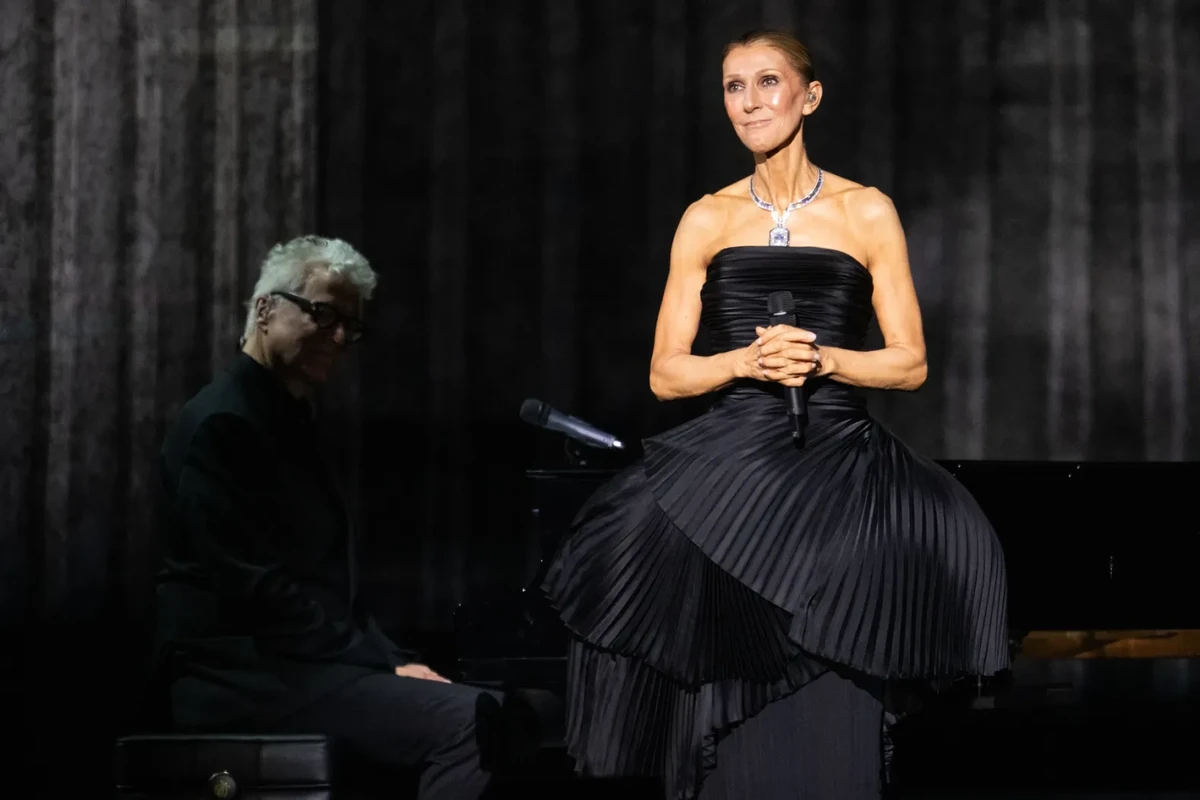
Then, with almost no fanfare, the enormous stone structure at the center of the stage slowly opened. A narrow light appeared. Dion appeared alone in black and remained silent, letting the wave of applause and affection from the arena wash over her. She barely moved, almost in contemplation. The ovation kept building, and eventually the tears came.
When she began the stripped-down opening lines of “On ne change pas” — “We Don’t Change” — her voice was already trembling with emotion. This title suddenly meant something more on this particular night. Jean-Jacques Goldman wrote the song. The album D’eux remains their most important collaboration. It came out in 1995, with Goldman as its writer and producer, and went on to become the best-selling French-language album of all time. “On ne change pas” came later, but opening with a Goldman song immediately brought Dion back to the French repertoire that has bound her to this audience for decades. The emotion soon overtook her. At one point, Dion had to stop singing altogether and let the audience carry the song for her. She had promised herself she wouldn’t cry, she told them, but those were tears of joy. Then came the words the arena had been waiting years to hear.
“I am standing here in this town I love,” Dion said. “It was a promise that I made to come back — and we made it.”
 Nicolas Gerardin
It was Dion’s first full concert since March 8, 2020, when her Courage World Tour stopped in Newark, New Jersey, just as the Covid-19 pandemic was bringing live music to a halt. For French audiences, the wait had been even longer: Dion had not performed a full concert in France since her Live 2017 tour, which ended its French run in Nice that July. Her performance of Edith Piaf’s “Hymne à l’amour” from the Eiffel Tower during the 2024 Paris Olympics had marked a spectacular return to public performance, but sustaining a full concert — and now a Paris residency — while living with stiff-person syndrome was something else entirely. Dion described the road back as “rocky” and longer than expected, with stops along the way. She had held onto a ray of light, she said, because she believed in it. Now, “the sun is here in front of me.” That night, she said, she wanted to sing “for you, for me, and sing life.”
There was no disguising the effort behind the triumph. Dion sometimes seemed vulnerable, sometimes completely in control, and the audience could see her moving between the two.
Montreal-born creative director Willo Perron divided the show into four acts. Stone was everywhere: huge grey monoliths, brutalist arches and slate surfaces against a largely black-and-white stage. The structures rotated, parted and opened like theatrical scenery, gradually revealing a pianist, strings, musicians and, eventually, a gospel choir. Even the massive screens often extended that same architecture, multiplying arches and walls of stone until the physical stage and its projected landscape seemed to merge.
Between acts, films directed by French filmmaker Thibaut Grevet developed that visual language into something more narrative. In one of the most striking, Dion walked alone across a desert landscape toward an enormous stone structure, somewhere between the otherworldly scale of Dune and the immaculate elegance of a fashion film. For someone whose own body has imposed new limits on movement, the landscape carried an obvious resonance. She was walking through a world made almost entirely of stone. And then the stone began to move. Walls shifted, arches opened, and musicians emerged from structures that had seemed immovable only moments before.

Nicolas Gerardin
A later film offered an almost opposite image. Dion appeared with a contemporary dancer and moved with him, the emphasis now on the body rather than the landscape, on contact, gesture and physical freedom. After years in which illness had imposed new limits on her movement, the image inevitably suggested a reclamation of the body. That idea then spilled onto the stage itself: later in the show, during a playful disco sequence, Dion danced.
This was not Vegas transplanted to Paris. The visual language owed as much to contemporary opera and Paris fashion culture as to the arena spectacular. Fashion runs through Perron’s work, from projects with Beyoncé and Rihanna to Chanel. It showed here. Black and grey couture, diamonds and sequins dominated Dion’s looks. Even the gospel choir entered with the precision of a runway procession. At times, the 35,000-seat arena almost disappeared; some scenes had the intimacy of opera. But intimacy was precisely its gamble.
And then there was the voice. It was not always predictable, nor did Dion behave as though it should be. At moments it wavered; elsewhere she seemed almost startled by the sustained notes and high reaches she could still command. Her intricate vocal runs could still make the human voice sound almost like a wind instrument, a display of formidable technique. Live performance has always contained risk. For an artist who has spent much of her life demanding almost impossible perfection from herself — and whose audience has learned to expect it — perhaps the more radical gesture was allowing that risk to remain visible. At one point, Dion forgot the words, laughed softly, apologized and simply started again.
“I’m going to tell you three words,” she later announced in French. “I am well.”
She had learned to live with this fragility, she explained. By living alongside it, she had learned to tame it and turn it into her “life force.”
Throughout the night, Dion moved between two parallel careers: the global superstar of “The Power of Love,” “My Heart Will Go On” and “All By Myself,” and the French-language collaborations with songwriters including Goldman, Michel Berger and Luc Plamondon that are woven into the cultural memory of the francophone world.
“My Heart Will Go On” arrived after “Hymn to the Sea,” as another section of the set opened and a giant chandelier descended overhead, evoking the grand salons of Titanic. Later, a playful sequence moved from Donna Summer’s “I Feel Love” through “I’m Alive” and “That’s the Way It Is” into Eurythmics’ “Sweet Dreams (Are Made of This).” Dion danced. Across the seated floor, people rose and moved together like a wave.
Then “Un garçon pas comme les autres (Ziggy),” the Michel Berger-Luc Plamondon song from the landmark French-language rock opera Starmania, became one of the night’s great communal singalongs, a reminder that some of Dion’s biggest emotional touchstones in France are not necessarily the songs by which America knows her best.
The final act moved toward gospel and opera. A choir filled the stage before Dion stood alone on a stone promontory to sing “Ebben? Ne andrò lontana” from Alfredo Catalani’s La Wally, an aria famously associated with Maria Callas, while snow fell through the arena.
Then came “All By Myself.” Dion reached for its formidable high note and landed it. For an instant, she looked almost astonished herself. She wasn’t only proving it to the audience. For a moment, she appeared to be proving it to herself.
After “Pour que tu m’aimes encore” and “S’il suffisait d’aimer”, bringing Goldman back into the story at the very end, Dion gave an almost operatic company bow, stepping aside so each section of the troupe could receive its applause before kneeling toward the audience on either side. Something about that final bow captured the evening. Dion has spent a career giving her audience everything she had while demanding an almost impossible level of perfection from herself, a standard the world eventually came to demand from her, too. In Paris, she seemed to be freeing herself from some of that weight. Not from discipline or ambition, both of which remain formidable, but from the idea that every effort must remain invisible and every performance immaculate.
There was something liberating in watching her allow the tears, laugh at a forgotten lyric, test the limits of her voice, move her body again and occasionally appear surprised by what it could still do. The stage has always seemed central to Dion’s life; now, returning to it also seemed like a way of reclaiming that life on different terms.
Around the stands, conversations were already turning to what would happen after the show. A group of young women who had spent night after night waiting outside the Royal Monceau hotel were debating whether to head straight back there. Since arriving in Paris, Dion has repeatedly come down late at night to spend time with fans waiting outside, talking with them, dancing with them, sometimes simply staying for a while. When she has needed to preserve her health and her voice, she has asked them to leave records with security for her to sign instead.
Later in the night, outside, some of them were already heading back to wait for her again.
Céline Dion’s Paris residency includes 26 performances at Plenitude Arena: 16 shows from Sept. 12 through Oct. 17, 2026, followed by 10 additional dates from May 8 through May 29, 2027, added in response to exceptional demand.
SETLIST — Plenitude Arena, Paris — Sept. 12, 2026
Act I
• “On ne change pas”
• “Destin”
• “Because You Loved Me”
• “Encore un soir”
• “Les derniers seront les premiers”
• “Tout l’or des hommes”
• “The Power of Love”
Act II
• “Hymn to the Sea”
• “My Heart Will Go On”
• “Beauty and the Beast”
• “The Chase”
• “J’irai où tu iras”
• “Ne bouge pas”
• “Dans un autre monde”
• “I Feel Love / I’m Alive / That’s the Way It Is / Sweet Dreams (Are Made of This)”
Act III
• “Dansons”
• “Un garçon pas comme les autres (Ziggy)”
• “Courage”
Act IV
• “Love Can Move Mountains”
• “The Prayer”
• “It’s All Coming Back to Me Now”
• “Je chanterai”
• “Ebben? Ne andrò lontana”
Encore
• “All By Myself”
• “Pour que tu m’aimes encore”
• “S’il suffisait d’aimer”
• “Des milliers de baisers” (snippet)
Alma Rota is publisher and chief digital editor at Rolling Stone France.