
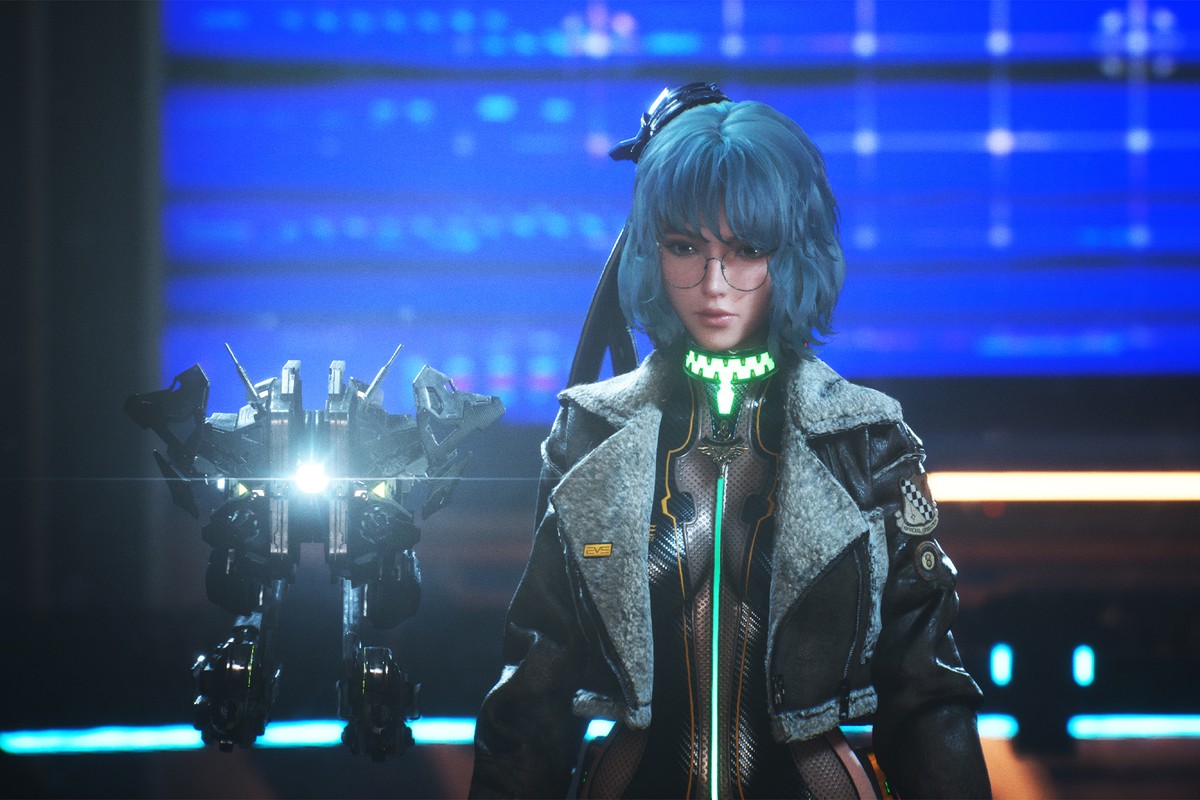

There was a point in the not-too-recent past where gaming was considered a hobby mostly targeted at teenage boys. Back when Tomb Raider‘s Lara Croft became a major magazine centerfold and E3 gaming expos were more famous for their booth babes than actual games, it was the norm for the industry to cater solely to the interests of pubescent young men. In recent years, strides have been made and, despite pushback from a vocal minority, technology has brought us to the point where women in video games can actually look like, well, women rather than cartoonish, gun-toting facsimiles of Jessica Rabbit.
But every so often a game comes along that eschews modern sensibility to utilize all of the industry’s greatest tech in service of a clear vision: What if video games made you horny?
PlayStation’s newest action title, Stellar Blade (out April 26), is that game. It’s also many other games, ripping pretty much every major idea from this era’s most popular releases — and anime as a whole — to create perhaps the thirstiest game since Dead or Alive gave up the fighting genre to become a beach volleyball sim.
Does that make it a bad game? Not really. Video games aren’t a monolith; they should be as open a palette as cinema or any other medium. But does the gratuitous, male-gazey focus help make it a good game? It certainly makes it a hilarious one.
The basic plot of Stellar Blade feels like a stock anime narrative. Earth has been destroyed by creatures named Naytiba. Humanity as we know is mostly extinct on earth after the umpteenth apocalypse, with survivors living primarily on an off-world colony. To wage war against the grotesque monsters on the planet’s surface, society’s vaguely defined leader/deity figure Mother Sphere dispatches platoons of Very Sexy super soldiers, the exclusively female Airborne Squads — dubbed Angels — to clean up the mess. Of course, they’re instantly wiped out save for a sole survivor, Eve, who serves as the player-controlled protagonist.
Let’s get this out of the way: Eve is not a character. She’s a vassal onto which overly sexualized violence is projected. What consists of her characterizations swings wildly between whatever scenario she’s placed in. Sometimes, she’s a completely helpless fawn in need of rescue, completely devoid of agency. Other times, she’s an unstoppable killing machine who can pull off gravity defying displays of viscera against behemoth abominations without breaking a sweat. Sometimes, she’s over it all and moody. Others, she’s a nurturing messianic figure helping bring humanity together by solving their day-to-day struggles.
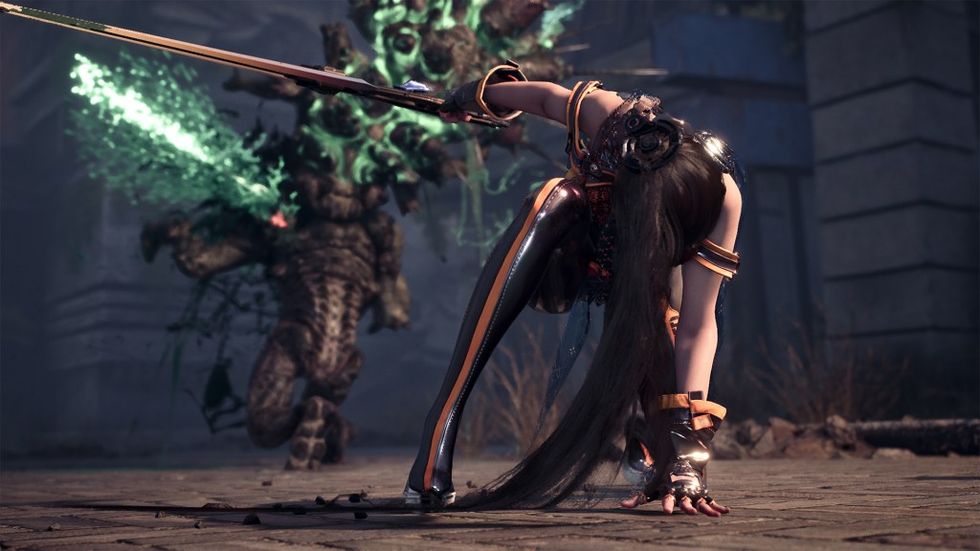
In another work, these dichotomies would make for a conflicted, humanized character. People are complicated, after all. Eve is not. Her POV is always driven by what’s most convenient to move the current scene forward and her only consistent trait is that she’s perpetually naïve and curious about the central mysteries spelled out before her. That, and she is half-naked by decree.
Since her public reveal, Eve has been the latest in a line of video game heroines whose over-the-top design is a point of contention. Comparisons have been made to Bayonetta and Nier: Automata’s 2B, a sexy witch and sexy android, respectively. And while 2B has a logical reason to be totally devoid of personality (she’s a robot), the comparison to Bayonetta is unfair. Bayonetta, ludicrously designed as she is, isn’t just sexy, she’s sexual — having ownership of her looks and mannerisms in ways that ooze self-esteem. Eve is a blank slate, a doll to be played with and dressed up, literally.
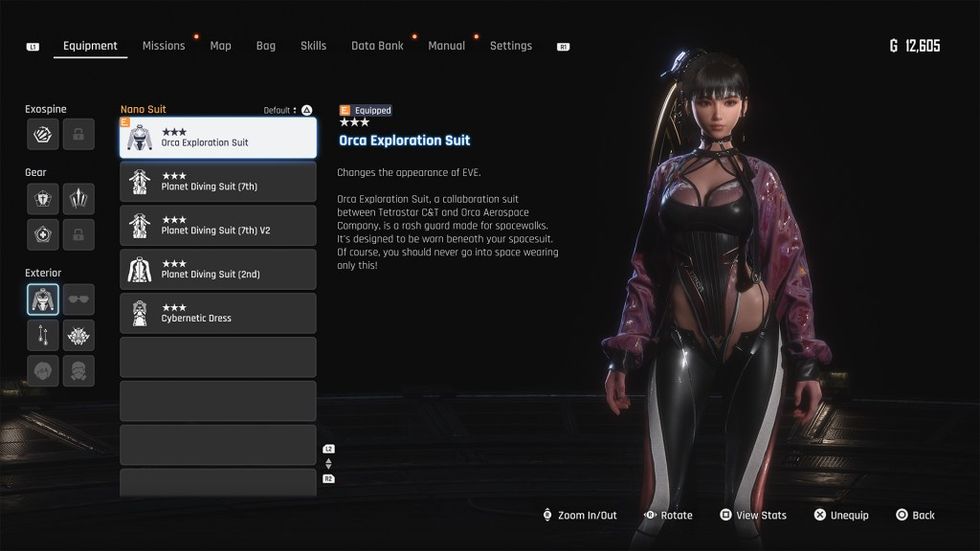
And while that’s inherently sad, it at least makes for an unintentionally funny dissonance throughout the entire experience playing Stellar Blade. Checking off all the boxes of modern game design, the game apes practically every type of action beat found in famous games — but with boobs! There’s a sequence mid-game that’s ripped straight from Uncharted 2 where Eve must escape a dangling train car as plummeting debris and freight rain around her. Where Uncharted made this into one of the most harrowingly cinematic scenes in the series, here it plays like a porn parody as the camera shifts almost exclusively behind her rear for full-frame up-skirts while she’s pelted comedically in the head.
Imagine trying to drive home a poignant narrative beat where you’re informing a young girl that her missing sister is dead, only for each reaction shot of Eve to focus on her breasts, swinging autonomously with jiggle physics run amok. She’s standing still!
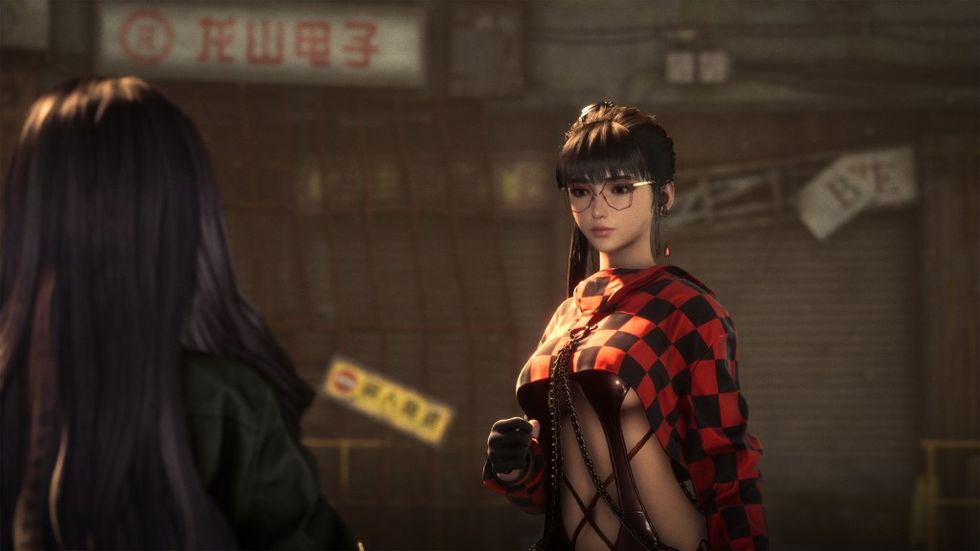
The game’s creators have gone on record that Eve was intentionally designed to be pure cheesecake because, frankly, players controlling her will spend the bulk of their time seeing her butt as she runs. Look, that’s their prerogative, but it stands out starkly when every female character, from iffy-aged NPCs to a cherub-like engineer also resemble waifu pillow designs. It’s more than a little unsettling when the team’s hacker speaks like an adolescent chimney sweep garbed in a dominatrix’s swimwear.
And the men? All but two of the game’s male characters don’t even have faces, instead opting for cybernetic enhancements or flat-out robot heads at all times to complement their tactical windbreakers and military pants.
Again, this isn’t to say that video game characters can’t be designed to be sexy, but when a world and its characters are as flatly written as they are here, playing it straight doesn’t do anything justice. Taken at face value, the story of Stellar Blade is fine, if tedious. But viewed ironically, it makes for one of the best comedic games of the last few years.
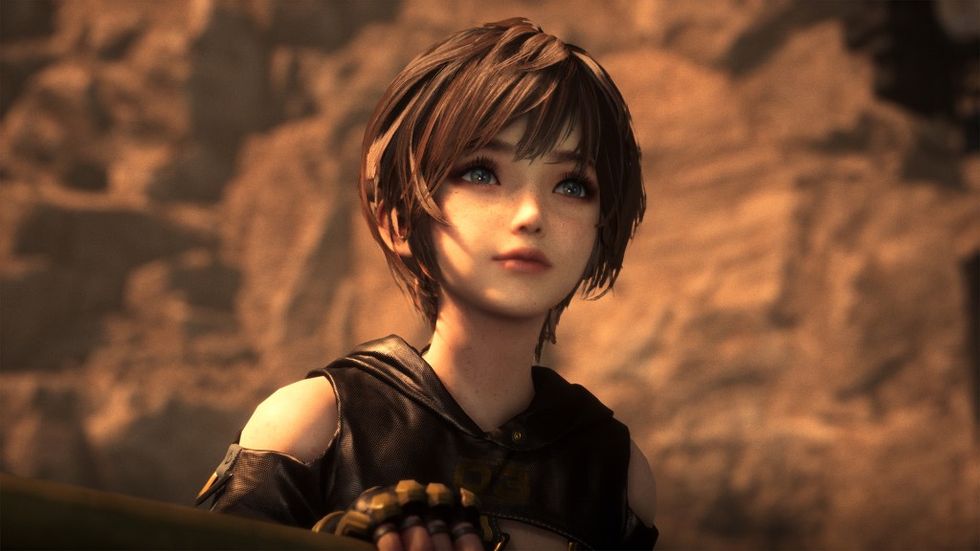
Make that an action-comedy because Stellar Blade is, after all, mostly about action. There, it shines. Pulling from games like Nier: Automata and various soulslikes (i.e. resembling Dark Souls), gameplay focuses mostly on meditative, carefully timed combat that pushes players to tightly parry, dodge, and execute lighting fast bloodletting with both swords and firearms.
It’s not all perfect. Switching between standard melee, heavy-hitting Beta Skills, and time-sensitive Burst Skill reactions is fine enough, but switching to gunplay proves more cumbersome. There’s plenty of times during boss battles where it isn’t even worth swapping for long-range weaponry as the clunky shift between mechanics leaves Eve open for strikes. Guns don’t load quickly, and it’s as if the enemies plan their next move while the player is stuck frantically selecting an ammunition type in the drop-down menu. Don’t even start on the fact that expended ammo doesn’t regenerate if you die, requiring a trip to a shop kiosk after every failed attempt.
It’s a shame because the shooting mechanics feel great, with Stellar Blade being one of the few PS5 exclusives to lean heavily into the tactile feedback of the DualSense controller. Wrestling with an adaptive trigger to pull off the heavy click of a shotgun shell burst would feel great if it weren’t such a liability. But the DualSense features extend throughout the whole game, with noticeable shifts in vibration that really sell the tangibility of this world, whether it’s Eve’s high heels drudging through sand or clacking against metallic floors.
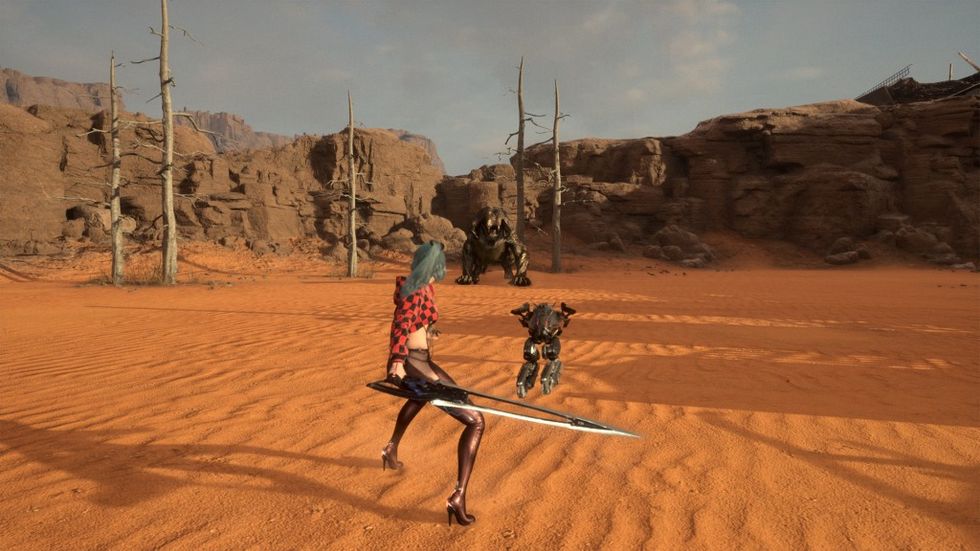
The game looks great too. Aside from whatever weapon’s grade processing power is dedicated to make Eve’s chest physics so mighty, the visuals actually utilize the PS5 to create a vibrant world that feels next-gen, which is nice when even major games like Final Fantasy VII Rebirth failed to deliver more than soulless husks for character models as of late.
The issue is that there’s very few times when that visual polish gets to shine in the environments, many of which lack diversity. There’s sunken cities and urban ruins, creepy underground facilities, and occasionally some truly spellbinding sci-fi settings, but the bulk of the game disappoints by dropping players in barren desert and wasteland for long stretches of pseudo-open world fetch questing.
This draws back to the fact that the game, created by Korean developers Shift Up, doesn’t really know what it wants to be. It begins as an eerie, sci-fi flavored take on the soulslike, before immediately dropping the veneer for canned exploration in desert environments that resemble Horizon Forbidden West’s apocalyptic natural terrain more than anything. There’s a special layer of irony there given how that game has recently become an online punching bag for having the gall to star a heroine who looks like a person, rather than an airbrushed avatar, to which some view Stellar Blade as the anti-woke answer for people looking for more titillating character design. The jury’s out on whether that’s intentional, but “sexy Horizon” this ain’t.
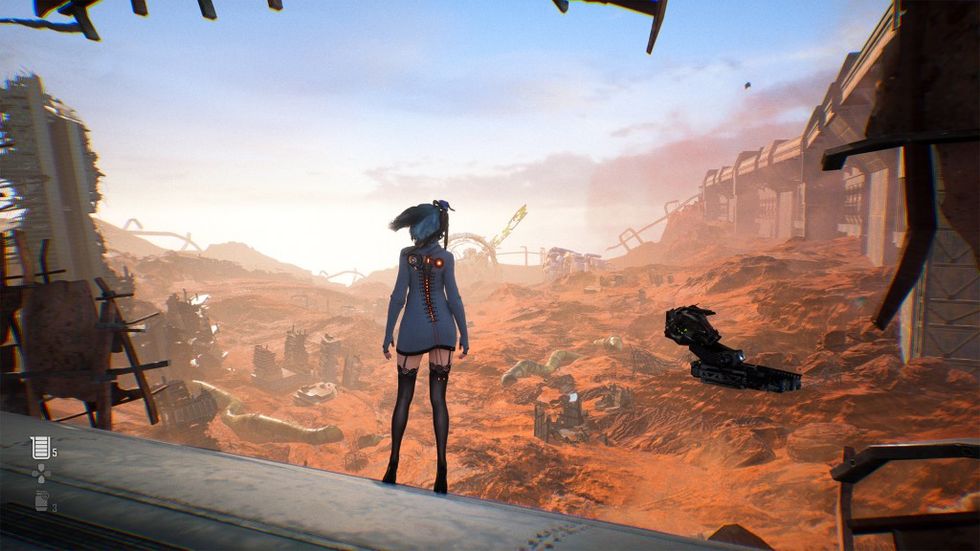
So, what remains is equal parts Nier: Automata, Dead Space, and Horizon, wrapped into a profoundly stupid, yet oddly enjoyable package. With a by-the-numbers story whose twists are telegraphed miles away, and finicky action that’s exhilarating when it works, the game never really lives up to its inspirations, but still manages to retain your interest for its roughly 40-hour campaign. If you ignore all the side quests in the main town hub and speed run to the objectives at the heart of the rickety open world, Stellar Blade can imitate the high-octane actioner you probably think it is.
Otherwise, Stellar Blade is a serviceable action romp that occasionally broaches greatness, all set to the strangely hypnotic ambience of jazzy K-pop ballads. That, plus boobs.














America Got the World Cup It Deserves — Good and Bad