
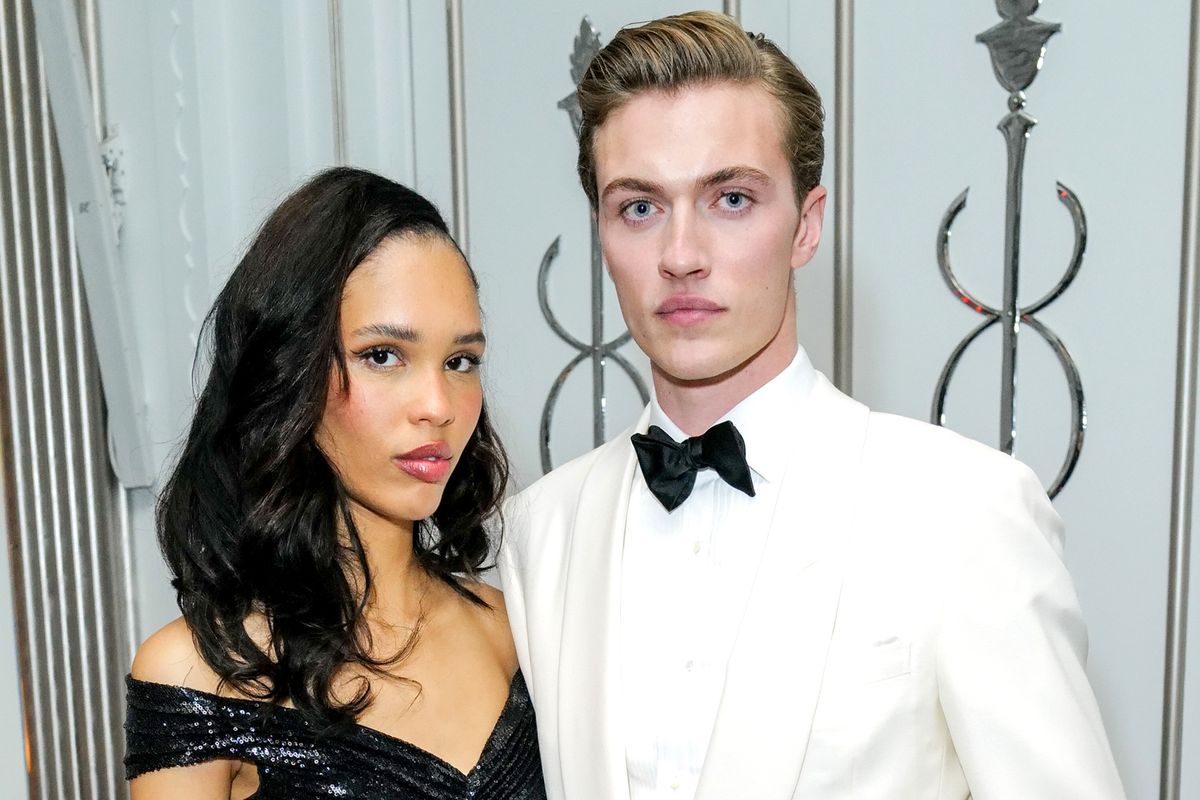

“Today’s my husband and I’s fourth wedding anniversary, so I decided to wake up super early and make him bagels and cream cheese from scratch,” Nara Smith narrates in a recent TikTok video. The model is dressed in a sweeping black peignoir set, her hair perfectly slicked back, her cheekbones flawlessly contoured, her voice as smooth and unctuous as the olive oil she pours into her mixing bowl. She is also eight months pregnant.
Over the next few minutes, Smith documents in painstaking detail how she makes her own dough and chive-covered cream cheese, tossing the bagels into a pot of boiling water next to her trademark Mackenzie Childs teapot. At the end of the video, her husband, the model Lucky Blue Smith, enters the kitchen in a white tank top, his hair unwashed, looking far less put-together than his heavily pregnant wife. “Lucky always needs his toasted, so I did that,” she narrates. “He gave them a 10 out of 10, which is very rare. So I was very pleased with that.” She giggles as Lucky takes a bite, gazing up at him lovingly.
Smith is a model and lifestyle influencer of indeterminate age — some outlets say she is 23, others that she is 28 — who has about 2.7 million followers on TikTok (Nara did not respond to a request for comment sent to her via her agency, IMG Models). Born Nara Pellman, she is of German and South African descent, marrying Lucky in 2020. They have two children, Rumble Honey (born that same year) and Slim Easy (born 2022) and are currently expecting their third.
Lucky has been a prominent influencer for some time, reaching the apex of his fame in the 2010s Tumblr era after appearing in campaigns for brands like Marc Jacobs and Tom Ford. It hasn’t been until relatively recently that his wife has received the same level of attention, thanks to her TikTok account, where she documents her stunning maternity wardrobe, her dinner dates with her husband, and the painstakingly elaborate meals she makes for him and their two children. In one video, she wears a gown while making Cocoa Puffs from scratch; in another, she makes Lucky homemade cookies ’n’ cream fro-yo. She makes the daily drudgery of motherhood and household labor look not just easy, but impossibly sexy.
As a young, beautiful, stylish Black woman, Smith’s content is, in many respects, quite different from that of many other lifestyle “tradwife” accounts, a term used to describe an internet aesthetic promoting a return to 1950s gender roles and values. “Think rural landscapes, gingham tablecloths, farm animals, and several tow-headed children,” says Sara Petersen, the author of Momfluenced: Inside the Maddening, Picture-Perfect World of Mommy Influencer Culture. “Whiteness and mid-century ideals are often front and center in such accounts.” The popularity of the tradwife aesthetic has prompted debate over whether influencers are glamorizing a return to fundamentalist values, such as women retreating from the workplace to care for their husband and children.
Smith’s content is not overtly political, nor does it advocate for a specific agenda or demographic (unless that demographic is absurdly genetically blessed people). Yet many comments have accused Smith of using her platform to promote the tradwife lifestyle, particularly in light of the fact that her husband Lucky is Mormon and was raised in the Church of Jesus Christ of Latter-Day Saints. The fact that she is a Black woman married to a white member of the Church (which barred Black people from the priesthood and the temple until 1978) also further complicates the narrative. “This is Mormon propaganda, she’s like 22 years old,” says the caption on one viral tweet of a “What I Eat In a Day” video. Another reads, “tradwife FKA twigs got yall down bad.”
The specifics of Smith’s relationship with Mormonism are unclear. Though I was unable to verify online rumors that she had converted upon marrying Smith, she has responded affirmatively to comments asking if she self-identifies as LDS, and she has obliquely referred to studying scripture and the Book of Mormon in her content. Unlike Lucky, who in September 2023 wrote a lengthy Instagram post promoting “ my testimony of [the Book of Mormon] and Jesus Christ,” she does not speak openly about what, if any, relationship she has with the Church, other than to quell others’ speculation. “It’s absolutely crazy to me that people assume they know what I believe and what my faith is, and what they assume my stance on other issues are,” she said in one December 2023 video.
Smith’s own religious affiliation aside, however, there is a well-documented history of women in the LDS church — particularly young, attractive mothers — wielding their influence to promote values that are traditionally associated with the church to a secular audience, even if they are not explicitly promoting the religion in itself.
LDS women have long been well-represented in the influencer space. Historically, they have been discouraged from seeking full-time employment, with the Church urging them to lean into roles as mothers and homemakers. Though this has changed somewhat in recent years, with more LDS women seeking work outside the home, blogging — and later, influencing — provided many women with a way to combine both traditional homemaking and journaling, a longtime tradition within the Church.
“We’re taught from an early age to document our lives, and especially when it comes to Mormon women, this whole medium is tailor-made for crafting and DIY and sewing and all of these homemaker activities,” Heather Armstrong, an ex-Mormon who became the ur-mommy blogger when she launched her wildly popular blog Dooce in 2003, told me a few years ago. (Armstrong died last year at age 47.)
Perhaps the most well-known LDS influencer is Hannah Neeleman, a mother of eight who goes by @ballerina.farm on Instagram. The former ballerina and beauty pageant winner has garnered 8 million followers by performing traditional wifedom and motherhood: she bakes bread barefoot, wears overalls in her rustic, wood-paneled kitchen, and cooks from scratch on her $30,000 AGA stove.
Like many Mormon momfluencers, Neeleman does not make religion an obvious part of her brand. But that’s not to say that the Church isn’t aware of these women’s popularity — nor is it to say that they don’t try to harness it for their own purposes. Over the years, I’ve spoken to many momfluencers who belong to the Church who have shared that they will receive emails from Church officials requesting they promote various initiatives, including their Christmas Light the World campaign; others have been known to post sponsored content for the Church, or to give away copies of the Book of Mormon in between posting about recipes and DIY projects. The Church-owned Deseret Corp., which operates both Deseret News and a book publishing company, has published books by influencers like Davis and the LDS food bloggers the Six Sisters, thus directly profiting off their platforms. (The Church did not immediately reply to Rolling Stone’s request for comment regarding its relationship with influencers.)
Even if LDS momfluencers are not explicitly promoting the Church, it is not unheard of for them to approach their professions in a way that advances both theirs and the Church’s interests — and the line between being a good representative of the faith and proselytizing on its behalf can often be blurry. This is something that frequently comes up during church meetings, says Emily January, a former Mormon and an associate professor of English at Weber State University, who studies Mormon mommy blogging as a form of activism.
“There’s this idea that if you live a good life, others will see what a good person you are, and they’ll be intrigued by how different you are and ask you about what makes you tick, or why you are so happy,” she explains. “The myth behind it is that we are shiny, happy people, that there’s a light in our eyes, and people will just see that. And then by our example, we can influence others to be more godly or religious.”
This is where the discourse surrounding Mormon tradwives gets complicated: whether they are explicitly promoting the Church or not, they are clearly promoting the allure of traditional, stay-at-home motherhood, largely to an audience that does not share these values or have the financial resources necessary to embody them (Neeleman, for instance, is married to the scion of the JetBlue fortune and is worth an estimated $400 million, which makes the fact that she has time to swan around in pinafores while making sourdough much more explicable).
Much has been written about feminists’ perverse fascination with tradwives, and how they tap into the secret fantasies of progressive working women in urban areas who fantasize about ditching their laptops and melatonin supplements and embracing a more traditional, gender-normative lifestyle. But such content also glosses over a fundamental truth: that for many women offline, patriarchal servitude is not an aesthetic performance, but their only option. Women like Smith and Neeleman have access to enough resources that they can slip off the shackles of domesticity at any moment, while “there are other women,” such as low-income mothers juggling multiple jobs, “who cannot,” says January. “And I think that gives us an unrealistic look at what it means to embrace traditional values or perform motherhood.” Of Smith in particular, she says, “she is not oppressed in the sense that women who find themselves in a situation where their husband expects to be catered to are, where they’re perhaps yelled at or worse for not performing those roles.”
There is no indication on Smith’s social media platform that her husband, Lucky, harbors such expectations: he appears to be a devoted partner, to the degree that her fans and followers regularly swoon over the affection they have for each other, expressing their desire to similarly cater to their own husbands. But it’s hard not to notice that many of the meals his wife makes from scratch are intended for him, and that he is rarely seen performing any type of domestic labor whatsoever. “It seems to be a very traditional way of looking at marriage and patriarchy,” January says. While this is not particularly unusual in most American households, where the majority of women say they bear the lion’s share of the responsibility for childcare and housekeeping, it does beg questions about why this dynamic is so appealing to Smith’s followers, who openly fantasize about a life of domestic servitude in her comments.
It is perhaps unsurprising that Smith has been widely embraced by the right as an exemplar of ideal womanhood, with her fans accusing detractors of merely being envious of her youth, beauty, and glamorous lifestyle. The right-wing Gen Z publication Evie Magazine ran not one but two stories about Smith in the past week, with one headline calling her “the ultimate TikTok tradwife.” “She has the idyllic life that Gen Z dreams of, one that older millennials can’t relate to,” blogger Nicole Dominique wrote, accusing “white, liberal women” of demonizing her out of bitterness and jealousy.
Petersen, for her part, thinks the issue with Smith’s content is not that she is using her platform to endorse regressive values. Rather, it highlights a bigger problem with the social media space for mothers in particular: that it creates “unattainable, toxic expectations for mothers in a country famously unfriendly and unsupportive of mothers.” Few wives and mothers are blessed with the cheekbones or designer wardrobe of an IMG model, or the time and resources necessary to be able to make cinnamon rolls from scratch for their husband at a moment’s notice. It’s not Smith’s fault that she has those things, but it’s somewhat troubling that a significant proportion of her following thinks that they could, if only they had the ability to devote themselves to a life of catering to others’ desires and demands.
Smith may not necessarily be proselytizing for the Church, but she is indisputably proselytizing for this lifestyle, regardless of whether or not it’s actually attainable. But in truth, that doesn’t make her much different than most other influencers on TikTok. Everyone on social media is trying to convert their audience to something, whether it’s to the benefits of an all-meat diet or a 28-day detox or quitting your job and traveling across the country in a converted van. Mormon moms, who have been trained from an early age to evangelize and speak publicly about their testimonies, are trying to convert their followers into believing they, too, can be shiny, happy, and blessed — they just happen to be better at it than others.












America Got the World Cup It Deserves — Good and Bad