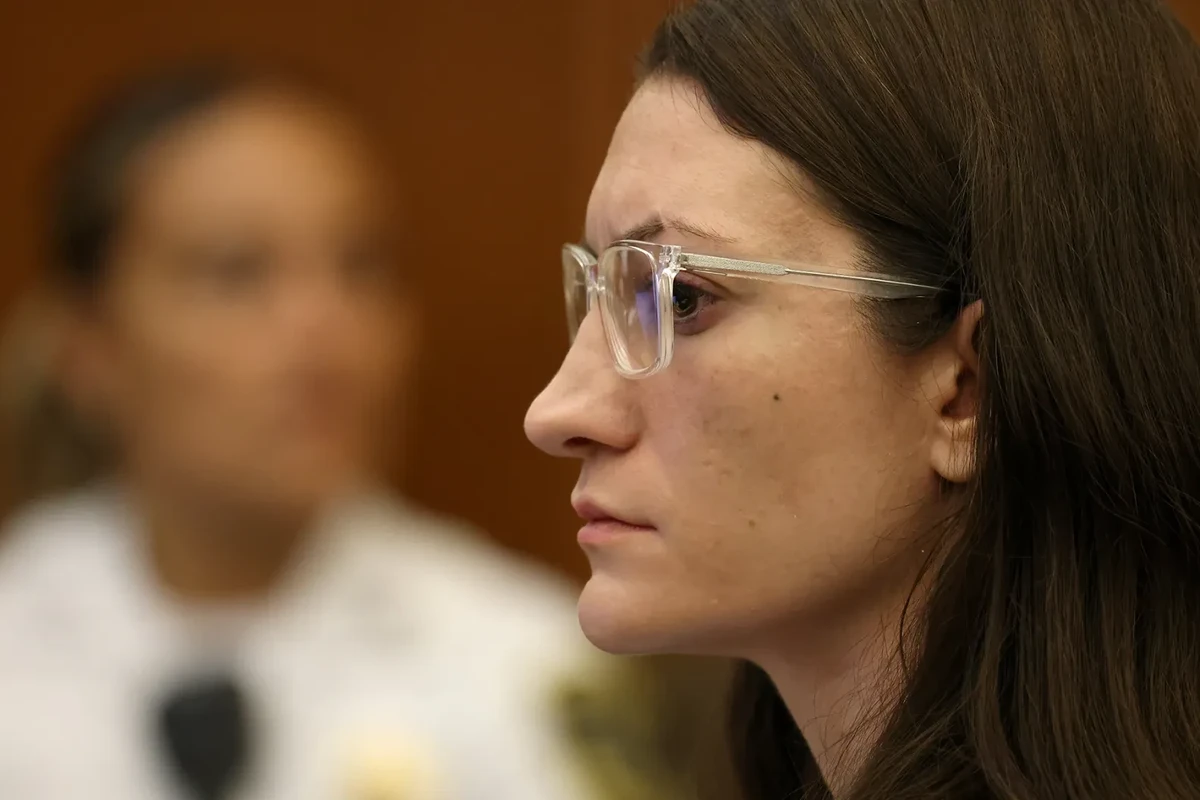

Lindsay Clancy’s triple murder trial ended in a mistrial Friday after jurors said they were hopelessly deadlocked and a higher court rejected a last-ditch defense bid to intervene in the deliberations.
“I’m going to declare that the jury is deadlocked, and I’m going to declare a mistrial,” Plymouth County Judge William Sullivan said from the bench Friday afternoon, according to a livestream of the trial by Channel 5 Boston. He then thanked jurors for their service during the heart-rending trial of the Massachusetts mother charged with killing her three young children during what defense lawyer Kevin Reddington described as a severe episode of postpartum psychosis.
The ruling capped a chaotic day in which Sullivan said in the morning that he intended to declare a mistrial, Reddington called the decision a “travesty,” and the judge gave him “one hour” to seek an emergency stay from a higher court.
The scramble followed a Friday morning note from the jury foreperson saying jurors could not reach a unanimous verdict. A day earlier, the jury had reported an 11-1 split, with a lone holdout preventing a verdict.
“It is with a heavy heart that we report we are unable to come to a unanimous decision and will not be able to,” the jury’s Friday note said.
Reddington disclosed in court that the holdout was a man and seized on the phrase “heavy heart,” arguing that it suggested jurors had reservations about a mistrial. Citing the foreperson’s Thursday note, he said the holdout had “made statements acknowledging doubt” but “will not apply reasonable doubt to the evidence to return a not guilty verdict.”
ADVERTISEMENTReddington had previously asked the judge either to remove the holdout and replace him with an alternate or to order the jury to continue deliberating. The judge denied both requests, saying that removing a juror during deliberations was an extremely fraught and “sensitive” step, and he did not believe there was sufficient cause to take it. The parties are due back in court Sept. 29 to discuss what happens next. In the meantime, the charges against Clancy remain in effect.
Plymouth County District Attorney Timothy Cruz told reporters outside the courthouse that his office had not yet decided whether to retry Clancy. She remains held without bail at Tewksbury Hospital, a state-run psychiatric and medical facility.
During the closely watched trial that became a viral phenomenon, prosecutors argued that Clancy was deeply troubled but understood that what she was doing was wrong when she strangled her children with exercise bands. They asked the jurors to convict her of three counts of first-degree murder.
ADVERTISEMENTThe defense argued that Clancy should be found not criminally responsible due to improperly treated mental illness, a verdict that likely would have resulted in her indefinite commitment to a forensic psychiatric facility.
During the divisive seven-week trial, prosecutors claimed the killings were “meticulously” and rationally planned by a controlling mother who was depressed and exhausted but not psychotic when she decided to kill herself and take her children with her. They asked jurors to hold Clancy criminally responsible for killing Cora, 5, Dawson, 3, and Callan, 8 months, in the basement of the family’s home in a suburb of Boston on Jan. 24, 2023.
“This is not a public debate about women’s mental health and how the medical system treats women,” Plymouth County Assistant District Attorney Shanan Buckingham said in her opening statement on July 27. But the trial became exactly that.
Clancy’s defense centered on testimony that she was suffering a complete psychotic break and hallucinating a commanding male voice outside her body, telling her to kill the children so she could then kill herself. Following the strangulations, Clancy used a kitchen knife to slash her own throat and wrists before she “threw herself” out of the second-story window of her bedroom, shattering her cervical spine, Reddington said. (A former labor and delivery nurse at Massachusetts General Hospital, Clancy, 35, was paralyzed in the fall and sat through the trial in a wheelchair.)
Jurors heard that after Callan’s birth, Clancy struggled with debilitating depression, sleep deprivation, intense anxiety, psychotic symptoms of dissociation, and intrusive thoughts about harming herself and the kids. She was “spiraling down,” Reddington said, at times crying hysterically or appearing like a “zombie,” as she repeatedly begged for help. The homicides happened just two and a half weeks after she was discharged from a psychiatric hospital.
Clancy was prescribed more than a dozen psychiatric medications over roughly four months, jurors heard. Trial testimony revealed a fragmented course of care from a rotating cast of prescribers who didn’t seem to have the full picture of Clancy’s mental state and medical records. Online, many trial observers seized on those gaps, claiming Clancy was failed by a system that expected an unstable patient to carry her critical information from one provider to the next.
In his closing argument, Reddington accused prosecutors of being “manipulative” by calling a witness who floated the theory that Dr. Paul Zeizel, a defense psychologist, planted in Clancy’s head the idea that she heard a voice ordering her to kill the children. He pointed to testimony from Sheila Cavanaugh, a chaplain at Brigham and Women’s Hospital, who met with Clancy immediately after the January 2023 killings.
During the trial, Cavanaugh testified that Clancy described hearing a “persistent” voice that “told her that if she did not follow the command, neither she nor her children would be safe.” Reddington argued Cavanaugh was present when Clancy was extubated and around for eight days before Dr. Zeizel even knew “Lindsay exited.”
“She told Sheila first that she heard voices, command hallucinations,” he argued before the case was handed to jurors for deliberations on Thursday, Aug. 27.
Shortly after the trial started, it quickly became a social media cause célèbre, with countless moms taking to Instagram, Facebook, and TikTok to say they saw echoes of their own postpartum struggles in Clancy’s private writings and Google searches. While postpartum psychosis is rare, affecting an estimated one to two people per 1,000 births, postpartum depression is much more common.
As the trial unfolded, supporters said they identified with Clancy’s notes about feeling overwhelmed and exhausted, and the crushing guilt she experienced over her choices related to breastfeeding, sleep-training, and how she divided her attention among her three kids. A medical expert for the defense testified that struggling mothers, such as Clancy, might minimize their psychiatric symptoms out of fear they could be reported to child protective services and lose custody of their children. The expert said Clancy also may have worried that disclosing her most severe symptoms could jeopardize her nursing license. (Prosecutors argued that Clancy’s decision to share her intrusive thoughts with her husband and mother, but not with her medical providers, was evidence of rational thinking because she understood that disclosing them to clinicians could have consequences.)
As public support for Clancy grew by the day, online sleuths went to work challenging the prosecution’s narrative, closely scrutinizing witnesses and criticizing authorities for not investigating certain details more aggressively. Some went further, circulating theories that questioned whether Lindsay Clancy had even killed the children at all. They argued that Clancy’s injuries, including her extremely low body temperature and damage to her thyroid gland and voice box cartilage documented at the hospital, were inconsistent with prosecutors’ account of what happened and raised the possibility of foul play.
Reddington, a veteran defense attorney, attracted a devoted following among trial watchers who praised how he held his client’s hand during difficult testimony and comforted her when she broke down in sobs. He was lauded online when he excoriated prosecutors for bringing a case that he said would “kill the soul” of a mentally ill mother who “loved those children up to the time of their death.”
“She knows that she killed these children,” Reddington told the jury. “She’s living her own hell. She knows what happened with those kids, and she wanted to die.”
Clancy’s former husband, Patrick Clancy, testified that he watched his wife’s condition steadily deteriorate from mid-October through December 2022. “She just kept getting worse and worse,” he testified.
As Clancy’s struggles deepened, her parents visited regularly from Connecticut to help out with the kids and support their daughter, he told jurors. “We didn’t have a diagnosis,” Patrick Clancy said. “We just didn’t really know what was wrong.”
He testified that Clancy told him she worried about harm coming to the children, but she denied having a plan to do anything herself, he said. Her behavior at other times appeared ordinary, he testified.
“It was very confusing because a minute later she was making lunch or playing with them or getting them ready for bed or whatever it was,” he told the jury. “I never saw Lindsay harm the kids.”
Describing the night of the killings, Patrick said he left the house to pick up some medication and takeout food for the family. When he returned, the house appeared eerily quiet. He went upstairs, found the door to the primary bedroom locked, managed to open it, and saw “blood everywhere,” with the window open, he said. When he ran outside, Clancy was on the ground with deep cuts to her wrists and a cut across her neck, he testified.
Clancy, who was in and out of consciousness, allegedly told him the children were in the basement of their Duxbury home, he said. Once paramedics arrived, he ran to the basement while still on the phone with a 911 operator. He found the children unresponsive, with exercise bands around their necks.
The two older children were pronounced dead at the hospital. The couple’s 8-month-old died several days later. As he testified about the horrific scene and losing all three children in one night, Patrick Clancy’s chin was quivering. Jurors and people in the courtroom heard his 911 call, but the judge did not allow it on the public livestream.
In his testimony, Patrick said his wife called him not long after the incident from the women’s hospital where she was being treated. “She didn’t talk about our kids. She talked about what she went through,” he told the jury. “She said she heard a man’s voice telling her that if she didn’t do it now, she would lose her chance.”
Investigators said that before killing her kids, Clancy researched how long the trip to the restaurant and a pharmacy would take so she would know how much time she had alone with the children.
After the killings, Patrick said in a statement that he had forgiven his wife and urged others to do the same. “I wasn’t married to a monster,” he later told The New Yorker. “I was married to someone who got sick.”
Both Lindsay and Patrick Clancy have filed separate lawsuits against her medical providers, alleging they failed to properly diagnose, treat, and monitor Clancy’s postpartum psychiatric condition.
“Lindsay Clancy did everything a mother in her situation could do,” her lawsuit says. “She recognized something was wrong with her. She sought medical treatment. She went to emergency rooms. She called crisis hotlines. She admitted herself to hospitals. She took the medication prescribed to her. She communicated her worsening symptoms to her providers. She told them the medications were making her worse.”