
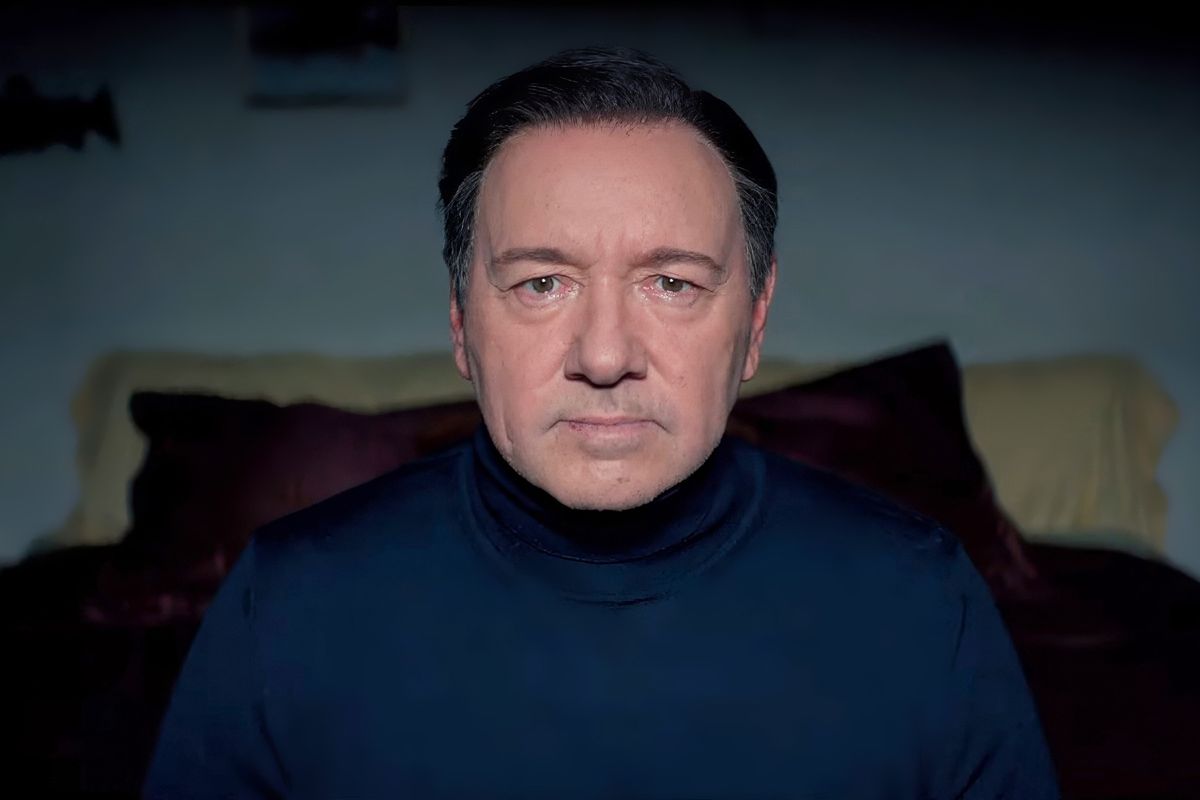

Not that long ago, a dark thriller featuring Kevin Spacey as a smooth-talking stranger who arrives in a small town with an apparent vendetta against one of its inhabitants might have been a major movie event. He was, after all, a hugely popular and critically acclaimed actor, known for playing iconic villains from The Usual Suspects and Seven all the way up through House of Cards. His gift for intimate, Shakespearean malice could certainly boost a box-office haul.
But not this time: I saw Spacey’s new film, Peter Five Eight, a punishingly awkward misfire that splits the difference between a religious allegory and an anti-alcoholism PSA, on Sunday night at the only theater in Los Angeles screening it — and I was the entire audience.
Even with a full house, it would have been a stretch to call this a comeback. In fact, Spacey is a bit rusty when it comes to commanding the frame, sluggish in his attempts at intimidation. Also a bit jowlier these days, and still speaking with a hint of the hammy drawl he used for Frank Underwood in House of Cards, Spacey as the mysterious Peter is closer to Elmer Fudd than Anton Chigurh — and it doesn’t help that he’s often wearing a jaunty fedora with a feather on it.
We all know how he fell so far: at the height of the #MeToo reckoning in 2017, actor Anthony Rapp accused Spacey of making a sexual advance on him at a party in 1986, when Rapp was 14 and Spacey was 26. Spacey issued a statement to the effect that he remembered no such encounter and was officially coming out as gay — a detail that some LGBTQ celebrities criticized as an attempt at deflection. More than a dozen others then came forward against Spacey with allegations of sexual misconduct or assault spanning from the 1980s to the present.
Netflix cut ties with Spacey and produced a season of the smash hit House of Cards without him; Ridley Scott edited him out of the finished film All the Money in the World, recasting Christopher Plummer in Spacey’s role and quickly reshooting the necessary scenes. His publicist and talent agency both dropped him. In the years that followed, two potential U.S. criminal cases against Spacey fell apart — one because prosecutors scrapped the charges, the other because an anonymous accuser died — and, at trial, Rapp lost a lawsuit pertaining to the alleged 1986 incident. In 2023, a U.K. jury found Spacey not guilty on nine charges of sexual assault or misconduct stemming from allegations made by four men. And last month, Spacey agreed to pay $1 million to settle an arbitration case related to his alleged sexual harassment of younger crew members on the House of Cards set, a far lighter penalty than the $31 million he’d originally been ordered to pay in 2021.
On paper, then, Spacey has come through a period of dizzying scandal relatively unscathed, avoiding the most serious legal consequences he faced. In reality, however, his reputation will never be the same — partly because many of his public comments since his career imploded take the form of creepy Christmas greetings videos where he continues to address the viewer as Underwood, in vaguely sinister tones. Recently, he seems to have embraced right-leaning grievance politics, performing at an anti-“cancel culture” event at the University of Oxford (to a standing ovation) and recording his latest Christmas message as an Underwood interview with former Fox News host Tucker Carlson.
Yet where it comes to Hollywood, Spacey has yet to reclaim the spotlight. In 2023, he had an offscreen part in the British indie Control, voicing an unknown man who hijacks a politician’s self-driving car. Reviews were poor, though in premise and execution it surely surpasses the dire Peter Five Eight, written and directed by longtime visual effects artist Michael Zaiko Hall, which benefits in no way from Spacey’s own bizarre promotional video comparing it to noir masterpieces including Sunset Boulevard and The Big Sleep. Instead, this film has the garish lighting, cloying score, and nonsensical plot of a soap opera, without any of the suspense. Hell, daytime serial dramas have better sound mixing, too.
The title, we learn at the outset, is a reference to the Bible verse Peter 5:8, “Be sober, be vigilant; because your adversary the devil, as a roaring lion, walketh about, seeking whom he may devour.” The script takes “sober” literally, introducing us to a woman who is definitely not: Sam, a real estate agent played by German-American actress Jet Jandreau (who also co-produced). In the California mountain hamlet of Dunsmuir (likewise the setting of Hall’s 2022 directorial debut), Sam struggles to sell a house and bickers with a deadbeat husband named Travis, both of them turning to booze to cope. The performances of intoxication are cartoonish at best, Jandreau at times missing her mouth as she slops the liquor down, recalling the “drinking problem” gag in Airplane! Equally distracting is her choice — perhaps a nod to those 1940s noirs — to adopt a now extinct Mid-Atlantic accent, which grows more shrill and hysterical as she begins to realize her past has come back to haunt her.
That haunting comes courtesy of Spacey’s Peter, who turns up in Dunsmuir and begins to stalk Sam, albeit not so stealthily: it takes him all of 20 minutes to buy the house across the street, and he approaches a number of locals to bluntly inquire after her — including an old yokel gas station attendant who demands $100 in Bitcoin to share what he knows. (It is not the only baffling reference to cryptocurrency in the movie.) Peter oozes pompous affectation, answering a neighbor’s question about whether she can help him with the assurance that there’s nothing she can do because he’s a “fallen soul,” adding that he’s “doomed to play the villain’s part.”
In this role, Spacey evidently wants to have his cake and eat it too, leaning into a smarmy caricature of himself as prowling monster while also delivering moral judgments on the need to “have accountability for the things that we’ve done.” That’s because Sam has a terrible secret — the thing she’s running from — and Peter has been hired by a nondescript wealthy boss to see that she doesn’t escape it. Except the nature of Peter’s mission is hopelessly muddled. Clearly a hitman by trade, he doesn’t try to kill Sam, opting to hang around in her social orbit so he can guilt her with aggressive hints at her crime while the rest of the townsfolk remain totally oblivious.
After Peter runs off a couple of Sam’s real estate clients by causing a gas leak in the property she’s showing (there’s a whole scene where the characters stand around in a kitchen freaking out over the poisoned air instead of fleeing), he seduces one of her coworkers, Brenda (Rebecca De Mornay, deserving anything but this). Their fling doesn’t advance Peter’s confusing agenda but affords plenty of tone-deaf dialogue meant to evoke hard-boiled romance, plus one of the least believable sex scenes ever put to the screen.
Sam, meanwhile, continues to spiral out of control as she tries to rid herself of Peter — without confronting her own conscience. When blood is finally shed toward the finale of this clumsily paced potboiler, Peter manages to somehow kill all the wrong, irrelevant people instead of her friends and loved ones, as he seemingly intended. Along the way, he pursues Sam across a tiny lake in a canoe chase so unexciting it scans as a bucolic parody of pulse-pounding stunt choreography.
“We all exist in this sort of absurd chaos,” Peter proclaims at a moment that feels as if Spacey is breaking the fourth wall, Underwood-style, to comment on the incoherent story he’s trapped in. Up through the very last shot, which posits that his character may represent a kind of immortal evil, if not the devil himself, Peter Five Eight mangles its return-of-the-repressed concept with this false profundity and Spacey’s theatrical preening as the bad guy you’ll never be rid of. And it’s true that after he slums it in another two or three of these low-budget affairs, bigger producers and directors may decide it’s safe to hire him again.
In that sense, you could read Peter Five Eight as a fable about the impermanence of “cancelation,” a fate that rarely lasts in our amnesiac culture. Alone in my theater, I chuckled at one of Peter’s various corny attempts to frighten Sam, then recognized it as a meaningful threat from anyone cast out of their industry for alleged transgressions: “Ta ta,” he tells her, “for now.”
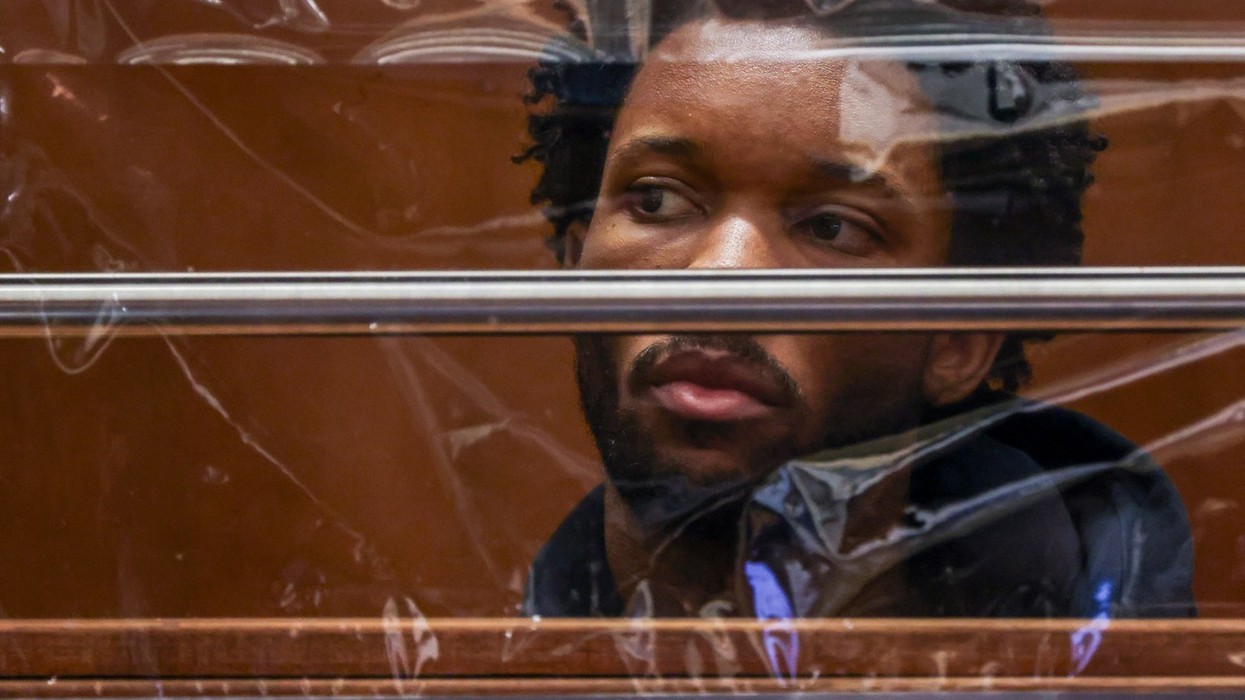

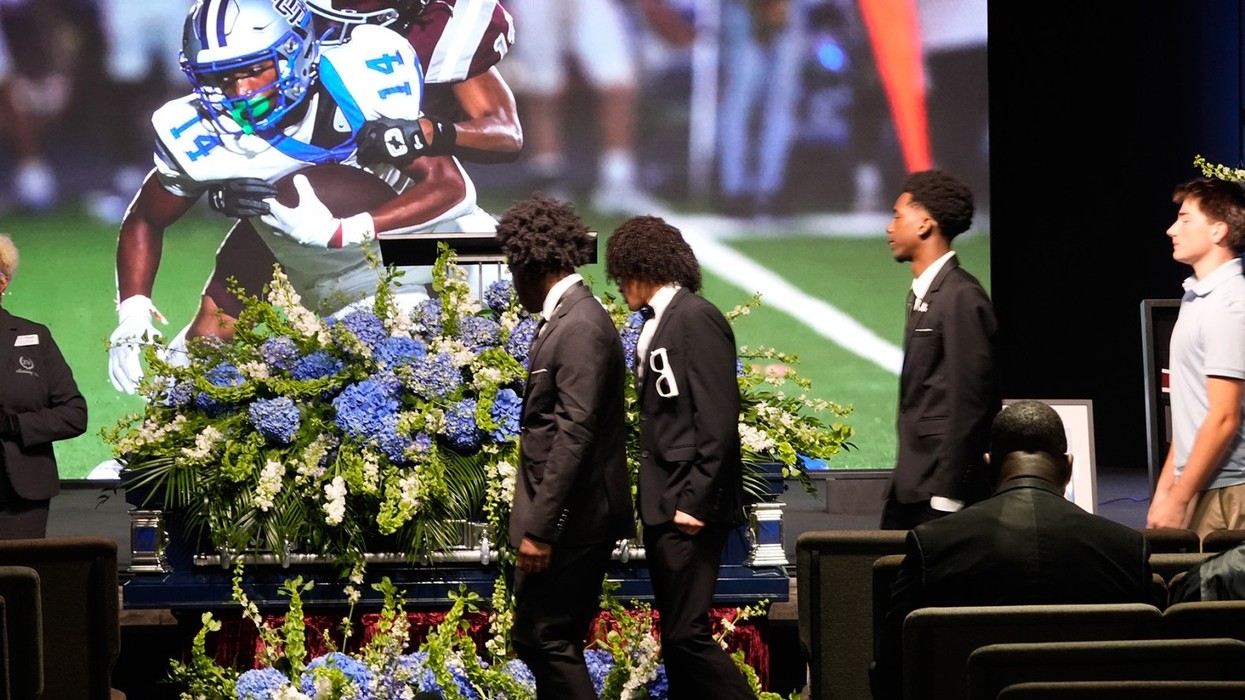
 Christine Wonsley with her husband, Elmore (second from left), attorney Ben Crump (left), and Rev. Al Sharpton (right), during a memorial service for her son Nolan Xavier Wells.Gerald Herbert/AP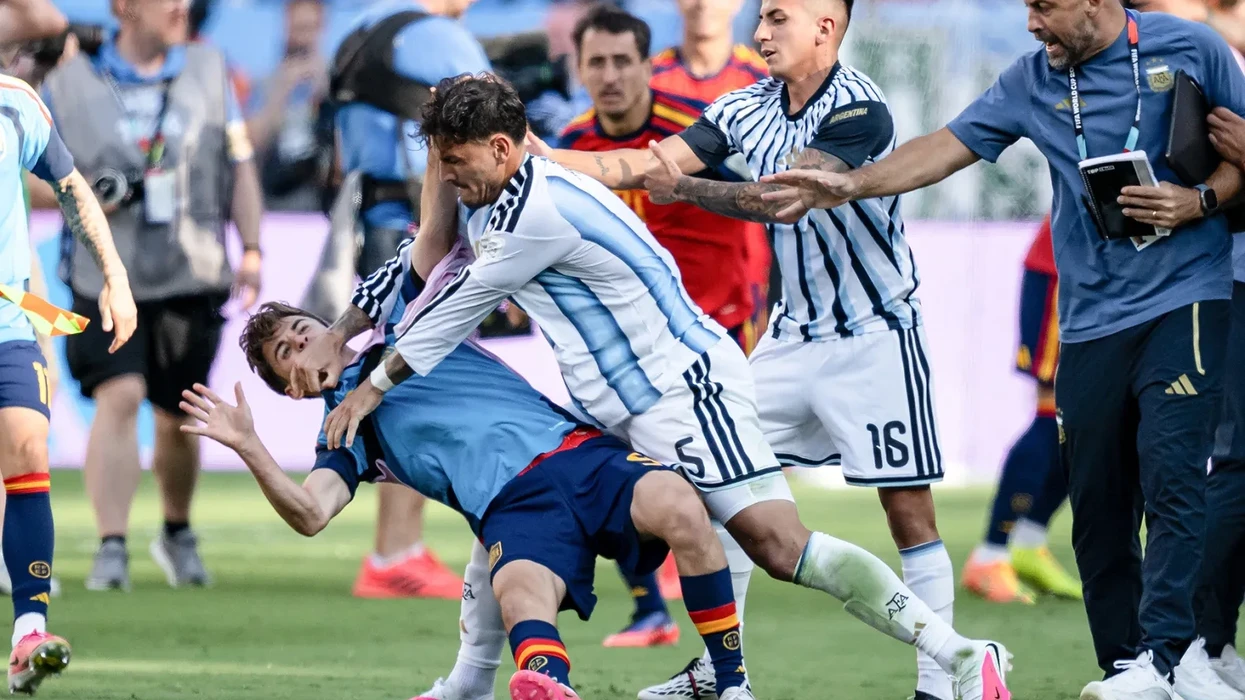

Donald Trump and FIFA President Gianni Infantino stand as Spain celebrates its World Cup victory, on July 19, 2026.
America Got the World Cup It Deserves — Good and Bad
For the past six weeks or so I’ve been having a recurring fight with my friends. The dispute is over whether or not it’s ethical to support the U.S. national team in the World Cup.
To the vast majority of people reading this article, this is an absurd question: of course you can and should support the United States Men’s National Team, you weirdo. And look, I’m with you. But despite the fact that my friends are pompous dorks who are no fun to watch the game with, the question they raise is valid: Are our national teams avatars of the administration in power, or of the people and promise of that country?
If you believe the former, then yeah, it’s pretty fucking weird to support the USMNT. In doing so, by that thinking, you’d be engaging in a sort of athletic nationalism on behalf of a country run by Donald Trump, the most corrupt president in history, who forced the Iranian national team to flee across the border immediately after the final whistle of each of their games, whose federal police have shot numerous civilians dead in the street during a brutal immigration crackdown, who has started a war and supported a genocide while covering up his close personal friendship with the most notorious pedophile in modern history.
I mean just look at him. On Sunday he waddled down onto the field to present Spain with their trophy, lingering on stage with the victorious team as they tried to celebrate. The presence of Mexican President Claudia Steinbaum and Canadian Prime Minister Mark Carney did little to dilute the image of Trump standing next to his crony Gianni Infantino, grinning at all the trappings of their power, hands caressing a trophy they’d done nothing to earn, lingering well past his cue to leave Spain to their glory. This World Cup, literally, had Donald Trump’s fingerprints all over it.
And yet, this was one of the most thrilling, beautiful World Cups in recent memory. That’s America, baby — contradictions abound.
Over the past five weeks of the greatest athletic competition on Earth, we’ve seen games that will literally never leave my memory. The final, which I attended yesterday in New Jersey, was remarkably forgettable — a 0-0 draw until the 106th minute, with Spain dominating every second of play and yet unable to score, undone time and time again by their insistence on tricksy passing and the personal heroics of Argentina’s goalkeeper Emi Martinez. The rest of the tournament, however, delivered. Cabo Verde, refusing to lose until the very last moments of the first knockout round, battling back again and again against both teams that would eventually play in the final. The sheer dominance of France’s Kylian Mbappe in front of goal, scoring at will, rivaled only by the aging GOAT Leo Messi and the Norwegian warlord Erling Haaland. England’s heroic stand at the Estadio Azteca in Mexico City, 45 minutes in the rain, a man down, holding out for the win and singing “Wonderwall” with what felt like half the stadium when it ended. Off the pitch, too: the Algerian national team being welcomed with open arms by Lawrence, Kansas; Scottish braves drinking Boston dry and partying wildly with Haitian fans that overcame so much just to be at the tournament. In Mexico, of course, the World Cup was everything, and its fans threw joyous South Koreans pumped full of tequila into the air, and celebrated in the streets with opposing fans even after their hard-fought defeat to England.
For the United States, what the 2026 World Cup was — what our team was, what our fans were, what our performance as hosts was — is a reflection of two things at once: what our nation is and what it can be.
Our star striker, Folarin Balogun, was born here by accident, a citizen only because of a birthright system that our president is currently trying to erase. We have Ricardo and Giovanni and Freeman and Zendejas. We have another striker whose name is Haji, for goodness sake. I look at that team and I see the country America can be, one in which any soul born in or living within our arbitrary borders can become part of a great national project that seeks to improve the lives of everyone it can. And yet, I can also look at that team and see a reflection of what the country is, because there is an anchor around its neck. When Balogun was — albeit unjustly — suspended for a crucial match, Trump himself stepped in. Cronyism saved the day and got Balogun reinstated, but ruined the fragile harmony the team had enjoyed. On the pitch against Belgium, they came apart. Temperamental star Christian Pulisic tried to go alone and then quit, aging defender Tim Ream’s legs failed him when he needed them most, a young goalkeeper slipped and fell when he had no good options for support.
What more can you say about a team, about our country? The team is an entity that is capable of more but still has so far to go, that is vulnerable to the same forces of avarice and selfishness and fear that plague our national identity writ large.
It’s possible to end the story there, to say good riddance to another failed year and fractured team. But I think that’s a mistake. I think if you believe that you haven’t really been watching. I think that’s also why it pissed me off so much that some of my friends wouldn’t root for the U.S. Yes, we have flaws, like every country involved in the tournament. Yes, our current team management and political government are filled with morons. But if you won’t put on the shirt you’re essentially opting out of our future. We can’t wait around for a better world, a better team, a better president, before we deign to lend our support. Progress only comes from effort, from caring, from believing in something more.
One of my favorite images of the World Cup was a crowd shot of the opening match against Paraguay in Los Angeles: every race, color and creed of American there is, all covered in red white and blue. It’s corny and trite, sure. But that’s what it’s all about. That’s why we’re here. You have to believe. The U.S. won that game 4-2. In four years, we’ll be even better.