
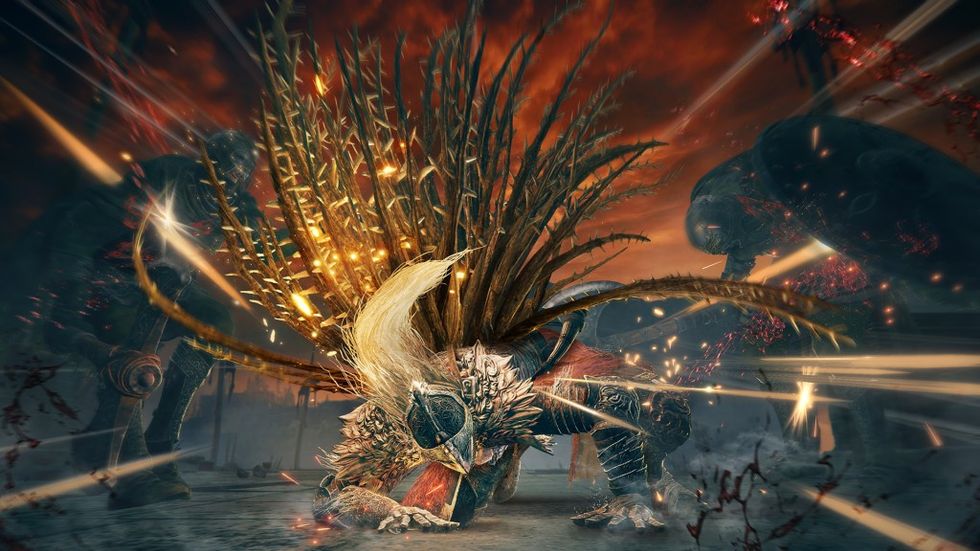
Elden Ring was undoubtedly 2022’s Game of the Year, winning numerous awards across different shows and publications. With its dark fantasy atmosphere, punishing combat, and challenging difficulty, players keep coming back for more. It was also developer FromSoftware’s first open-world game, so it needed to have more content than any game that the studio had made before.
Two years later, FromSoftware is back with brand new content for Elden Ring in the expansion Shadow of the Erdtree.
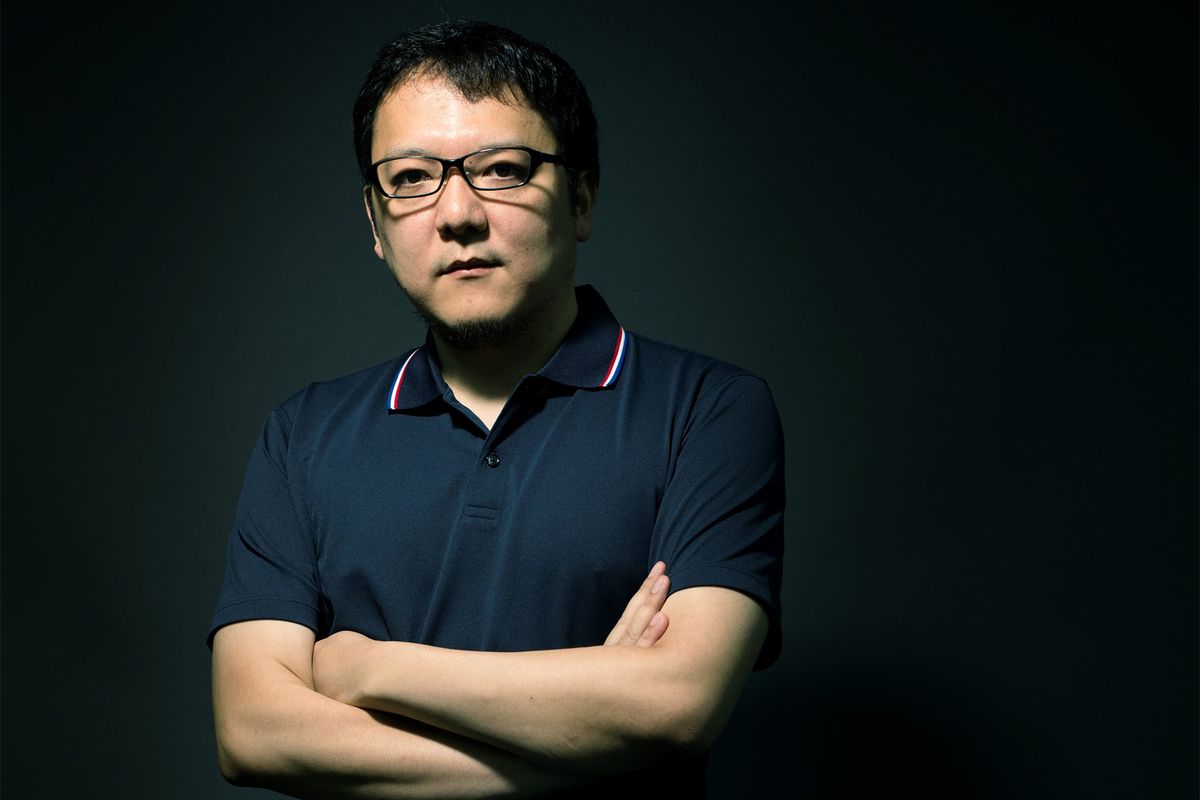
Rolling Stone recently sat down with FromSoftware president Hidetaka Miyazaki, the director of some of the most influential games in the video game industry, including Demon’s Souls, Dark Souls, and Bloodborne. We discussed the inspirations behind Shadow of the Erdtree, FromSoftware’s influence on the video game industry, and what the future holds for the studio.
Meeting expectations
It’s uncommon to see video game developers release extra downloadable content (DLC) two years after a game’s release, but for FromSoftware, there was no other choice. Its sheer size necessitated the time it took to work on it. Miyazaki acknowledges that it’s been a while since Elden Ring’s launch.
“What really defines Elden Ring as a game is that excitement of exploration and adventure, combined with a certain degree of freedom that the players get to enjoy,” says Miyazaki. “So in order to make sure expectations were met on all those different fronts, it ended up being as big as it did.”
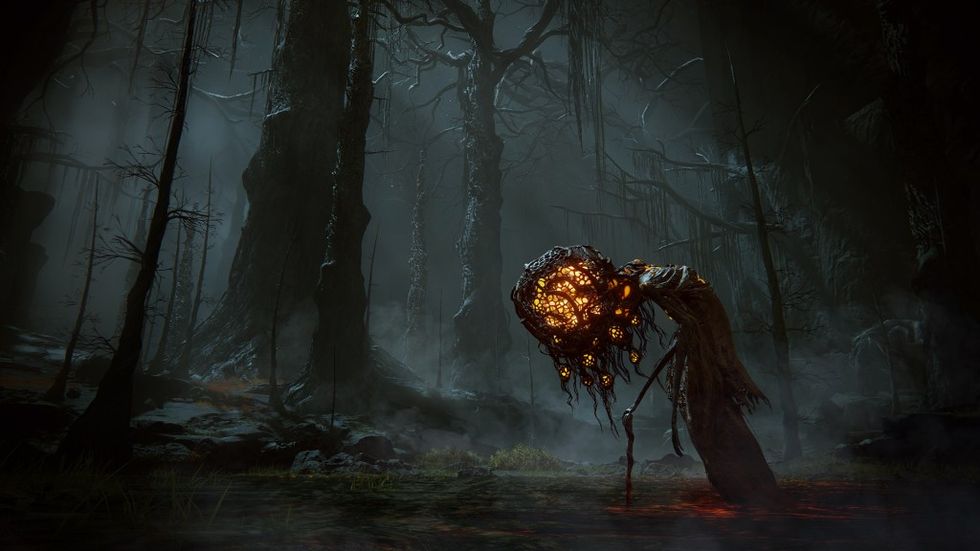
Writer George RR Martin helped provide mythology and worldbuilding for the main game of Elden Ring, but wasn’t involved with Shadow of the Erdtree. He wrote the background lore of Miquella, who has the ability to ascend to godhood. While Miquella is referenced a few times in the main game, players never really come in contact with him. Miyazaki explains it was a story that FromSoftware wanted to revisit and tell fully, so Shadow of the Erdtree is where Miquella’s story expands.
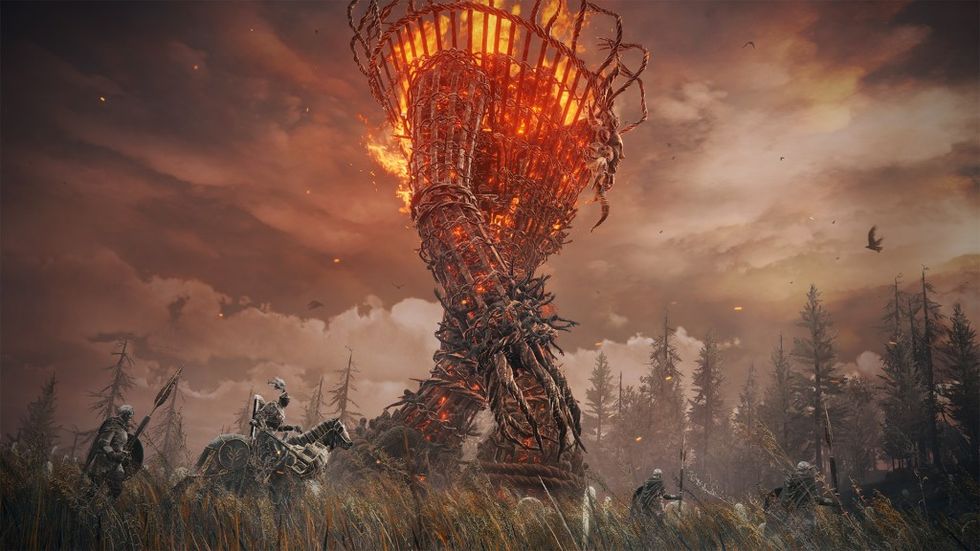
Of course, DLC isn’t new for FromSoftware. The Dark Souls series received DLC expansions starting with 2012’s Artorias of the Abyss, building off the very first Dark Souls game, which came out the year before. What makes Shadow of the Erdtree different from past FromSoftware expansions was not only the sheer size, but how it was integrated: It takes place in a different area from the main game (called the Land of Shadow) so the assumption is that players are already at a high level and powerful by the time they take it on.
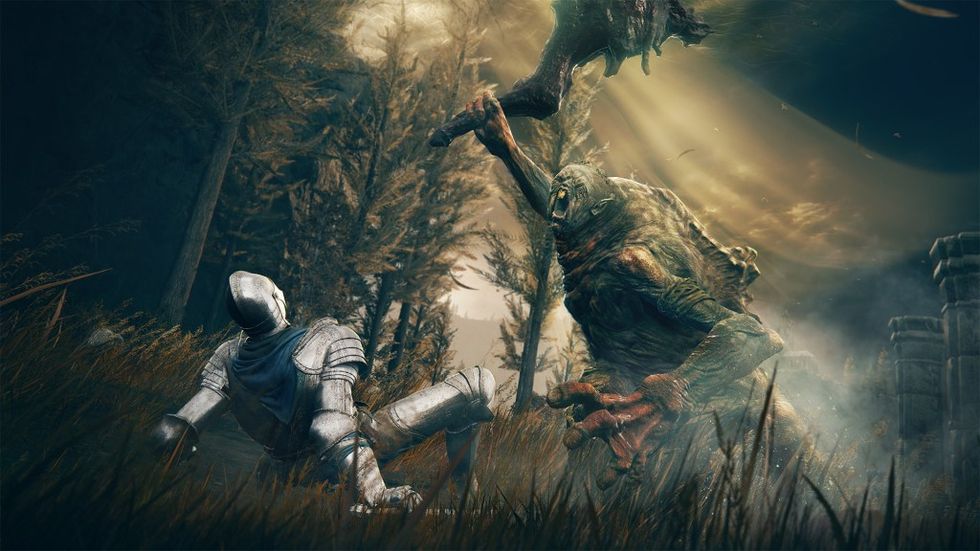
“What made the base game quite exciting is the sense of a threat or the unknown. ‘Hey, am I strong enough to even engage with this boss yet or not?’ You don’t know that even though you’re almost at an end game level,” Miyazaki explains. “Going into the DLC, you get that character growth and that sense of threat again, so it feels fresh.”
Miyazaki has already confirmed that Shadow of the Erdtree will be the only expansion for Elden Ring. FromSoftware could’ve split it into smaller separate expansions, but that would mitigate Elden Ring’s grand ethos of freedom and exploration.
Influencing the industry
Elden Ring and FromSoftware’s games have inspired an entire subgenre of video games called “Soulslikes.” Basically, that label gets put on any game that features hard bosses and players constantly dying against them. However, Miyazaki says that he wouldn’t go so far as to say FromSoftware invented an entire genre, as core gameplay mechanics aren’t something that the studio invented.
The act of dying, learning, repeating, and applying knowledge you’ve accumulated for your next attempt was an idea that FromSoftware arrived at with 2009’s Demon’s Souls. Miyazaki notes that FromSoftware got lucky that the video game market wanted a game with a learning curve and death cycle for its core gameplay loops.
“We just happened to release it into the market at the right time,” Miyazaki explained. “So as happy as it makes us, I think it’s also very humbling to know that there has been a lot of credit given to us for naming a genre.”
As other developers have attempted their own spin on making a Soulslike game, many have added unique mechanics and utilized different settings to stand out. Examples include Team Ninja’s Japan-inspired Nioh, Ubisoft’s sci-fi The Surge, and even the anime-style Code Vein, which Bandai Namco developed in-house (Bandai Namco also publishes Dark Souls and Elden Ring).
“Yes, I do play other so-called ‘Soulslike’ games,” Miyazaki admits. “But not so much as a consumer but as research, so to speak.” He explains that due to him working with similar gameplay concepts, themes, and gameplay restraints, it’s always interesting to see different interpretations other studios or game designers put on the subgenre that FromSoftware perhaps haven’t thought of. “It’s very stimulating for me to be able to see it from many different angles, because we’re all working within the same sandbox, in a way.”
Going off the beaten path
Miyazaki’s directing credits mainly consist of the Dark Souls and Armored Core franchises, but he’s also interested in other projects. In 2018, he directed Deracine, a PlayStation VR-exclusive. It was a narrative-adventure game that was wildly different from the games people associated him with.
If the opportunity presented itself, Miyazaki says that he’d like to experiment with other kinds of games. However, he also says that the bigger challenge was to find an environment that allows for games that deviate from FromSoftware’s typical mainstream hits.
“In the case of Deracine, there was new technology with virtual reality,” he said. “We wanted to challenge ourselves as a studio and acquire some new learnings to apply whatever it is we did next.”
Interestingly, Miyazaki also mentions that part of him wants to make a traditional Japanese roleplaying game someday. FromSoftware released one in 2006 called Enchanted Arms, directed by now-Capcom employee Masato Miyazaki (no relation). However, Miyazaki says that it most likely won’t be related to Enchanted Arms.
He doesn’t see himself being able to inherit FromSoftware’s past IP and put his own spin on them. “I think a lot of these games are so intertwined with the directors who almost invented that style of game,” Miyazaki explains. He used FromSoftware’s debut game, 1994’s King’s Field, as an example. It was produced by FromSoftware’s first president, Naotoshi Zin, who also went on to produce the franchise’s second and third games.
“I don’t think there’s a scenario where I myself would make a King’s Field. The same can be said about Otogi and Enchanted Arms,” he says. There is one exception, however. Miyazaki started at FromSoftware in 2005 as a planner on Armored Core: Last Raven — and he could see himself revisiting the series again. “I worked on Armored Core 4 and Armored Core: For Answer. It enabled me to put my own interpretation on Armored Core VI: Fires of Rubicon and develop that.”
The future of FromSoftware
There’s no telling where FromSoftware goes from here. With the excitement surrounding Shadow of the Erdtree, it’s a hard accomplishment to top — so what’s next? Will FromSoftware make Dark Souls 4, a sequel to Sekiro: Shadows Die Twice, or finally bring Bloodborne to PC?
For the studio itself, Miyazaki says to expect more games being directed by people other than himself. Last year’s Armored Core VI: Fires of Rubicon is a prime example, as he was initially its director before the project was handed off to Masaru Yamamura.
“I attribute a lot of our in-house creative team growth to Elden Ring because the sheer scale of what that game demanded naturally elevated our talent pool to a higher level that they’re able to direct their own games now,” he explains. “We want to definitely take advantage of that growth through Elden Ring and apply it to whatever comes next, with different directors and game designers.”
Miyazaki’s words are a stark contrast to current trends in the video game industry, where developers have relentlessly been getting laid off within the last few years. While Miyazaki doesn’t want to speak on behalf any other company or generalize the state of the industry, he has no intention of laying anyone off because it goes against what he believes are core values of FromSoftware: being able to make good games and be in an environment to not worry about losing a job.
Miyazaki hopes that FromSoftware is never in a position where he’d have to lay developers off, and he believes that comes down to the studio’s business practices. The studio’s conservative sales forecasts are what has kept them humble.
“Of course, Elden Ring was a massive success, but we never make any assumptions or build our next forecasts on the assumption that our next game has to do Elden Ring numbers or we’re not going to make it,” he explains. “So it’s my job to make sure FromSoftware can always continue to be in business and has a very strong foundation.”






 Cherry Torres, Jay Armstrong Johnson, Jimin Moon, Ryan Duncan, and Ryann Redmond Matthew Murphy*
 Cherry Torres, Jimin Moon, Ryann Redmond, Jay Armstrong Johnson, and Ryan Duncan Marc J Franklin*