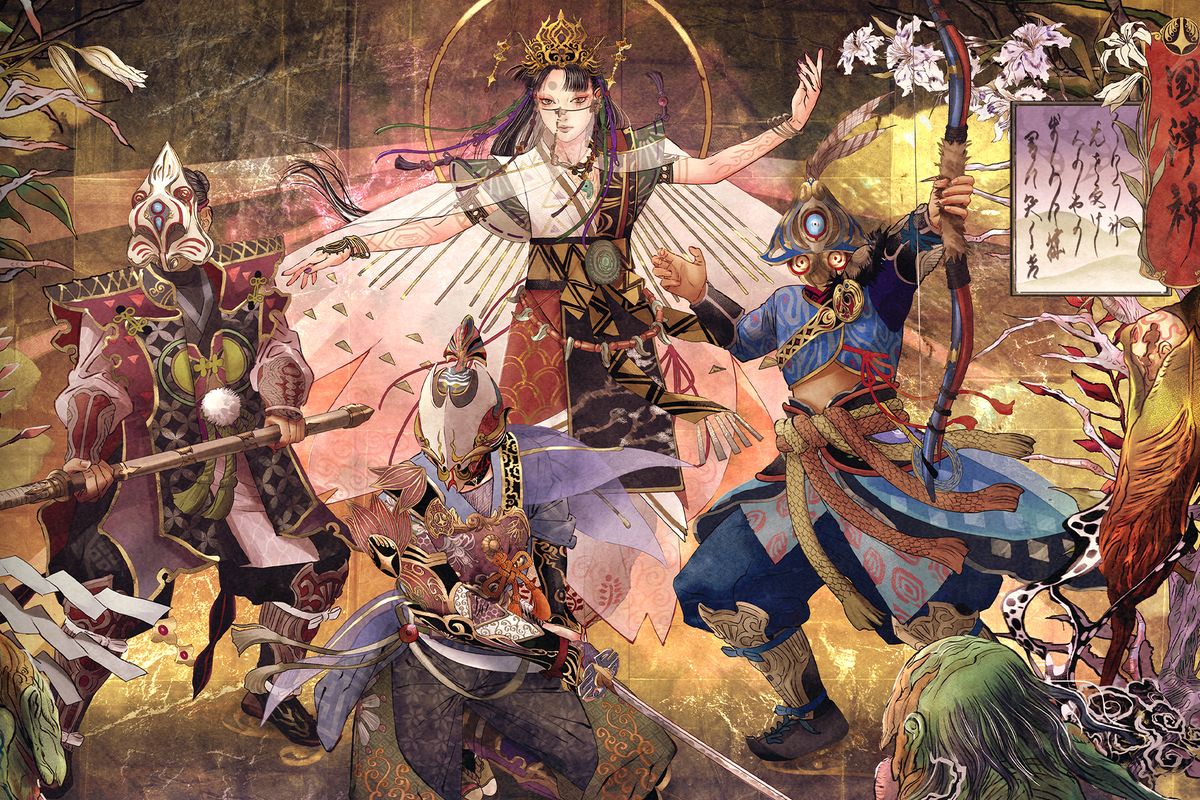

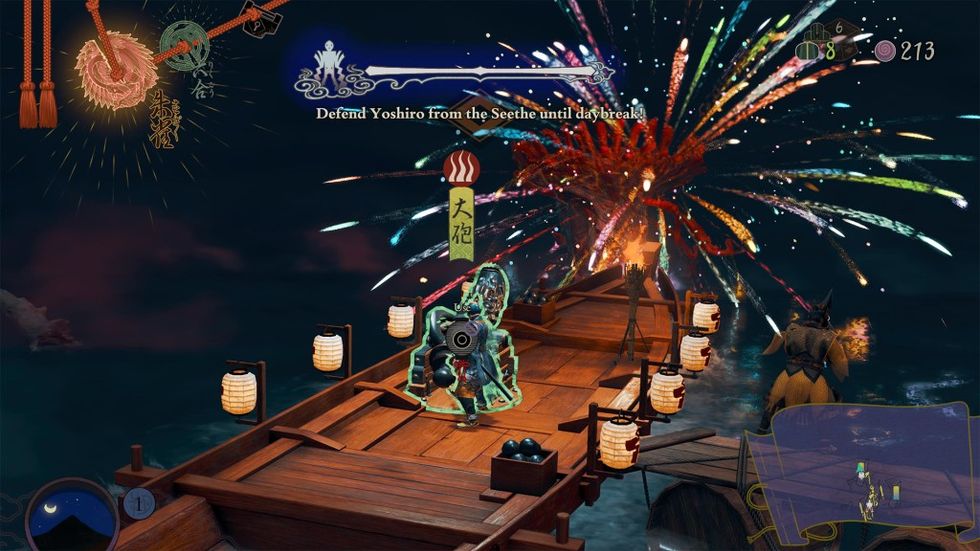
As gloomy as the ambiance of Kunitsu-Gami: Path of the Goddess can be, you’re constantly challenging it with a colorful celebration. Fireworks are a recurring motif, symbolizing the accomplished feats of your journey as you help cleanse villages and shrines from the threat of Yokai-inspired foes — supernatural entities and spirits in Japanese folklore. In combat, each time you set off a cannon, the impact turns the pale creatures into a splash of particles. Outside of it, fireworks are ever-present when you rebuild people’s homes, as townsfolk jump and scream in joy to see hope restored.
The latest from Capcom mixes hack-and-slash action with strategy elements that echo the tower defense genre. Playing as Soh, you wield your sword through a series of increasingly challenging stages to protect the shrine maiden Yoshiro. She’s the only person who can purify the gates at the end of each level, and ultimately the corruption tormenting the land altogether. But she can’t fight back on her own. As you quickly realize, Soh can’t do this alone either — instead, you recruit the help of the villagers you rescue as different unit types, slowly building a group to stand together against rampant hordes of enemies. It’s a novel concept, and one that evolves with surprising results.
The first few levels of Kunitsu-Gami serve as an extended tutorial that introduces the tone and general structure. After losing an early encounter, Soh is left in a weak state with just a few abilities available. Moreover, 11 goddess masks are scattered throughout the explorable region of Mt. Kafuku, each unlocking a new unit type for you to assign to your villagers including cannoneers to deal with large groups of enemies, shamans that heal those around them, thieves that can lockpick locked chests, and so on.
The mechanics can be hard to grasp at first. You observe Soh from a top-down view, controlling them like your usual hack-and-slash game. Villagers, on the other hand, act independently — you assign their positions on the map, as well as calling out some general direct orders, like all-out attacks during boss fights. They’re all quite competent, aside from a few odd cases where they can get stuck in environments.
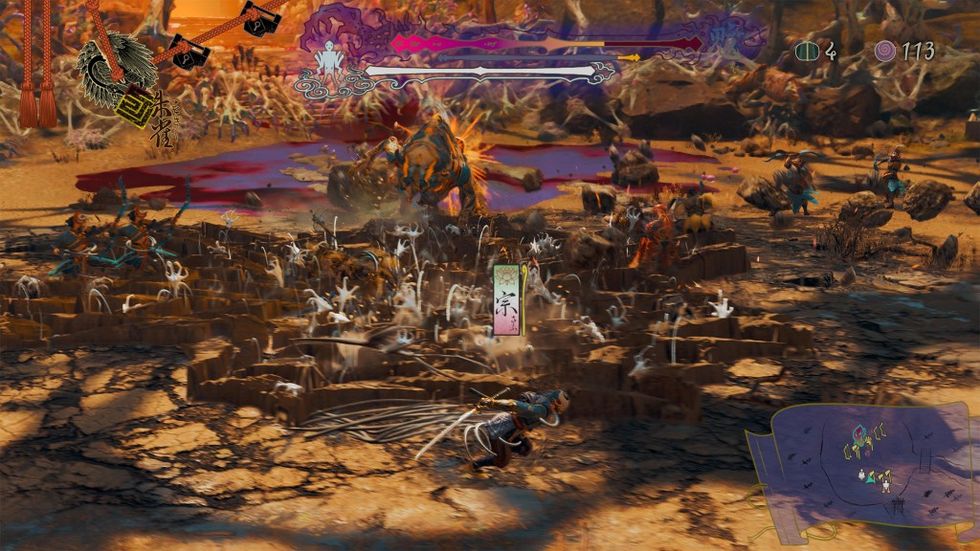
Once you begin to understand what each unit type excels at, and how to best counter enemies, the loop becomes engrossing. The structure of each stage varies, but you mostly carve a path for Yoshiro with your sword from point A to B in a stage for her to move to the gates needing purification. A day and night cycle dictates a time limit — more often than not, Yoshiro might need more than one in-game day to reach the gate. Once the sun sets, enemies begin to swarm in, trying to reach Yoshiro. The plan is to strategically place units around choke points to ward off danger, and set up traps.
You can’t just assign roles to villagers freely, however, as doing so costs in-game currency called crystals. During the day, Soh can purify a few areas of each stage, which grants crystals in return. If you manage to find all of them, you’re rewarded with equippable trinkets that grant passive skills. You also need to manually liberate some of the villagers — which is essential to avoid jumping into the fray with a number disadvantage. Defeating enemies also gives you crystals, and you can assign roles in the midst of combat which freezes time, a convenient and welcoming mechanic as encounters become harder to fight against.
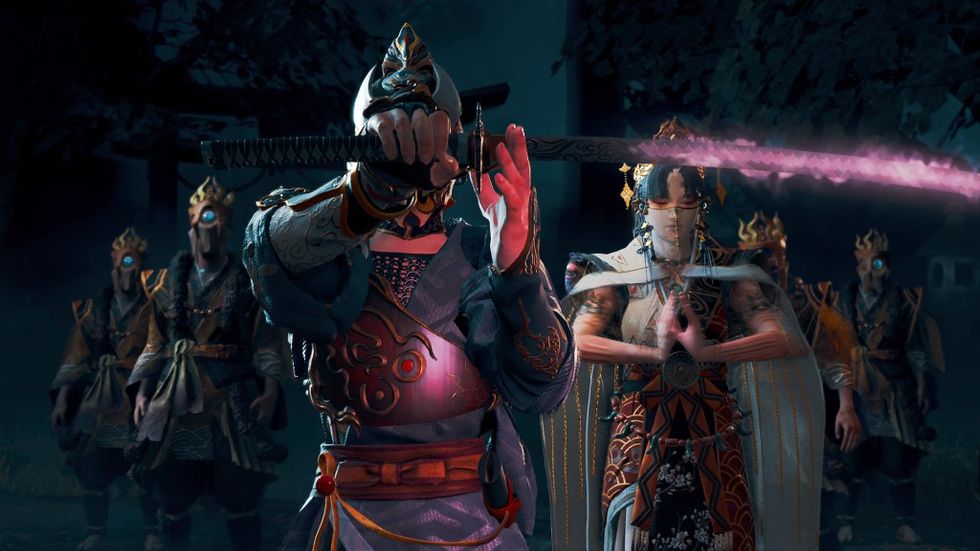
But it takes a while for Kunitsu-Gami to become challenging. I spent the first few stages ignoring the map altogether. Instead of placing units on different paths and making use of the space available, it was easier to group everyone near the gate’s entrance to wreak havoc on enemies as they appeared. The structure began to feel stale — I was able to tackle all of my duties during the day with plenty of time to spare, eroding any sense of friction from the day and night cycle. Once I got acclimated with the core loop and mechanics, I kept waiting for Kunitsu-Gami to show its hand.
Eventually, it does. Stages start to feature different permutations and obstacles to keep track of, such as dark caves with lanterns that need to be lit up, to ensure villagers can see enemies and attack them. The maps themselves are more convoluted, with multiple gates opening simultaneously and changing location on a whim, requiring you to always think on the fly and move units around. Enemies also become tougher to deal with — some preventing Soh from healing themself or controlling units until you take them down, while others are walking kamikazes that explode if not killed. Doing so hurts enemies instead. It takes a while for these layers to appear, but once they do, they make for a satisfyingly breakneck rhythm.
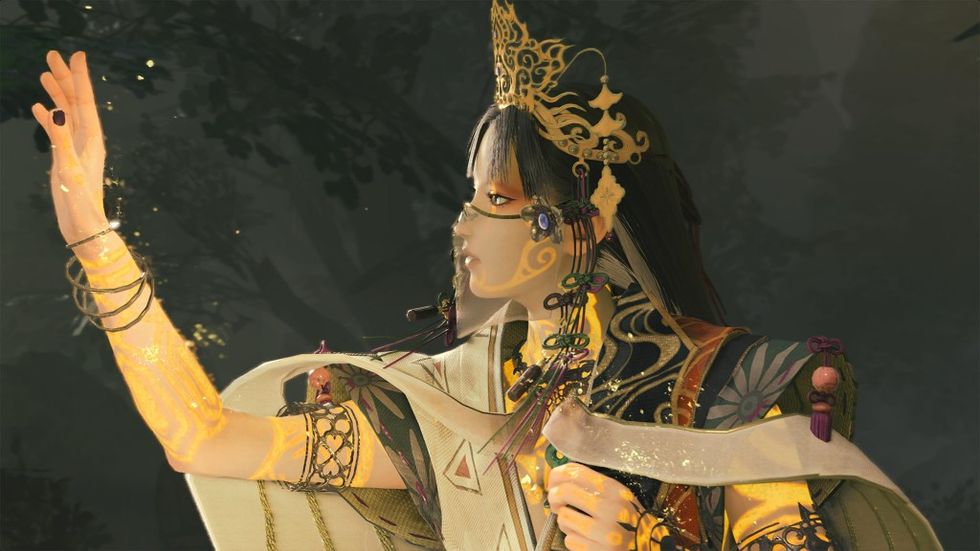
Completing stages rewards you with another currency that is used to upgrade each unit type. You can reset upgrades on the fly and redistribute those points elsewhere in case you’re feeling stuck with your current choices. Eventually, you also get access to Soh’s own ability trees. Don’t expect an overly deep progression path here, but there are abilities that are a must-have, such as unlocking more slots to use trinkets and special attacks, or even gaining access to different combat styles, including ranged attacks with a bow. It’s the same currency also used to upgrade your villagers which adds yet another strategic component. I kept wondering whether to invest more in Soh and my agency as a player, or make my villagers stronger so I could focus on special enemies while they held down their positions without having to constantly defend them.
One aspect where Kunitsu-Gami falters is in the moments between stages. After successfully purifying a village, it becomes a base where you can rebuild structures to gain currency, and trinkets. For this, you have to manually interact with wreckage to assign the required number of villagers, requiring multiple visits until the entire base is rebuilt. The rewards are significant, such as increasing your limits of crystals and rations, which are used to heal Soh and the villagers. But the back and forth can become a slog, especially with multiple bases undergoing simultaneous repairs. For villages to finish them, you need to complete a stage. Some require more than one, creating a backlog.
Don’t expect Animal Crossing levels of complexity here, as rebuilding structures is a fairly shallow feature that isn’t intended to be a farming sim. But it’d be nice to have the option to cash in on the rewards after a repair is completed from the overworld map, instead of manually having to revisit each one and interact with the structure again.
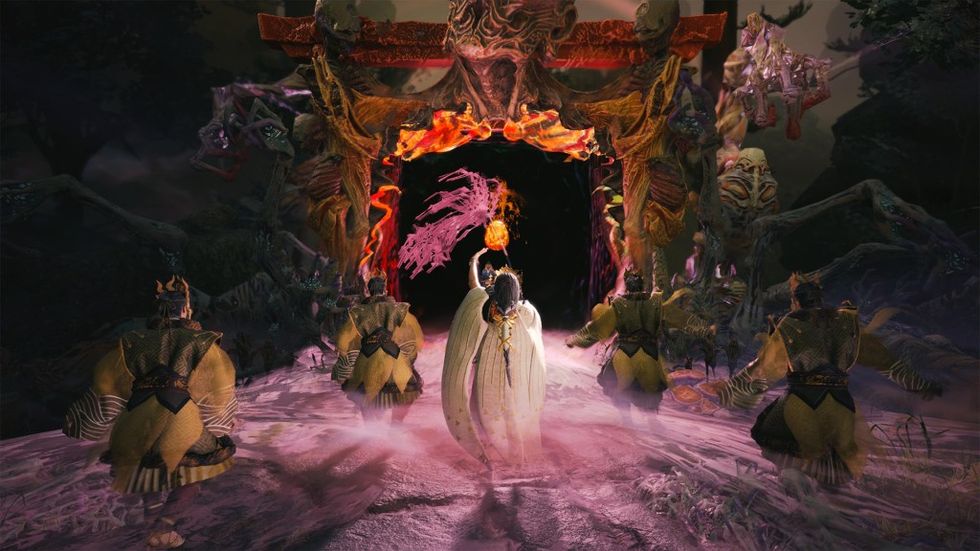
Fireworks aren’t the only way in which Kunitsu-Gami symbolizes celebration. Rebuilding a structure causes flowers to blossom around them, while villagers cheer at each for a job well done. Bases brim with life after they’re purified, with wildlife hanging around and gathering around Yoshiro once you cleanse their corruption. These touches are small, but are signs of care and passion that add to the experience. Aside from the busywork, I became invested in helping the townsfolk, and it was satisfying to completely rebuild a town, walk on a lake that was previously poisonous, or pet a deer that first tried to flee whenever I got close to it initially.
The further I got into Kunitsu-Gami, the better the mechanics came together. Getting to longer stages with bigger threats with a strong synergy between my units, prevented Yoshiro from getting a single scratch, and felt like cracking a puzzle that had been building up for the past dozen hours. Boss fights, in particular, can be quite inventive, putting past lessons to the test and forcing you to engage with every tool at your disposal to achieve victory.
In an interview with GamesRadar+, director Shuichi Kawata said the team is, “Constantly trying to find the best way to explain what this game is about to everyone.” I can see why. The trailers alone don’t really convey what the experience is about. The satisfaction that comes from managing 12 villagers at once and actually making it out alive requires a substantial time investment, sitting through tutorial after tutorial.
As AAA companies continue to invest in existing series with sequels and remakes, it’s refreshing to also get experiences like Kunitsu-Gami, presenting new worlds with genre blends that might be a hard sell for mainstream audiences. It takes a while for its charm to blossom, and some mechanics aren’t clear without trial and error, but once the concept comes to life, conquering its challenges becomes a puzzle worthy of its fireworks.