
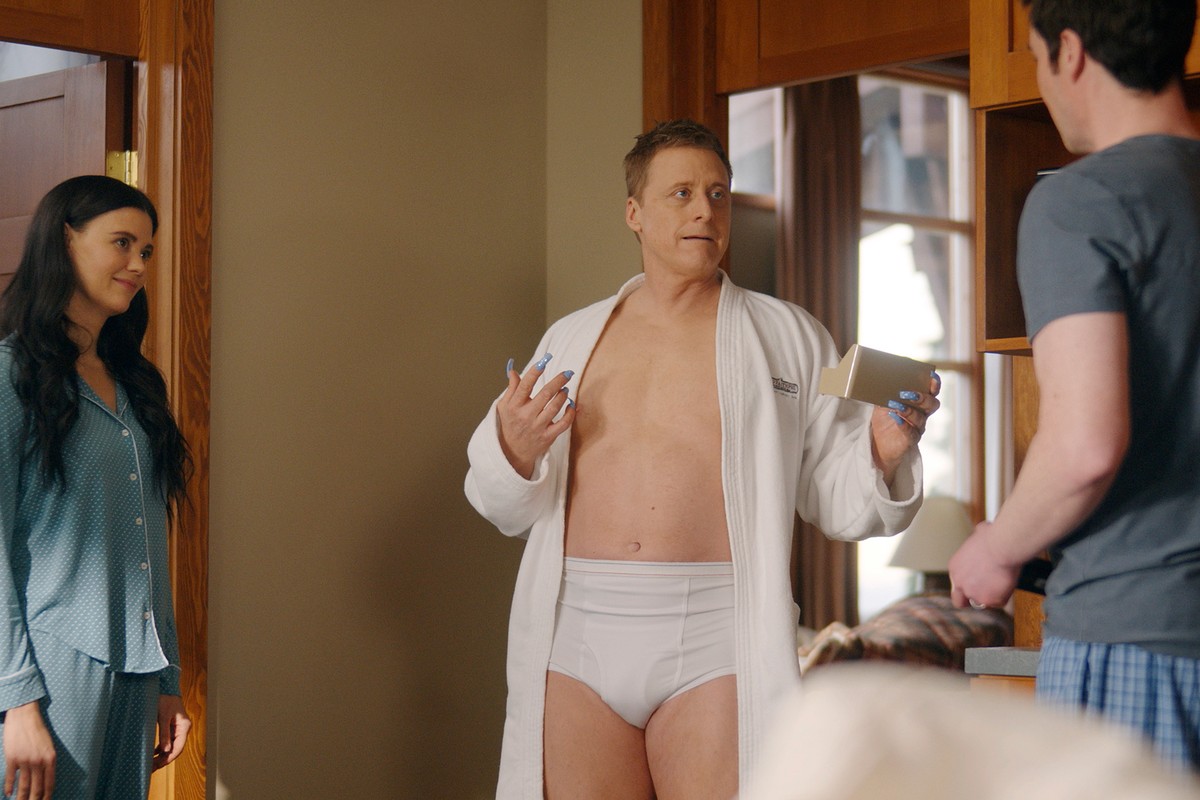

Back in March, I wrote a column about the Netflix Effect, and the boost that non-Netflix shows often get when they arrive on the streaming giant. One of the series I used as an example was Resident Alien, starring Alan Tudyk as an extraterrestrial posing as a Colorado small-town doctor after being stranded by a spaceship crash; I had barely watched it in its primary home on Syfy, only to begin bingeing it once the first two seasons joined the Netflix library. In that column, I observed, “It’s often less exciting when the star’s off-screen, but he’s so good, and works so well with co-stars like Sara Tomko, that I’ve learned to accept some of the more blatantly time-killing subplots about the supporting cast.”
At the time, I was midway through Season Two. Last week, I got fully caught up (Season Three is on Peacock; the first two seasons are on both Netflix and Peacock), and found to my pleasant surprise that I had warmed to nearly everyone in the larger ensemble. Tudyk’s weird, physically specific performance remains the series’ biggest draw by far. But the subplots about everyone else in town no longer feel like padding, and instead have become appealing, even necessary, parts of the larger story, because of a crucial change that largely took place this year: By the end of the third season, every regular character knows that aliens exist and are on Earth, even if not everyone knows that Harry himself is an alien.
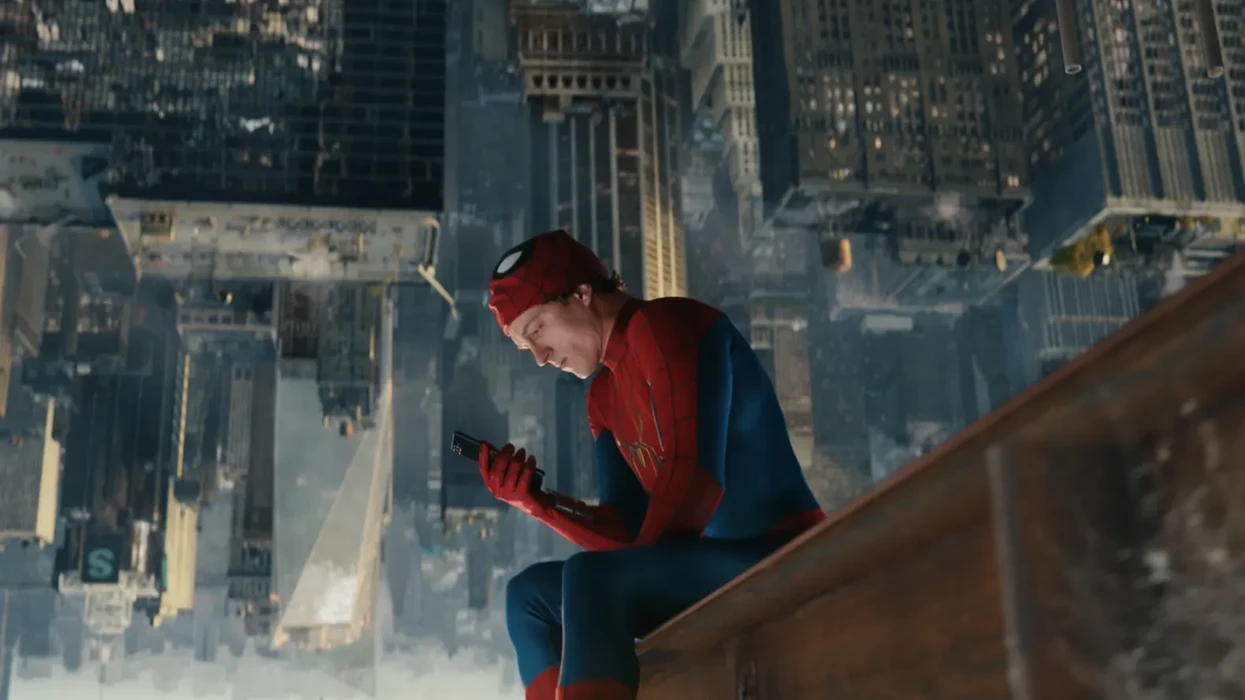
Stories about heroes (even reluctant ones like Harry) with secret identities go back a very long time. The early comic book superheroes kept their real names hidden in part because the writers who created them were influenced by the Scarlet Pimpernel, Zorro, and various masked pulp heroes. It was an effective narrative hook, adding extra layers of suspense, romantic intrigue, and more. At times, the concept could be taken too far — practically every other Superman story from the Fifties was about Lois Lane trying and failing to prove that he was really Clark Kent — but more often than not, it paid huge dividends. So much of what makes Spider-Man a great character, for instance, comes from all the problems Peter Parker has to deal with in both roles simply because he can’t endanger Aunt May by letting the world know the truth.
Lately, though, especially in television, the trope winds up doing more harm than good. When most or all of the supporting characters don’t know the truth about the protagonist(s), one of two things tends to happen: 1)Anyone who doesn’t know becomes unpopular with the audience, often while endangering the hero because, for some contrived reason, they’re oblivious to what the hero really does; or, 2)Those characters are only there to fill time and prevent the lead actors from being worked to exhaustion, and their lack of narrative purpose becomes its own drag on the story.
For a while, the Resident Alien supporting players fit the second category. For most of the first season, the only character who knew that Harry was really a giant green monster — and one who had initially come to Earth as a scout for a mission to save the planet by destroying the human race — was Max (Judith Prehn), a local kid who could somehow see through Harry’s human disguise. The show had a lot of fun pitting Max against Harry, who acts like a spoiled child most of the time anyway, so that worked. And sensible nurse Asta (Tomko) made an entertaining foil for Harry in those early days, as the person who had to deal with him and his eccentric behavior the most, and as the one person who had any ability to curb his worst antics. Every other character seemed at best amusing but inessential, like blowhard Sheriff Mike (Corey Reynolds) and his overlooked deputy Liv (Elizabeth Bowen), at worst annoying distractions, like Max’s bickering parents Ben (Levi Fiehler) and Kate (Meredith Garretson).
Then Harry had to out himself to Asta following an accident where he was badly injured, and her attempts to keep his secret — and convince him to save humanity — became the show’s comic engine, as well as its first big emotional one. But everybody else kept getting in the way: not just inadvertently complicating Harry’s efforts to stop a rival alien race, the Greys, from conquering the planet, but simply stealing focus from the best part of the show. Gradually, though, characters like Asta’s best friend D’arcy (Alice Wetterlund) learned that Harry wasn’t human, while everyone else at least learned that aliens are real. Ben, it turned out, had been taken by the Greys multiple times since he was a kid, and the Greys later stole Ben and Kate’s unborn child, repeatedly abducted Kate to help care for the baby, then wiped her memory each time. Even if no one else can match Tudyk’s comic genius, everyone now feels like part of the same story, and worth following even when Harry’s otherwise occupied.
That first category, where the secret identity means that the sidekicks keep unwittingly getting their friend into trouble, has become pretty widespread at this point, especially since we’ve had so many superhero shows over the last decade. The CW’s Arrow-verse dramas struggled with this a lot, where there was rarely a good reason for the hero to not bring all of their loved ones inside the circle of trust. On The Flash, Barry’s girlfriend Iris didn’t know he was the Fastest Man Alive until late in the first season; not coincidentally, she became a much more interesting part of the show almost immediately after he told her the truth and she could help him in both identities, rather than needing extra assistance because she was out of the loop.
But we’ve also seen this happen on shows that are at most superhero-adjacent, if not super at all. On the ABC thriller Alias, Jennifer Garner played Sydney Bristow, a deadly spy whose best friends Will Tippin (Bradley Cooper) and Francie (Merrin Dungey) thought she worked at a bank. The show wanted Will and Francie to illustrate several of Sydney’s core dilemmas: her wish that she could actually have a boring but safe life as a banker, but also her desire to protect her loved ones at all cost. The issue was that Sydney/Francie scenes could never compete with ones where Sydney ran away from assassins while wearing a multi-colored wig, while Will’s journalist investigation into Sydney’s true employer kept risking both her life and his. Alias creator J.J. Abrams was surprised with how vehemently most of the audience came to dislike Will in those days, and Will was eventually read into the spy half of the show to get viewers on his side. Meanwhile, poor, forgettable Francie got murdered and replaced by a rival agent who had been surgically transformed into her exact lookalike; Dungey’s excitement at finally getting something juicy to play was infectious.
The challenge is that sometimes, there’s a legitimate reason for a secret identity being kept not only from the world, but from the people the protagonist knows best. In the Alias pilot, Sydney tells her boyfriend Danny the truth after they get engaged; her duplicitous employers respond by killing Danny to protect operational security. Showtime’s Dexter, meanwhile, is perhaps the show with the all-time widest quality gap between stories about the main character and stories about anyone else. But it’s hard to make an ongoing series about a serial killer hiding in plain sight if a lot of people know he’s a serial killer. Dexter just did a worse job than its peers in finding things for everyone else to do that wouldn’t make viewers immediately fast-forward to the next scene. (Dexter’s sister Deb, the one second banana who eventually learned the truth without immediately dying, was unsurprisingly the only person on the show other than Dexter in whom the audience had any investment.)
Sometimes, having a loved one learn the truth doesn’t automatically make them more compelling. On the NBC spy comedy Chuck, Chuck’s sister Ellie was, like Will and Francie on Alias, kept around as a representative of the normal life that espionage kept pulling Chuck away from. But even once she belatedly learned the truth — after several other characters, including her husband, found out first — her subplots were still pretty extraneous, and she never quite fit into the spy stories once she knew. But in many other cases, the value a supporting character has in this kind of story is in direct proportion to how much they know about what the story is actually about. (See also Cordelia Chase on Buffy the Vampire Slayer, a clever but somewhat unnecessary mean girl who became one of the show’s more beloved figures once she got a look at real monsters and joined the Scooby Gang.)

In very rare, special instances, a show can make this work over the long haul. Another espionage drama, FX’s The Americans, revolved around Philip and Elizabeth’s roles as deep cover Soviet spies posing as a suburban American couple. Their kids didn’t know, nor did their FBI agent neighbor Stan, who, oblivious to their agenda, became best friends with Philip. Americans managed to treat its premise as a ticking time bomb for practically the entire run of the series. Stan doesn’t seriously suspect Philip until late the last season, and doesn’t know definitively until midway through the series finale, yet the writers ensured that he never seemed like an idiot for not finding out sooner, gave him strong storylines (some tied directly to what Philip was doing, some not), and made sure that the moment of truth was worthy of the very long buildup(*). It helped that there was a safety valve of sorts to relieve some of that pressure: midway through the show, Philip and Elizabeth’s daughter Paige creates some difficulty for them because she doesn’t know they aren’t who she thinks they are, but that’s a set-up for them telling her the truth and attempting to turn her into a Soviet agent herself. Her living with the secret for multiple seasons proves just as tragic as Stan not knowing it until the last time he ever sees his pal.
(*) Breaking Bad also does this effectively with Walter White’s DEA agent brother-in-law Hank, who takes until the final season to figure out that Walt is the meth kingpin he’s been chasing for years; it’s one of many instances of that show being the exception that proves various rules of TV storytelling
In that case, of course, the secret identity was the main point of the whole show, whereas the Flash, Green Arrow, etc., only use it because that trope’s been around since long before anyone writing these characters was born.
(More recently, Netflix’s Bridgerton has had some creative success by keeping most of the ensemble from learning that Penelope Featherington secretly publishes a gossipy society newsletter under the moniker Lady Whistledown. But the audience didn’t find that out until the end of the first season, and Penelope only became a main character in the third, so it hasn’t been a primary source of tension for very long.)
None of this is to say that the heroes of all these shows should stand before the assembled press and reveal themselves to the world like Tony Stark does at the end of Iron Man. (It’s worth noting, though, that the MCU has done just fine not bothering with secret identities, other than a few like Spider-Man, Daredevil, and Ms. Marvel.) But there’s a difference between the world not knowing and the members of a character’s inner circle, whom we watch season after season, not knowing.
I’m reminded of something TV veteran Stephanie Savage told me while I was reporting Welcome to The O.C. We were discussing Oliver, a troublemaking character from the teen drama’s first season. Viewers loathed the Oliver arc, and not necessarily for the reasons that Savage and the other writers assumed they would. The problem, she explained, wasn’t that Oliver was a bad guy. It was that Oliver was obviously a bad guy, yet every character but Ryan couldn’t recognize that he was a bad guy, and refused to believe it even when Ryan offered evidence — and that this phase of the story went on for a while, rather than Ryan convincing his friends within an episode of developing his own suspicions. The audience, Savage realized, doesn’t like to get too far ahead of the characters, and they begin to resent it when bad things happen entirely because the people on screen can’t see what we see.
Maybe Lois Lane was right to spend the better part of a decade attempting to get Clark Kent to admit he was more than just a mild-mannered reporter. She, like people in The O.C. audience with Oliver’s (not particularly masked) villainy, was going mad that everyone else couldn’t recognize what was as plain as the nose on her face. But perhaps she also recognized that a time would come when the idea of Superman keeping this secret from her would outlive its dramatic usefulness.



 David Jonsson and Vivian Oparah in RYE LANEChris Harris/© Searchlight Pictures/Everett Collection

 Sophia Gibber and David JonssonEmma McIntyre/Getty Images

 Tom Holland and
