
Growing up in Brooklyn, John “Divine G” Whitfield was a natural performer. As a Bruce Lee-obsessed teenager, he and a friend would create karate movies, charging 10 cents a pop to view the action-packed films. He grooved on the local television program Soap Factory Disco and enrolled in a High School for Performing Arts in the 1970s. He sang. He DJ’d. He did acrobatics. So when Whitfield was incarcerated for a homicide he didn’t commit in the late 1980s, he intuitively leaned into the arts for an emotional release. In 1996, he became a founding member of Rehabilitation Through the Arts, a theater troupe inside the maximum-security Sing Sing correctional facility 40 miles north of New York City.
“Once you get bitten by the element of creativity, it’s like you become hooked,” Whitfield, 60, tells Rolling Stone. “It’s escapism that’s so soothing and away from all the pain and suffering and despair. Prisons are brutal, especially [in] New York, they have a very draconian system, very draconian. So those moments of escapism are life-saving.”
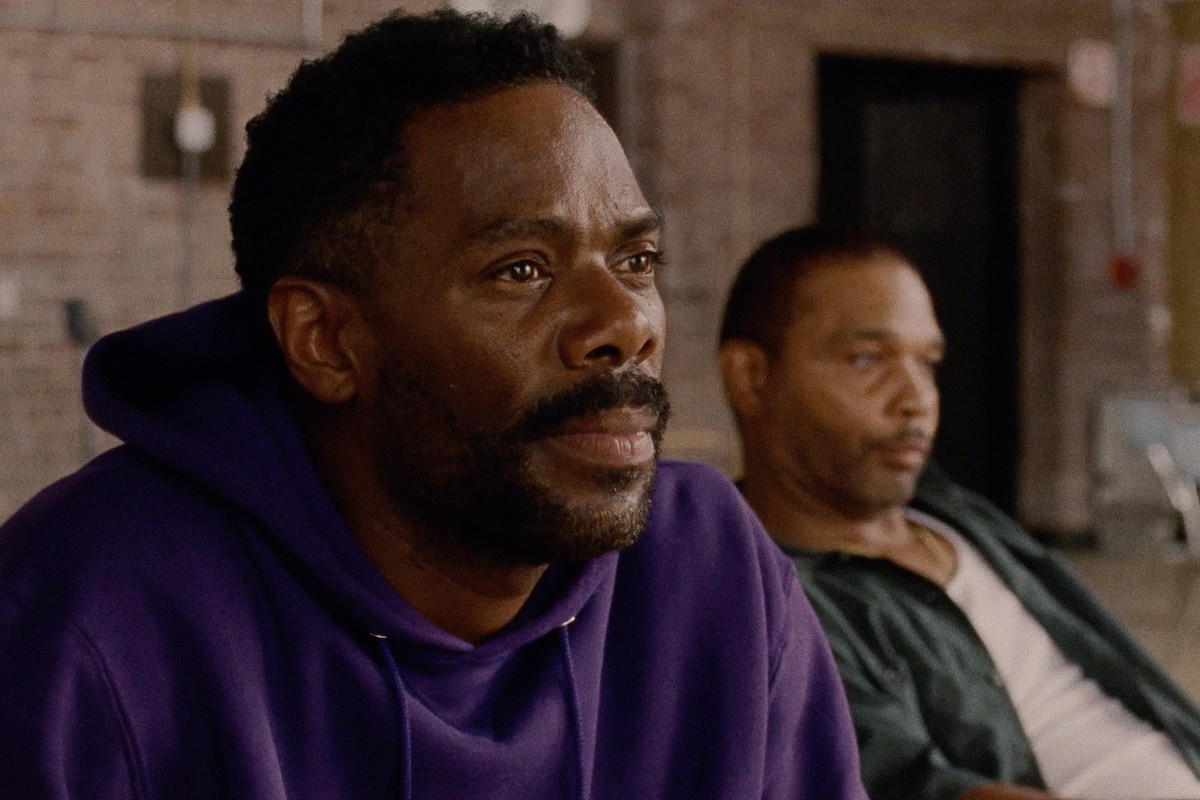
Whitfield and RTA are the beating heart of Sing Sing (releasing nationwide Aug. 2), which examines how the prison’s theater program spiritually liberates incarcerated people from their sentences, even for just a moment, and has helped many rediscover their humanity. RTA has such a powerful impact that the recidivism rate for those who’ve been a part of the program is less than three percent. (In contrast, nationwide, 62 percent of people return to prison after three years of release, according to a report from the Bureau of Justice Statistics.) Whitfield’s Divine G is played by Colman Domingo, but with the exception of co-stars Paul Raci (Sound of Metal) and Sean San José, the majority of the cast — more than 85 percent — is made up of formerly incarcerated men, many who are alums of the RTA program.
The Greg Kwedar-directed film follows the incarcerated theater troupe as they prepare for their next production: a time-traveling musical comedy called Breakin’ the Mummy’s Code, written and directed by real-life RTA coach Brent Buell. A wild tale featuring an Egyptian prince, Western outlaws, deep sea pirates, and Hamlet, the show was first staged at Sing Sing in 2005. Throughout the film, the players run lines in the dining hall, participate in acting drills led by coach Brent (portrayed in the film by Raci), and attend dress rehearsals. While some aspects of the film’s story are fictional, others, like the men referring to each other as “beloved” or tear-filled drama practices, were pulled from real experience. Ultimately, Sing Sing is about how theater has allowed these incarcerated men to dream beyond their life-altering convictions.
Whitfield, who served more than 24 years behind bars, refused to let Sing Sing leave him bitter. During his time there, he wrote several novels and screenplays, and earned his Bachelor’s degree in behavioral science and Master’s degree in theology. “I was like, ‘I’m not going to fall victim to this,’” he says. “‘I’m not gonna let the system further destroy me by me helping destroy myself.’”
Whitfield appears in a cameo in Sing Sing, as an incarcerated person who asks Domingo’s Divine G to sign a book. He also serves as a writer and producer on the film — and is thrilled to have Domingo portraying him. “Ever since Fear the Walking Dead, I just loved Victor Strand [Domingo], I was like, ‘Oh, Victor Strand playing me, that’s a no-brainer,’” he says.
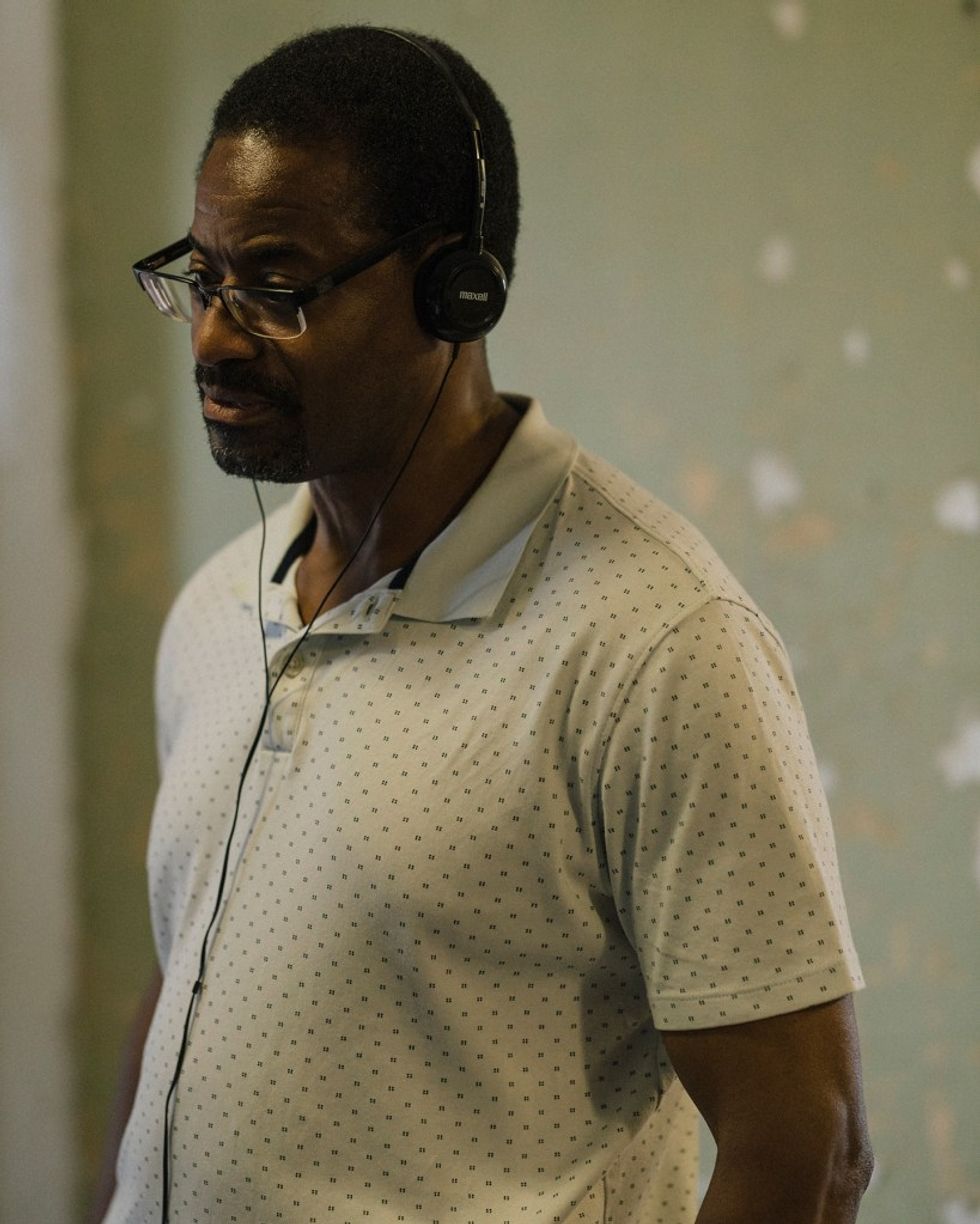
Many of the formerly incarcerated Sing Sing cast members are playing themselves in the film, rather than a fictional character. They may not be professional actors, but the producers implemented a financial model where every cast and crew member, from Domingo on down the line, were paid the same daily and weekly rate. For Kwedar, working with formerly incarcerated men had a profound effect on the production, as well as on him personally.
“Once you see someone’s humanity inside of these cells and behind these walls, it starts to gnaw at your soul,” Kwedar says. “For me, it just felt like I had a moral and personal responsibility as a citizen of this country and this world to lean in, in that moment.”
Prior to conducting initial research on the project in 2016, Kwedar, a 39-year-old filmmaker raised in suburban Fort Worth, Texas, admits that incarcerated people were largely invisible to him. During his research, Kwedar found a 2005 Esquire article that traced the auditions, rehearsals, and compelling performance of Sing Sing’s Breakin’ the Mummy’s Code, which enlightened him on rehabilitation programs within prisons. After reaching out to Buell and grabbing breakfast with Whitfield, Clarence “Divine Eye” Maclin (who appears in Sing Sing as himself), and other Sing Sing alums, Kwedar was even more motivated to hold a mirror up to this theater program thriving in a bleak environment.
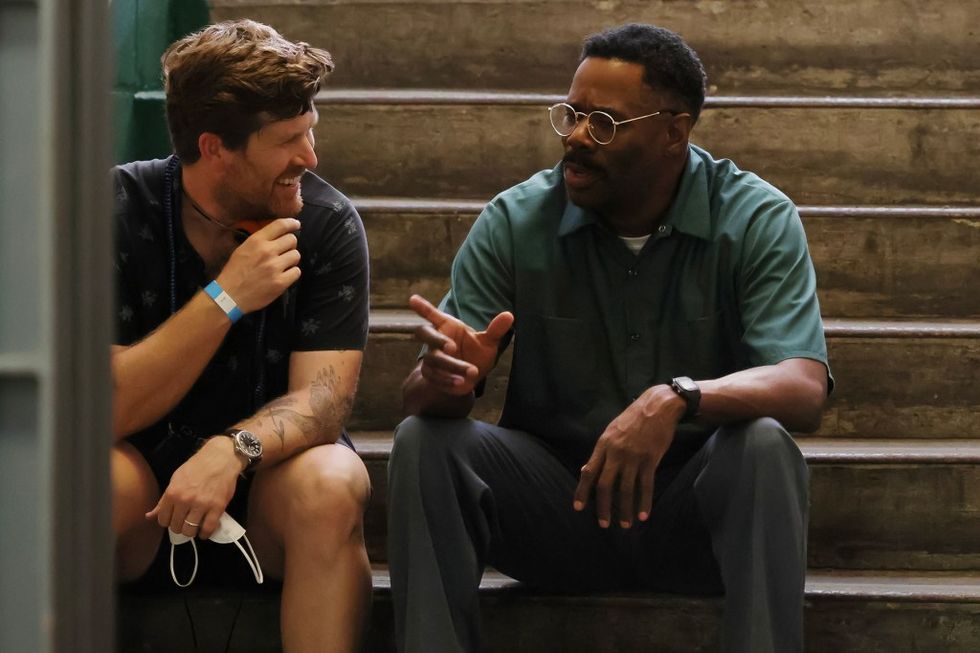
Incarceration “peel[s] away people’s individuality and humanity,” Kwedar says. “Someone becoming a number and not not a name first… These moments of proximity are like electric shocks that can wake you up if you haven’t been personally touched by the system.”
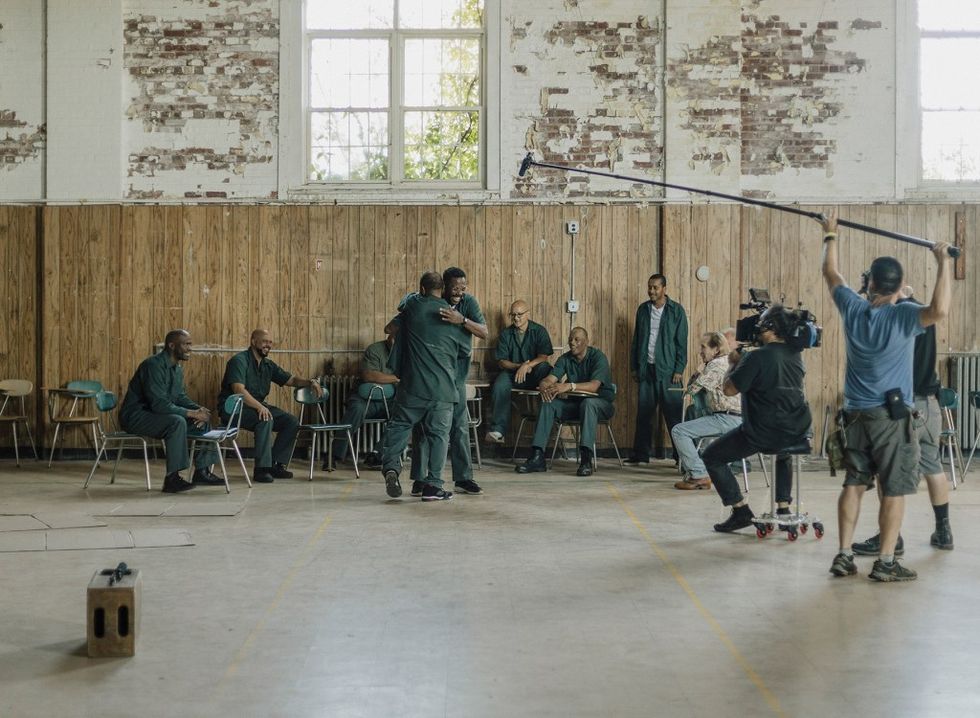
In the summer of 2022, camera crews began taking video of the exteriors of the Sing Sing prison complex. Interior scenes were filmed within a decommissioned prison, Downstate Correctional Facility in the Hudson Valley. (Sing Sing remains a functioning facility, which presented insurmountable logistical challenges to filming, Kwedar says: “Every screw and every little piece of glass on a camera would have to be itemized and accounted for.”) But having so many cast members with that shared history on prison grounds raised one question: Will filming in a correctional facility retraumatize the former population?
For Maclin, who is also a writer and producer on the film, it took some time to adjust. The green prison uniforms were “itchy,” he says. “Putting back on that same garb, that same prison uniform that’s so identifiable, there’s a lot of apprehension,” Maclin says. “However, the purpose of doing what we do, the purpose of the messages that’s in this movie is way more important than any apprehension that any of us could have.”
Maclin served 17 years in Sing Sing for robbery, and appreciates how RTA gave him and others permission to swap their numbered uniforms for a bejeweled gladiator plate, a Hawaiian shirt, or a cowboy hat. The theater troupe was able to create art without limitations: They auditioned for lead roles, practiced vocal warmups, improvised battle scenes, and embraced their emotions. Maclin began as a two-line background character in an RTA production called Stratford’s Decision and later went on to star as Hamlet in Breakin’ the Mummy’s Code, an arc depicted in Sing Sing.
“It seemed like prison was on the other side of the door,” Maclin, 58, says about performing in RTA plays. “In here, we’re free. We’re free to express ourselves, we’re free to communicate. I can get in front of my brothers and cry right now and nobody will judge me.”
Sean “Dino” Johnson, who also appears as himself in Sing Sing, says in the film, “We’re here to become human again and enjoy the things that is not in our reality.” Johnson, a soft-spoken, six-foot-four-inch giant, was a co-founding member of the RTA and describes it as a program that helped him maintain his sanity.
“A lot of us have a mental prison,” Johnson, 59, says. “We’re not incarcerated physically, sometimes we’re mentally incarcerated. And me, finding my freedom beyond a wall with creativity and the arts, that was powerful. The arts taught me how to travel mentally.”
The Sing Sing general population who filled the makeshift auditorium seats in the film also reaped the benefits of their counterparts’ creative expression. Jon-Adrian “JJ” Velazquez, who stars as himself, used to be an audience member. He’s “part of the spirit” of the rehabilitation program, he says, and walked away from performances entertained and informed.
“I don’t want to separate myself from RTA because RTA is in my DNA,” Velazquez, 48, says.
Velazquez, who was granted clemency after serving more than 23 years for a wrongful homicide conviction, had been released for less than a year when he got the call in 2022 to join the production. He admits entering the wardrobe room filled with green prison suits brought flashbacks of the cold showers, buzz cuts, and pocket-emptying he experienced when he first got processed. “I fought for 23 years, seven months, eight days to get out of prison not to come back and put on some greens and act like I was actually living before,” he says.
But this time it was different. As they filmed Sing Sing for four weeks in the unforgiving summer heat, they were reminded that the institution no longer had power over them. They controlled the narrative, just as they did on the RTA stage.
“Acting is all about playing a role, right?” Velazquez says. “So, if our audience can put themselves in our places and realize the reality that’s before them, no matter what they’re going through, no matter what point they’re at in life now, they can change, too. They could turn it all around. We did.”