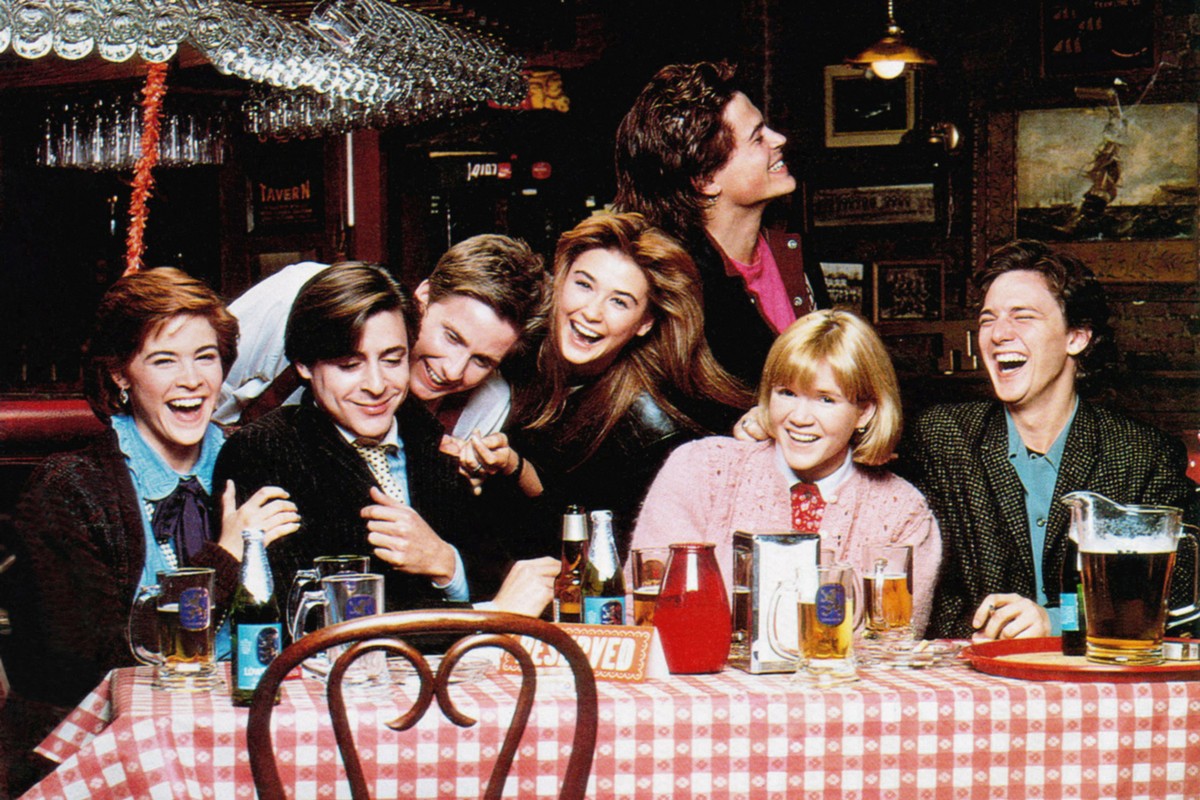

May 1985 was a good moment to be a hot, young actor. You had filmmakers like John Hughes presenting the teen experience in a way that resonated with teen audiences. You had studios who were suddenly happy to make films that catered to this lucrative, 14-to-24 demographic, so work was steady. You had ensemble films like The Breakfast Club, which had just come out the previous February, that provided the perfect showcases for this abundance of under-30 talent. It was not a coincidence that one of the most hotly anticipated movies of the season, St. Elmo’s Fire, happened to feature three of Club‘s cast members, as well as the two stars of the 1983 teen sex comedy Class, and a popular General Hospital actress who was being singled out as the next It girl. With that drama about the agonies and ecstasies of being a modern-day twentysomething scheduled to hit theaters the following month, you felt like you were in for a very, very good summer.
And most of all, you had a peer group to share all this good fortune with, a gaggle of actors that were serious about their craft yet ready to embrace the perks of stardom. There was the sense that the whole world was yours for the taking.
Fast forward to June — specifically, June 10, 1985 — and suddenly, being a hot, young actor didn’t seem quite as magical as it had the previous month. New York Magazine had run a cover story on your friends and fellow co-stars that painted this new generation of movie stars as rich, entitled, hedonistic celebrities who cared about little other than club-hopping their nights away. As if that wasn’t bad enough, the journalist who’d written the piece had given all of you a catchy, pun-heavy handle. He called you guys “The Brat Pack.” The phrase would end up having a lot of staying power. It would also end up being the sort of nickname that quickly turned into a punch line. It felt like a joke, until it didn’t.
Andrew McCarthy only got a fleeting mention in that article, but the sting of it — and his association with such a dismissive, less-than-flattering term — stayed with him for years. “We were labeled in a way that we didn’t want to be labeled,” he says, sitting in a cafe on New York’s Upper West Side. “We sort of instantly had the narrative of our careers taken from us. That’s how it felt, at least. The great irony of ‘the Brat Pack’ is the minute that name became a label, it ended. Because the people who were in it no longer wanted to be associated with it, and the people who making those kinds of ensemble films with young actors no longer wanted to make ‘Brat Pack’ films.
“Some people shook it off and moved on very nicely,” he adds. “Others didn’t.”
McCarthy counted himself among the second group, and for a long time, he felt like the term contributed to his career taking what he considered a downturn. Still, he continued to act, started working behind the camera more and more, and became a prolific travel writer with a few books under his belt. When people began suggesting that McCarthy write about his time in the 1980s spotlight, he immediately said no; why would he want to go back to that painful moment? Then he reconsidered, and in 2021, McCarthy published Brat, a memoir about his association with that era, those beloved movies, and that particular term. “It was, ‘OK, did that. Got through it,'” he recalls. “I thought I was done.”
Having finally come to peace with being a Brat Packer, McCarthy then began to wonder: How did the other reluctant members of this group feel about that period of their lives? A self-admitted loner — “I’m not an actor’s actor, and I can’t think of any close actor friends that I have,” he confesses with a laugh — the Pretty in Pink star suddenly had a yearning to get his old co-stars’ perspectives on the good, the bad, and the ugly of being at the center of a fame supernova. The result is Brats, a documentary (now playing on Hulu) that follows the director-slash-tour guide as he travels across the country, chatting with former cast members, filmmakers, and fans like Malcolm Gladwell about the phenomenon known as the Brat Pack. It’s one part road-movie travelogue, one part bumpy memory-lane stroll and several parts collective catharsis.
“It’s funny, because I’d never talked to anybody within that circle about it, they hadn’t really talked about it [in public] — and we were the ones that experienced it!” he says. “But I turned 60 last year, I had been thinking a lot about that Eugene O’Neill quote about the past being the present and the future too, and… My wife says that people need a community, otherwise we’re all just fucking alone in our heads and are disconnected from reality. I’ve had an evolving relationship with these movies even though they’re decades old, and I suddenly wanted to know what everyone else’s relationship to them was like. I got to write about my journey with this thing. What’s theirs?”
McCarthy pauses, as if he’s lost in thought. “It would have been easy to make a movie about the Brat Pack just being this wonderful thing that people remember,” he says after a few seconds. “But I didn’t want to do a nostalgia piece. I wanted to do something more personal.”
He was also dead set on it being a documentary, because “the Brat Pack really only existed on film. We didn’t exist in real life. I mean, I did feel like there was this exciting generation of actors around my age, and it felt like there was new sense of youth on film being projected back to audiences in a way it hadn’t been before. But it was more of an idea than a real thing. It was like, we all met each other on film — so why not revisit this shared experience on film as well?”
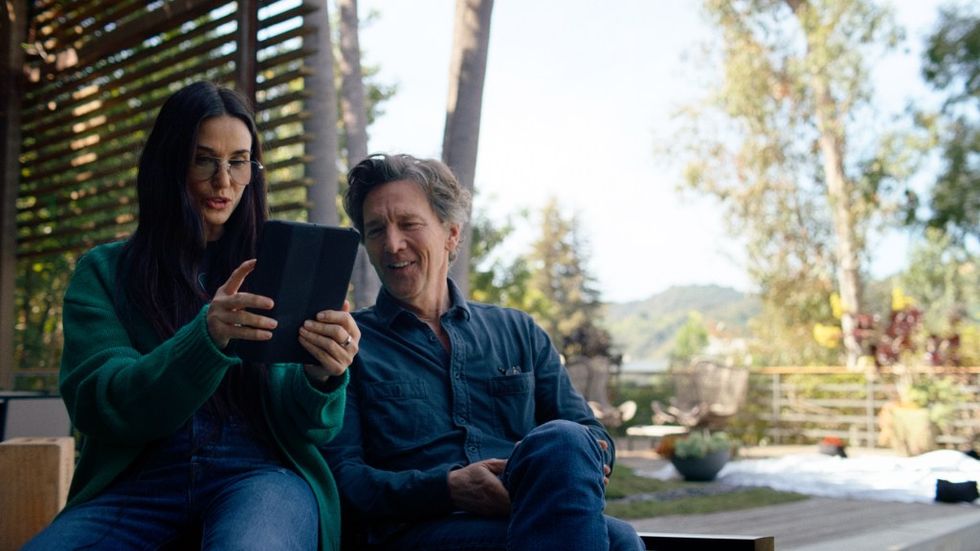
Given the range of conversations that McCarthy manages to capture in Brats, you feel lucky that he had those cameras running. Emilio Estevez talks tentatively about how the label changed the industry’s perception about him; when McCarthy asks him whether he wished it had never happened, the long silence before he answers speaks volumes. (“My editor kept wanting to take that pause out,” the director says, “but I kept saying: Let him sit in it. Let’s see him thinking. That’s the movie.”) Demi Moore, who McCarthy affectionately refers to as “Obi-Wan,” talks about that early brush with superstardom with a Zen-like sense of calm and reflection. Ally Sheedy giggles when McCarthy admits he had a crush on her. Rob Lowe couldn’t be more enthusiastic about reminiscing — he exudes a Chris Traeger-level of giddiness about that bygone moment — and prods McCarthy into recounting the night they ended up at Sammy Davis Jr.’s house. (“The Rat Pack met the Brat Pack!”)
The fact that a few prominent actors associated with the label passed on the opportunity to speak about their individual Pack experience only underlines what McCarthy says was his reason for wanting to make Brats in the first place. “Their absence is showing you something, you know, in a very wonderful way,” he notes. “The very mention of ‘the Brat Pack’ brings up a very broad range of intense emotions, so it’s almost like a proof-of-concept for the film.” When talking to Jon Cryer, McCarthy mentions that their Pretty in Pink costar Molly Ringwald immediately said thank you, but no. Judd Nelson initially agreed to participate, then changed his mind.
“There’s a scene early on where you see me on the phone, and I’m telling the person on the other end, ‘No, don’t tell me now, save it for the camera!'” McCarthy says. “That was Judd calling me back. He said, ‘Yeah, I’d love to get into this’ — and then launched into a 20-minute monologue about what it all meant to him. I kept saying, ‘Stop, stop, I have to get this on film, Judd!’ We kept trying to find a time to make it happen, then he finally called back and said, ‘Yeah, I’m not sure I can do this right now.'” McCarthy does give him the final word, however, by ending on Nelson’s climactic fist raise from The Breakfast Club. “It is, in my mind, the ultimate Brat Pack image. It’s ‘Us!’ power.”
And, in what is perhaps the documentary’s most compelling sequence, McCarthy sits down with David Blum, the journalist who wrote that infamous New York article and coined the Brat Pack term. The director notes that he went into every conversation for the film with “zero expectations and no agendas. This was designed to be an exploration, and I was interested in people’s honest reactions and feelings.” That went double for Blum, he notes, because it would have been too easy to have decades of ill will color their chat. “When I first called him up, he asked, ‘What’s your angle? Are you coming after me?’ And I told him I wasn’t, because I really wanted to hear his side of things. I didn’t want to lead him anywhere. Because I wanted to do exactly what he didn’t do for us. I wanted to see him clearly.”
Still, when Blum begins to complain that a film critic said mean things about him on an episode of Donahue, you can practically see McCarthy’s eyes pop. “I was like, ‘Really, dude? Really?!'” he says. “But I didn’t want to editorialize. It was just, OK, OK. That’s how you’re viewing things here.” When the interview ends, McCarthy wonders aloud if Blum feels, in retrospect, that he could have been a little nicer in his piece. The writer replies, “Eh, sticks and stones.”
“Yeah, that made my jaw drop,” McCarthy admits, laughing. “This is why you keep the camera rolling even when the interview is done. I remember saying to him at one point, ‘Dude, you’re like the fifth Beatle. You can’t escape this either.’ He said, ‘I hope I’m not just remembered for this.’ And it’s like, you sound like the Brat Pack right now! That’s the only time I saw him stung. But it’s true. It’s followed him his whole career, his whole life. He doesn’t know what to do with that legacy either. I thought that was interesting.”
What surprised McCarthy more than Blum’s reaction, however, was his genuine affection for the man who made his life hell with three small words. In fact, the self-described loner who had not talked to some of his Brat Pack brethren in over 30 years was shocked by how much love he felt for all of the folks he once associated with a traumatic time in his life. Writing Brat had been the first step to making peace with moniker and the period. Making Brats and getting to share in others’ personal regrets, remembrances of things past, and re-examinations of their collective Brat-itude took it even further, he says. McCarthy no longer bristles at the term. In fact, he’s beginning to wholeheartedly embrace it.
“For so long, I hated this particular facet of my past, ” McCarthy confesses. “And now I’ve grown to think it’s one of the biggest blessings of my career. The beauty of it — why we’re sitting here right now — is that it’s morphed into this iconically affectionate term that we can go, wow, I’m the avatar of youth for a generation? How did that happen? And then kind of not needing rose-colored glasses to look back and think: That’s actually fucking awesome, you know?”