
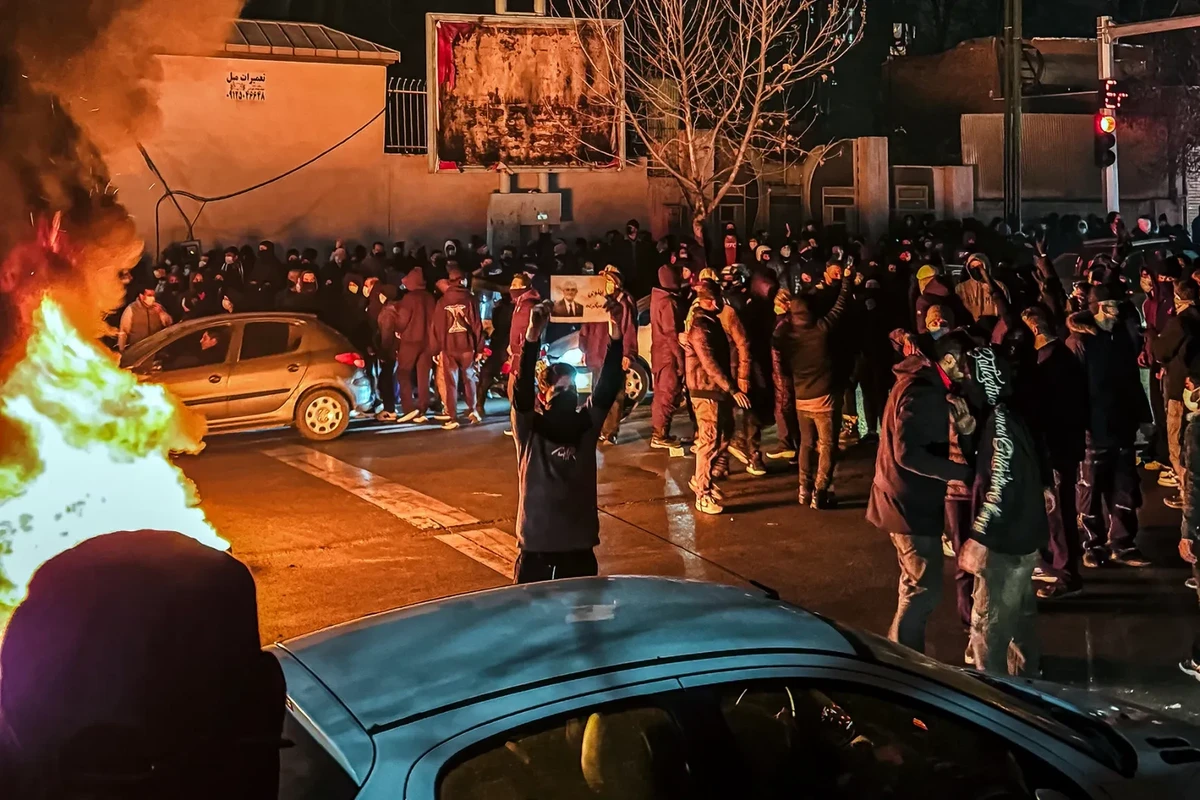

President Donald Trump’s promise that “help is on its way” for anti-government protesters in Iran appears to be increasingly at odds with realities on the ground, and the administration’s desire for an easy foreign policy win — or regime change in Tehran — remains elusive.
As large-scale protests have gained momentum in Iran amid a near-total information blackout, fragmentary evidence indicates the demonstrations have been crushed in a bloody crackdown by Iran’s security forces.
“The low estimate for the number of people killed is 2,000. The high estimate today [Jan. 14] is 15,000,” says Farzan Sabet, a researcher focused on the Middle East at the Global Governance Center, who runs the blog Iran Wonk. “They’re also lining up to do mass executions.”
Amid rumors that American military strikes were imminent, Trump told journalists Wednesday that “We have been informed by very important sources on the other side that the killing has stopped and executions won’t take place,” later adding: “I hope it’s true. Who knows.”
Whether this means the U.S. has ruled out military action for now is unclear. Unpredictability is a feature, not a bug, of this administration’s foreign policy. Trump previously pulled a bait-and-switch on Iran in June last year, promising a week-long window for diplomacy, only to carry out “Operation Midnight Hammer” against the country’s nuclear program hours later.
The protests, which began weeks ago over deteriorating living conditions and economic hardship, grew in size after outside voices endorsed the demonstrations.
On Jan. 6, Reza Pahlavi — the son of the former shah of Iran, who lives in the United States as a dissident-in-exile — released an Instagram post declaring his support for the protests. “Despite the regime’s ongoing violent crackdown, you are resisting, and it is inspiring,” Pahlavi said, calling on demonstrators to gather on the following Thursday and Friday and start chanting at 8pm. “Based on your response, I will announce the next calls to action.”
The video electrified many Iranians.
“I started getting messages, both from people inside Iran and also students who have family who are from Iran, or are here with family. And they were like, ‘Did you see this video? It’s got 15 million views.’ I’m like, ‘OK, I’ll go check it later,’” Sabet tells Rolling Stone. “When I checked later, it was at 80 million views.”
By Thursday, the regime cut internet and phone services across the country. Protesters who had originally been motivated by high inflation were now taking to the streets across Iran chanting “Jâvid Shâh,” or “Long live the Shah,” and “Death to Khamenei,” the most significant direct challenge to the legitimacy of clerical rule in decades.
Trump’s social media post on Jan. 2 promising to take action if protesters were harmed also encouraged turnout. “I think that was a big deal. And his capture of [Venezuelan President Nicolás] Maduro reiterated the credibility of President Trump’s words,” Sabet says.
By the weekend, the regime had unleashed the army, police, and the Islamic Revolutionary Guard Corps (IRGC) — the military branch charged with the protection of Iran’s government — as well as its volunteer paramilitaries, known as Basij.
Handfuls of photos and video clips have leaked out via Starlink satellite-internet terminals or have been hand-carried into neighboring countries. They document heavy and sustained gunfire in city streets, security forces firing on protesters, and rows upon rows of body bags.
“Iranian Patriots, KEEP PROTESTING – TAKE OVER YOUR INSTITUTIONS!!!” Trump wrote on Tuesday, Jan. 13, after thousands had already been killed.
Yet the military assets required for a U.S. intervention aimed at stopping Iran’s security apparatus were simply not available in the area when Trump first made his pledge in early January. There are no carrier strike groups currently within operational distance of Iran, and until early Wednesday there had been no significant build-up of American forces in the region. Open-source researchers observed multiple aerial refuelling aircraft taking to the sky Wednesday, a possible indication of military action.
“Some of the messages I’ve been hearing from Iran is a sense of betrayal by President Trump,” Sabet says. “They thought they were going out there with him behind their backs.”
It is an open question what Washington expects to accomplish with the resources on hand. Administration insiders previously told the press that the White House is considering a range of non-kinetic options, including boosting anti-government media online, attacking Iranian targets with cyberweapons, or increasing sanctions, as well as limited military strikes aimed at critical targets.
The U.S. does maintain a number of fighter aircraft and naval vessels in the region — notably at Al-Udeid Airbase in Qatar and a naval base in Bahrain — which are capable of launching cruise-missile and stand-off munitions strikes. But destroying Iran’s security forces, dismantling its political and military leadership, and bringing down the regime will likely require a significant commitment in military resources.
“It’s not a one-off,” says Victoria Taylor, a former deputy assistant secretary of state for Iraq and Iran. “Any effort to bring the regime down through military force would require what is best described as a sustained campaign.”
It’s not clear whether Trump is willing to commit to such an action.
“One of the challenges within the administration is there are very different camps in terms of a willingness and readiness to use force,” Taylor says. “Clearly, there are hawkish elements within the administration who are ready to pursue a much more muscular foreign policy — I’d count Secretary [of State Marco] Rubio among those. But we also know that there are strong voices in favor of restraint, like Vice President [J.D.] Vance.”
Amid the lack of a clearly articulated goal or strategy for Iran, some experts are skeptical Washington can achieve its desired results.
“There is no violent shortcut to an outcome where the United States and Israel will be happy,” says Ali Vaez, the Iran program director at the International Crisis Group. He observes that while Trump could use non-kinetic options to escalate pressure on the regime, “they won’t check the box of ‘spectacular’ it seems he so often opts for, and might not produce a significant result.”
A series of limited strikes, similar to the airstrikes on Iran’s nuclear program last summer, may give Trump a PR victory. But they are unlikely to destroy the regime or protect the lives of protesters.
“There’s certainly a risk that the lesson learned from Venezuela and from the 12-Day War [when Israel and the U.S. attacked Iran in June 2025] is that U.S. military power is so overwhelming that we are capable of achieving our goals quickly without putting boots on the ground, and without casualties,” Taylor says. “The difficulty in Iran is really that even if the U.S. were able to topple the regime, I am skeptical that we will be able to control the follow-on to a desired outcome.”
Nevertheless, the protests and the crackdown indicate structural weakness in the Iranian regime, which has portrayed the strife as part of a plot coordinated by Israel. But the sheer scale of the protests belies that they are simply the work of foreign agents. Significant protests in the past which began over social or economic grievances have spiraled into direct challenges to the government, known as “the System” in Persian, which is viewed as oppressive and backwards by many young Iranians.
“The regime is able to suppress, but it is not able to address the underlying causes,” Vaez says. “So all it’s doing is buying time until the next round of confrontation with civil society, and these are becoming more frequent and more violent every time.”
Sabet sees the current crisis as part of a much larger pattern, whose threads can be traced back through nearly a decade of internal protests and crackdowns. “The underlying assumption for me is a trend line where people understand that this system can’t meet their needs,” he says.
“Why are people constantly coming into the streets and killing security forces, and getting killed in huge numbers? Why is there a mass murder happening in the streets right now if reform works?” he asks.
The reason that Pahlavi’s post went viral and added fuel to the flames of protest, Sabet says, was revealed in conversations he had with acquaintances: “They were like, ‘Yeah, listen, we didn’t have an alternative before. Here’s an alternative, right?’ At least it’s trying to provide a vision of some kind of a positive future, or hope for the future.”
Still, the influence of Pahlavi — and Trump — is limited.
“Although the stock of the former shah’s son has improved over the past few months, he is by no means universally seen as the opposition leader,” Vaez notes. “And in any case, he doesn’t have any ground organization.”
Sabet adds: “If there’s a year of mass executions and crackdowns, it might be enough to put a stake in Pahlavi’s ambitions.” Still, while it’s hard to see the U.S. bringing down the regime quickly, Sabet says “a few well-considered actions on the cyber and non-kinetic side, or also on the kinetic and military side, could have an enormous effect” in encouraging another cycle of protest. “This situation is so unstable and fluid that nothing would surprise me.”
Vaez simply does not see the U.S. determining the final outcome for the regime that has ruled a country of 92 million people for nearly 60 years.
“This is an Iranian affair. Outsiders are mere bystanders,” he says.
Nevertheless, Trump views his previous military adventures in Iran — the killing of IRGC commander Major General Qasem Soleimani in 2020 and the strike against Tehran’s nuclear program last year — as unequivocal successes, and “bystander” is rarely a role he embraces.


 Sunsara Taylor (right, with Michelle Xai) is a leader and co-founder of Refuse Fascism.Juliana Yamada/Los Angeles Times/Getty Images
 Bob Avakian (pictured in 2014), who founded the Revolutionary Communist Party, has ties to Refuse Racism.Courtesy of The Bob Avakian Institute
 Members of the Revolutionary Communist Party march from the South End to Boston Common during May Day in Boston, May 1, 1980.Tom Landers/The Boston Globe/Getty Images
 Activists with RevComs held the protest near MacArthur Park in December 2024 ahead of President-elect Trump’s planned wave of migrant deportations.Mario Tama/Getty Images
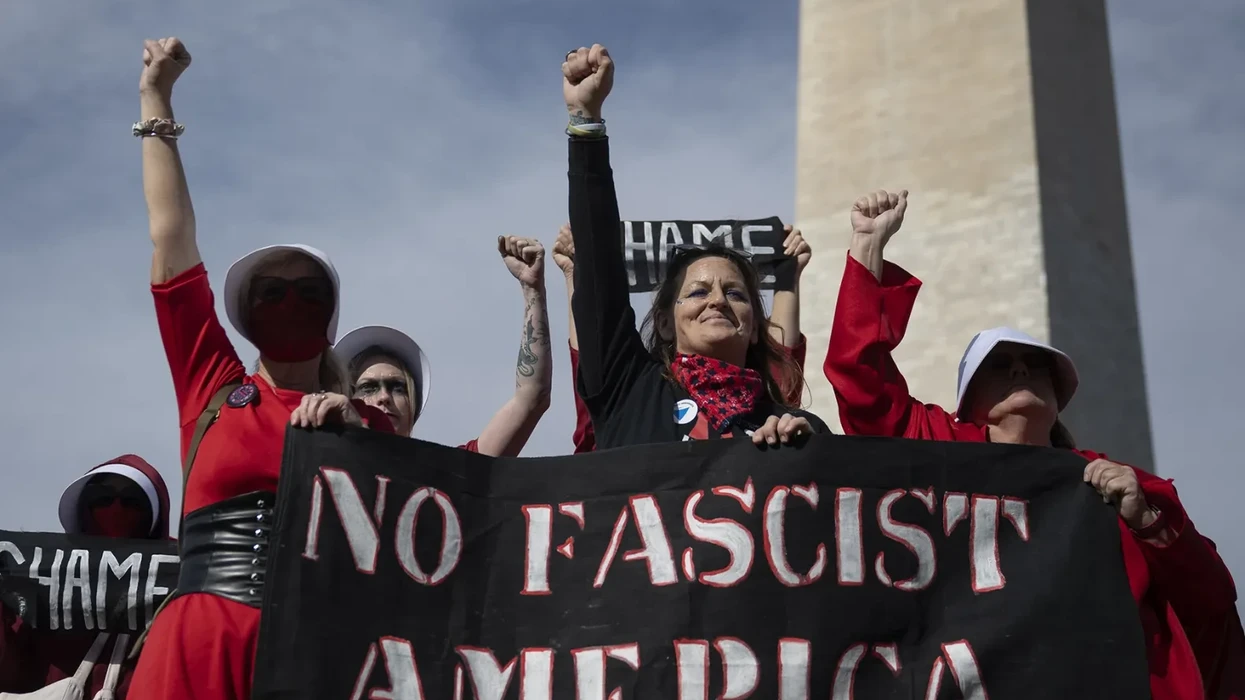
 Refuse Fascism protestors hold a rally around the Washington Monument on November 5, 2025.Celal Gunes/Anadolu/Getty Images

North West Was Born To Be a Star