
This article was produced by Capital & Main in collaboration with Rolling Stone.
“It could be two steps forward or 20 steps back, cautious optimism or completely hopeless.”
The next meeting of the largest annual climate conference in the world takes place in Baku, Azerbaijan, just six days after the U.S. presidential election in November. And organizers of COP29 are already bracing themselves for the election results to either strengthen or doom their efforts.
“It’s very scary,” said a climate adviser involved in the planning of COP29 who asked to remain anonymous because he’s not authorized to speak on behalf of the conference, where global leaders coordinate their efforts to reduce climate-altering greenhouse gas emissions and accelerate the transition to clean energy. “The Trump effect dominates all of our discussions.”
The tightly contested election is still five months away, but Trump is already having an impact on global efforts to combat the climate crisis, congressional action on global warming and clean-energy industry goals for 2025 and beyond.
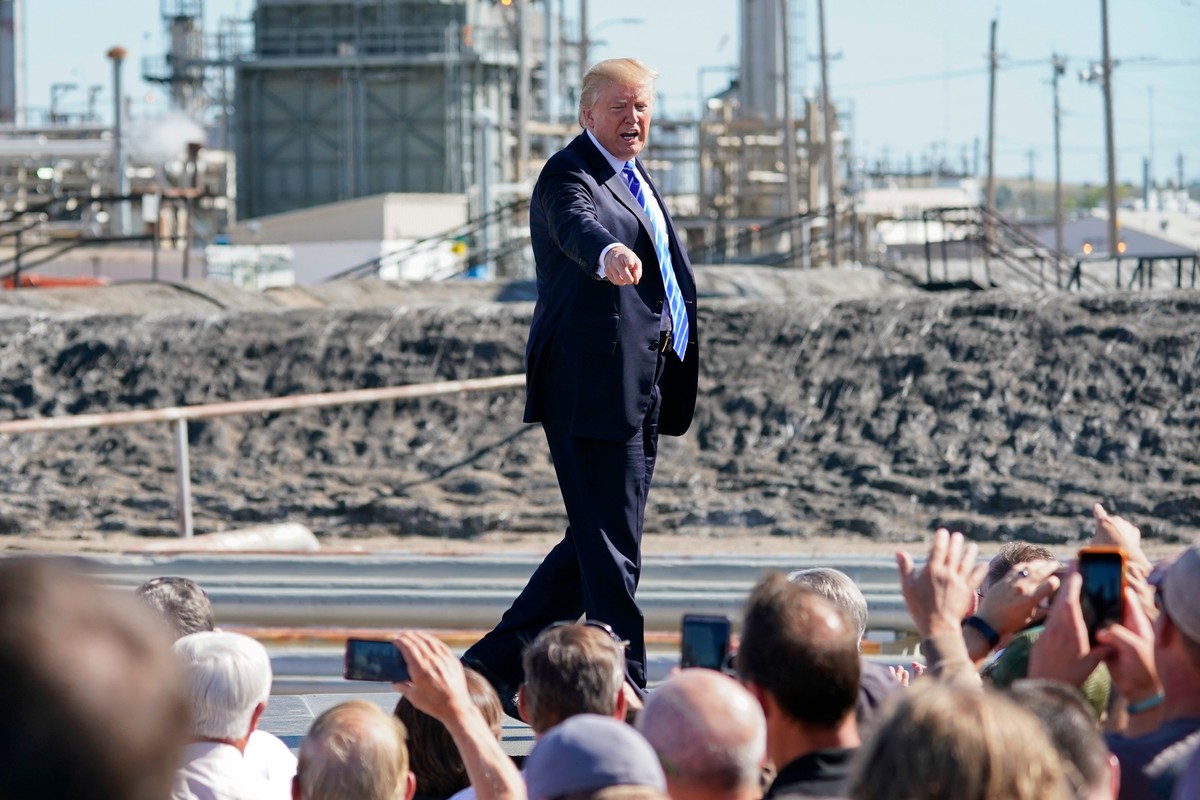
As Trump holds steady in the polls against President Biden, he’s been more outspoken about his intention to boost oil and gas production, strident in his skepticism about climate change and resistant to incentives to boost the use of renewable energy. That’s a major shift from the 2016 election, when climate was rarely discussed during the campaign and his proposals were vague.
Now, Trump is clear in his ambitions to dismantle Biden’s climate initiatives such as the massive Inflation Reduction Act and regulations intended to reduce power plant and vehicle emissions. Those proposals — as well as many more specific and detailed plans to shred climate and environmental policies across the federal government — are included in Project 2025, a blueprint for a second Trump administration crafted by dozens of conservative groups. Among those suggestions: authorizing the Department of the Interior to dramatically increase onshore and offshore oil and gas leasing on public lands, such as the controversial Willow oil drilling project in Alaska; directing the Federal Energy Regulatory Commission to advocate for oil and gas and ignore greenhouse gas emissions when deciding to permit gas pipelines and liquefied natural gas export facilities; eliminating clean-energy programs at the Department of Energy; shrinking the Environmental Protection Agency and freezing its current regulations; and scrapping the annual publication of the National Climate Assessment.
The monumental $22 million initiative, shepherded by the Heritage Foundation, is forthright in its intentions, declaring the government has an “obligation to develop vast oil and gas and coal resources” and emphasizing the need “to end the focus on the climate crisis and green subsidies.”
The details of the project have alarmed scientists, such as Rachel Cleetus, policy director at the Union of Concerned Scientists. “Given the dire needs of the climate crisis, we need to accelerate the momentum of our transition to clean energy,” she told Capital & Main. “What [Project 2025] would do is slow down and delay that transition, undercut the ability to bring down emissions, which is very harmful for the climate and causes a lot of pollution in communities near these facilities.” A spokesperson for the foundation did not return calls for comment from Capital & Main.
Karoline Leavitt, the national spokesperson for the Trump campaign strongly denied that the project has a role in the campaign, telling Capital & Main that “Project 2025 is not connected to the campaign at all,” adding that “unless a message is coming directly from President Trump or an authorized member of his campaign team, no aspect of future presidential staffing or policy announcements should be deemed official.”
In addition, the fossil fuel industry has been drafting ready-to-sign executive orders that aim to boost oil and gas production. The aggressiveness of these efforts — and the brazenness of Trump, who recently told oil and gas executives at a fundraising dinner that he’d trash Biden policies on electric vehicles and wind energy in return for $1 billion in campaign contributions — are alarming environmentalists and galvanizing activists.
Leavitt responded to concerns about Trump’s climate agenda with a statement: “Crooked Joe Biden is controlled by environmental extremists who are trying to implement the most radical energy agenda in history and force Americans to purchase electric vehicles they can’t afford. Biden’s $700 billion dollar so-called ‘Inflation Reduction Act’ contributed to the worst inflation crisis in generations and caused prices to increase 20 percent higher than they were under President Trump. President Trump will cancel Joe Biden’s radical mandates, terminate the Green New Scam, cut costs to reduce inflation, and get our economy booming again.”
Here are the five most consequential potential climate effects of a Trump presidency, according to climate scientists and energy analysts:
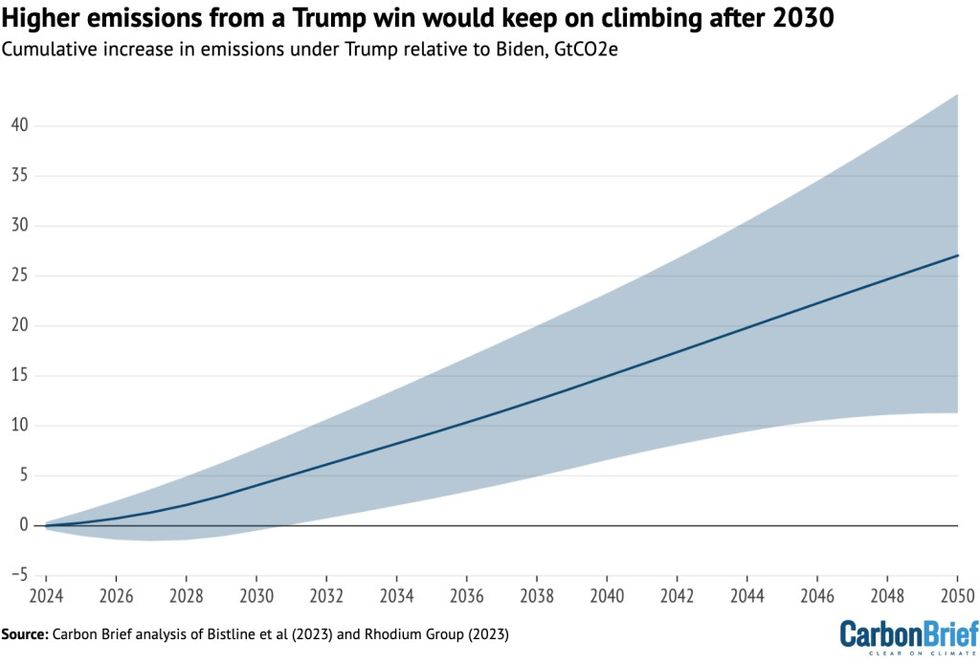
- Adding 4 billion metric tonnes (4.4 billion tons) of greenhouse gas emissions by 2030, compared to Biden’s plans to cut emissions by 50-52 percent, per an analysis by Carbon Brief. The emissions would keep growing even after Trump leaves office, the brief said. That’s equivalent to the combined annual emissions of the EU and Japan and would “negate twice over all of the savings from deploying wind, solar and other clean technologies around the world over the past five years.” The effects on the climate would cost more than $900 billion — via, for example, flood damage, the health impacts of wildfire emissions and property damage from hurricane winds, according to U.S. government valuations cited by Carbon Brief. The changes in policy would also likely lead to more extreme weather. Last year, there were a record-breaking 28 extreme weather disasters from Vermont to Hawaii that each exceeded $1 billion in damage. That increase in emissions from the prospective Trump policies is large enough to impede progress towards global climate goals — which is to keep global warming below 1.5 degrees C (2.7F) above pre-industrial levels.
- Pulling out of the Paris Agreement — again — which would set back efforts to curb global emissions since the U.S. would no longer be required to set targets for cutting emissions and to report on the progress it’s making to hit those targets. Beyond that, Project 2025 proposes to make that exit permanent by getting the U.S. to leave the U.N. Framework Convention on Climate Change, which undergirds the Paris Agreement. “It would completely undermine any U.S. action on climate, signifying to the world an abdication of American leadership, which in turn would adversely impact the global effort to reduce carbon emissions and avert catastrophic warming of the planet,” said Michael Mann, professor of Earth and environmental science at the University of Pennsylvania.
- Net zero becoming out of reach: The U.S. is the second-biggest emitter of greenhouse gases behind China. And reduced policy support for renewable energy will extend the lifespan of fossil fuel, pushing back its projected peak demand by at least 10 years, and slowing the investment pathway for clean energy. As a result, such a delayed transition scenario won’t hit the “pace required to reach net zero by 2050,” per an analysis by Wood Mackenzie.
- Dramatically reducing low-carbon energy investments: Trump proposals to reverse initiatives such as the Inflation Reduction Act and Infrastructure Act could jeopardize $1 trillion in low-carbon energy investments, which are currently projected to total about $7.7 trillion between 2030 and 2050 under current policies, according to another Wood Mackenzie analysis. In addition, weaker emissions rules and fuel economy standards would reduce investment in electric vehicles — cutting in half the total stock of EVs by 2050.
- Extra deaths: Rolling back environmental regulations to protect air and water will almost certainly result in more pollution. In his first term, Trump cut more than 100 environmental rules — including 30 air pollution and emission rules, 12 drilling and extraction rules and eight water pollution rules. Those decisions resulted in more than 22,000 extra deaths in 2019 alone, due to worse air pollution, according to the Lancet Commission on Public Policy and Health in the Trump Era.
The prospect of a second Trump term — and a second U.S. pullout from the Paris Accords — spooked representatives from 200 countries attending the recent Bonn Climate Change Conference in Germany. They made little progress on reaching a deal to finance climate action in developing countries due to uncertainty over whether the U.S. would contribute funds in the future.
“Many of us worry that if there’s a change of government, if parties are elected that are against climate action, if the U.S. has the same problem with Trump as in 2016, we’re in trouble,” a negotiator told Politico. “But time is running out and we’re still not discussing real issues.”
Out of concern for a Trump victory in November, Democrats in Congress added a provision to the Inflation Reduction Act that establishes a $27 billion Greenhouse Gas Reduction Fund that the Environmental Protection Agency must spend by Sept. 30, four months before Trump would take office again and potentially undo major parts of Biden’s initiative.
And given Trump’s outspoken disdain for wind energy, industry leaders are bracing for the prospect that a new Trump administration would slow down permitting of new projects or even retroactively seek to pull back approvals for current ones.
Such a pullback “would be devastating,” said Mann, the University of Pennsylvania professor. “Fossil fuel interests, plutocrats and the front groups they fund are already working to undermine implementation of the [Inflation Reduction Act] climate provisions, and with the wind in their sails from a Trump victory, they would likely be successful in that effort.”