
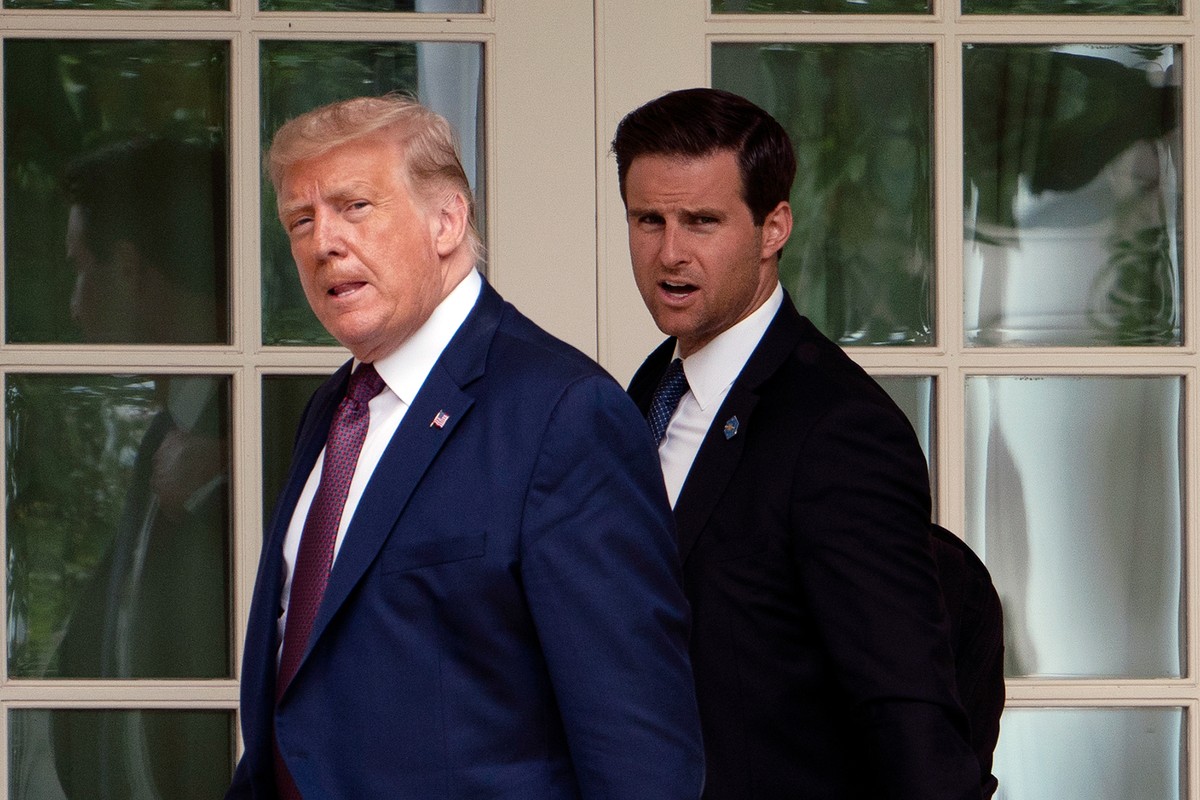
John McEntee flashes a thin-lipped smile at the camera, waving around a stack of bills he pulled from the center console of his car. “I always keep this fake Hollywood money in my car, so when a homeless person asks for money then I give them a fake $5 bill,” he tells TikTok. “So I feel good about myself, they feel good — and then when they go to use it they get arrested. So I’m actually helping clean up the community, you know, getting them off the streets.”
The video, posted to the TikTok account of the dating app The Right Stuff, drew widespread outrage, not only because it could be a crime if he was really handing out counterfeit money, but also because it’s the kind of thing you expect to hear in an interview with Tucker Carlson, the depths of 4chan, or in the replies to Elon Musk’s recent posts — not from a dating app.
“Just a joke. Everyone calm down,” McEntee — who co-founded the app in 2022 after serving as an aide in the Trump administration — wrote in the caption.
@daterightstuff Just a joke. Everyone calm down #fyp
The Right Stuff is not a typical dating app. It’s a gimmicky right-wing alternative to popular dating apps like Tinder and Bumble that promises conservatives a way to “connect in meaningful and authentic ways.” The app itself has had issues since its Peter Thiel-funded launch in 2022 — including a preponderance of trolls, a lack of female users, and the FBI allegedly using it to track Jan. 6 rioters who bragged about their participation on their profile.
What hasn’t flopped is The Right Stuff’s TikTok account, which — in contrast to other dating apps’ marketing strategy — does not feature a variety of couples or jokes about the horrors of modern courtship, but a single 34-year-old man smugly spouting all manner of reactionary right-wing platitudes. McEntee has the vibe of a guy who hasn’t quite gotten over his frat-boy days, typically sporting an orange tan, pullover hoodie, and a shit-eating grin, as he eats a plate of food. The content is sometimes simple cringey culture-war commentary, but the videos often veer into outright racism and stereotyping.
“Why do we only judge white people for owning slaves when every culture had them?” he muses while inhaling a burger in one video. “I was watching TV the other day — which I usually don’t do — and I noticed something with the commercials. When did everyone in America become Black and gay?” he says in another.
The account has over 2.3 million followers. The videos regularly garner millions of views, and some have brought in over 20 million. The video joking about cruelty to the homeless has been seen 7 million times.
McEntee has other prospects if his foray into the digital dating market doesn’t pan out. Just as The Right Stuff is not a typical dating app, McEntee was not a typical Trump administration aide. In fact, if the next several months go a certain way, he could be in serious contention to become one of the most influential players in the U.S. government over the next four years.
Seriously.
Multiple people close to Donald Trump or who worked in his administration say that it is highly likely that McEntee — who remains in the former president’s good graces — would have a standing job offer from Trump for a very senior role, if there is indeed a second Trump administration in 2025. The sources cite Trump’s continued affection for McEntee in recent years, Trump privately voicing support for bringing McEntee and other uber-loyalists back into government, and the former president’s enthusiasm for purging various sectors of American power in a possible second term in office — which is seen as McEntee’s speciality.
A former senior Trump administration official tells Rolling Stone that within the past two years, Trump has said of McEntee: “There’s nobody better at that,” referring to the commitment of his closest loyalists to going after what he calls anti-Trump subversives in the federal apparatus.
According to another source who has discussed the matter directly with Trump during his post-presidency, the former president has repeatedly expressed interest in casting in a role similar to what McEntee had during the final year of the administration as head of the White House personnel office. The source describes this potential role for McEntee as being the chief enforcer for “MAGA purity” in the different departments and agencies of the executive branch.
For McEntee, it would be the ultimate comeback. He was ousted from his position at the White House in 2018 after a security clearance check revealed significant problems related to his online gambling habits. According to The Atlantic, before his sudden departure, McEntee’s office had resembled a melding of “the Rockettes and the Dungeons & Dragons group,” with McEntee having developed a habit of hiring young, attractive women, and decidedly less attractive men.
After a two-year absence, he was rehired by Trump in 2020 to serve as a senior adviser to the reelection campaign. That year, McEntee gained a widespread reputation in the administration for his mission to purge the federal government of officials deemed insufficiently faithful to Trump. McEntee — or “Johnny,” as he’s affectionately called by some members of the Trump family and other former aides — is well-known among the MAGA elite as being the truest kind of Trump true-believer. In late 2020, even after it was clear that Trump had lost the presidential race to Joe Biden, McEntee and his office were still actively vetting candidates for Trump administration job openings for 2021.
Ahead of the Jan. 6 Capitol riot, McEntee issued a memo to the chief of staff for then-Vice President Mike Pence outlining his dubious reasoning for how Pence could overturn the election on behalf of Trump. In the memo, McEntee argued that Thomas Jefferson had used his vice presidential powers to secure the presidency, and that the VP had “at a minimum, a substantial discretion to address issues with the electoral process.”
In the aftermath of Trump’s departure from the White House, McEntee continued playing both formal and informal roles in shaping what a second Trump administration’s personnel makeup could very well look like, including in his senior adviser position with the Heritage Foundation-run Project 2025.
Project 2025 is a sweeping policy plan described by the right-wing group as “the conservative movement’s unified effort to be ready for the next conservative administration to govern at 12:00 noon, January 20, 2025.” The plan includes such proposals as more hardline, national restrictions on access to abortion; attacks against contraception; the elimination of diversity and equity programs; the militarization of immigration enforcement; the effective privatization of Medicare; and a purge of federal agencies.
Last year, upon announcing that McEntee would be joining the project, the Heritage Foundation touted that his appointment would embrace “the motto that ‘personnel is policy,’” and the project would launch a “database to collect résumés and vet thousands of potential applicants in advance of Jan. 20, 2025, when the next president takes office.”
McEntee expressed his excitement to “bring thousands of vetted, trained conservatives from across the country to Washington,” in a statement announcing his new position.
He seems to be well-positioned to join a prospective second term. In responding to questions from Rolling Stone, he hedged regarding whether he was engaged in discussions with the former president’s team, or if he plans to accept a prospective appointment.
“Totally focused on The Right Stuff,” he wrote.




President Donald Trump discussing Venezuela at a press conference at Mar-a-Lago.
Why Venezuela Could Be a Turning Point in Gen Z’s Support for Trump
When Donald Trump called himself “the peace president” during his 2024 campaign, it was not just a slogan that my fellow Gen Z men and I took seriously, but also a promise we took personally. For a generation raised in the shadow of endless wars in Iraq and Afghanistan, it felt reassuring. It told us there was a new Republican Party that had learned from its failures and wouldn’t ask our generation to fight another war for regime change. That belief stood strong until the U.S. overthrew Venezuelan President Nicolás Maduro.
Growing up in the long wake of the wars in Iraq in Afghanistan shaped how my generation learned to see Republicans. For us, “traditional” Republican foreign policy became synonymous with unnecessary conflicts that caused young people to bear the consequences. We heard how Iraq was sold to the public as a necessary war to destroy weapons of mass destruction, only to become a long conflict that defined the early adulthood of many millennials. Many of us grew up watching older siblings come home from deployments changed, and hearing teachers and coaches talk about friends who never fully came back. By the time we were old enough to pay attention, distrust of Bush-era Republicans wasn’t ideological, it was inherited from what we had heard.
As the 2024 election was rolling around, that dynamic had flipped. After watching wars in Ukraine and Gaza dominate headlines while Joe Biden was president, the Democrats were now the warmongers. My friends constantly told me how a vote for Kamala Harris was a vote to go to war. On the other hand, Donald Trump and the Republicans were the ones my friends thought could keep us safe. “I’m not voting for Trump because I love him,” one friend told me. “I’m voting for him because he cares about us and I don’t want to go fight in a stupid war.” For many of my friends, much of their vote came down to one question: Who was less likely to send us to fight? The answer to them was pretty clear.
Fast forward to now, and Venezuela has begun to complicate that belief. Even without talk of a draft or a formal declaration of war, the renewed focus on U.S. involvement and troops on the ground has brought back the same language of escalation my generation was taught to distrust. Young men online have been voicing the same worries, concerned that the ousting of Maduro mirrors the early stages of wars they were raised to fear. When I asked a friend what he thought about Venezuela, he shared that same sentiment. “This is how all these wars always start,” he told me. “They might try to make it sound like it’s not actually a war, but people our age always end up being the ones that pay the price for it.” For young men who supported Trump because they believed he represented a break from interventionist politics, Venezuela blurs the line between the “new” Republican Party they thought they were backing and the old one they were raised to reject.
For many young men, Venezuela has become a major part of a broader shift of how they view Trump. A recent poll from Speaking with American Men (SAM) found that Trump’s approval rating has fallen 10 percent among young men, with only 27 percent agreeing with the statement that Trump is “delivering for you”.
Gen Z men’s support of Trump was never about ideology or party loyalty, it was about the idea that he had their back and would fight for them. But that’s no longer the case. Recently, Trump proposed adding $500 billion to the military budget. Ideas like that will only hurt the president with young men. My friends don’t want more military spending that could get us entangled in foreign wars; they want a president who keeps them home and fights for their economic and social needs. As Trump pushes for a bigger military and more intervention abroad, the promise that once made him feel like a protector of young men now feels out of reach.
For my generation, Venezuela isn’t just another foreign policy dispute, it’s a conflict many young men worry they could be the ones sent to fight. Gen Z men didn’t support Trump because he was a Republican, but because they believed he was different from the old Republicans. He would be a president who would have their back, fight for their interests and keep them from fighting unnecessary wars. Now, that promise feels fragile, and the fear of being the ones asked to face the consequences has returned. For a generation raised on the effects of the wars in Iraq and Afghanistan, the idea of another war isn’t abstract, it’s personal.