
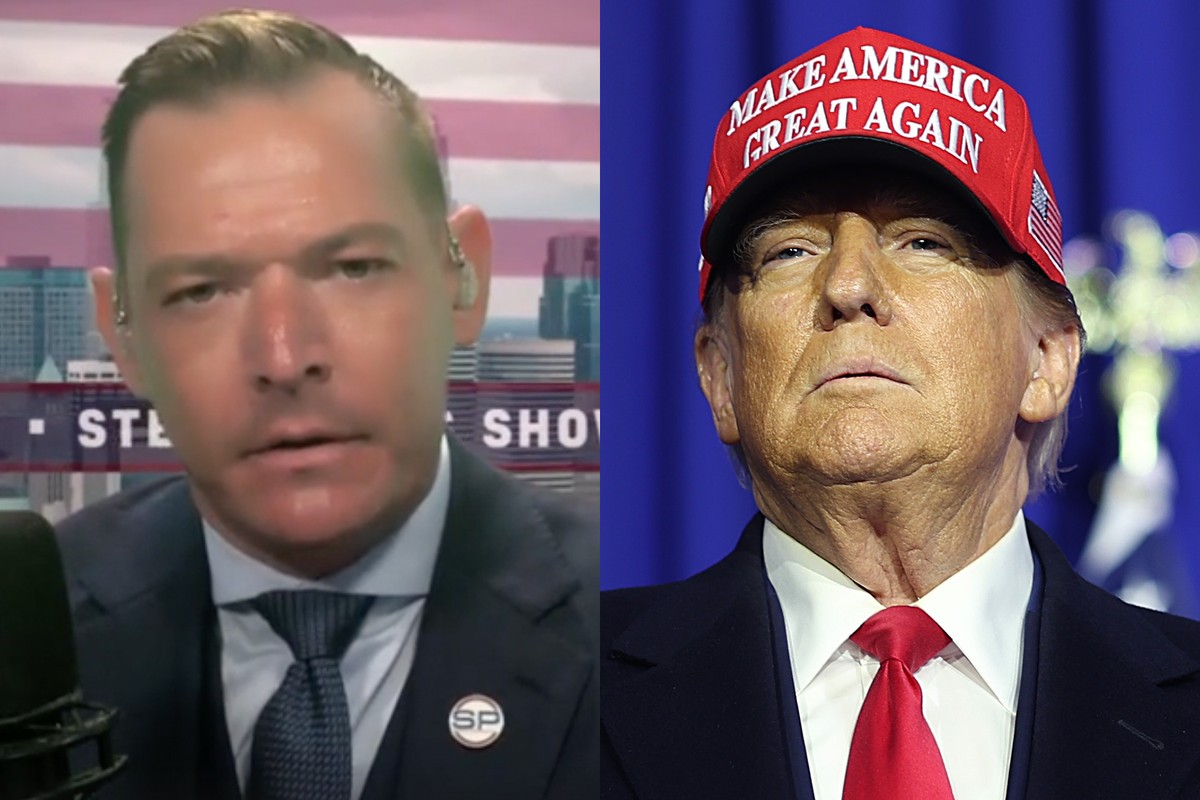

Former President Donald Trump’s campaign is running online advertising to raise cash for 2024 — and a portion of that ad spending is monetizing pro-Nazi content on the streaming service Rumble, Rolling Stone has observed.
In a short video ad that plays before select videos on Rumble, Trump makes a pitch to the MAGA masses to help him counter “crooked Joe Biden” by donating to his 2024 campaign: “I am very humbly asking if you could chip in $5, $10, or even $25.” Trump vows that donors will help him “win back the White House” and “make America great again, greater than ever before, I promise you that.”
On Monday, Trump ads were being served up at the beginning of a new Rumble video by the reactionary broadcaster Stew Peters. In that video, Peters touts Adolf Hitler as “a hero” for the horrific Nazi book burnings of the 1930s, calling the violent display of cultural erasure “awesome.” Peters even advocates a modern reenactment of the fiery Nazi spectacle, seeking retribution against what he falsely paints as a Jewish-led conspiracy to “make us surrender” to LGBTQ acceptance and sexual “degeneracy.”
It should be shocking for any American presidential candidate’s advertising to appear alongside pro-Nazi content. Yet in the context of the 2024 campaign, there are few surprises when it comes to open fascism. Trump has in recent months echoed Hitler himself by claiming immigrants are “poisoning the blood” of America, and polls show such fascist rhetoric has been avidly received by MAGA supporters.
Peters, likewise, has been undergoing a steep slide into fascism. A failed rapper and former bounty hunter, he found success in far-right media, particularly on Rumble, where The Stew Peters Network has more than 500,000 followers. But what began as Peters promoting dark conspiracy theories about the Covid-19 vaccine soon morphed into calls for Anthony Fauci and Hunter Biden to be hanged. In response to the Israel-Gaza war, Peters began spouting anti-Zionism, mixed with far uglier antisemitism. He soon dropped any pretext by hosting Holocaust denier Nick Fuentes on his show to “expose international Jewry,” as well as by platforrming the neo-Nazi leader of the “Goyim Defense League.”
Why are Trump campaign ads monetizing Peters’ explicitly pro-Nazi content? The campaign lays responsibility for placement of the advertising with Rumble. A spokesperson for the Trump campaign tells Rolling Stone: “We aren’t picking any particular video or channel to run ads on, and we are not given visibility into every single ad that is served during every video. Rumble is ultimately responsible for the ads that are served on any given video on their platform.”
The Trump advertising links out to a landing page seeking donations that benefit the Trump Save America joint fundraising committee. The fundraising arm benefits both Trump’s official 2024 campaign and Save America, his “leadership PAC,” which is helping pay off the former president’s astonishing array of legal bills. The URL for the donation page includes the words “generic,” ”rumble,” and “video,” lending credence to a lack of targeting.
Rumble touts its streaming service as an “unapologetically free-speech platform” that is “content neutral” and “designed to be immune to cancel culture.” The company’s early investors include J.D. Vance, now a GOP senator from Ohio, who is said to be in the mix for Trump’s 2024 running mate. As a YouTube alternative popular with far-right and cultural-outcast creators, Rumble hosts controversial figures including Andrew Tate and Russell Brand. Last year, it suffered a public flight of advertisers who chose not to be associated with such content.
Rumble did not respond to multiple emails from Rolling Stone about whether the platform has guardrails to avoid placing a presidential campaign ads against pro-Hitler content, or whether individual advertisers can choose to block certain content or creators.
In an FAQ for Rumble investors, the company says it offers both “programmatic and non-programmatic” advertising — that is, advertising placed by computer algorithm and not. The Trump campaign statement refers to its use of “run of network inventory” — a term of art for untargeted, computer allocated advertising — meaning its ads “appear on any video the algorithm serves.” The Trump campaign did not answer questions about whether it has any concerns about its advertising relationship with Rumble or qualms about helping Peters monetize his pro-Nazi views.
In the March 8 video where the Trump campaign ads appeared, Peters leaped over the fascist line he’s been towing, and landed squarely in pro-Nazi territory. The title of Peters’ video is chockablock with buzzwords that a responsible advertiser might choose to avoid: “America TRANSforms Into Weimar 2.0: Nazi’s BURNED LGBT Propaganda To Cleanse Germany.”
During the broadcast, Peters blasts the “Weimar conditions” in the contemporary United States and insists they must be met by “Weimar solutions.” Weimar is a reference to the German Weimar Republic that was overthrown by the Nazis. Peters praises the horrific Nazi campaign of book burning that was enacted shortly after Hitler came to power, calling it “one of the first remedies that Hitler and the National Socialists had to offer” to what Peters described as a Weimar era of “complete and total degeneracy” and “sexual perversion,” which had been encouraged, he claimed, by a government and culture “ruled” by Jews.
In Peters’ twisted telling of this dark history, Nazis across Germany united to “storm perverted libraries, perverted bookstores, and burn all of their transgender manuals, all of their porn, all of their disgusting literature on leading homosexual lifestyles.” (The Nazis infamously also burned books by Bertolt Brecht, Ernest Hemingway, Sigmund Freud, and Hellen Keller.) Peters said the Nazis “did exactly what reasonable people would do if given the opportunity,” and insisted of the book burning: “It was justified. It was great. It was awesome. Period. Point blank.”
Peters used his show to voice denial about the Holocaust — claiming war “propaganda” made it impossible for him to know if Hitler was really “a ruthless person that murdered millions” — before returning to the book burning campaign. Peters asked of the Nazi leader, “Wasn’t he a hero?” for enacting it, elaborating: “Wasn’t Hitler doing the right thing when he ordered these books to be burned and these places to be stormed by force?”
Leaving no doubt about his own dark agenda, Peters called for a modern reenactment. “I want to see people on horseback storming the school libraries and collecting these books — and the people who push them,” he said, adding that the bonfires would serve as “a public societal cleansing ceremony.” But Peters does not want to stop with spectacle: “We will burn their books, we’ll burn their ideas to the ground. And then we’ll put them on trial, and they’ll be held accountable for their assault on humanity, and the rape and murder of childhood innocence. No quarter for parasites. Maximum accountability. Extreme accountability is the only remedy here. Kill it with fire.”
(Full disclosure: Peters has previously called on this reporter to be publicly hanged — after a trial for “mass psyops” — as part of his agenda for “extreme accountability.”)
Rumble’s terms of service supposedly prohibit creators from posting content that is “abusive, inciting violence, harassing, harmful, hateful, antisemitic, racist or threatening.” It’s unclear how much Peters makes from his Rumble broadcasts, or if monetization of his videos has ever been in jeopardy. Peters is currently preparing to launch a new show called Uncancelable.
The evening after this article was published, Peters posted a show segment titled “Rolling Stone TARGETS Stew Over Weimar TRUTH.” Peters doubled down on his description of Nazi book burning as a “heroic act,” but he added: “That’s not to say that Hitler was a hero; that’s not to say Hitler and his cronies didn’t do bad things. Of course they did. Everyone did. It was a war!” (Peters also insisted that media “vultures” like Rolling Stone are “in league with Satan.”) In a quote provided to Rolling Stone, Peters continued to advocate modern-day book burning: “If you’re like Rolling Stone and you’re NOT advocating for the mass burning of perverted, pedophilic and/or pornographic content, you are COMPLICIT in child sexual exploitation.”
Rumble is hardly alone in keeping Peters’ content in circulation. He is active on Telegram. Despite a vow by X execs to stamp out antisemitism, Peters posts and streams regularly at Elon Musk’s platform. He even has an Instagram channel that is brimming with antisemitic content.
Ironically, while Trump ads run against his show, Peters does not take a kind view of the former president, whom he claims “bows to his Zionist masters.” In recent days Peters has been posting memes of Trump mugging with a menorah and a cartoon of Trump pulling apart his shirt to reveal a Star of David where a Superman ‘S’ might go. In a caption to the cartoon, Peters writes of Trump: “America FIRST… after Israel of course. 
 .”
.”
Update, Mar. 15: This story has been updated to reflect Peters’ latest remarks and statement to Rolling Stone.


War Is Peace: Trump’s Regime-Change Reversal
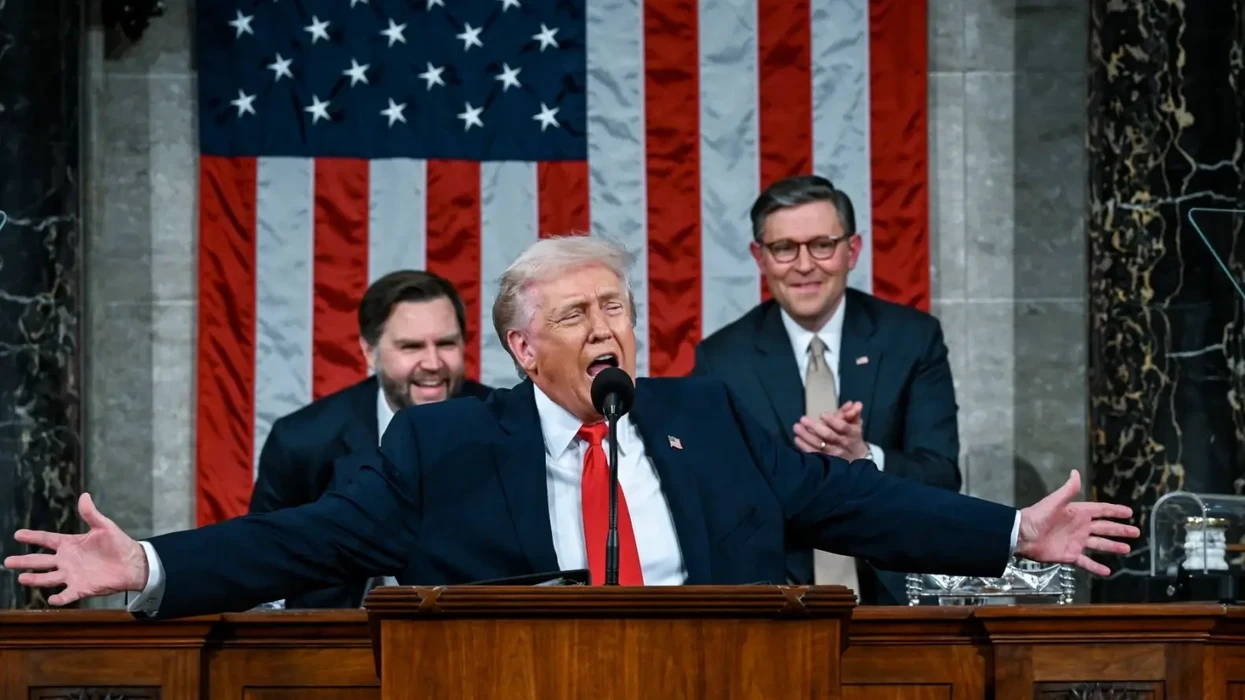
As American and Israeli rockets fly into Tehran, with the stated goal of regime change, anyone who bought into the self-evidently absurd idea of “Donald the Dove” ending America’s forever wars ought to be suffering from a bloody form of buyer’s remorse.
It was always bullshit. But that’s what the Trump team was selling hard. Take human ghoul Stephen Miller’s tweet days before the election: “Kamala = WWIII. Trump = Peace.”
The Trump team reads George Orwell’s 1984 like an owner’s manual and so of course “war is peace.” Their undermining of NATO and the dismantling of American alliances in favor of a “might makes right” foreign policy executed by a sycophantic kakistocracy is a guarantee of more war amid autocratic power grabs worldwide, with a side order of corrupt crony capitalism to profit from the chaos.
If you voted for Trump and believed him, this is on you. And that includes self-styled Palestinian peace activists who thought that Biden and Harris were the worst of all possible worlds and stayed home. We will no doubt see protests for the innocent lives lost in these strikes — but I’d have a lot more time for those folks if they were also seen protesting the estimated 20,000 to 30,000 Iranian lives snuffed out by murderous mullahs in the last few months alone.
The Islamic Republic of Iran has been despotic and dangerous from its inception. The Iranian people have been oppressed and denied basic freedoms for decades. But this is an extreme example of a war of choice. The American military strikes against Iran’s nuclear weapons facility last year were justified because Iran cannot be trusted with a nuclear weapon. That is true. But the much trumpeted total obliteration of those facilities is apparently not true — or so goes the justification for this war. And don’t forget that it was Trump who pulled the U.S. out of an Obama-era deal to stop Iran from developing weapons — arguing absurdly that the imperfect anti-nuke deal needed to be blown up to stop Iran from developing a bomb. Iran’s subsequent progress toward a bomb then created the rationale toward these strikes. This is a self-inflicted state of emergency. Peace is war and war is peace.
Pity the willful dupes in Congress who deluded themselves into thinking that Trump deserved the Nobel Peace Prize. They’ll probably rationalize that he would’ve been peaceful if he got the honor. Now it will be read as a cautionary tale for not sucking up. The chairman of the Board of Peace is now bored of peace. While Rand Paul remains admirably consistent, it’s Lindsey Graham who is pirouetting around the Senate floor while the Gimp Speaker Mike Johnson is unable to speak for the basic constitutional principles of separation of powers let alone authorization to go to war.
If you’re feeling shell-shocked trying to keep up with Operation Epstein Distraction, get ready for the inevitable next crisis — regime change without a plan for replacement. This is what the Trump administration did in Venezuela — kidnapping the socialist dictator Maduro but keeping his regime in place in exchange for crude oil access. The opposition is still in exile and its leader María Corina Machado gave her Nobel Peace Prize to Trump in exchange for exactly nothing.
One of the clear lessons of history is that if you don’t win the peace, you don’t win the war. The Saudis and their Sunni allies will back the U.S. and Iran because they hate the Shia Iranians (who, incidentally, are not Arabs), but beyond removing the Iranian regime, the plans for replacement and stabilization seem TBD — and with Trump’s inability to stay focused on anything beyond his immediate self-interest, solid plans are unlikely to emerge. Maybe a leader will come from the underground opposition; maybe it will be the Shah’s son, who has been living in the U.S. waiting for a restoration like many members of the diaspora. The upside is that Iran has a distinguished history and an accomplished Persian culture: The Islamists don’t represent the entirety of the people of Iran and never have.
But the path ahead will be messy at best. It will require concerted effort and civil commitment, not just an open call for private investment from Mar-a-Lago members. If the United States is now kidnapping and killing dictators without direct provocation, it establishes a dangerous precedent which will come back to bite us after demolishing our moral authority in the world.
It is the unexpected effects, the cascades of consequence where we cannot always plan ahead, that cause most responsible statesmen to try to keep the peace. But Trump has the carelessness of a rich-boy bully who can always buy or bluster his way out of trouble. He’s a con man who has found his ultimate mark in his followers, who fool themselves into thinking that a reflexive liar is the one man with the courage to tell the truth.
Perhaps the most prominent example is the vice president himself — a bright guy who not that long ago compared Trump to Hitler and a deadly narcotic but then convinced himself that careerism demanded an abrupt conversion. After all, he endorsed Trump less than two years ago with this very serious column headlined “Trump’s Best Foreign Policy? Not Starting Any Wars,” explaining, “He has my support in 2024 because I know he won’t recklessly send Americans to fight overseas.”